Inglise keele variandid (Varieties of English) (1)
Varia - Need luuletused on nii erilised, et neid ei saa kuidagi kategoriseerida
Standard and non-standard varieties of English
Standard varieties of English are the
varieties of the English language that are considered to be a norm
and are spoken and written by the minority (educated people). This is
the optimum for educational purposes.
The standard varieties of English are:
BrEng ( British ), EngEng (English), NAmEng ( North -America), USEng
(United States ), CanEng (Canada), AusEng ( Australia ), NZEng (New Zealand ).
Standard
English (British
English) is the most widely accepted
and understood among native speakers, learned by foreigners. It
is used in broadcasting, TV, news etc. It doesn’t concern
pronounciation (accent), but grammar and vocabulary . It includes formal and informal styles.
British
Standard English grammar and vocabulary, together with the RP accent
should be called English English.
RP
( Received Pronounciation) is an
accent
that originates from South - East of England . A social accent, associated only with England.
12-15% of native speakers in England use Standard English (BrEng).
3-5% of them use RP (EngEng).
Non-standard
varieties of English are often
called dialects. They are any other dialect of English other than Standard English. They are stigmatized as shameful and inferior ,
socially lower . Judging people by their accent might, however , be
offensive. These varieties are connected to race in US and class in
UK. Grammatical and lexical differences throughout the world
in the English language are rather insignificant .
Most oftenly pronounciation is the most significant/ different .
Deviations from the standards:
Multiple negations – „I didn’t do nothing .“
Ain’t – negative of „have“ or „be“
„ Never “ used to refer to a single occasion in the past – „I never done it“ (I didn’t do it)
Extension of 3rd person ending „s“ to 1st and 2nd person forms – „I/You wants“ (used by the working class)
Regularisation of „be“ – „Me/You/They was“
Regularisation of some irregular verbs – draw /drawed/have drawed; go/ went /have went
Optional „-ly“ ending on adverbs – „He writes real quick .“
Unmarked plurality on amounts of measurement after numerals – 10 pound, 20 year
Different forms of the relative pronoun – „The man what lives there .“/ „The man as lives there.“
Regularisation of reflexive pronouns – myself ; herself ; hisself; theirselves
Distinction between main and auxiliary verb „do“ – „You done it, did you?“
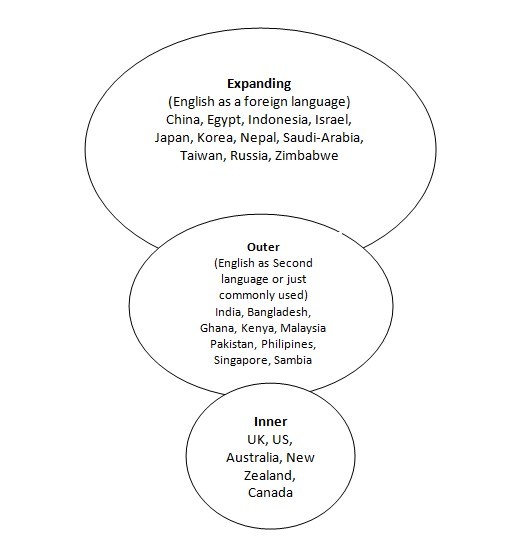
The spread of English. The Inner / Outer / Expanding Circle
THE SPREAD OF ENGLISH
- 16-18th century the spread took place .
- By the beginning of the 19th century English had spread to virtually every part of the world.
- 19-20th century the number of speakers only grew.
The growth was achieved by covering more land , exploring more land, going west , and accepting new immigrants from other places of the world.
The spread of
English also brought political growth and the spread of power . Besides the number of countries, it also grew from the economic and military might and strength of the people. When Elizabeth I didn’t
have much choice but to let the empire grow and so the nation , the wealth , the trade, the industrial sntregth and might.At that time the
countries and the colonies felt like they were saved by the white
people and the British brought with them democracy , bureaucracy,
christianity, the English language, literacy .
English is often
the language of education, internet , airline services , EU, the
language of business, international tourism, preferable language when studying cultures , literature etc. It is the language of songs, popular culture and music, advertisement, computer diagramming etc.
We
may generally speak of 2
dispersals
(diasperas) in English:
DISPERSAL
When people migrated
from the British isles (England, Ireland ) to North America &
Australia. Resulted in native
varieties of English .
DISPERSAL
Colonisation of Asia and Africa . Varieties as a second
language developed .
DISPERSAL
- 12th century - the Normans established a territory called “the Pale ” in Ireland. A great influence on the territory of Ireland.
- 1535 - A Statute of Wales (law) that required people in Wales to speak English.
- - there was trade going on between English ships and West Africa. A decade later slave trade started .
- 1580s - The first 2 English settlements in North America were established.
- - James I of England became king . Scotland and England merged politically together as Great Britain . English spread to Scotland.
- 1607 - the first lasting settlement in North America was established in Virginia, Jamestown .
- 1609 - the colonisation of Ulster. (first tried out by Queen Elizabeth I and later continued officially by James I). Ulster was colonised to prevent further rebellion. The Irish were forced to become protestants. Due to these events, we can now see some common features in speech between lowland Scotland and Northern Ireland.
- 1620 - the English ship Mayflower sailed to North America from England. The ship failed to reach Virginia and landed in Plymouth instead. Jamestown and Plymouth were now the 2 settlements and grew rapidly.
- 17th century - the English began to spread in Southern America as a result of slave trade. New kind of Englishes developed so that slaves and captors could understand eachother. This happening is called the Pidgin (Pidgin English).
- 18th century - Large scale immigration from Ireland to North America. Parts of Canada were settled by the French , but Britain also had it’s interest there.
- 1763 - Canada (French speaking areas ) was conceded to the British.
- 1776 - the Declaration of Independence of the United States. England didn’t want to let the United States go, but people who were born in North America considered themselves as Americans.
- 1769 - Captain James Cook reached the coastline of new Zealand.
- 1770 – James Cook discovered Australia. Australia and New Zealand were claimed for the British Crown.
- 1788 – James Cook landed in Queensland . 1788 was also the first penal colony . 160000 prisoners were transported from England and Ireland.
- 1820 - New settlers began to arrive in New Zealand in larhe numbers . As a result, the dialects mixed.
- 1840 – The first official colony in New Zealand. Immigrants arrived there in 3 stages. (from Britain; from Australia and Ireland; from UK). This also resulted in the mixture of dialects. There was also a great influence of Maori.
- 1795 – The British arrived in South Africa and later began to settle in larger numbers.
- 1822 – English was declared as the official language is South Africa.
DISPERSAL
- 1795 – South Asia is occupied
- 18th and 19th century – English in west Africa is tied to slave trade.
- From 15th century – British travel to and from West Africa
- 18th century – first settlement in West Africa. English was emplored as lingua franca to be used between the English traders and the people living there. One by one the East African countries were declared independent, but in some of them English still remains. If it is not the official, it is the 2nd language to be learnt.
- From 1850s – Many East African countries were settled by English colonies. There were many expeditions and explorers
- 18th century – English was introduced in the subcontinent of South Asia.
- 1765-1947 – British sovereignty in India. (the Raj)
- 1803 – Louisiana, was bought from the French.
- 1890 – Florida was bought from Spain .
- 1835 – English educational system was introduced in India
- Hindi , the official language, has influenced English spoken in India and it now has a distinctive national character .
- Late 18th century – more English influence was seen in Asia and in the South Pacific.
- Beginning of 19th century - English had spread to virtually every corner of the world. In the course of the 19 and 20 centuries , the number of speakers only grew.
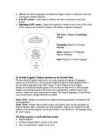
The Inner / Outer /
Expanding Circle
Expanding: English
as a foreign language
Outer:
English as a 2nd language
Nigeria,
Tanzania
Inner: English as a native language
British English: Dialects spoken on the British Isles
The term British English would cover (in a wide variety) all
varieties of langauges spoken on the British Isles. We distinguish
English-English & Welsh -English (there is also the Welsh language
of the Celtic origin), Scottish English & Irish English.
People of Scotland and Ireland oppose to this as they see themselves
as Welsh people. English was born/developed on the British Isles and therefore is different from other varieties, which have been
introduced elsewhere. The English language in Great Britain was, at
some point, strongly affected by invaders.
Inner Circle – People came and the new English speaking
population outnumbered the local population.
Outer Circle – People whose mother tongue was English came,
but the population of English speakers didn’t outnumber the local
population. English was imposed for trade purposes, educational
purposes, law & government . It co-existed as a 2nd language along
the native tongue.
The dialects spoken on the British Isles include :
- English-English
- Southern English dialect, spoken in the south
- West Country Dialect, spoken in the west
- Midland English dialect, spoken in the midland counties
- Northern English dialects, spoken in the north
RPs:
- Public school English
- King’s English
- Queen’s English
- Posh
English English, RP, Estuary English
1. English English
- the English language as spoken in England. British Standard English
grammar and vocabulary (used by many) together with the RP accent
(used only in England) should be called English English.
2. RP - Accent
which is normally taught to students who are studying EngEng. Used
natively by only 3-5% of the population of England. RP has a large
number of diphthongs and not a particularly close relationship to
English orthography. RP is a social accent, rather than regional,
and is associated particularly with the upper -middle and upper classes .
Some features:
- The /i:/ of bee, rather than the /ɪ/ of be, occurs in the final syllable of very, many, etc.
- The vowel /ɪ/ in unstressed syllables (in RP) often corresponds to /ə/ (in near-RP accents).
- The consonant /t/ may be realized as a glottal stop [?].
- Most EngEng accents have lost the original contrast.
- Some English accents are „rhotic“ or „r-ful“ and others are „non-rhotic“ or „r-less“.
3. Estuary English
- a dialect of English widely spoken in South East England. IT is
commong among young Londoners. Something between RP and Cockney.
Some features:
- They use intrusive / r /
- They use the broad / a: / sound
- They use glottal stop more often (instead of k/p/t)
- Use of / w /, recieved pronouncation will have / l / sound
- /l/ may disappear [vunnerable]
- /I/ -> /i:/
- Use of question tag – [Ain’t I? (einnai)]
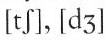
- Yod coalescence – when two things come together. Like: /dʒ/ instead of /dj/
/tʃ/
instead of /tj/ – [tʃu:zdeI]
- H-dropping ( Tell him= [tellim])
Cockney, Cockney Rhyming Slang
Cockney English
has a very distinctive accent, intentionally made and cryptical.
It is used in a sense of community and also by traders or criminals to confuse the police . Cockney English is a “working class English”
with approx. 7 million speakers.
Cocnkey Rhyming
Slang is a secret language used for communication in a group
(traders speaking to eachother; criminals confusing the police;
amusement) in the English language and is prevalent in the East End
London dialect.
It create a binary expression that rhymes with a single everyday word. Eric Partridge
wrote the dictionary of slang in 1840.
Some expressions :
- Apples and pears - stairs
- Bowl of water - daughter
- Rabbit and pork - to talk
- Trouble and strife - wife
- You and me- tea
- Butcher’s hook - to look
- Scooby doo - clue
Some features:
- [θ] -> [f]
- [h] dropping
- Prolonging dipthongs
- /aI/ - > /ɒI/
- /ð/ -> /v/
- [e] -> [w]
- Done/seen, instead did/saw
- [ŋ]-[nk]
- Adding [h]
- [eI]-[aI]
- [au]-[a]
- Intrusive r
- Double negation
- Tag questions
Welsh English (peculiarities of pronounciation, grammar, vocabulary)
Pronounciation:
Differences
between WEng and RP:
- Last, dance , etc. often have /æ/ rather than /a:/
- Unstressed orthographic a tends to be /æ/ rather than
- Unstressed orthographic o tents to be rather than
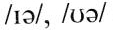
- There is no contrast between
- There is, in many varieties, an additional contrast between and between
- The vowels do not occur in many varieties in WEng
- Educated WEng is not rhotic
- Tendency to lengthen intervocalic consonants before unstressed syllables (butter, money)
Non-systemic pronounciation differences
- For some speakers, /g/ is absent in the words language and longer.
- For some speakers /ʊ/ occurs in the words comb and tooth.
Grammar:
- Generalisation of word forms (I likes , they sees)
- Non-standard use of „never“ (I never did it)
- Participles are often proceeded by „a“ (I sat there a-watching)
- Universal tag „isn’t it“ is used disregarding the main person, tense or auxiliary (You are going now, isn’t it?)
- In North-Wales Welsh use „yes“ (You are studying Welsh, yes?)
- Fronting of a constituent ( Singing they were; Coming tomorrow he is)
- Negative use of the word „too“ (They can’t do that too)
- Repetition of an adjective or an adverb for emphasis (It was a high high building )
- Use of „do“ to assure (I do go to chappel every Sunday)
- The use of „there“ for exclamations (There strange it was! Meaning : How strange it was!)
Vocabulary:
- „Del“ and „ Bach “- terms of endearment
- Welsh use „ delight “ in the meaning of „interest“
- „ Rise “ in the meaning of „get“ or „buy“ (I’ll rise the drinks )
- „Tidy“ in the meaning of „nice“ or „ good “ (It’s a tidy car)
- Bara brith – a loaf of bread
- Words with double “l” (Llymru – porridge dish)
- Eisteddfod – a competitive arts festival
Scottish English (peculiarities of pronounciation, grammar, vocabulary)
Pronounciation:
- Velar fricative [x] (loch, night )
- Dark „l“ : fu ( full ), saut ( salt ), ca (call)
- Short vowels are longer (jacket= [jaykit]
- Bright [breht]
- Rhotic „r“
- Absence of dipthongs before r (cheers -> chers )
- There’s a rule that determines when vowels are pronounced short or long
- Distinction between [ ] and [w]
- No distinction between / æ/ / ʊ/ / ɒ/ and /a:/ /u:/ / ɔ:/
Grammar:
- Have does not need „do“ support
- Using „will“ with first person subjects in questions (Will I put out the light ?)
- Certain stative verbs (want;need) use progressive form
Vocabulary:
- Cheerio just now! – goodbye for now!
- To go to the messages- to go shopping
- How are you keeping ?- How are you ?
- That’s me away - I’m going now
- Aye – yes
- Folk- people
- Pinkie- little finger
- Loch- lake
- Wee- small
- Syne – goal
Irish English (peculiarities of pronounciation, grammar, vocabulary)
Pronounciation:
- A rhotic language
- Wide range of vowels preceding „r“
- Dental stops [d] and [t] are used to replace fricatives [th] (think- tink)
- [t] between vocals is pronounced [d] (water-wader)
- Words with „ea“ pronounced [i:] also merge and retain the historical [e:]; in informal speech [ei] (tea- tei)
- A little contrast between [ä] and [a:]
- „many“ and „any“ are pronounced with [ä]
- „ price “ and „choice“ are pronounced the same
- „i“ and „schwa“ have merged
- Epenthesis (sound, which is not there really , is inserted to the word)
- In the north [e] and [ä] have no distinction
Grammar:
- Unmarked plurality concerning measure and time
- Three dimensional demonstrative system
- Nominalisation - givin a word or phrase a noun -like status
- Distinction between singular and plural „you“ / „youse“
- Hot news perfect tense is expressed by preposition „after“ + -ing ( gerund form)
- Present tense instead of Pr.Perfect or Pr. Perf . Cont
- „It- clefting“ constructures (it’s very ill that he looked)
- Continuous forms with stative verbs (I’m seeing it very well)
- Past simple is used instead of Past perfect (If he saw him, he wouldn’t have done it)
- Distinction between habitual and non-habitual actions or states (I do bit drunk vs. I am drunk)
- Word „let“ can be used in second person ( Let you stay here )
- „Yes“ and „no“ are used less frequently
Vocabulary:
- Great part comes from English, Scots, Irish.
- Many English metaphors, idioms come from Irish
- Banshee – fairy woman
- Cairn – sacred stone mound (burial, worship place)
- Creel – basket
- Bannock – home made bread cake
- Number of Eng words have a different meaning in Irish (backwards- shy; doubt - believe or expect )
- „I’m not at myself“- I’m not feeling well
US English (peculiarities of pronounciation, grammar, vocabulary)
Pronounciation:
- [?] before n
- Final „t“ often unreleased
- Intervocalic „t“ – „d“
- Neutralization between „t“ and „d“
- Reducing [lj] into [j] (million)
South:
- Falling vowels [i];[ä];[e]+ schwa
- [ai]- [a:]
- [e] and [i] sound identical in monosyllables (pen;pin)
- [z]-[d] (isn’t- idn’t)
West:
- [o:]-[a:] (caught)
- [ä];[i:]-[e:][i] before „ r“ (mirror, marry )
- [a] and [e] merge before „r“ (hurry)
- [ju]-[u] (new)
Northeast:
- Closer to EngEng
- Upper classes have fewer local accents
- Non-rhotic
- Intrusive „r“
- Fricatives- t/d
Grammar:
- Some irregular verbs are regularized (learn-learned)
- Some regular verbs are irregularized (snuck; dove)
- Word formation with –ify and –ize are more productive (citify, uglify, burglarize)
- Changing word’s class (to host , to skyrocket)
10) North American English
vs. British English
- There are a number of countable nouns in both varieties, that don’t require the use of an article.
- Eng Eng doesn’t use an indefinite article in the future. US uses an article in the future.
- EngEng requires indefinite article with phrases beginning with half of sth. USEng can use this aswell but can also not.
- In EngEng attribute follows the name, in UsEng attribute comes in front of the name.
- Both varieties use the indefinite pronoun „one“ in formal styles
- Both varieties use the informal „you“
- The nominal form can be used as locative in EngEng. In USEng the modified form is used.
- Sometimes US Eng uses adjecitves instead of adverbs.
- The comparative adjective „different“ is usually followed by a preposition form in EngEng. In Us Eng it is more frquently followed by the word „than“.
- One particular ending is more productive in UsEng than in EngEng – wise.
- The adverbs „yet“ „just“ „already“ and „still“ are usually used with present perfect tenses. They are not possible in past simple in EngEng, but are so in UsEng.
- The ordinals (firstly, secondly etc) are used in both varieties in numbering or listing. The difference is „first of all“ when introducing next idea. Eng Eng uses „Secondly“, UsEng uses „second of all“, „third of all“.
- The adverb „presently means soon in both varieties.
- Time adverbs „ anymore “ is used in both varieties in negative context .
- There are some prepositions which differ in form in the two varieties. (EngEng – „out of“, „ around “; USEng – „out“, „ round “
- „ Through “ means up to and including in UsEng, but in EngEng „through“ means the time inbetween
- Prepositions in and on have some differences. In EngEng to be in a team . USEng to be on a team. EngEng to live in a street , UsEng to live on a street.
- Sometimes in UsEng prepositions can be omitted. (The sale started January the 1st)
11) Canadian English (peculiarities of pronounciation, grammar,
vocabulary)
Pronounciation:
There are no paticular forms that separate Canadian, EngEng and AmEng . Vey often the forms can be mixed, both varieties can be used.
Generally speaking the standard forms of Canadian and modern American
English are alike.
Particularities
in pronounciation: ( special features)
- Canadian Raising – (found in lexical sets : price, mouth) Before voiced consonants: Diphtongs /aI/ /aʊ/ would be pronounced more like /əi/ /ʌI/ and /əʊ/.
- Absence of distinction between cot/caught – pronounced alike, with an a (close to AmEng)
- T - flapping and T –deletion. Sound /t/ between vowels will be pronounced as /d/ - (water, ladder, latter ) = T-flapping. When the /t/ is deleted, usually after /n/ - (winter, („ winner “), interesting („ineresting“)) – we are dealing with = T-deletion
- Schedule, hostile and some other words are pronounced depending on social variation and region . (Great degree of influence from AmEng)
- Again (st), sometimes /əgen/, sometimes /əgeIn/
- Been [bin]
- Shone – [sho:n] follows BrEng variant
- Tomato [tomæto] different from both AmEng and BrEng
Grammar:
- Younger geneation follows AmEng forms and older BrEng forms.
- Canadians use the Q tag „eh?“
- Sneek – Snuk
- Dive – Dove
Vocabulary:
- General trend towards American vocabulary, but not fully, therefore there would be both variants in the dictionary. Candy= Sweet , for example.
- They developed a vocabualry that they needed to use in a special environment. The environment was different from Britain/US.
- Indian language borrowings (ex: moose)
12)
Australian English (peculiarities of pronounciation, grammar,
vocabulary)
Pronounciation:
- /i:/ rather than /I/ in /i:/ rather than /I/ in very, many, etc.
- rather than /I/ in unstressed syllables.
- /a:/ in laugh, path, grass , etc.
- in dance, sample, plant , branch
- RP smoothing of does not occur.
- Front vowels tend to be more close than in RP
- Some diphthongs are wider than in RP
- Tendency for diphthongs to be „slower“
- The is a very front /a:/
- Word-final is often very open
- The vowel usually receives more lip-rounding than in EngEng
- AusEng is non-rhotic and has linking and intrusive /r/
- Intervocalic /t/ might become the voiced flap as in NamEng.
- Often /l/ that is darker than in RP
- Assume may be pronounced with rather than s .
- Similarly, presume can have rather than /z/ or /zj/
- In some areas may be heard in off, often, etc. more than in RP.
- Australia, auction, salt have only in AusEng
- Days of the week tend to be pronounced with finaly
- Initial /tj/, /dj/ may be pronounced as
- /lj/ often becomes /j/ as in brilliant
- Memo is pronounced with /i:/ rather than
Grammar:
- Use of auxiliaries shall and should with first-person subjects as in I shall go
- The use of have in expressing possession is not so usual, got is preferred.
- Collective nouns usually don’t take plural verbs (The government has made a mistake)
- May use infinitive rather than participle in some constructions
- Some speakers use whenever to refer to a single occasion
- The past participle forms like known , blown, sown are often pronounced with final rather than /n/
Vocabulary:
- Footpath – pavement
- Frock – dress
- Goodday – hello
- Lolly – sweet
- Picture theatre – cinema
- Radiator – ( electric ) fire
- To chunder – to vomit
- Crook – ill, angry
- A sheila – a girl
- Hard yakka – hard work
- A wog – a germ
- A chook – a chicken
13) New Zealand English (peculiarities of pronounciation, grammar, vocabulary)
Pronounciation:
- Words as „ham“ and „pen“ are often heard as [hem] and [pin]
- when schwa is close to the /w/ sound, it sounds like /u/
- Words like “dance”, “ castle ”, have the sound /a/
- grown is pronounced as [growen]
- boot is pronounced as [beu:t]
- lengthening of the final „y“ [häpi:]
- flap „t“ approaching „d“ city- [ cidi ]
Grammar:
- Standard N-Z is the same as the standard British English with some minor differences for ex. roof -roofes vs. roof-rooves
- Uses „in the weekend “
- Uses „Will I close the window ?“ instead of „Shall.. ?“
- In words like „organize“ N-Z uses -ise „organise“
- Words of Maori origin appear without plural marker „s“
- The word for „ university “ is „varsity“; “ute” for “utility “
- „Can I have a cup of tea, thanks ?“
Vocabulary:
- tramping- hiking
- fair well- to say goodbye to
- to uplift- to pick up, to collect
- an identity - a character
- to flat - together with someone, to live in a same flat
- a joker- just a guy
- a Kiwi- a new-zealander
Borrowed from Maori language:
- Mounganui- a big mountain
- Waitangi- a waterfall
- Ahora- love
- Mana- power
- Oa- a village
- Rangatiratanga- a kingdom
- Tangata- people
- Tapu- sacred
1)Standard and non-standard varieties of EnglishStandard varieties of English are the varieties of the English language that are considered to be a norm and are spoken and written by the minority (educated people). This is the optimum for educational purposes. The standard varieties of English are: BrEng (British), EngEng (English), NAmEng (North-America), USEng (United States), CanEng (Canada), AusEng (Australia), NZEng (New Zealand).Standard English (British English) is the most widely accepted and understood among native speakers, learned by foreigners. It is used in broadcasting, TV, news etc. It doesn’t concern pronounciation (accent), but grammar and vocabulary. It includes formal and informal styles.British Standard English grammar and vocabulary, together with the RP accent should be called English English.RP (Received Pronounciation) is an accent that originates from South-East of England. A social accent, associated only with England. 12-15% of native speakers in England use Standard English (BrEng). 3-5% of them use RP (EngEng).Non-standard varieties of English are often called dialects. They are any other dialect of English other than Standard English. They are stigmatized as shameful and inferior, socially lower. Judging people by their accent might, however, be offensive. These varieties are connected to race in US and class in UK. Grammatical and lexical differences throughout the world in the English language are rather insignificant . Most often pronunciation is the most significant/different.
Sarnased õppematerjalid
![Foneetika ja inglise keele variandid eksamiküsimused]()
12
odt
Foneetika ja inglise keele variandid eksamiküsimused
1. English vowel system and its description:
A vowel is a letter of the alphabet [a,e,i,o,u and sometimes y (happy)] that represents a
speech sound created by the relatively free passage of breath through the larnyx and orav
cavity. English has 5 vowels.
Front vowels Central vowels Back vowels
High/close /i:/ see /i/ sit /u:/ boot /ʊ/ book
Mid /e/ bait /Ɛ:/ bird /ə/ sofa /3:/ bird /o/ boat /ɔː/ bought
Low/open /æ/ bat /ʌ/ under /a:/ father /ɒ/ sock
With front vowels tounge is pushed forward, with central vowels its neutral and with back
vowels tongue is pushed back.
![ESSAY YORKSHIRE]()
9
docx
ESSAY YORKSHIRE
Varities of English Sirelin Koval
YORKSHIRE ENGLISH
Introduction
The history of the Yorkshire variety, sometimes known as The Broad Yorkshire, or Tyke,
can be traced back to 400 AD, with the arrival of Angles, Saxons, and other Germanic tribes
on the mainland of Britain. Yorkshire is located in the north of today's Britain and even
though allowing for boundary changes, has remained the biggest county in England. The
English language has become one of the most known lingua franca. Language is used for
![RE English is spoken on all five continents]()
6
docx
RE English is spoken on all five continents
Introduction
English is spoken on all five continents. With regard to the numbers of speakers it is only
exceeded by Chinese and Spanish. But in terms of geographical spread it stands at the top
of the league.
The varieties of English in the modern world are divided into four geographical groups as
follows.
British Isles America
United States (with African American
England English)
Wales Canada
Ireland The Caribbean
Africa Asia, Pacific
![Estuary English - A Controversial Issue]()
7
doc
Estuary English - A Controversial Issue?
Estuary English
1. The geographical dimension: Is `Estuary' English estuary?
Estuary English is a dialect of English widely spoken in South East England,
especially along the River Thames and its estuary. Phonetician John C.
Wells defines Estuary English as "Standard English spoken with the accent of
the southeast of England".[1] The name comes from the area around the
Thames, particularly London, Kent, north Surrey and south Essex.
The variety first came to public prominence in an article by
DavidRosewarne in the Times Educational Supplement in October 1984.
[2]
Rosewarne argued that it may eventually replace RP (Received
Pronunciation) in the south-east. Studies have indicated that Estuary English is
![English as a Global Language]()
60
pdf
English as a Global Language
Tallinna Mustamäe Humanitargümnaasium
Valeria Jefremenkova
ENGLISH AS A GLOBAL LANGUAGE
INGLISE KEEL KUI ÜLEMAAILMNE KEEL
Research work
Supervisor: Jevgenija Kozlova
Tallinn 2016
1
�Table of Contents
СONTENT…………………………………………………………………………………...2
INTRODUCTION…………………………………………………………………………...3
![Exami kysimused-vastused]()
13
doc
Exami kysimused-vastused
1. STYLE
The term "style" is polysemantic (has many meanings): a Latin word "stilus" originally meant a writing instrument used by
ancient people. Already in classical Latin the meaning was extended to denote the manner of expressing one's ideas in written or
oral form. Jonathan Swift defined style as "proper words in proper places". In present day English the word "style" is used in about
a dozen of principle meanings:
1. the characteristic manner in which a writer expresses his/her ideas (e.g. style of Byron)
2. the manner of expressing ideas, characteristic of a literary movement or period
3. the use of language typical of a literary genre (e.g. the style of a comedy, drama, novel).
4. the selective use of language that depends on spheres / areas of human activity (e.g. style of fiction, scientific prose,
![Inglise keelt kõnelevate maade ühiskond ja kultuur]()
6
docx
Inglise keelt kõnelevate maade ühiskond ja kultuur
SOCIETY AND CULTURE OF ENGLISH-SPEAKING COUNTRIES
Introduction
1. Nowadays, English is so widely spoken that it can hardly be considered "a one
nation's" language. The main countries where English is spoken are: the U.K, the U.S,
Canada, Australia, the Republic of Ireland, New Zealand, West Indies
2. There are approx. 300-400 million speakers of English in the world. English occupies
the 3rd place by its number of speakers; it is right behind Mandarin and Spanish.
3. ESL (English as a Second Language) used in your own country (e.g. India)
EFL (English as a Foreign Language) used in a foreign country
ESP (English for Specific Purposes) used in business, airlines, hotels etc.
4. Settlement colonies people migrated into them from Britain and started their own
![Translation history]()
14
docx
Translation history
problems associated to them?); language use – tenor, mode and
domain (what do these notions mean and what are some problems
associated to them?).
Register-analysis
Language user vs. language use – the two main parameters of language
change.
Variability in the language user is further defined by three broad
parameters:
1-Time- (when?) the time when the speaker or the writer lived. For
example, if you were to translate a Dickens book from english to russian,
you could use the same language as did Dostoyevsky, because they lived
at the same time (19th century)
2-Region- The second parameter that defines the language user is region.
Region refers to where the author/speaker (sometimes character) is from.
May be on a broader scale – Middle East, Western world; but also
narrower – Germany, Latvia, Minnesota; and even narrower – Conrwall,
London, Pärnu, etc.
Problems related to region (similar to the problems covered in previous
Meedia
Kommentaarid (1)
 100 punkti
Autor soovib selle materjali allalaadimise eest saada 100 punkti.
100 punkti
Autor soovib selle materjali allalaadimise eest saada 100 punkti.
 ~ 15 lehte
Lehekülgede arv dokumendis
~ 15 lehte
Lehekülgede arv dokumendis
 2012-05-20
Kuupäev, millal dokument üles laeti
2012-05-20
Kuupäev, millal dokument üles laeti
 51 laadimist
Kokku alla laetud
51 laadimist
Kokku alla laetud
 1 arvamus
Teiste kasutajate poolt lisatud kommentaarid
1 arvamus
Teiste kasutajate poolt lisatud kommentaarid
 Celinde
Õppematerjali autor
Celinde
Õppematerjali autor
 annaabi.ee














Kõik kommentaarid