Vajad kellegagi rääkida?
Küsi julgelt abi LasteAbi
Logi sisse

Foneetika ja inglise keele variandid eksamiküsimused (0)

1 Hindamata
Punktid
Varia - Need luuletused on nii erilised, et neid ei saa kuidagi kategoriseerida
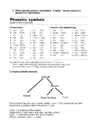
1. English vowel system and its description :
A vowel is a letter of the alphabet [a,e,i,o,u and sometimes y (happy)] that represents a speech sound created by the relatively free passage of breath through the larnyx and orav cavity. English has 5 vowels .
Front vowels
Central vowels
Back vowels
High/ close
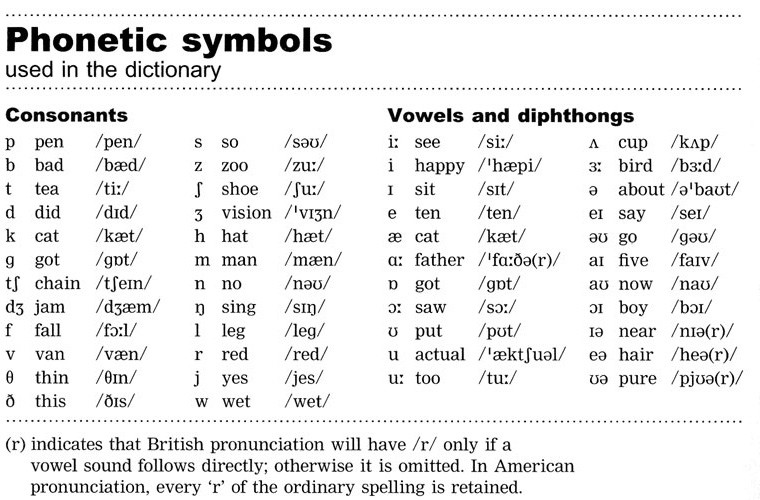
/i:/ see /i/ sit
/u:/ boot /ʊ/ book
Mid
/e/ bait /Ɛ:/ bird
/ə/ sofa /3:/ bird
/o/ boat /ɔː/ bought
Low/ open
/æ/ bat
/ʌ/ under
/a:/ father /ɒ/ sock
With front vowels tounge is pushed forward , with central vowels its neutral and with back vowels tongue is pushed back.
High/close vowels tongue body is raised, mid vowels its intermediate and low/open tongue body is lowered.
2. English consonants, their description/ classification based on (I) manner of articulation and (II) place of articulation:
I English has 21 consonants, they are classified into two groups manner of articulation and place of articulation.
According to the manner of articulation (how breath is used) the consonants are: stops/plosives, fricatives, affricates, nasals , laterals and approximants . Nasals, laterals and approximants are always voiced; stops, fricatives and affricates can be voiced or unvoiced.
II According to the place of articulation(where in the mouth or throat the sound is produced) the consonats are: bilabial(with both lips ), labiodental( between lower lip and upper teeth), dental /interdental(between the teeth), alveolar (the ridge bbehind the upper front teeth), alveo- palatal or post-alveolar(the area between the alveolar ridge and the hard palate), palatal(hard palate or roof of the mouth), velar(the soft palate or velum), glottal or laryngeal(space between the vocal cords).
3. Speech organs and the articulation of speech sounds
Speech organs or articulators, produce the sounds of language . Organs used for speech include the lips, teeth, alveolar ridge, hard palate, velum (soft palate), uvula, glottis and various parts of the tongue.
In phonetics and phonology , articulation is the movement of the tongue, lips, jaw, and other speech organs (the articulators) in order to make speech sounds.Sound is produced simply by expelling air from the lungs.
  • All the symbols used for representing **English** speech sounds (i.e. symbols for transcription)
    5. (English) syllable structure
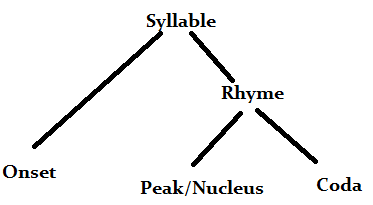
    Every syllable has a nucleus : a vowel, syllabic l, m or n. The nucleus may be either perceded by a syllable onset or followed by a coda .
    Onset - the beginning of the syllable
    Peak /nucleus – open part of a syllable, normally a vowel
    Coda – a consonant sound at the end of a syllable
    Rhyme – nucleus + coda = (- onset)
    6. Basics features of English stress patterns and rhythm ( including weak forms )
    The characteristics of the stressed syllables which enable us to identify them : in terms of production – more muscular energy; in terms of perception – more prominent than the unstressed syllables.
    Stress in simple words - factors:
  • loudness
  • length
  • pitch
  • quality
    Stress(accent) – relative loudness and tenseness of syllable peak
    Pitch( tone ) – the auditory property of a sound that enables a listener to place it on a scale going from low to high, without considering the acoustic properties such as the frequency of the sound.
    Stress- timed – syllables may last different amounts of time, but stressed syllables appear at a roughly constant rate. Non-stressed syllables are shortened to accomodate this.
    Syllable-timed – every syllable is percived as taking up roughly the same amount of time. Syllables are given equal stress.
    Word stress – stress is a suprasegmental feature
    Phonetic means to stress a syllable:
  • change the pitch ( usually by raising it)
  • make the syllable longer
  • make the syllable louder
    Weak forms- pronounced weaker
    Rhythmdifferences in the allowed syllable structures influence the rhythm of a language. These rhythmic differences can be described in terms of length variation . Whether the vowels all have fairly similar length. Whether the short vowels intermix with long ones. Syllable-timed rhythm vs. Stress-timed rhythm.
    7. Kachru's model of world Englishes
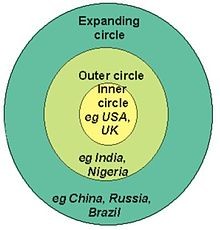
    World Englishes divided into 3 concentric circles:
    Inner Circle – ENL countries 'norm- providing ' : USA, UK, Australia
    Outer Circle – ESL countries 'norm- developing ' : India, Nigeria
    Expanding Circle – EFL countries ' norm- dependent ' : China, Russia , Brazil
    Limitations:
  • based on geography and history rather than the speakers' use of English
  • grey area between circles
  • the world's bilingual and multilingual speakers are not taken into account
  • difficulty of using the model to define speakers in their proficiency
  • does not account linguistic diversity
  • the term Inner Circle implies that speakers from ENL countries are central, and thus may be interpreted as superiour
    8. Explain and illustrate the following notions: standard language, vernacular , variety, accent, dialect , regional variation, social variation, lingua franca, creole , pidgin , L1 varieties , L2 varieties.
    Standard language – a variety of a language which is considered to be the norm
    Vernacular – unstandardised, no official status
    Variety – the features which distinguish one dialect from another
    Accent – the pronounciation
    Dialect – the pronounciation, vocabulary, and grammar
    Regional variation – social (originates among social groups and are mainly related to social class , religion or ethnicity) vs regional (reginal variation in pronounciation, in the choices and forms of words, and in syntax) dialect.
    Lingua Francaknown as a bridge language, common language, trade language or vehicular language, is a language or dialect systematically used to make communication possible between people who do not share a native language or dialect, particularly when it is a third language that is distinct from both native languages
    Creole – pidgin that has developed into a fully fledged language; a pidgin which has aquired native speakers
    Pidginarise from language contact; a language which has no native speakers; developed as a means of communication between people who do not have common language
    L1 varietiesfirst diaspora, migrations to North-America, Australia, New Zealand , South Africa = new englishes
    L2 varieties – colonisation of Asia, Africa = new englishes
    9. Describe British English and its regional and social variation
    British English aka received pronounciation (RP) is a social prestige accent associated with the South- East of England . Today is best described as an 'educated' accent. Main accent taught to foreigners. Most common features in Britain are h-dropping (social phenomenon , a norm in Wales and urban regional accents of England), glottal stop(apart from RP, it is widely used in other regions), rhoticity( rhotic accents- Scottish , Irish , North America; non-rhotic accents- Welsh , English, Australia, New Zealand, South Africa, the southern US, NYC, the Carribean)and yod-dropping (confined to East Anglia). ETC
    10. Describe Scottish English
    Scottish accents are rhotic(have the post-vocalic /r/). Distinction between bee and beer by the presence of /r/. Length is not a distinctive feature of Scottish vowels ( pull = pool; caught = cot; palm = Pam) Monophthongsare pure; there are only 3 diphthongs . It is very common to have different vowels in the following words: fern, fur, fir. All Scottish English vowels except /i/ and /ʌ/ are subject to the Scottish Vowel Length Rule . Glottal stop is a frequent realization of non-inital.
    11. Describe Irish English
    Northern Irish English
    Vowels are very similar to Scottish English except that /e/ in bay can be /ei/.Vowels are short before /p, t, k, tʃ/ but long before other consonants or when final, therefore unlike in Scottish English, the pair cot and caught is distinct. Intervocalic /t/ is often a voiced flap, there is post-vocalic /r/ present like North-American /r/ in bird.
    Southern Irish English
    Irish accents are rhotic and words such as path , dance may often have /æ/ rather than /a:/. There is a strong tendency for /u/ and /a/ NOT to be distinct in strongly local Dublin accents - /u/ in government. Phoneme /a/ does occur , particularly in more educated speech. Words like book, cook , may have /u:/ rather than /ʊ/. Irish English has /æ/ rather than /e/ in words like anyone , many. /p, t, k/ tend to be strongly aspirated or sometimes even become affricated.
    12. Describe American English, Canadian English
    American English
    There are three major dialect regions in the United States – the Inland North, the South, and the West . American English is mostly rhotic, with the exception of NYC and a small part in the South. The traditional dialect is rich with nautical terminology – lulling down, breezing up (decreasing and increasing winds). The northern US dialect is an extremely unified dialect area. The different pronounciation of the vowels in hoarse and horse . The use of [s] rather than [z] in greasy . The South has a laxing and centralization of the long high and mid vowels. The southern feature – the monophthongization of /ay/, it is not found in any speaker north of the Southern line but is found in all of the speakers South of the line. Also monophthongization before voiced consonants. A diversity of American dialects declines steadlily as one moves westward. The most prominant feature of Western phonology is the merger of long and short open /o/.
    Main characteristics of US English:
  • rhotic
  • no glottal stop
  • intervocalic /t/ is a flap
  • no difference between dark and clear /l/
  • RP /a:/ is /æ/ in dance, half , can't
  • non-rhotic varieties do have centralising diphtongs
    Canadian English
    Main dialect areas in Canada are Newfoundland , and Central Canada, Ottowa Valley, Vancouver , Toronto, Quebec , Nova Scotia, Prince Edward Island. Canada has 2 official languages – English and French . The most clearly differenciable feature of Canadian English is Canadian raising - that is, the diphthongs /aɪ/ and /aʊ/ are raised before voiceless consonants, such as /p/, /t/, /k/, /s/, /ʃ/ and /f/.Newfoundland is a special case because it is an regional dialect. Newfoundland dialects differ from English spoken in other parts of Canada. Age is the crucial sociolinguistic variable in smaller Newfoundland communities. Canadian English is entirely rhotic except for small isolated areas in southwestern New Brunswick, parts of Newfoundland, and the Lunenburg English variety spoken in Lunenburg and Shelburne Counties, Nova Scotia, which may be non-rhotic or variably rhotic.
    13. Describe Australian English, New Zealand English
    Australian English
    There is a distinction between Broad, General and Cultivated Australian English. It is non-rhotic; front vowels are more close than RP; /i:/ rather than /i/ in all unstressed syllables ( begin , naked, hoest village, etc.); the sequence of /lj/ othen becomes /j/ in brilliant. Distinctive intonation pattern – High Rising Tone/Australian Questioning Intonation.
    New Zealand English
    It is Non-rhotic; no strong lip-rounding and spreading ; the vowel /i/ in bid is a central vowel in the region of /ə/; no distinction between /i/ and /ə/; the RP vowel /ə/ corresponds to /ʌ/; /l/ is dark in all positions ; no use of shall , should for 1st person .
    14. Asian Englishes: Indian English, Singapore English
    Indian English
    One of the biggest populations of English speakers. They have a reduced vowel system. Indian English is pronounced as syllable-timed, unstressed syllables pronounced as stressed, including function words (of, to, etc.), no reduced vowels.
    Singapore English
    It is non-rhotic(educated variety), but lacks intrusive or linking /r/; syllable-timed; word-final consonant clusters tend to be simplified; no syllabic consonants; word-final stops tend to be glottal stops and unreleased.
    15. English-based creoles: Jamaican English
    Jamacan English in contemporary Jamaica is the Carribean-accented standard variety used in formal and public contexts. It is rhotic; /h/ is phonemic and pronounced; /a/ may be realised as /a/ or /ɔː/; unlike Jamaican Creole it has consonants /θ/, /d/, /ʒ/.
    16. The future of English: What are the predictable tendencies?
    Metropolitan standards; colonial standards, regional and social dialects, Pidgin Englishes and Creole Englishes; English as a second language, Immigrant Englishes, language- shift Englishes, Jaron Englises, Hybrid Englishes. Large influence from Spanish in the EU and America with simpler pronounciation, spelling and verb system.
  • Vasakule Paremale
    Foneetika ja inglise keele variandid eksamiküsimused #1 Foneetika ja inglise keele variandid eksamiküsimused #2 Foneetika ja inglise keele variandid eksamiküsimused #3 Foneetika ja inglise keele variandid eksamiküsimused #4 Foneetika ja inglise keele variandid eksamiküsimused #5 Foneetika ja inglise keele variandid eksamiküsimused #6
    Punktid 100 punkti Autor soovib selle materjali allalaadimise eest saada 100 punkti.
    Leheküljed ~ 6 lehte Lehekülgede arv dokumendis
    Aeg2017-05-23 Kuupäev, millal dokument üles laeti
    Allalaadimisi 3 laadimist Kokku alla laetud
    Kommentaarid 0 arvamust Teiste kasutajate poolt lisatud kommentaarid
    Autor AnnaAbi Õppematerjali autor
    Foneetika ja inglise keele variandid eksamiküsimused

    Sarnased õppematerjalid

    Inglise keele variandid-Varieties of English
    15
    doc

    Inglise keele variandid (Varieties of English)

    1) Standard and non-standard varieties of English Standard varieties of English are the varieties of the English language that are considered to be a norm and are spoken and written by the minority (educated people). This is the optimum for educational purposes. The standard varieties of English are: BrEng (British), EngEng (English), NAmEng (North-America), USEng (United States), CanEng (Canada), AusEng (Australia), NZEng (New Zealand). Standard English (British English) is the most widely accepted and understood among native speakers, learned by foreigners. It is used in broadcasting, TV, news etc. It doesn't concern pronounciation (accent), but grammar and vocabulary. It includes formal and informal styles. British Standard English grammar and vocabulary, together with the RP accent should be called English English. RP (Received Pronounciation) is an accent that originates from South-East of England. A social accent, associated only with England. 12-15% of native speakers in Eng

    Inglise keel
    ESSAY YORKSHIRE
    9
    docx

    ESSAY YORKSHIRE

    Varities of English Sirelin Koval YORKSHIRE ENGLISH Introduction The history of the Yorkshire variety, sometimes known as The Broad Yorkshire, or Tyke, can be traced back to 400 AD, with the arrival of Angles, Saxons, and other Germanic tribes on the mainland of Britain. Yorkshire is located in the north of today's Britain and even though allowing for boundary changes, has remained the biggest county in England. The English language has become one of the most known lingua franca. Language is used for trading, diplomatic and academic context, as well as other social channels built on communication. Yorkshire dialect has remained a peculiar pronunciation and grammar as well as its connection to early English and some other North Germanic languages, which makes it appealing to research about. Talking about the English language, we often hear more about the southern dialects and the Stan

    Inglise keel
    English Phonetics and Phonology-Mid-term2
    4
    docx

    English Phonetics and Phonology. Mid-term2

    Phonology. Mid-term 2. Syllable - is a phonological unit consisting of one or more phonemes. In phonetics ­ a syllable is a unit which consists of a centre, that has little or no obstruction to airflow; it is comparatively louder than other sounds. In phonology ­ syllables are the possible combinations of phonemes. The syllable consists of - onset, nucleus, coda. (every syllable has a nucleus: vowel, syllabic l, or m, n). Rhyme/rime ­ nucleus + coda; the nucleus and the coda constitute a sub-syllabic unit ­ rhyme. Words rhyme, when their nucleus and coda are identical. (E.g 'cr-o-wn', 'd-o-wn'). The hierarchical structure of the syllable: Onset ­ the beginning of the syllable Nucleus/peak ­ the open part of a syllable, generally a vowel. Coda ­ a consonant sound which ends the syllable. Open syllable - has no coda Closed syllable - has a coda! Texts: [t-e-k-s-t-s]- (Consonant, Vowel, Consonant, Consonant, Consonant, Consonant). Strong syllables - has as its nucleus one of the

    Inglise keele foneetika ja fonoloogia
    Mid-term 1 in English Phonetics and Phonology
    6
    docx

    Mid-term 1 in English Phonetics and Phonology

    Phonetics and Phonology. Mid-term 1. Terminology. Testi tuleb kindlasti see tabel! Nasal, Bilabial: m Nasal, Alveolar: n Nasal Velar: Plosive, Bilabial: p; b Plosive, Alveolar: t; d Plosive, Velar: k; Affricate, Post-Alveolar: t; d Fricative, Labio-dental: f; v Fricative, Dental: ; Fricative, Alveolar: s; z Fricative, Post-Alveolar: ; Fricative, Velar: x Fricative, Glottal: h Approximant, Alveolar ja Post-Alveolar: Approximant, Palatal: j Approximant, Velar: w Lateral, Alveolar: l Phonetics and Phonology. Mid-term 1. Phonetics ­ the general study of the characteristics of speech sounds: how they may be "strung" together to form meaningful units how they are produced It studies: how to describe the speech sounds in the languages of the world what these sounds are how they fall into patterns how they change in different circumstances Acoustic phonetics ­ the study of the physical properties of the sounds themselves. Auditory phonetics ­ the st

    Inglise keele foneetika ja fonoloogia
    Foneetika ja fonoloogia
    10
    docx

    Foneetika ja fonoloogia

    Definitions: Phonology is the study that describes the systems and patterns of speech sounds in a language. Phonetics is the general study of the charecteristics of speech sounds – studies how different speech sounds are produced. Phoneme is a meaning-distinguishing sound in a language. E.g. artistic-al-ly To know if a sound is a phoneme use the minimal contrasting pair method where the difference is only one sound: pin vs pen. Allophones are different variations of how a phoneme is pronounced according to the context. E.g. dark and clear l – clear and dull. Segmentation is the act of dividing speech sounds into units. E.g. segment- ation Larnyx (kõri) is the voice box. Glottis is the opening between the vocal cords. Manner of articulation is the way the airstream is blocked when producing a sound – blocked vs partially blocked; vibrating vs no vibration. Different sound types:  Velar sounds are produced by the tongue being in contact with the lower sid

    Inglise keel
    History of the English language
    7
    doc

    History of the English language

    Suppletion Present in languages of different families. Present in Old, Middle and Modern English, though the general tendency is towards more regularity/iconicity so the number of suppletive forms has decreased.In the text: goon ­ to go wenden - to turn Gan was suppletive in Old English, past form: eode.Eode was supplanted by went (past form of wenden) at the end of the Middle English period.To wend has survived in Modern English in phrases such as to wend one's way, we wended homewards (ironic usage). Thus: suppletivity- suppletion ­ different parts of one and the same paradigm come from what were originally different paradigms (different words with close meanings or words in different but close dialects).Suppletion embraces verbs, adjectives, nouns. Be ­ was/were ­been (Old English beon/wesan) (am, art, is, are); in Old English some suppletive forms were used parallel to one another) Good ­better ­ best Bad ­ worse ­ worst Much ­ more ­ most Little ­ less ­ least Estonian

    Inglise keel
    Phonetics Glossary Homework
    6
    odt

    Phonetics Glossary Homework

    CITATION FORM The citation form of the lexeme is the form that is employed to refer to the lexeme; it is also the form that is used for the alphabetical listing of lexemes in a conventional dictionary. In English, the citation form of a noun is the singular: e.g., mouse rather than mice. For multi-word lexemes which contain possessive adjectives or reflexive pronouns, the citation form uses a form of the indefinite pronoun one: e.g., do one's best, perjure oneself. In many languages, the citation form of a verb is the infinitive: French aller, German gehen, Spanish ir. In English it usually is the full infinitive (to go) although alphabetized without 'to' (go); the present tense is used for some defective verbs (shall, can, and must have only the one form). In Latin, Ancient Greek, and Modern Greek (which has no infinitive), however, the first person singular present tense is normally used, though occasionally the infinitive may also be seen. The pronunciation form in a dictionary

    Inglise keele foneetika ja fonoloogia
    History of english review questions and answers 2016
    5
    odt

    History of english review questions and answers 2016

    CHARACTERISTIC FEATURES OF OLD ENGLISH - 15 monophtongs, (7 long, 7 short, 1 central), 4 diphtongs, 17 consonants. Free variaton of R, and it was pronounced everywhere. Very much Germanic in character. Quite some special consonants that no longer exist. About morphology: synthetic with numerous aglutinating tendencies. System of tenses Germanic, but with a reduction of tenses. Paradigmatic leveling; Stress shift; Word order; Loan words (Old Norse, Old French). Dual pronouns. Determiners - no separate definite article. Strong and weak verbs. Word order relatively free with tendencies towards SVO. SVO, SOV, VSO most common. Adposition and podposition were both possible (eesliide ja tagaliide). About syntax: clauses were joined much simpler than nowadays, using and, then etc. Because of case syncretion the word order in a sentence became much more important to be able to tell the difference between words. FIRST CONSONANT SHIFT (GRIMM'S LAW) Grimm's Law (also known as the First Germanic

    Inglise keele ajalugu


    Meedia

    Kommentaarid (0)

    Kommentaarid sellele materjalile puuduvad. Ole esimene ja kommenteeri


    Sellel veebilehel kasutatakse küpsiseid. Kasutamist jätkates nõustute küpsiste ja veebilehe üldtingimustega Nõustun