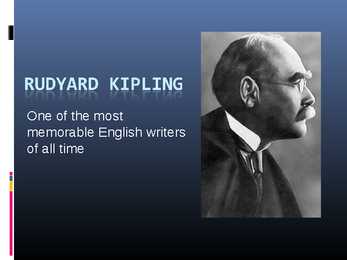
Rudyard Kipling - One of the
most memorable English writers of all timeFamily
of
Joseph Rudyard Kipling Mother -
Alice MacDonald Kipling. Alice Kipling (one of
four remarkable
Victorian
sisters) was a vivacious woman
about
whom a future Viceroy
of India would
say, "Dullness and Mrs. Kipling cannot
exist in the
same room."[3]
Father
- John
Lockwood Kipling. Lockwood Kipling, a sculptor, an
illustrator,
museum curator and pottery designer, was the principal
and
professor of architectural sculpture at the newly-
founded Sir
Jamsetjee Jeejeebhoy
School of Art and Industry in Bombay.
Later in life Kipling
illustrated many of Rudyard Kipling's
books , and
other works . Kipling also remained editor of the
Journal of
Indian Art and
Industry, which carried drawing works from the
students of the
Mayo School.
COUPLE
– named their son after the
place they had
first met – Rudyard
Lake.
Alice
Kipling Fleming
-
Sister of
British author Rudyard Kipling who
became a well-
known psychic, producing
automatic writing
under the name "Mrs.
Holland ." Born
June 11, 1868, Alice
Kipling was privately educated. She
went to India at age 16 and
married British
army officer John Fleming.
While in India she wrote a
number of
poems , and in 1893 initially experimented with automatic
writing. After a long
illness she returned to
England in
1902 and in
the
following year read the
classic study Human
Personality and Its Survival of Bodily Death ,
by F. W. H. Myers. As a
result she contacted the
secretary of the
Society
for Psychical Research
(SPR),
London, regarding her own automatic writing. She was one of the
seven principal mediums involved in the
famous cross-correspondences cases.
Fleming continued to do automatic writing
until 1910 , when she
suffered a nervous breakdown.
Early LifeRudyard
Kipling was born
Joseph
Rudyard Kipling
on 30 December 1865 in Bombay,
in British
India.
Some of Kipling’s earliest and fondest memories are of his and
sister Alice’s
trips to the bustling fruit
market with their
ayah
or
nanny , or her
telling them Indian nursery rhymes and
stories before their nap in the
tropical afternoon
heat . His father’s art
studio provided many creative outlets with clay and paints. Often the
family
took evening walks
along the Bombay Esplanade beside the
Arabian Sea, the dhows bobbing on the glittering waters. Kipling's
days of "
strong light and
darkness " in Bombay were to end
when he was
five years old.[21]
As was the
custom in British India, he and his three-
year -old sister,
Alice (or "
Trix "), were taken to England—in their case to
Southsea
(Portsmouth),
to be cared for by a couple that took in
children of British
nationals
living in India. The two children would
live with the
couple,
Captain and Mrs. Holloway, at their house, Lorne Lodge, for
the next six years. In his autobiography, published some 65 years
later, Kipling would recall this time with horror, and wonder
ironically if the combination of cruelty and neglect he experienced
there at the
hands of Mrs. Holloway might not have hastened the
onset of his
literary life. She ruled the
boarding house with
fire and
brimstone and Kipling was often beaten by her and her son.
“Then
the old Captain died, and I was sorry , for he was the only person in
that house as far as I can remember who ever threw me a kind
word.”—ibid.
Kipling soon learned to read and
found solace in
literature and
poetry , voraciously
turning to the magazines and books his
parents sent him
including Daniel
Defoe ’s
Robinson Crusoe .
Wilkie
Collins ’
The
Moonstone
and works by the
likes of Ralph
Waldo
Emerson and Bret
Harte
also
left an indelible impression on Kipling.
Respite
from the Holloway household was gained when he
spent one
month a year
in London with his mother’s kindly sister
Aunt Georgie and her
husband , pre-Raphaelite painter Edward Burne
Jones and their
children. Those months of December were a veritable paradise to
Kipling;
North End House was constantly brimming with visiting
friends and relatives, and the homey and
artistic effects of the
affectionate couple were
everywhere . Their home echoed with laughter
and the patter of little
feet or was eerily hushed as the children
raptly listened to fantastic stories told by Edward. They also played
the organ, sang
songs , dressed up in
costumes and acted out
plays .
In
January 1878 Kipling was admitted to the United
Services College,
at Westward
Ho!,
Devon ,
a school founded a few years earlier to
prepare boys for the
armed forces.
The school proved
rough going for him at first, but later led to
firm friendships, and provided the
setting for his schoolboy stories
Stalky
& Co.
published many years later.[22]
During his time there, Kipling also met and
fell in love with
Florence Garrard, a fellow boarder with Trix at Southsea (to which
Trix had returned). Florence was to become the model for Maisie in
Kipling's first
novel ,
The
Light that Failed
(1891).[22]
Towards
the end of his
stay at the school, it was decided that he lacked the
academic ability to get into Oxford
University on a scholarship[22]
and his parents lacked the wherewithal to finance him;[16]
consequently, Lockwood Kipling obtained a job for his son in
Lahore (now in
Pakistan ),
where Lockwood was now Principal of the Mayo
College of Art
and Curator of the Lahore
Museum.
Kipling was to be assistant
editor
of a small
local newspaper , the
Civil & Military Gazette.
He sailed for India on 20 September 1882 and
arrived in Bombay on 18
October 1882. This arrival changed Kipling, as he explains, "There
were yet three or four days’ rail to Lahore, where my people lived.
After these, my English years fell
away , nor ever, I think,
came back in
full strength ".
Travels
& First writings
During
the
summer of 1883,
Kipling visited
Simla
(now Shimla), well-known
hill station and summer capital of British India. By then it was
established practice for the Viceroy
of India
and the
government to
move to Simla for six months and the town
became a "
centre of power as well as pleasure."
Kipling's family became yearly visitors to Simla and Lockwood Kipling
was
asked to
serve in the
Christ Church there. He returned to Simla
for his annual leave each year from 1885 to 1888, and the town
figured prominently in many of the stories Kipling was writing for
the
Gazette.
Kipling describes this time: "My month’s leave at Simla, or
whatever Hill Station my people went to, was
pure joy—every golden hour counted.
It began in heat and discomfort, by rail and
road . It
ended in the
cool evening, with a wood fire in one’s bedroom, and next
morn—
thirty more of them ahead!—the early cup of tea, the Mother
who
brought it in, and the long talks of us all together
again . One
had
leisure to
work , too, at whatever play-work was in one’s head,
and that was
usually full."
Back
in Lahore, some thirty- nine stories appeared in the Gazette between November 1886 and June 1887.
Most of these stories were
included in
Plain Tales from the Hills ,
Kipling's first prose collection ,
which was published in Calcutta
in January 1888, a month after his 22nd birthday. Kipling's time in
Lahore,
however , had
come to an end. In November 1887, he had been
transferred
to
the
Gazette's
much larger sister newspaper,
The Pioneer ,
in Allahabad
in the United
Provinces.
His
writing continued at a frenetic pace and during the following year,
he published six collections of short stories:
Soldiers
Three,
The
Story of the Gadsbys,
In Black and White,
Under
the Deodars,
The
Phantom Rickshaw,
and
Wee
Willie Winkie,
containing a total of 41 stories, some
quite long. In
addition , as
The
Pioneer's
special correspondent in western
region of Rajputana,
he wrote many sketches that were later collected in
Letters of Marque
and published in
From
Sea to Sea and Other Sketches, Letters of Travel.[4]
In
early 1889,
The
Pioneer
relieved Kipling of his
charge over a dispute. For his
part , Kipling
had been increasingly
thinking about the future. He
sold the
rights to his six volumes of stories for £200 and a small royalty, and the
Plain
Tales
for £50; in addition, from
The
Pioneer,
he received six-months' salary in lieu of notice. He decided to use
this
money to make his way to London,
the centre of the literary universe in the British
Empire.
On 9
March 1889, Kipling left India, travelling first to San
Francisco via Rangoon,
Singapore,
Hong Kong
and
Japan . He then travelled
through the United
States writing
articles for
The
Pioneer
that too were collected in
From
Sea to Sea and Other Sketches, Letters of Travel.
Starting his American travels in San Francisco, Kipling journeyed
north to
Portland ,
Oregon;
on to
Seattle ,
Washington;
up into Canada, to Victoria
and
Vancouver ,
British
Columbia ;
back into the U.S. to
Yellowstone National Park;
down to
Salt Lake City;
then
east to Omaha,
Nebraska
and on to
Chicago ,
Illinois;
then to Beaver,
Pennsylvania
on the
Ohio River to
visit the Hill family; from there he went to Chautauqua
with Professor Hill, and later to Niagara
Falls ,
Toronto,
Washington,
D.C.,
New
York and
Boston .
In the
course of this
journey he met Mark
Twain
in Elmira,
New
York,
and
felt much awed in his presence. Kipling then crossed the
Atlantic ,
and reached Liverpool
in October 1889. Soon thereafter, he made his
début
in the London literary world to great acclaim .
Career as a writer In
London,
Kipling had
several stories accepted by various
magazine editors. He
also found a place to live for the next two years. In the next two
years, and in short order, he published a novel,
The
Light that Failed;
had a nervous
breakdown;
and met an American writer and publishing agent, Wolcott
Balestier,
with whom he collaborated on a novel,
The
Naulahka
(a title he uncharacteristically misspelt; see
below ). In 1891, on
the
advice of his
doctors , Kipling embarked on
another sea
voyage visiting
South Africa ,
Australia , New
Zealand and
once again India.
However, he cut short his
plans for spending Christmas
with his family in India when he heard of Wolcott Balestier's sudden
death from typhoid
fever ,
and immediately decided to
return to London. Before his return, he
had used the
telegram to propose to and be accepted by Wolcott's sister Caroline (
Carrie )
Balestier, whom he had met a year earlier, and with whom he had
apparently been
having an intermittent romance. On 18 January 1892,
Carrie Balestier (
aged 29) and Rudyard Kipling (aged 26) were married
in London, in the The
wedding was
held at All
Souls Church, Langham Place.
Henry James
gave the
bride away.
Settled
in the U.S, and
seemed content
there until four years later, when a quarrel his
wife had had with
her
brother resulted in a messy law
suit and
intense media
interest .
Kipling was horrified by the publicity and returned the family to
England, thus continuing the restlessness that had remained with him
since childhood. He would always be on the move, looking for
somewhere to settle down. But he
never quite succeeded in
finding a
country that lived up to his
expectations .
After
The U.S , South Africa became the next land he felt able to
transfer his affections to. The
Boer war had just begun, and Kipling, never a
man to shirk his
imperial responsibilities, threw
himself whole heartedly into the fray. He enthusiastically supported the British
claim to the territory, and proclaimed that the
Dutch settlers must
be subdued.
At
this point in Kipling’s career, the
political enthusiasms/
obsessions that would contribute
greatly to his falling out of favour
with the British Public began to become
prominent themes in his work.
Kipling
lived outside Capetown from 1900-08, and during that
period again
produced a great deal of work, much of
it
far more ‘Imperialist ‘
than anything he had written before. During this time the public’s love
affair with Kipling ended, a trend that was hastened by the
increasing harshness of his views . He became a much
caricatured
figure in the press, whilst the public became tired of
constant exhortations. Kipling left South Africa in disgust when the
Liberals came to power in
Britain , and, as he saw it, destroyed all
that had been gained in the Boer war. Until
the end of his life, Kipling’s
world view would be distorted by the
paranoid belief that conspiracy
and betrayal were everywhere in public life.
World
War One proved a bracing diversion for the embittered Kipling, who
had long predicted that
Germany ’s rivalry with Britain would result
in conflict, and who positively revelled in
patriotic occasions. He
urged his son John to join up,
even using his
influence to secure the
boy a commission. Tragedy ensued when
John
Kipling disappeared in action
only a month after his arrival.
My
Boy Jack – Author Rudyard
Kipling and his wife search for their 17-year-old son after he goes
missing during WWI. (TV 2007)
Kipling
saw the subsequent settlement at
Versailles as another betrayal,
mocking the sacrifices of the fallen allies.
For
his remaining two decades, he endured constant pain and discomfort
from a
series of misdiagnosed
stomach ailments. In his
autobiography
Something of Myself
(1935) , Kipling
makes no
mention of his years of suffering, just as
he also avoids mention of the other tragedies in his life. He
continued to write, and to
develop his art, right up until the end of
his life.
Peak of his career
The
first decade of the
20th century saw Kipling at the
height of his
popularity . In 1907 he was awarded the
Nobel Prize
for Literature.
The prize citation said: "In
consideration of the power of observation, originality of
imagination, virility of
ideas and remarkable talent for narration
which characterize the creations of this world-famous author."
Nobel prizes had been established in 1901 and Kipling was the
first
English language
recipient. At the
award ceremony in
Stockholm on 10 December 1907, the
Permanent Secretary of the
Swedish Academy,
C.
D. af Wirsén,
praised
both Kipling and three
centuries of English
literature.
"Book-ending"
this achievement was the publication of two connected poetry and
story collections:
Puck
of Pook's Hill
and
Rewards
and Fairies
in
1906 and 1910 respectively. The
latter contained the
poem "If—".
In a 1995 BBC
opinion poll, it was
voted
the UK's favourite poem.
This exhortation to self-
control and stoicism is arguably Kipling's
most famous poem.
Many
have
wondered why he was never made
Poet Laureate
.
(A poet
laureate is a
poet
officially appointed by a government and is often expected to compose poems for State occasions and other government events . In
the United Kingdom
the term has for centuries been the title of the official poet of the
monarch ,
since the time of Charles
II )Some
claim that he was offered the post during the interregnum of 1892-96
and turned it down. At the
beginning of World
War I,
like many other writers, Kipling wrote pamphlets which
enthusiastically supported the UK's war aims.
Death
and legacy
Kipling
kept writing until the early
1930s , but at a
slower
pace
and with much
less
success
than before. He died of a
perforated
duodenal
ulcer
(
perforeeritud kaksteistsõrmiksoole haavand ) on
18
January 1936,
two days before George V, at the age of 70. His death
had
in
fact previously
been
incorrectly
announced
in a magazine,
to which he wrote, "I've just read that I am dead. Don't
forget to delete me from your list of subscribers.
Rudyard
Kipling was cremated and his ashes
were buried in Poets ' Corner ,
part of the South Transept of
Westminster Abbey.
In
2010, the International
Astronomical Union
approved that
a crater on the planet Mercury
would be named after Kipling - one of ten newly discovered impact
craters
observed by the MESSENGER
spacecraft in 2008-9.
Many
older
editions
of Rudyard Kipling's books
have
a swastika
printed on their covers associated with a picture of an elephant carrying a lotus flower .
Since the 1930s this has raised the possibility of Kipling being
mistaken for a
Nazi -sympathiser,
though the Nazi party did not adopt the swastika until 1920.
Kipling's use of the swastika was
based on the Indian sun symbol conferring good luck and well-being;
the word derived from the
Sanskrit word
svastika meaning "auspicious
object ". He used the swastika symbol in
both right- and left-facing orientations, and it was in general use
at the time. Even before the Nazis came to power,
Kipling
ordered the engraver to remove it from the printing block so that he
should not be thought of as supporting them.
Less than one year before his death Kipling gave a speech to The
Royal Society of St George
on 6 May 1935 warning of the
danger Nazi
Germany
posed to the UK.
is
a collection of stories by British Nobel laureate Rudyard
Kipling.
The
original publications
contain illustrations, some by Rudyard's
father, John
Lockwood Kipling.
The tales in the book (and also those in
The
Second Jungle Book
which followed in 1895, and which includes five further stories about
Mowgli ) are fables,
using animals in an anthropomorphic manner to give moral lessons.
The verses of
The
Law of the Jungle,
for example, lay down rules for the
safety of individuals,
families and communities. Kipling put in them
nearly everything he knew or
"heard or dreamed about the Indian jungle."[2]
Other readers
have
interpreted the work as allegories of the politics and society of the
time.[3]
The
best -known of them are the three stories
revolving around the
adventures of an abandoned "man cub" Mowgli
who is raised by wolves in the Indian jungle.
The
Jungle Book,
because of
its
moral tone,
came to be used as a motivational book by the Cub
Scouts ,
a junior element of the Scouting
movement . This use of the book's universe was approved by Kipling
after a direct petition of Robert
Baden -Powell,
founder of the Scouting movement, who had originally asked for the
author's permission for the use of the
Memory Game
from
Kim
in his scheme to develop the morale and
fitness of
working -
class youths in cities. Akela,
the head wolf in
The
Jungle Book,
has become a senior figure in the movement, the name being
traditionally adopted by the
leader of each Cub
Scout pack.
Kim (novel)
Kim
is a picaresque
novel by Rudyard
Kipling.
It was first published serially in
McClure's
Magazine
from December 1900 to October 1901 as well as in
Cassell's
Magazine
from January to November 1901, and first published in book form by
Macmillan
& Co. Ltd
in October 1901. The story unfolds against the backdrop of The
Great Game,
the
political
conflict between Russia
and Britain
in Central Asia .
It is set after the Second
Afghan War
which ended in 1881, but before the Third,
perhaps in the 1890s.
The
novel is notable for its detailed
portrait of the people, culture,
and varied religions of India. "The book presents a vivid
picture of India, its teeming populations, religions, and
superstitions, and the life of the bazaars and the road.
Kim
(Kimball O'Hara) is the orphaned son of an
Irish soldier and a
poor white mother who have both died in poverty. Living a vagabond
existence in India under British
rule in the
late 19th century, Kim
earns his living by begging and
running small errands on the streets
of Lahore.
He
occasionally works for Mahbub Ali, a
horse trader who is one of
the
native operatives of the British
secret service . Kim is so
immersed in the local culture, few realise he is a white
child ,
though he carries a packet of
documents from his father entrusted to
him by an Indian woman who cared for him.
Kim
befriends an aged Tibetan
Lama who is on a quest to free himself from the
Wheel of Things
by finding the
legendary 'River of the
Arrow '. Kim becomes his
chela,
or disciple, and
accompanies him on his journey. On the way, Kim
incidentally learns about parts of the
Great Game
and is recruited by a British officer to carry a
message to the
British commander in Umballa.
Kim's trip with the Lama along the
Grand Trunk Road
is the first great
adventure in the novel.
By
chance, Kim's father's regimental chaplain identifies him by his
Masonic
certificate, which he wears around his neck and Kim is forcibly
separated from the Lama. The Lama insists that Kim should comply with
the chaplain's plan because he believes it is in Kim's best interests
and the boy is sent to a top
English school
in Lucknow.
The Lama funds Kim's education and Kim remains in contact with this
Holy Man he has come to love
throughout his years at school. Kim also
retains contact with his secret service connections and is
trained in
espionage while on vacation from school by Lurgan
Sahib , at his jewellery shop
in Simla.
As part of his training, Kim
looks at a tray full of mixed objects
and
notes which have been added or taken away, a pastime
still called
Kim's
Game,
also called the
Jewel Game. After three years of schooling, Kim is
given a government appointment so that he can
begin his
role in the
Great Game. Before this appointment begins however, he is granted
time to take a much-deserved break. Kim rejoins the Lama and at the
behest of Kim's
superior , Hurree Chunder Mookherjee, they make a trip
to the
Himalayas .
Here the espionage and
spiritual threads of the story collide, with
the Lama unwittingly falling into conflict with
Russian intelligence
agents . Kim obtains maps, papers, and other
important items from the
Russians working to undermine British control of the region.
Mookherjee befriends the Russians under
cover , acting as a
guide and
ensures that they do not recover the
lost items. Kim,
aided by some
porters and villagers, helps to rescue the Lama.
The
Lama realizes that he has
gone astray. His search for the 'River of
the Arrow' should be
taking place in the plains, not in the
mountains , and he
orders the porters to take them back. Here Kim and
the Lama are nursed back to health after their arduous journey. Kim
delivers the Russian documents to Babu, and a concerned Mahbub Ali
comes to check on Kim. The Lama finds his river and achieves
Enlightenment.
The reader is left to decide whether Kim will henceforth
follow the
prideful road of the Great Game, the spiritual way of Tibetan
Buddhism,
or a combination of the two. Kim himself has this to say: "I am
not a Sahib. I am thy chela."
 50 punkti
Autor soovib selle materjali allalaadimise eest saada 50 punkti.
50 punkti
Autor soovib selle materjali allalaadimise eest saada 50 punkti.
 ~ 7 lehte
Lehekülgede arv dokumendis
~ 7 lehte
Lehekülgede arv dokumendis
 2010-11-19
Kuupäev, millal dokument üles laeti
2010-11-19
Kuupäev, millal dokument üles laeti
 14 laadimist
Kokku alla laetud
14 laadimist
Kokku alla laetud
 0 arvamust
Teiste kasutajate poolt lisatud kommentaarid
0 arvamust
Teiste kasutajate poolt lisatud kommentaarid
 MilkChocolate
Õppematerjali autor
MilkChocolate
Õppematerjali autor
 annaabi.ee






Kõik kommentaarid