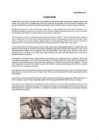
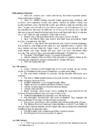
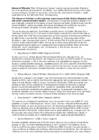
Thylacine AKA the Tasmanian Tiger/Wolf • The Tasmanian Tiger was the largest known carnivorous marsupial of modern times. • Native to continental Australia, Tasmania and New Guinea. • Believed to have become extinct in the 20th century. • Became extremely rare or extinct on the Australian mainland before British settlement of the continent, but it survived to the 1930s on the island of Tasmania. https://www.youtube.com/watch?v=6vqCCI1ZF7o • The thylacine was able to open its jaws to an unusual extent: up to 120 degrees. This capability can be seen in part in David Fleay's short black-and- white film sequence of a captive thylacine from 1933. The jaws were muscular but weak and had 46 teeth. • The thylacine held the title of Australia's largest predator until about 3500 years ago.
Bayerische Motoren Werke AG Tallinna Tehnikakõrgkool Valdur Kübarsepp ET 21 Bayerische Motoren Werke AG • Usually known as BMW. • German luxury vehicle manufacturing company. • Founded in 1916. History • 1912 manufactured aircraft engines. • Vercailes Armistice treaty. • Shifted to motorcycle production. • 1929 automobiles. • First launched car named Dixi. • 1930s started manufacturing aircraft engines. • Used forced labour. History BMW i • Sub-brand of BMW founded in 2011. • To manufacture plug-in electric cars. • 2014 launced plug-in hybrid car. BMW i Used sources • https://en.wikipedia.org/wiki/Plug-in_electric_vehicle • https://en.wikipedia.org/wiki/BMW_Dixi • https://en.wikipedia.org/wiki/Austin_7 • https://en.wikipedia.org/wiki/BMW
2007- Presidential Medal of Freedom of the United States Main characters Finches Scout story-teller 6-9 years A bit of tomboy, clever and curios Jem 10-13 Adventurous, polite Atticus About 50 Lawyer, honest, gentleman, caring General atmosphere Many short-forms 1930s Maycomb Children trying to understand this world Racism problem Becoming a lady and gentleman The plot Children adventures Dill Boo Radley Fishing pole The trial Tom Robinson vs Ewells Tom only helped Mayella
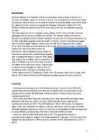
Reklaaminduses kujutati inimesi ebaproportsionaalselt, umbes kolm korda pikema ja kõhnemana kui tegelikult. Keha taoline paljastamine oli rahva seas veel vähelevinud. See oli ühtlasi ka esimene kord, kui riiete müümiseks inimkeha kasutati12. Joonis 10. Trikood 1930 Allikas:http://vintagedancer.com/193 0s/women-1930s-fashion/ (15.05.17) 9Kättesaadav Internetist: http://vintagedancer.com/1930s/women-1930s-fashion/ 10 http://www.e-ope.khk.ee/ek/roivaajalugu/rivastus_aastatel_19301939.html 11 http://vintagedancer.com/1930s/women-1930s-fashion/ 12 https://www.youtube.com/watch?v=lQbQ6Y99n9A 10 1.4. 1940ndad aastad Teise maailmasõja puhkemisega 1939ndal aastal tekkis puudus kõigest. Eriti toidust, mis
It is a very popular holiday destination in summer. It's also situated between the sea and the Pärnu river. Pärnu was first mentioned in the 12th century, so it is older 700 years old. In the middle ages Pärnu was a very important trading centre. It was a member of the Hanseatic League. Pärnu became a resort town in the 1830s when a group of businessmen founded the first bathing establishment. Before that today's Beach Park's area was just wet pasture. In the 1930s Pärnu cecame especially popular with Finns, Swedes, Latvians and Lithuanians. In Soviet times, however, people from the west were not allowed to stay in Pärnu for the night. Pärnu's sanatoria were full of holiday-makers from the s.u.
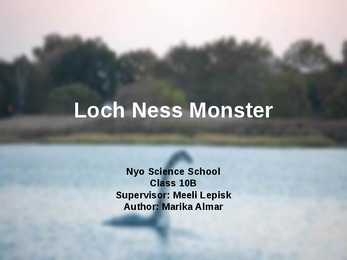
Loch Ness Monster Nyo Science School Class 10B Supervisor: Meeli Lepisk Author: Marika Almar Loch Ness Status of a classic phenomenon Popularity endures Best known cryptozoological creature Most-sighted monsters 1000 feet deep 24 miles long 6th century The Picts - the main inhabitants Strange beast in the Scottish highlands The first references 1930-1933 1930s new road 1933 - a couple reported an enormous animal Observations Footprints 1934 Robert Wilson's photo First photo of a "head and neck" Snapped 5 photos 1975 photo was fake 1975 An American-based expedition Possibly an ancient reptile 2011 George Edwards' photograph The most convincing Nessie photograph ever 2013 David Elder - amateur photographer
.. hospitable tolerant following a live and let live philosophy with strong sense of community and duty Canadians invented basketball baseball glove lacrosse Lacrosse mix between soccer and hockey 10 players 3 attackmen, 3 midfielde, 3 defensemen and 1 goalkeeper Canada has worlds longest coastline onetenth of the worlds forests longest national highway in the world Great Slave Lake deepest lake in North America in the 1930s, there was discovered gold max depth of 614 m Canadian Rockies highest point is Mount Robson second highest point is Mount Columbia Toronto largest and most important city financial centre in Canada have only real castle in all of North America Ottawa capital of Canada one of the nation's youngest cities have three universities Canada timeline Thank you for listening !
Nuclear weapon Heleanor Kala Henri Möll What is nuclear weapon? • tools of mass destruction • suddenly releases the energy • explosive devices • nuclear fallout • damage your blood, cells and organs • special isotopes of uranium or plutonium how it works? • atom • breaking that nucleus • combining two nuclei • large amounts of energy history • Scientist discovered how to create a chain reaction • in the 1930s • Robert Oppenheimer • Manhattan Project • development of the nuclear bomb Nuclear bomb effect • release four kinds of energy 1. Radiation (Cause Disease and will effect the next Generation) 2. Electromagnetic 3. Heat 4. Pressure Hiroshima • Hiroshima was the primary target of the first nuclear bombing mission on August 6, 1945 • “Little boy” • thirteen kilotons • 70 000-80 000 killed • 70 000 injured the destruction of Hiroshima
“The Wikman Boys” by Jaan Kross Subitems 1)Author 2)Summary 3)Main Characters *Jaak Sirkel *Richard Laasik *Virve Pukspuu *Penno 4)Screening Summary • Action takes place in Estonia in late 1930s • Estonia before World War II • Pictures everyday life of young lads • Private school (the Gymnasium of Wikman) • Intense relationship between the boys and their teachers Jaan Kross • Noted novelist • Born in 1920 in Tallinn • Studied at the University of Tartu (1938- 1945) • Novels, short-stories, plays, poems • He was against the Soviet regime -> was sent to G.U.L.A.G 1946 • Was married with Estonian poet Ellen Niit • Died in 2007
Teksased Anoreksia 1980-1989 Tõuslik stiil Kitsad puusad Laiad õlad Ratsapüksid Rullkraega särgid Karusnahksed mütsid päikeseprillid 1990-1999 Suur moevalik Spordirõivad Lihaseline kehakuju Tätoveeringud Platvormkingad Prantsuse patsid Individuaalsus Kasutatud m aterjal http://www.uptowntwirl.com/fashion-spotlight-4/390 1/ http://www.e-ope.khk.ee/ek/roivaajalugu/rivastus_a astatel_19101919.html http://oteea-land.com/2012/01/12/fashion-nostalgia- the-stylish-1930s/ http://glamourdaze.com/2009/08/1940s-fashion-wom ens-dress-code.html http://glamourdaze.com/2012/07/1950s-wardrobe-the- correct-fashion-line-for-you.html http://www.pinterest.com/laurenarandall/60s-beach- theme/ https://woodstockwardrobe.wordpress.com/tag/1970s -fashion/
Estonian sport Alfred Neuland ● 10 October 1895 ● first Olympic gold 1920 ● weightlifter ● 12 WR Palusalu’s triumph ● 10 March 1908 ● Berlin Olympic games 1936 ● two gold ● Greco-Roman and freestyle heavy weight ● people came to railway stations ● 40 000-60 000 people Paul Keres ● January 7, 1916 ● chess grandmaster ● the world's top players from the mid-1930s to the mid-1960s. ● the strongest player never to become world champion ● one of the greatest players in history Jaan Talts ● 19 May 1944 ● weightlifter ● silver 1968 ● gold 1972 ● 41 WR ● lifted 500 kg Erika Saulmäe ● born 11 June 1962 ● track bicycle racer ● only Estonian female medallist ● gold in 1988, 1992 Andrus Veerpalu ● 8 February 1971 ● most successful male cross country skier ● 2002 gold and silver ● 2006 gold
of early art nouveau style in Estonia. The grand villa with a large garden was built in 1905 and belonged to the Ammende merchant family. Ammende Villa The house has been also used as a summer casino and a club. The villa has now been restored and turned into a luxurious hotel and restaurant. Monument to Raimond Valgre The musician Raimond Valgre who played in Pärnu in 1930s and brought the town a lot of fame, can today be found sitting in the park near Kuursaal, as a bronze statue. Monument to Raimond Valgre You can sit down next to the beloved Estonian composer and enjoy his beautiful compositions. Also be sure to go to the traditional Homage to Valgre musical night that takes place every summer, when Estonian star singers perform Valgre's immortal songs at the outdoor stage.
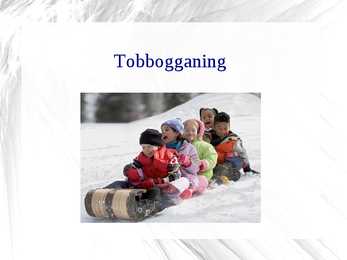
The only kind of a sled used today, is the bobsled with fancy racing colors. How it works? Aerodynamics takes a huge part in this. Every member of the team pushing with all their might. Who could make it down the farthest. Tobogganing as sport Probably originated on the slopes of Mount Royal in Montreal. During the late 1880s it spread to the United States, where it had considerable popularity until the early 1930s. During the heyday of tobogganing, many artificial chutes were constructed. Sides of ice or wood and frequently were built with several parallel tracks to accommodate more than one toboggan at a time. The chutes were quite steep Speeds of up to 60 miles (96.6 km) per hour were attained. Many of the chutes are still in use. Penguins way of moving on ice is also called tobogganing Thank you for listening! :)
Max Plancki medal. `' Kes pole kungi ühtegi viga teinud, pole järelikult kunagi proovinud midagi uut'' A. Einstein Herbert McLean Evans 23. september 1882 a. USA 6. märts 1971 a. USA Ameerika Ühendriikide anatoom 1923- avastas kasvuhormooni 1922- Vitamiin E publikatsioonid Kasutatud allikad http://www.annaabi.ee/Teadus-Eestis-1920-1930-m51318.html http://www.timetoast.com/timelines/advances-in-science-1920s-1930s http://www.lib.ttu.ee/exhs/fuajee.2010/veebruar.html http://rescomp.stanford.edu/~cheshire/EinsteinQuotes.html http://et.wikipedia.org/wiki/Herbert_McLean_Evans http://et.wikipedia.org/wiki/Albert_Einstein
His family was very strict and religious. His father taught his children a love of nature and the outdoor life. His mother taught him a love of music and art. At the school he wrote for school newspaper. He didn't do to college. He worked for the Star newspaper in Kansas City. Hemingway was fascinated by war. He had wanted to become a soldier but couldn't because he had poor eyesight. He became ana ambulance driver and was sent to Italy, where he was wounded. In the 1930s he became a war correspondent in the World War II. Many of his books were about war. His best book , For Whom the Bell Tolls, was written in 1940. Hemingway success in writing but not very successed by personal happiness. He married 4 times. In 1928 his father committed suicide. Hemingway's health was not good and he had many accidents. He was awarded the Nobel Prize for literature. Hemingway killed himself with a shotgun, just as his father had done before him.
Some of the books he wrote are: "Story of the American Flag" Profusely illustrated. "The Real Abraham Lincoln" "The Life of Alexander Hamilton" "The Real Robert Morris" (A Pennsylvania banker known as "the financier of the American Revolution.") "Story of the Great Seal of the United States." "History of American Emblems" "The History of American Heraldry" The Father of Flag Day Bernard J. Cigrand was first and foremost an American patriot. From the 1880s through the 1930s, he preached respect and honor for the nation and its flag. In 1885, however, Cigrand still a teenager and only at the beginning of his journey. He entered dental college later that year, mixing his professional studies with the promotion of the flag. In June 1886 he made his first public proposal for the annual observance of the birth of the flag when he wrote an article titled "The Fourteenth of June" in the old Chicago Argus newspaper.
flying lakes etc. The magic world of Kristjan Rauds drawings charms the viewer with its epic poetry. In 1935 many Estonian homws acquired a copy of their national epic Kalevipoeg illustrated by Kristjan Raud. This made his name known to his fellow countrymen. Kalevipoeg with Rauds pictures was reissued in 1975. To an average Estonian Kristjan Raud is primarily known as the illustrator of the national epic and as an advocate of national romantic art ideas in the 1930s when quite different winds were already blowing even in the remote European province of Estonia. Characteristic of Estonian folklore Kristjan Rauds work contains very few light and playful undertones. The image of a singing Kalevipoeg is one of the most joyful motifs in the artists entire work. More than 40 drawings and sketches picture Kalevipoeg as a triumphant giant standing on a hillside and singing to his brothees. In Rauds
Best Costume Design, Best Director, Best Film Editing, Best Music-Original Dramatic Score, Best Picture and Best Sound. An Oscar went to Robert Towne for Best Writing-Original Screenplay. It also has won three BAFTA Film Awards for Best Actor, Best Director and Best Screenplay, Edgar Allan Poe Award for Best Motion Picture, four Golden Globes and many more.2 Chinatown is a layered film, which takes place in Los Angeles in the 1930s. It narrates a story of a private detective J.J.Gittes, who investigates the murder of head of the city's water and power board Mulwray with help from his wife Evelyn Mulwray. From the beggining, the movie develops an interesting and enthralling plot, which is enriched with sarcastic humour and complex human relations. The plot is very unpredictable so when the final result appears, it is very unexpected and well-hidden.3 Each incident pulls the audience deeper into the story
country teeming with birdlife and waters full of fish and other kai moana (seafood). · With bacciferous land the farming was easy and the settlers were stayed to NZ. Wars. · New Zealand was an enthusiastic member of the British Empire, fighting in the Boer War, World war one and World war two, and supporting Britain in the Suez Crisis. · The country was very much a part of the world economy, and suffered as others did in the Great Depression of the 1930s. · The depression led to the election of the first Labour goverment, which established a comprehensive Welfare state and a protectionist economy. Flora and fauna . · New Zealand has extraordinary flora and fauna. · About 80% of the New Zealand flora occurs only in New Zealand. · Until the arrival of humans, 80% of the land was forested. The two main types of forest are those dominated by podocarps including the giant kauri, and in cooler climates the southern beech
8 m) long and the head of a goalkeeper's crosse may measure up to 12 inches (30 cm) wide, significantly larger than field players' heads to assist in blocking shots. Box lacrosse Box lacrosse is played by teams of six on a hockey rink where the ice has been removed or covered by artificial turf. The enclosed playing area is called a box, in contrast to the open playing field of the traditional game. This version of the game was introduced in the 1930s to promote business for hockey arenas, and within several years had nearly supplanted field lacrosse in Canada. Women's lacrosse The rules of women's lacrosse differ significantly from men's lacrosse, most notably by equipment and the degree of allowable physical contact. Women's lacrosse does not promote physical contact primarily because the only protective equipment worn for this sport is a mouth guard and face guard and sometimes thin gloves
Was the British Empire a good thing that enlarged the world creating possibilities for everyone or was it just a way for some to gain power and wealth? How is the modern-day Commonwealth different? The British Empire used to be one of the largest and wealthiest empires in the world. Its prosperity started at the early 1600s and reached its high peak at the end of the World War I. The Empire faded into the Commonwealth at the end of 1930s as one colony after another gained its independence. After studying the topic I would say that it cannot be said whether the British Empire was a very good or a very bad thing. Of course any kind of oppression should not be approved of and actually the Empire and native British forced on their way of life and culture to the colonies. On the other hand the Empire also helped its subjects to develop in a positive sense.
Britain, along with the US, was the main contributor in the development of rock and roll, and Britain has provided some of the most famous bands, including The Beatles and many others. Britain was at the forefront of punk music (see below) in the 1970s with bands such as the Sex Pistols and The Clash, and the subsequent rebirth of heavy metal with bands such as Motorhead and Iron Maiden. Music in Britain from 1920s to the Present Day 1920s - Young people listened to ragtime and jazz. 1930s - Swing became popular. Benny Goodman and his Orchestra were the 'King of the Swing', as were Glenn Miller and Artie Shaw. The music was fast and frantically paced and led to dances being banned from dance halls, as the young women being flung into the air by their partners showed their stocking tops and underwear. Jazz continued to be popular. 1940s - The Second World War brought fast, frantic (and often American) dance music - boogie-woogie or jitterbug
Film review Jeeves and Wooster is a British comedy television series. It's adapted by Clive Exton from P.G Wodehouse's "Jeeves" stories. The series was produced by Picture Partnership Productions for Granada Television and screened on the ITV network from 1990 to 1993. It starred was Hugh Laurie as Bertie Wooster and Stephen Fry as Jeeves. The stories are set in England and the United States in the 20 th century but it describe action in 1920s and 1930s when the Second-World-War was taken place. ,,Jeeves and Wooster" have 23 episodes. The first season are directed by Robert Young, the second by Simon Langton and the two last series are directed by Ferdinand Fairfax. The theme song is an original piece of music in the jazz/swing style written by composer Anne Dudley. Like I was saying the action discribe 1920's and 1930's and that's the reason why the jokes are more controlled than today
"Shoot all the blujays you want, if you can't hit `em, but remember it's a sin to kill a mockingbird." Atticus said that to his children, he gave the instructions for life with this sentence. Mockingbird is a symbol of innocence and therefore it's a sin to harm innocent people. My opinion It was enjoyable and quite serious reading. That book wasn't only a story of relations between people but also a historical review about what was going on in southern America in the 1930s. I knew that racism was a great issue on those days but now I know more about it. I would recommend "To Kill a Mockingbird" to the people who fancy classics and who like books where you have to think also during reading.
and ice, in global mean sea level rise, and in changes in some climate extremes. Initial causes of temperature changes Greenhouse gases The greenhouse effect is the process by which absorption and emission of infrared radiation by gases in a planet's atmosphere warm its lower atmosphere and surface. It was proposed by Joseph Fourier in 1824, discovered in 1860 by John Tyndall, was first investigated quantitatively by Svante Arrhenius in 1896, and was developed in the 1930s through 1960s by Guy Stewart Callendar. Solar activity Since 1978, output from the Sun has been precisely measured by satellites. These measurements indicate that the Sun's output has not increased since 1978, so the warming during the past 30 years cannot be attributed to an increase in solar energy reaching the Earth . The graphs show otherwise. Effects of global warming on oceans Global warming can affect sea levels, coastlines, ocean acidification, ocean currents,
Orwell for the Home reading book. When I was in the library I first took the book ,,1984". I had started to read it I found out that it had been translated into Estonian and it had been made into a movie. I knew that the ,,Animal Farm" is readable in Estonian too. I had no chance, but to choose ,,The Road to Wigan Pier". I first fought it was a novel, but after reading two chapters I found out it was an autobiography. But it was very fassinating to read about the life in United Kingdom in 1930s. And I really enjoyed reading about Orwells thoughts, his life and socialism. I got a lot smarter thanks to this book and it was really interesting to read.
Also, the losses to the Japanese destroyed the myth of the European omnipotence. Secondly, heavily in debt to the United States, the United Kingdom was financially exhausted. This left it almost impossible to defend its wider colonies by force. So the vast markets were opened to American companies and to weaken the UK in general. No empire has been larger or more diverse than the British Empire. At its apogee in the 1930s, 42 million Britons governed 500 million foreign subjects. Britannia ruled the waves, and a quarter of the earth's surface was coloured red on the map. Where Britain's writ did not run directly, its influence, sustained by matchless industrial and commercial sinews, was often paramount. Yet no empire (except for the Russian) disappeared more swiftly. Within a generation, this mighty structure sank almost without trace leaving behind a scatter of sea-girt dependencies
language writer to receive the prize. Among other honours, he was sounded out for the British Poet Laureateship and on several occasions for a knighthood, all of which he declined. Later in life Kipling came to be recognized as a "prophet of British imperialism." Many saw prejudice and militarism in his works, and the resulting controversy about him continued for much of the 20th century. Kipling kept writing until the early 1930s, but at a slower pace and with much less success than before. He died of perforated duodenal ulcer on 18 January 1936, two days before George V, at the age of 70. His death had in fact previously been incorrectly announced in a magazine, to which he wrote, "I've just read that I am dead. Don't forget to delete me from your list of subscribers." Rudyard Kipling was cremated at Golders Green Crematorium and his ashes
where four large peninsulas (Juminda, Pärispea, Käsmu and Vergi) are separated from each other by four bays (Kolga, Hara, Eru and Käsmu.) Lahemaa translates roughly as "Land of Bays". 8. Kadriorg Palace Catherinethal ("Catherine's valley") is a Petrine Baroque palace of Catherine I of Russia in Tallinn, Estonia. It was built after the Great Northern War to Nicola Michetti's. Catherinethal was abandoned by Russian royalty throughout the late 18th and 19th centuries. In the 1930s Konstantin Päts, Estonia's first president, embarked on extensive and controversial restorations with the aim of transforming the park and the palace into his private domain. 5 9. Kõpu Lighthouse Kõpu Lighthouse is one of the best known symbols and tourist sights on the Estonian island of Hiiumaa. It is one of the oldest lighthouses in the world, having been in continuous use since its completion in 1531. The lighthouse is
David, who received a skin from a hunter. · The first westerner known to have seen a living Giant Panda is the German zoologist Hugo Weigold, who purchased a cub in 1916. · The Giant Panda has been a · The population boom in target for poaching by locals China after 1949 created since ancient times, and by stress on the pandas' foreigners since it was habitat. introduced to the West. · During the Cultural · Starting in the 1930s, Revolution, all studies and foreigners were unable to conservation activities on poach Giant Pandas in the pandas were stopped. China because of the · After the Chinese economic Second Sino-Japanese War reform, demand for panda and the Chinese Civil War, skins from Hong Kong and but pandas remained a Japan led to illegal poaching source of soft furs for the for the black market, acts locals
The real dismanting of the empire took place in the 25 years following the secnd world war. it gradually became clear that britain was no longer superpower in the world in 1997 britain handed hong kong back to china, thus losing its last imperial posession of any significant size the urban working class finally began to make its voice heard The labour party gradually replaced the liberals as the main opposition to conservatives From the 1930s to 80s the trades union congress was probably the single most powerful political force outside of the institutions of government and parliament since then the working class has faded as a political force in 1900 a general sence of prosperity was combined with a rather high long term unemployment rate and concerns about an underclass in 1950 sense of austerity was combind with a very low rate of unemployment
Sündis mitu olulist uut tööd ja plaati. 1970 võttis Ellington ette pikima turnee, mille jazzorkester eales ette võtnud: Nõukogude Liit, Euroopa ja Ladina-Ameerika. 25. mail 1974, kui Ellington suri, avaldas talle austust kogu muusikamaailm Leonard Bernsteinist Miles Daviseni. 11 Kasutatud materjal "Jazziraamat", Joachim E. Berendt, 1999. a. www.freemaninstitute.com/BCF%20Dukephoto.htm www.authentichistory.com/audio/1930s/music/1932-It_Dont_Mean_a_Thing.html www.allaboutjazz.com/albums/pedroscassa/ellington.sized.jpg www.americaslibrary.gov/DukeEllingtonPoster.jpg www.users.globalnet.co.uk/~mcgoni/ella/ www.schirmer.com/composers/Ellington.gif www.ellington-music.co.uk www.images.allposters.com www.dukeellington.com www.redhotjazz.com www.dellington.org www.dike-ellington.com 12 13 14 15 16
troupe was disbanded and "Estonia" continued as just a musical theatre. In 1906 was hired the first music director Otto Hermann, 1907 saw the first operetta, Hervé's "Mam'zelle Nitouche", on stage, a steady production of operas started in the 1918/19 season. In 1911, the first Estonian operetta, Adalbert Wirkhaus' "St. John's Night" was staged. In 1926 , choreographer Rahel Olbrei founded the permanent ballet troupe in the theatre, the ballet became more regular in the 1930s. In 1994--2009 the theater was managed by Paul Himma, since 1 September 2009 the general manager is Aivar Mäe. Tallinn City Theatre This theatre was founded in 1965 named Youth Theatre, but from the beginning it was a regular drama company, with only slightly more plays for the children than in the other theatres. The objective of its first leader Voldemar Panso was to change the unnatural situation, created in
Stress What is stress? Physiologists define stress as how the body reacts to a stressor, real or imagined, a stimulus (erguti) that causes stress. Acute (terav) stressors affect an organism in the short term; chronic stressors over the longer term. The term stress was first employed in a biological context by the endocrinologist Hans Selye in the 1930s The effects of stress: Alarm is the first stage. When the threat or stressor is identified or realized, the body's stress response is a state of alarm. During this stage adrenaline will be produced in order to bring about the fight-or-flight response (võitle või põgene) Resistance is the second stage. If the stressor persists (püsib), it becomes necessary to attempt some means of coping (toimetulemisega) with the stress. Although the body begins to try to
and the Great Depression. In 1932, he became the first monarch to use the medium of radio to speak to the nation. He later described himself as `a very ordinary sort of fellow'. Prince Edward, Duke of Windsor (King Edward VIII) (1894-1972), Reigned 1936 Eldest son of George V and Queen Mary. Prince Edward was commissioned into the Guards in 1914, but as heir to the throne his request for active service was denied. He spent the war abroad, visiting troops. During the 1920s and 1930s, his concern for unemployment and successful tours throughout the Empire made him a popular figure. He was King Edward VIII from January to December 1936, but abdicated following insoluble constitutional problems raised by his proposed marriage to the American socialite and divorcée, Wallis Simpson. They married in June 1937 and lived abroad, mainly in France. He was Governor of the Bahamas from 1940 to 1945. King George VI (1895-1952), Reigned 1936-52
inverted snobbery middle-class people try to adopt working-class values and habits. posh of a class higher than the one I belong to; being posh being pretentious 7. In the early years of the twentieth century, the playwright and social commentator George Bernard Shaw remarked that an Englishman only had to open his mouth to make some other Englishman despise him. What was he talking about? Would he say the same thing today? 8. In the 1930s people in middle-class neighbourhoods often reacted angrily to the building of housing estates for the working class nearby. In one area they even built a wall to separate the two neighbourhoods! This could never happen today. Why not? What has changed? 9. English class system has survived in Britain because of its flexibility. How do the social classes differentiate themselves in Britain? What is the role of language, accent, clothes, money, habits and attitudes?
available. In these days the repertoire of Estonian Drama Theatre consists of the plays written by Shakespeare, Moliere, Calderon and also Friel, Bergman etc. 7 Estonia National Puppet Theatre Estonia has no age-old puppetry tradition, like some other countries. Regular puppet shows were first a feature of the children's program of the Estonian Drama Theatre in the 1930s. A separate puppet theatre was founded in 1952; for decades it worked under the leadership of Ferdinand Veike. At first it had no house of its own, constantly travelling around the country. In 1955 part of an historic building in the old-town quarter of Tallinn became its home. The theatre started to broaden its means, often mixing puppets and live performers. From 2000 the artistic director is Andres Dvinjaninov and the managing director is Meelis Pai
of Mistrust. During night all traffic between the Upper and Lower town was stopped and the gates were shut at 9pm. The Short Leg gate tower at the top of Lühike Jalg Street was created in 1454-56 and it connects Short Leg and Long Leg. It can be considered the most haunted spot in the Old Town, simply due to the number and persistence of reported incidents. Sightings have included a pair of monks, a woman in an old-fashioned dress, and even a fire-spitting dog. In the 1930s some local spiritualists made several attempts to contact the troubled spirit of a monk who had been the town executioner in his earlier life.They failed, perhaps because the monk's ghost must have spoken Latin. As Tallinn has two "legs" of different length, it is sometimes humorously called "a limping town". Right from the Danish Conquest Toompea started to develop into the centre of provincial authority, clergy and nobility in Northern Estonia. Most of the vassals
ncbi.nlm.nih.gov/pmc/articles/PMC1200696/, 10.01.2016. 2 I think that knowledge in natural sciences can have less value to us when compared to human sciences even though it is, in most cases, produced with difficulty. There were many scientists that carried out experiments to study plant life. It was in the 1600s when the first reasonable hypothesis was made by Jan Van Helmont (although only partially correct), and it was only later in 1930s that Cornelis Van Niel was able to propose the general equation for photosynthesis.3 It has taken hundreds of years for scientists to make sense of photosynthesis, but we don’t really value this information and it isn’t of much importance to us, the ordinary people. An argument for this would be the importance of understanding photosynthesis will help us grow a healthier crop for our population or efficiently
Provincial hospitals followed in 1800s Hospitals were financed by private capital and, mostly charitable and received patients from the working classes. In the Americas the women of colour and immigrants were. For the first time uninhibited access to female body becomes possible. HOWEVER, o Medical assistance could not improve midwife assisted mortality record. o Toxaemias of pregnancy, sepsis and haemorrhage were noT brought under control till 1930s. o Maternal and infant mortality remained at a constant high from 1835 to 1935 o Post WWII almost 90% births became institutionalised Take a highly successful `natural process' (e.g., salmon swimming upstream to spawn) PunchOne:renderit dysfunctional with technology (dam the stream, preventing salmon from reaching their spawning grounds) Punch Two : fi x i t wi t h technology (take salmon out of the water with machines, make them spawn artificially and grow eggs in
topographically. Presents only what is necessary. Big Ben – symbol of time; opposition between the time of the clock and the time of the mind. English literature between the world wars; existentialism. Postmodernism; Anthony Burgess Interwar period, i.e. the 1930s – a change in the mood, the aesthetic programme, moral convictions and public taste in England. 1900-‐1920s – the time of high modernism, a lot of experiments; 1920s – emergence of the “lost generation”, marked by a search for stability and faith.
Ta oli koolis pesapalli mängja. 4 Fidel Castro Poliitika Castro elus. Fidel Castro on Kuuba riigipea. Aasta lõpus 1945, Castro kantud õiguse kooli University of Havana . He became immediately embroiled in the political culture at the University, which was a reflection of the volatile politics in Cuba during that era. Ta sai kohe sotkeutunut poliitilist kultuuri ülikoolis, mis oli peegeldus lenduvate poliitikas Kuubas sel ajastul. Since the fall of president in the 1930s, student politics had degenerated into a form of gangsterismo dominated by fractious action groups, and Castro, believing that the gangs posed a physical threat to his university aspirations, experienced what he later described as "a great moment of decision." Kuna sügisel president Gerardo Machado 1930, üliõpilaste poliitikas oli mandunud vorm gangsterismo domineerivad jonnakad tegevusrühmad ja Castro, uskudes, et jõukude põhjustatud
Keir Hardia, gave the proletariat a greater voice in Parliament. Britain's Decline as a World Power After Victoria, his eldest son came to the throne in 1901 when he was 60 years old. He ruled nine years and then he died. The next monarch was George V, who ruled for 26 years and was confronted with many crises, including World War I, Ireland's fight for (and winning of) independence, women's battle to secure the vote, the General Strike of the 1920 and the Great Depression of the 1930s. During the World War I, he changed the name of the royal family, which used to be Saxe-Coburg-Gotha, to Windsor. The white settler colonies of British Empire had always enjoyed considerable self- government and in the first decade Canada, Australia, South Africa and New Zealand were all allowed to draw up their own constitutions to become dominions. The non-white colonies were not so fortunate. World War I started in 1914. It was between France, the UK and the British Empire,
government events. In the United Kingdom the term has for centuries been the title of the official poet of the monarch, since the time of Charles II )Some claim that he was offered the post during the interregnum of 1892-96 and turned it down. At the beginning of World War I, like many other writers, Kipling wrote pamphlets which enthusiastically supported the UK's war aims. Death and legacy Kipling kept writing until the early 1930s, but at a slower pace and with much less success than before. He died of a perforated duodenal ulcer ( perforeeritud kaksteistsõrmiksoole haavand ) on 18 January 1936, two days before George V, at the age of 70. His death had in fact previously been incorrectly announced in a magazine, to which he wrote, "I've just read that I am dead. Don't forget to delete me from your list of subscribers. Rudyard Kipling was cremated and his ashes were buried in Poets' Corner, part of the South Transept
[6] So the background behind Renard is passion from one side, and a designer with creative ambition but no outlet. Somebody once said that four wheels move your body but two wheels move your soul. [6] Lauri: When did you start with the Renard project? Andres Uibomäe: I stumbled upon Renard trails accidentally, seven years ago, when talking to a motorcycle restorer who had been investigating Renard history (Renard was a small Estonian motorcycle brand at the end of 1930s). [6] Renard is a beautiful name, and I am happy that such an old motorcycle industry legacy is available for us to continue. Due to the Soviet occupation, most historic ties have been broken. If we had not restored the legacy, then most probably the next generation would not have remembered Renard any more. I hope that we are worthy of the name, and that the new company can last for longer than the old company lasted before WWII. The modern company, Renard Ltd, was established in June 2008.
In the sixteenth century in England, the state first tried to give housing to vagrants instead of punishing them, by introducing bridewells to take vagrants and train them for a profession. In the eighteenth century, these were replaced by workhouses but these were intended to discourage too much reliance on state help. These were later replaced by dormitory housing ("spikes") provided by local boroughs, and these were researched by the writer George Orwell. By the 1930s in England, there were 30,000 people living in these facilities. In the 1960s, the nature and growing problem of homelessness changed for the worse in England, with public concern growing. The number of people living "rough" in the streets had increased dramatically. However, beginning with the Conservative administration's Rough Sleeper Initiative, the number of people sleeping rough in London fell dramatically. This initiative was supported further
worked for the war. In 1918 women aged 30+ were given the right of suffrage. In 1924 all adult men and women got the right to vote. The Labour Party supported this and was more popular because they gave equal rights. 9. Women’s role during WWI; between the world wars – the flappers and the roaring twenties. 1930s and WWII. Important changes in society and politics during the first half of the 20th century that helped improve women’s rights and opportunities. After the war people had a lot of grand emotions, they were happy, had many parties. With that came the flapper movement in the 20s. Flapper women smoked and wore excessive makeup, drank, bobbed their hair and ignored other social and sexual norms. The flapper
,,And not yet i am now alive, but let me rest still." Clarissa and Septimus: Mrs Dalloway-her sense of personal identityt, her past, Peter and Sally, now-Mrs. Dalloway, always Mrs. Dalloway. Compromisin her soul, dr william Bradshaw, psychiatrist, Septimus-afraid doctors will take his soul, throws himself out of the window, would not compromise his soul, siw wiliam comes to clarissa's party, society full of dangerous peple like sir wiliams. 9. English Literature of the 1930s-1950s. Aggravating political and economic situation in the 1930s-1940s. A turn in the mood, aesthetic programme, moral convictions and public taste. The Golden Age of crime fiction. The literature of `fair play'. Graham Greene. Realism and Existentialism. English Literature of the 1930s-1950s. Reception theory. Only the process of reading generates a meaning for a text. Reading connects reader and the text. A good degree of inderterminacy and gaps to make the connection possible
The Estonians are a Finnic people closely related to the Finns, with the Estonian language sharing many similarities to Finnish. The modern name of Estonia is thought to originate from the Roman historian Tacitus, who in his book Germania (ca. AD 98) described a people called the Aestii. Similarly, ancient Scandinavian sagas refer to a land called Eistland, close to the German term Estland for the country. Early Latin and other ancient versions of the name are Estia and Hestia. Until the late 1930s, the name was often written as Esthonia in most English speaking countries. Estonia is a democratic parliamentary republic and is divided into fifteen counties. The capital and largest city is Tallinn. With a population of only 1.4 million, it is one of the least-populous members of the European Union. Estonia was a member of the League of Nations from 22 September 1921, has been a member of the United Nations since 17 September 1991, of the European Union since 1 May 2004
Mr. Quin. 6 Adaptations 6.2 Radio 3 6.1 Television A television film was produced in 2006 with David Suchet as Poirot in the ITV series Agatha Christie's Poirot. The cast included Elliot Cowan as David Hunter, Celia Imrie as Kathy Cloade, Jenny Agutter as Adela Marchmont and Tim Pigott-Smith as Dr. Lionel Woodward.The film made several significant changes to the plot: · Like almost all episodes of the TV series, the film is reset in the late 1930s as opposed to the post-World War II years: as a result of this, the death of Gordon Cloade was caused not by a German air raid, but an apparent gas explosion that Poirot later reveals was a bomb planted by David Hunter. · Rosaleen was made into a morphine addict. · Kathy becomes Adela's sister, whereas in the novel, it is Lionel who is a Cloade. The credits mistakenly refer to Lionel as a Cloade however, his surname is 'Woodward' (as revealed by Kathy when she visits
 annaabi.ee