 10 punkti
Autor soovib selle materjali allalaadimise eest saada 10 punkti.
10 punkti
Autor soovib selle materjali allalaadimise eest saada 10 punkti.
 ~ 2 lehte
Lehekülgede arv dokumendis
~ 2 lehte
Lehekülgede arv dokumendis
 2012-02-12
Kuupäev, millal dokument üles laeti
2012-02-12
Kuupäev, millal dokument üles laeti
 4 laadimist
Kokku alla laetud
4 laadimist
Kokku alla laetud
 0 arvamust
Teiste kasutajate poolt lisatud kommentaarid
0 arvamust
Teiste kasutajate poolt lisatud kommentaarid
 klehes
Õppematerjali autor
klehes
Õppematerjali autor
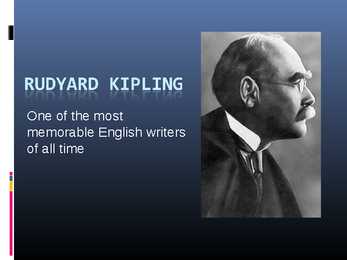
Rudyard Kipling - One of the most memorable English writers of all time Family of Joseph Rudyard Kipling Mother- Alice MacDonald Kipling. Alice Kipling (one of four remarkable Victorian sisters) was a vivacious woman about whom a future Viceroy of India would say, "Dullness and Mrs. Kipling cannot exist in the same room."[3] Father - John Lockwood Kipling. Lockwood Kipling, a sculptor, an illustrator, museum curator and pottery designer, was the principal and professor of architectural sculpture at the newly- founded Sir Jamsetjee Jeejeebhoy School of Art and Industry in Bombay. Later in life Kipling illustrated many of Rudyard Kipling's books, and other works. Kipling also remained editor of the Journal of Indian Art and Industry, which carried drawing works from the students of the Mayo School.
One of the most memorable English writers of all time Family of Joseph Rudyard Kipling Mother Alice MacDonald Kipling Father John Lockwood Kipling Sister Alice Kipling Fleming Early Life 30 December 1865 in Bombay, in British India Captain and Mrs. Holloway - Lorne Lodge Paradise at Aunt Georgie's and her husband 1878 - admitted to the United Services College Bombay in 1865 Travels & First writings 1883 - visited Simla thirty-nine stories appeared in the Gazette included in Plain Tales from the Hills Kipling's first prose collection 1887 Allahabad in the United Provinces published six collections of short stories
· Chamber Music (1907 poems) · Giacomo Joyce (written 1907, published 1968) · Dubliners (1914) · A Portrait of the Artist as a Young Man (1916) · Exiles (1918 play) · Ulysses (1922) · Pomes Penyeach (1927 poems) · Collected Poems(1936 poems) · Finnegans Wake (1939) · Giacomo Joyce (1968 poems) · James Joyce's Letters to Sylvia Beach, 1921-1940 (1987) Joseph Rudyard Kipling Joseph Rudyard Kipling (December 30, 1865January 18, 1936) was an English author and poet, born in Bombay, British India, and best known for his works The Jungle Book (1894), The Second Jungle Book (1895), Just So Stories (1902), and Puck of Pook's Hill (1906); his novel, Kim (1901); his poems, including Mandalay (1890), Gunga Din (1890), "If--" (1910) and "Ulster 1912" (1912); and his many short stories, including "The Man Who Would Be
fiction The Jungle Book (1894) (a collection of stories which includes Rikki-Tikki-Tavi), Kim (1901) (a tale of adventure), many short stories, including The Man Who Would Be King (1888); and his poems, including Mandalay (1890), Gunga Din (1890), and If-- (1910).He is regarded as a major "innovator in the art of the short story"; his children's books are enduring classics of children's literature; and his best works speak to a versatile and luminous narrative gift. Kipling was one of the most popular writers in English, in both prose and verse, in the late 19th and early 20th centuries. In 1907, he was awarded the Nobel Prize in Literature, making him the first English language writer to receive the prize. Among other honours, he was sounded out for the British Poet Laureateship and on several occasions for a knighthood, all of which he declined. Later in life Kipling came to be recognized as a "prophet of British imperialism." Many saw prejudice and
Ameerika Kirjandus 30.01.13 Naturalism · France, Emile Zola · Put down his theory in 1879: Le Roman Experimental, attempt to explain the development of human society throuch biological laws · Outlook is deterministic, pessimistic, fatalistic (fate or biology) · Man as an animal-clever than other beasts, still explainable within the framework · Man is not a free agent, is govern by something · Unable to determine his own faith · Hereditary · Naturalists tried to apply in fiction the processes of natural sciences · Writers task is to record facts, systems of behaviour, living conditions, never revealing any natural unbiased (completely natural) · Point of view: amoral-outside the category of morality, neither good or bad · Naturalist find it absurd to blame the wicked. These criminals are doing what nature, environment, their unconscious tells them to do. Naturalists do not judge their characters, they sim
The making of a new nation. The Enlightenment in America. The emergence of the notion of the American Dream. The great Enlighteners: Crèvecoeur, Jefferson, Paine, Franklin. The American Enlightenment is the intellectual thriving period in the United States in the midtolate 18th century (17151789), especially as it relates to American Revolution on the one hand and the European Enlightenment on the other. Influenced by the scientific revolution of the 17th century and the humanist period during the Renaissance, the Enlightenment took scientific reasoning and applied it to human nature, society, and religion. American Enlightenment a gradual but powerful awakening that established the ideals of democracy, liberty, and religious tolerance in the people of America. If there were just one development that directly caused the American Revolution and uplifted the intellectual culture of the continent while it was only a British colony, it would be the American Enlightenment. Broadly
Legends of the Fall Jim Harrison Kasper Keps 11c About the author James "Jim" Harrison Born in December 11, 1937 in Grayling , Michigan. American author known for his poetry, fiction, essays, reviews, and writings about food Blind in one eye since childhood (left eye) . He was educated at Michigan State University where he received his B.A. (1960) and M.A. (1964) in comparative literature Married and has two daughters. Has written over 50 books. Main Characters COL. WILLIAM LUDLOW - Idealistic, formalistic, rational, stong willed, so principled that he left his job because of unethical behavor in the army, it's almost obsessive to him that Indians get treated properly; wrote a book to the government objecting to their policy. TRISTAN LUDLOW - Adventurer and smuggler who loves his freedom so much that he lives like an indian, his long hairs and horse riding symbolize his independence, too self-confident,
American literature The literary history of this nation when the first humanbeing living in what has since become the U.S used language creatively. · Mid to late 18 century put down · Words are powerful, magical · Words must be remembered · Native Americans stories creation of the world · Attidude thought their land/language · Similar stories Dates and names · America was discovered in 1492 by Columbus · 1497 John Cabot went to Canada · 1579 San Fransisco/St. Fransis · 1607 Jamestown collony/John Smith · 1620 a boat called MayFlower · 1630 Boston was established · 1636 Harvard University · 1773 Boston Teaparty · 1775 War of Independence · 1776 4 July Declaration of Independence · First President George Washington Christopher Columbus Christopher Columbus (1451
 annaabi.ee






Kõik kommentaarid