EstoniaTopicTallinn 2007List of Contents
page
Facts
and
figures 3
Geography 3
Climate 3
Nature 4
History 5
Economy 6
Culture 6
Biggest towns 7
Language 8
Facts
and figuresThe
Republic of Estonia is a small
country . Covering only 45, 228 sq km
it is
slightly bigger
than Denmark,
Belgium or Switzerland. Estonia’s
population is under 1.4 million. The
official language is Estonian
but
since very many Russians
live here Russian is also
wide spread .
The
capital of Estonia is Tallinn. The
currency used in Estonia is Eesti
kroon.
The
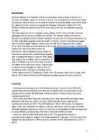
Estonian national flag is
blue -
black -white. It was originally the
flag of the Estonian
Students ’ Society. The flag was
first consecrated in Otepää
Church in 1884. For a
while ,
during the
Soviet occupation , the flag was banned but it was
again seen in
public in Tartu in May 1988.
The
national flower is cornflower, the national
bird is
barn swallow and
the national
stone is
limestone .
The
Estonian national
anthem called “My
Native Land , My
Pride and Joy”
was composed in 1848 by
Friedrich Pacius. The Estonian language
words were written by J. V.
Jannsen . It was officially adopted after the
War of Independence in 1920.The
same melody with
different words is
also
Finland ’s national anthem.
The
current coat of
arms of Estonia
is a
golden shield which includes three slim, blue leopards
(or lions)
in the
middle , with oak branches
along the side of the shield. It
originates from Denmark. It was officially adopted in 1925.
GeographyEstonia
is the northernmost of the three
Baltic States . It is
located on the
northern hemisphere on the
eastern shores of the Baltic Sea in the
north -
east of
Europe . It has land contact with
Russia from the east
and Latvia from the
south . In the north The Gulf of Finland separates
Estonia from Finland. The Gulf of Riga is
situated to the south-
west .
Estonia
has more than 1500
islands . The biggest
ones are located to the west.
The
four biggest islands are Saaremaa,
Hiiumaa ,
Vormsi and
Muhu .
The
highest point in Estonia and also in the Baltic region is Suur
Munamägi. It is 318.
above sea level.
Estonia
is a country of a
thousand lakes . The Largest one is Lake
Peipsi which is also the
fourth biggest freshwater lake in Europe. Lake
Peipsi and Lake Võrtsjärv are
rich in
fish .
Estonia
has many
rivers but only nine of
them are longer than
100km . The most
important ones are Pärnu
River and Emajõgi River
ClimateEstonia
lies in the northern
part of the temperate
climate zone and in the transition zone
between maritime
and continental
climate. Because Estonia is continuously warmed by the Gulf
Stream it has a milder climate despite its northern latitude.
Northern latitude
means long
summer daylight
hours (the
longest summer day stretches to 19 hours), and
dark winters when daylight
lasts sometimes only six hours.
Being
on the Baltic Sea the country is subjected to sea breezes and
humidity.
Estonia
has a temperate climate, with four seasons of
near -equal
length .
Summer is
warm , while
spring and
autumn can be
mild .
Winter , which
lasts from November to middel
March , can be very
cold . The cold
winter does not necessarily
mean constant snow; in
fact snowfalls are
few and far between. When it
falls it stays though, and
there tends
to be a
layer of snow on the
ground constantly. The deepest snow
cover is
usually in the south-eastern part of Estonia.
Temperatures range from a summer
average of 30°C to an average in winter of
-8°C.The coldest month is
considered to be
February and the hottest
July .
There are about 160 to 181 rainy
days a
year . Rainfall is distributed
throughout the year with the heaviest rainfall in August.
NatureWaterbodies
Estonia
is a country of thousands of lakes. There are about 1450 natural and
man-made lakes in Estonia. The two largest of them are Lake Peipsi
(the fifth largest in Europe; 3 555 sq km, shared with Russia) and
Võrtsjärv (270 sq. km). Of all the
other lakes, only 45 have an
area of more than 100 ha. Lake Peipsi and Lake Võrtsjärv are rich
in fish. In Lake Peipsi you can
find rare species of fish
such as the
lake whitefish and the Peipsi smelt. Võrtsjärv is
famous for its
catches of pike-
perch and eel, which are regarded as a delicacy.
Estonia
has more than 7 000 rivers, streams and drainage ditches. Only nine
are over 100 km in length. The longest, at 162 km, is the Võhandu
River in the southeast, followed by the Pärnu, Põltsamaa and
Pedja rivers.
Forests Forest covers
around one
half of Estonia. The most common
types of tree are
pine , spruce and
birch . The forests are rich in
game . The forests
contain elk, roe deer,
wild boar, beavers, lynxes, bears and wolves.
Estonia, along with Finland and
Sweden are the countries with the
greatest percentage of forest. Forest
management and
wood production
are
particularly important for the Estonian economy.
Meadows
Meadows in Estonia are much richer in
different species than
western Europe, and in summer
foreign tourists
travelling around the
countryside can discover for themselves the
variety and
colour of the roadside meadows. The type of meadow
richest in species is the wooded meadow.
Marshes and bogs
About one fifth of Estonia is covered with marshes and bogs, and most
of
these are to be
found in the central and eastern parts of the
country. The
best place to see marshes is in the
Soomaa National Park
in Western Estonia. Soomaa indeed means "Bogland" in
Estonian and impressive bogs cover the
majority of the park with the
thickness of the peat layer reaching up to 7
metres in some
places .
At
least 10 per
cent of the Estonian territory is
subject to the
environment
protection . The most important protection
areas are
resting and recreation areas for migratory
birds . Mainly seashore
wetlands and chaste
woodland and wetland areas. The preservation of
traditional cultural landscapes is important as well.
HistoryTo
the Nineteenth Century
The Estonians settled in their present territory before the Christian era. They were mentioned by Tacitus 1st century A.D., who called them Aesti . In the 13th cent. the Danes and the German order of the
Livonian
Brothers of the Sword formed an alliance to conquer the pagan Estonian tribes . The Danes founded Reval (now Tallinn) in 1219 and
introduced Christianity and Western European culture to Estonia.
While Denmark took the northern part of Estonia, the knights occupied
the southern portion. In 1346 the Danes sold their territory to the
order, and Estonia remained under the rule of the knights and the
Hanseatic merchants until the order's dissolution in 1561.
Northern
Estonia was then passed to Sweden, the rest was briefly held by Poland but was transferred to the Swedes by the Treaty of Altmark
in1629. It ended the first Polish- Swedish war. German nobles—the
Baltic barons— kept their sway over the Estonian peasantry until the
eve of the 1917 Russian Revolution .
Industrialization proceeded
during the 19th century. The republic became heavily interlaced with
railroads, and the port of Tallinn grew in importance . Russification
took place and it caused rebellion and considerable emigration mostly
to the United States and Canada .
The
Twentieth Century
Estonian
proclamation of independence in February 1918 was followed shortly by
German occupation. After Germany surrendered to the Allies in
November 1918, Estonia declared itself an independent democratic
republic and repulsed the invading Red Army .
In 1920, by the Peace of Tartu, Soviet Russia recognized Estonia's independence. Political parties were abolished in 1934, and President Konstantin Päts
instituted an authoritarian regime (režiim). A more democratic
constitution came into force in 1938; but the Nazi -Soviet Pact of
August 1939, placed the Baltic countries under Soviet control .Complete Soviet military occupation came in June 1940. Following elections in July, Estonia was incorporated into the USSR
as a constituent republic. Over 60,000 persons were killed or
deported during the occupation's first year. Estonian irregulars
fought Soviet troops in June 1941 as part of the German invasion, and
their support of the Nazis continued through 1944. Occupied by German
troops during much of World War II, Estonia was retaken by Soviet
forces in 1944, who killed or deported thousands of Estonians.
Collectivization of agriculture and nationalization of industry began
in the late 1940s.
In 1991, during the attempted hard -line coup
against Soviet President Mikhail Gorbachev,
Estonia declared its independence from the USSR. In June 1992,
Estonia replaced the ruble
with its own freely convertible currency, the kroon
(EEK). Constitutional law of Estonian Government was admitted on 28th
of June by national referendum and it came into force on 3rd of July.
Lennart Meri was elected president and Mart Laar, a radical
free- market advocate, became prime minister. The last Russian forces
were withdrawn from Estonia in August 1994.
Estonia joined NATO on 29th March
2004 and the European
Union on 1st May
2004.
EconomyIn the
years that Estonia was part of the Soviet
Union, it
provided the USSR(The Union of Soviet Socialist Republics)
with gas and oil produced from its large supply of oil
shale . It is
still the world's second largest producer of oil shale. The majority
of its workforce is involved in industry, which also includes
shipbuilding, phosphate
mining , and the
manufacture of electronics
and telecommunications equipment,
electric motors, excavators,
cement , furniture, and textiles and
clothing . Its efficient
agricultural
sector employs some 20% of the
labor force and produces
meat (largely
pork ),
dairy products , potatoes, flax, and
sugar beets.
Fishing is also important. Peat, limestone, dolomite,
marl , clays
(for cement and
earthenware ),
sand (for the
glass industry),
phosphorite (for fertilizer), and
timber are important natural
resources.
The
nation exports
light industrial products,
machinery, food, wood products, textiles, and electric
power . In 1993
Estonia
signed a free-trade agreement with its fellow Baltic
states, Latvia and
Lithuania ; the three nations became
members of
the European Union in 2004. Estonia's
major trade
partners include the countries of the European Union and Russia.
CultureThe
culture of Estonia incorporates indigenous
heritage . Due to its
history and geography, Estonia's culture has been
influenced by the
traditions of the adjacent area's various Finnic, Baltic and
Germanic peoples as well as the cultural developments in the
former dominant powers Sweden and
Russia.
Though
Estonian written language
could be said to
exist since J.J.Köhler
translated the New
Testament into Estonian in the
18th century as a
result of the
Reformation , few notable
works of
literature were
written until the 19th century. In the 19th century Friedrich
Reinhold
Kreutzwald collected Estonian folk
poetry and arranged
and published them as Kalevipoeg,
the Estonian national
epic . The era saw a
rise of
poets and novelists
who wrote in Estonian, notably Lydia
Koidula.
Modern
Estonian
popular music has
received attention also in foreign
countries, especially on the rock and
metal scenes, with such bands
as Vanilla
Ninja , Metsatöll
and
Arvo Pärt
gaining international
acclaim .
Cinema in Estonia
started in 1908.
The first
regular radio broadcasts in Estonia began in 1926.
Estonian
Television (ETV) is the national public television station of
Estonia. Its first broadcast was on July 19, 1955.
The
University of Tartu was
established by
King Gustavus Adolphus of Sweden in
1632.
Bengt Gottfried
Forselius was a founder of public education in Estonia
and
author of the first Estonian language ABC-book, and creator of a
spelling system which made the teaching and
learning of Estonian
easier .
The most
typical foods in Estonia are black
bread , pork,
potatoes and
milk -
related products. Estonians themselves have
considered
blood sausage (verivorst) and sauerkraut
(hapukapsas) "typical Estonian foods", but mostly those are
eaten only at
Christmas .
Holidays
Estonian
holidays are mostly based on the Western Christian calendar and
Protestant traditions.
Noteable holidays are Jaanipäev, Christmas
and th Estonian independece day.
Jaanipäev marks Estonian midsummer which involves seeking one's way to non- urban environments
and burning large bonfires. The midsummer traditions also include
different versions of pairing magic (such as collecting a number of
different kinds of flowers and putting them under one's pillow to see
the future in one’s dreams) and games (such as jumping above the
bonfire).
The Estonian Christmas
is generally in line with the North and Middle European traditions of
Christmas trees and Advent calendars and traditional meals, involving a number of dishes
which are typically only eaten on Christmas. Christmas is the most
extensive and appreciated and commercialized holiday in Estonia.
Holidays start from the 23th December and continue through Christmas
Eve (24th) and Christmas Day (25th). In schools and in many
workplaces, the vacation continues until the New Year.
The
Estonian independence day is the 24th of February. It is a national
holiday. Every year a parade is held in central city.
Biggest
townsTallinn
Tallinn
is the capital and
largest city of
Estonia. It lies
on the northern coast of Estonia, along the Gulf
of Finland. The city is an important industrial, political and
cultural
center , and seaport.
Through history Tallinn has also been called Reval
among other less
common
names .
Tartu
Tartu
is the second largest city
of Estonia. In
contrast to Estonia's political and financial capital Tallinn,
Tartu is more intellectual and cultural city. It is home to Estonia's
oldest and most renowned university
the Tartu University. Tartu is situated between Lake Peipsi and
Võrtsjärv. The Emajõgi
River, which connects the two largest lakes of Estonia, crosses
Tartu. Through history Tartu has been called
Tarbatu , Dorpat, Dorpt,
Derpt and
Jurjev .
Pärnu
Pärnu is situated in South-western Estonia. It is a popular summer
destination, a seaside
resort , and a town with a
lively cultural
life. It has shady
parks and
quality restaurants, cafés, spas and
nightclubs. Pärnu is mostly famous for its
beach . Every summer
thousands of tourists
visit it. If one is tired of the beach, they
can visit the
local theatre,
museums , numerous concerts and
exhibitions.
Pärnu is over 750 years old. Through the city flows the Pärnu
River, which is the longest river in Estonia.
Tallinn,
Pärnu and Tartu are all hansaeatic cities.
Narva
Narva
is the third largest city
in Estonia. It is
located by the Russian
border, on the Narva
River which drains Lake
Peipsi. Narva is the easternomost city in Estonia.
LanguageEstonia’s official language is Estonian. It is
spoken by about 1.1 million people in Estonia and by about ten
thousand people who live in various other countries. It is a
Finno -Ugric language and it is closely related to
Finnish . For a
small nation a language
plays a key
role in maintaining its national
identity . Estonian language uses the
Latin alphabet and it has 32
letters .
An
interesting feature that
sets Estonian apart
from most
languages is the
vowel . The most unusal ones for foreingers
are ä,ö,õ and ü. The language also has
grammar durations and
declinations. There are three durations (short, long and
extra long
and ) and
fourteen decliantions. These are possibly the hardest
thing for a foreinger to learn.
Also postpositions are used
quite often.
In Estonian no
articles or genders are used. Most loans
come from
German language.
8
 50 punkti
Autor soovib selle materjali allalaadimise eest saada 50 punkti.
50 punkti
Autor soovib selle materjali allalaadimise eest saada 50 punkti.
 ~ 9 lehte
Lehekülgede arv dokumendis
~ 9 lehte
Lehekülgede arv dokumendis
 2010-02-15
Kuupäev, millal dokument üles laeti
2010-02-15
Kuupäev, millal dokument üles laeti
 22 laadimist
Kokku alla laetud
22 laadimist
Kokku alla laetud
 0 arvamust
Teiste kasutajate poolt lisatud kommentaarid
0 arvamust
Teiste kasutajate poolt lisatud kommentaarid
 trikinipi
Õppematerjali autor
trikinipi
Õppematerjali autor
 annaabi.ee







Kõik kommentaarid