Topic
Australia Introduction
Many
people
know Australia as the
land down under because it is the only
continent except for
Antarctica that is all on the
southern hemisphere. Its name
means „Southland”.
The
official name of the
country is the
Commonwealth of Australia. It’s
capital is
Canberra . Australia is the
sixth largest country in the
world but the smallest continent.
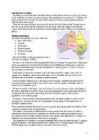
Australia has 6
states and 2 territories (New
South Wales, Victoria,
Tasmania,
Queensland ,
Western Australia , South Australia, The
Australian Capital Territory and the
Northern Territory).
The
Australian people are
culturally the
same as the Anglo – Americans.
There also
live aborigines. Aborigines are the ancestors of the
people.
Like
the US and
Canada , Australia was an
English speaking
colony of Great
Britain .
Today Australia is a modern
developed country with a
diversified
economy . Australia is an
island continent of 7.7 million
square kilometres, which
makes it a
little smaller
than the USA.
Located in south of
Asia ,
between The
Pacific and
Indian Oceans, Australia is
the World’s driest continent.
Although large
areas of the
centre are
desert , Australia has a
wide range of climate from
tropical in
the
north to temperate in the south –
east , where it frequently
snows in
winter .
Geographical
positionThe
coasts of Australia are
surrounded by the Pacific
Ocean , the Indian
Ocean and the Southern Ocean.
Four seas are surrounding Australia, which are the Timor Sea and Arafura
Sea in the north of Australia, the
Coral Sea in the north-east of
Australia and the
Tasman Sea,
near the island of Tasmania, in the
south-east of Australia.
Government The
full name of the
county is the Commonwealth of Australia. Its
territory is 7.7 million square kilometres and population is about
19.7 million.
The
state
symbols are the
coat of arms, flag anthem and aboriginal
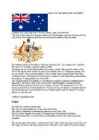
symbols. Australia’s flag has a
British Union flag. . It is blue
with the flag of the UK in the
upper left corner .
Five stars represent the Constallation Southern
Cross and a large
star is for the country’s states and territories.
The
coat of arms
features a kangaroo and an emu. The kangaroo and emu are
chosen for the coat of arms of Australia because they can only
move forward just like Australia.
The
national anthem of Australia is “Advance Australia Fair”. This
replaced the “God Save the
Queen ” as Australia’s national
anthem in 1984.
Aboriginal
art uses Earth
Colours (white, red, orange,
brown ).
These are the
colours of the desert. Aboriginal
artists made their paints from
natural materials. Aboriginal
paintings also use
lots of dots. They
used their fingers or sticks.
There weren’t any art shops where
they
could buy brushes. Aboriginal art includes lots of symbols for
the natural things
around them .
Australia
got its independence in 1st Jan 1901.
The
Commonwealth of Australia is a constitutional monarchy, in practise a
parliamentary
democracy . The head of state is the Queen of the United
Kingdom. Governor-General Michael Jeffery, performs her
functions in
Queen’s absence. The
parliament consists the Senate and the House
of the Reprentativer. The head of the government is the
prime minister. The Prime Minister is elected by the House of
Representatives and the Cabinet. The Prime Minister is John Howard.
Currency -
Australian
dollar .
Relief
Australia
has a variety of
landscapes .
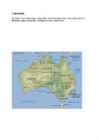
The
Great Australian Bight
lies in the south of Australia.
The
Gulf of Carpentaria is between the Arafura Sea and
Cape York .
The
Bass Strait separates the island of Tasmania from the mainland of
Australia.
The
Great Barrier Reef is in the north-east of Australia, between the
Coral Sea and the mainland.
The
western
part of Australia is covered with deserts. Most of the rocks
have turned into
sand .
The
biggest of them is the Great Sandy Desert, which lies in the north of
Western Australia.
The
Gibson Desert is in the
middle of Western Australia.
The
Victoria Desert is in the south of Western and South Australia.
The
Tanami Desert is in the
west of the Northern Territory.
The
Simpson Desert is in the south-east of the Northern Territory.
The
Great Dividing Range runs
along the
eastern coast of Australia.
The
highest mountains in Australia, the Australian Alps, run along the
southern coast of Australia, in Victoria. The highest point of
Australia is Mount Kosciusko (2,228m
above sea level).
The
Flinders Range starts from the southern coast and runs towards
inland.
The
biggest
single rock in the World Uluru is in the central Australia.
The
island of Tasmania is in the south-east of Australia. The capital of
Tasmania is Hobart.
The
seas and oceans that
wash the coasts of Australia are
warm . The Coral
Sea is the warmest that is why many corals live in the seas. The
skeletons of these
tiny organisms have formed a great
belt of coral-
called the Great Barrier Reef. Its is 2000 km long and 2-150 km wide.
There
are five distinguishable natural zones in Australia. In the very east
there are wet
forests that occupy the
space between the Great
Dividing Range and the eastern coast. The wet forests give
place to
beautiful grasslands with some
trees called the savannas. Farther
west the trees disappear and the bushlands begin. The
real desert
occupies the centre of the Western Plateau. In the very southwest
there are
thin forests of evergreen trees.
Most of
Australian trees are kinds of eucalyptus (or gum tree to Australians)
and
acacia (wattle of Australians). Eucalyptuses give the people
timber and eucalyptus oil.
Of 600
kinds of acacias the
golden wattle, the national flower of Australia,
is the
best known . Of
other trees there
grow bottle trees in the
savannas, tree ferns in the tropical forests and many
others .
Lakes Australia
has much
underground water. There are only few lakes which are full
of water only after it
rains . The biggest lake is Lake
Eyre which is
a
salt lake.
The natural lakes of the
interior of continental
Australia are salt lakes. Fed by streams and
rivers , they receive
water rarely. Lake Eyre, Torrens, Frome and Gairdner are the remains
of a vast inland sea which
once extended south from the Gulf of
Carpentaria.
RiversAustralia
has only few rivers. Many of them are full of water only after it
rains. There are many temporary rivers called creeks. The biggest
rivers are in the east. All the rivers in Australia are short.
Murray River is Australia’s principal river. The Murray River and its
tributaries run
approximately 3,370km in
length and form most of the
border between New South Wales and Victoria.
ClimateBecause
of its
size , Australia has many climates. The Tropic Capricorn cuts
across the northern part of Australia so about 40per
cent of the
country lies in tropics. In the south, the island state of Tasmania
lies in the cool roaring forties.
In the
north the climate is tropical. Monsoon winds bring moist air from the
northwest
during summer . This time of high rainfall, between December
and
March is known as “the wet”.
In the southern the climate
ranges from warm temperate to cool temperate. Winter
temperatures can
be low but rarely freezing in the southern states.
Australia
is a land of droughts and
floods . The droughts are caused by the EL Nino, a
weather pattern which happens when the Southern Pacific Ocean
heats up. This
causes the wind direction to
reserve . Instead of
bringing moist air towards eastern Australia, the rain bearing clouds
are blown
away .
An EL Nino occurs every four or five
years causing
droughts and bushfires. Droughts are often followed by floods.
Plant
LifeA long
time ago Australia was separated form other countries. This movement
caused the
difference of
species ,
plants and
animal form the other
countrys. The water controls the type of vegetation in a country.
The two
main
types of vegetation are the eucalyptus or gum trees and acacia
or wattles. The eucalypts are
found all over Australia. There are
more than 500
varieties of gum trees in Australia. Australia is the
home of some 600 species of acacia. These trees
develop smaller,
leathery leaves to
avoid loss of water.
Australia
has over 155 million hectares of
native forest, about 80 per cent of
which are eucalypt.
Animal
lifeAustralia
is a continent –
sized museum of
ancient animals . Anteater and
platypus are the two of the strangest animals in the world. They are
really reptile –
mammals . They have
hair like cats and
dogs , but
they lay shelled eggs like snakes and turtles. And they are found
only in Australia.
Another group of Australian mammals, the marsupials, are less like reptiles
than the anteater and the platypus, but they are not
highly developed
mammals either.
The
kangaroo and the
wombat are marsupials.
Their
young are born
before they are fully developed. The kangaroo is born
after being only seven weeks inside it’s
mother . It is completely
blind and only an
inch or an inch and a
half long. It crawls into its
mother’s
pouch and attaches itself to a nipple there. There it
stays for
almost three months, when it
begins to stick its head out.
It is six months old before it is big and
strong enough to leave the
pouch.
Some of
the marsupials in Australia
look very much like
higher animals. The
koala , which
looks like a live teddy
bear , is not really a bear at
all but a marsupial. Today Australian marsupials are dying out. Dogs,
cats, and rabbits
brought to Australia by men are rapidly destroying
the gentler marsupials. Some day there may be
nothing left of the
ancient animals.
Australia
has around 800 species of
birds , 400 of which are
unique to this
country. There are 55 species of parrots in Australia, and the birds
are as numerous as they are colourful.
Two
types of crocodile, the saltwater and the freshwater crocodile are
found in the north.
The
dingo, or native dog is not really an Australian native. It was
bought from Asia around 4000 years ago. The dingo is an effective
hunter . To save their sheep from dingo
attacks , farmers
built many
fences to
keep the dingo out.
These
fences didn’t
work so in 1946 the government built a single fence
which stretched 5400 km from Great Australian Bight in South
Australia to near the Queensland coast. The single fence worked
better.
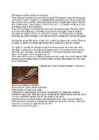
Lyrebirds are covered with brown feathers. They
live in forests and
woodland in Australia.
They eat
insects ,
spiders,
beetles and
worms .
Male lyrebirds can
copy many
sounds.
Lyrebird
gets its name because of the
tail of the male
bird . It is shaped like a
musical instrument called a lyre. There are
2 species of lyrebird, the superb lyrebird, about the size of a
rooster, and
Albert 's lyrebird, which is the smaller of the
species.
Lyrebirds have mostly brown feathers and although they
have
wings , they don't often fly. They move about in the forests,
running and jumping quickly on their short
legs . They have four claws
on each leg. At
night they
roost in trees.
Lyrebirds are a
protected species.
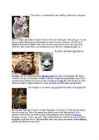
The koala is a small bear-like, tree-dwelling, herbivorous
marsupial which averages about 9kg in
weight . Its fur is thick and
usually grey . The koala gets its name from an ancient Aboriginal word
meaning "no
drink " because it receives over 90% of its
hydration from the Eucalyptus leaves (also known as gum leaves) it
eats, and only drinks when ill or
times when there is not enough
moisture in the leaves (during droughts etc.).
The Emu is the largest bird
native to Australia.
The
soft -feathered, brown, flightless
birds
reach up to 2 m in
height . The Emu is common over most of
mainland Australia, although it avoids heavily populated areas. Emus
can
travel great distances fast, if
necessary , can
sprint at 50 km/h
for some distance at a time. They eat a variety of plants and
insects. Emus are farmed for their
meat , oil
and
leather .
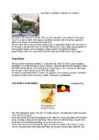
The Kangaroo is a common marsupial
from the
islands of Australia
and New
Guinea . There are 47 species of them. Kangaroos can hop up to
74 km per
hour and go over 9 m in one hop. These shy animals live
about 6 years in the
wild and up to 20 in
captivity . Most of them are
active at night. Many kangaroos are in
danger of
extinction .
Kangaroos eat
grass , leaves, and
roots . They
swallow their food
without chewing it and
later regurgitate a cud and
chew it. They need
little water; they can go for months without
drinking , and they dig
their own water wells.
The Dingo is Australia's wild dog. It is found in Australia, in all
states but Tasmania. They are found
throughout the mainland of
Australia,
close to a source of water. The Dingo is a
medium sized
dog, with a bushy tail, and red to
yellow coat. Dingos do not
bark ,
but they do howl.
They are meat eaters, and try to
feed mainly on
this. If unavailable, dingos have been known to eat reptiles, and any
food source it can
find . When food is scarce, dingos group together
to feed on larger animals
such as kangaroos. Dingos usually
stay and
hunt in family groups.Dingos mate once a
year , and the
female dingo
gives birth to up to
eight puppies.
PopulationThe
big country is far from crowded. It is about the size of the UK but
its some 16 million population is less than four time as big as
Chicago ’s. There are about 50 000 aborigines. More than half
of all the people od Australia live in its eight biggest cities.
Sydney and Melbourne are two largest. Each one has about 3 000 000
people.
Australia is multicultural
diverse society. The
languages most
commonly spoken in Australia are
English , Italian,
Greek ,
Cantonese, Arabic, Vietnamese and
Mandarin .
The
native Australians
Aboriginal
flag
The word "aboriginal" means "the
first "
or "earliest known". Australia may well be the home of the
worlds first people.
More than 30,000 years ago the population of
the world was small, and people lived in family groups,
hunting ,
fishing and food gathering. There where no cultivated crops, animals
were not herded for food and metalworking was yet to be
discovered .
At that
time, known as the last great Ice Age, Australia was joined to New
Guinea. Islands such as Java and Borneo were larger than today, sea
passages between them narrower. This made it possible for the
ancestors of the people now called Australian Aboriginals to reach
Australia from lands to the north.
It is
not known from where the Aboriginals began their
journey , but it is
certain that people with some kind of water craft crossed the 100 -
160 kilometres stretches of water between the islands to the north;
and reach the southern continent. This sea
voyage is the earliest
evidence of sea travel by prehistoric man.
As the
ice flows of the Ice Age began to melt, the sea level
rose , isolating
Australia, and
making the sea passages too wide for
crossing by the
simple forms of watercraft
available at the time. About 10,000 years
ago, Tasmania
became separated from the main land, isolating the
people there, and about 5,000 years ago the Australian continent
took on the
shape of that it has today.
The
biggest citiesIn each
of Australia’s six states, there is a large city which is near a
river and the sea. Sixty per cent of Australians live in those cities
or near them.
New
South Wales is the oldest state in Australia. Sydney is its capital,
which is known for it’s
rich cosmopolitan lifestyle, fine
restaurants, cool
shopping , as well as the world
famous harbour.
Sydney
is the oldest and biggest city. It’s population is 3.7 million
people. It’s a
busy modern city and its high-
rise buildings are the
centre for much of Australian business. Sydney is also an
international city.
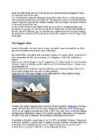
Sydney
Opera House (SOH) was opened in 1973 for music, theatre and
dance .
The
roof of this beautiful
building looks like sails on Sydney
Harbour.
Sydney
has one of the
longest bridges in the world called the Sydney Harbour
Bridge .
Victoria
is the smallest mainland state in area but the most populated.
Melbourne is
Victoria's capital, with more than 70% of all Victorians
living there. Melbourne is the second biggest city. It was the capital of
Australia from 1901 to 1927. It has wide streets, lovely old
buildings and large parks. Melbourne is famous for its
theatres and
pubs. Melbourne is very
important for
sports . Each year in September
the Australian
football finals are
held there.
Queensland is
Australia’s second largest state. It is 25% of Australia’s
landmass. Queensland is known as Australia’s sunshine state. Its
capital is Brisbane. Brisbane is the third largest city in Australia,
with a population of just under 2 million. Brisbane has many stilt
houses - wooden houses on
tall posts which let cool ain
underneath the
house.
The
Australian Capital Territory was
established in 1911 to create a
capital for the newly federated country. Canberra is it’s capital,
also Australia’s capital. Canberra is known for its
stylish restaurants,
bars and a
calendar of
events . It is the newest city and
is 120 km from sea.
Tasmania
is a land apart- a place of wild mountains and beautiful landscapes,
friendly welcoming people, temperate climate, quality wines and food,
a spirited history. It is all
wrapped up in a relaxed lifestyle. The
capital of Tasmania is Hobart. A smaller and quieter city. It is
Australia's second oldest and twelfth largest city.
South
Australia has a wonderful outback, tasty wines etc. At kangaroo
Island you can see sea lions, kangaroos, koalas etc.
Adelaide is the
capital
city of South
Australia, and is the fifth largest city in Australia, with a
population of over 1.1 million. It is a
coastal city beside the
Southern Ocean.
Adelaide is known for its many festivals
as well as for its
wine , arts and sports. Adelaide arranges
festival of music, theatre and
film every two years.
Western
Australia has
dolphins and
whale sharks- the worlds largest
fish ,
that you can
swim with.
Perth is the capital
of Western
Australia. A population of 1,477,800 makes Perth the largest city
in Western Australia. One third of the
families in Perth own a
boat .
The
Northern Territory is blessed with a variety of natural landscapes.
Flora and
fauna are diverse.
EconomyThey
have got beef productions,
dairy industries, fisheries, forestry and
wine industry.
They
have got a lot of grazing lands, where they keep sheep, cows, pigs
etc. They have beef productions. They
export about 65% of it, so
they keep less than half to themselves.
Then
they also have got dairy industries, which are mostly in Victoria.
They export butter, cheese,
milk etc.
Because
of the
fact that people love seafood, they also have got fisheries.
They export it mostly to Asia and America.
Forestry
includes a lot of things. For example they grow grain, oilseeds,
wheat, barley and rye.
They
also have world
class wine industries. They make great wines.
SportsSport plays an important part in Australian culture,
assisted by a climate
that favours
outdoor activities . At an international level, Australia
has
particularly strong
teams in cricket,
hockey ,
netball, rugby
league, rugby
union, and performs well in
cycling ,
rowing and
swimming .
Nationally, other popular sports
include Australian
rules football, horse
racing ,
soccer and
motor racing.
Australia has participated in every summer Olympic
Games and every Commonwealth
Games. Australia has hosted the 1956
and 2000
Summer
Olympics .
CultureThe
modern culture of Australia draws from many
sources including indigenous Australians, United Kingdom and the
immigration of a
diverse range of people with the Australian
gold rushes of the 1850s
and past.
Australian
art is one of the oldest in the world. Tribes people were painting on
cave walls and cutting pictures into rocks 20 000 years ago.
When Europeans first
came to Australia, it was along time before they
started to
paint , write, act or make music. They were too busy
building roads and cities, and above all they had a
whole new country
to discover. And they all came from Britain. After the First World
War new
ideas began
coming from Australia. Britain began to seem less
like home. More people began to
listen American pop
songs and
radio shows . They watched American
films but some people believed that
European art, music and
literature were the
best . Australian Art
didn’t seem to be so important at all.
All
that has changed now. Australia has
grown up. Sydney is one of the
artistic capitals of the world. World famous Australian
actors and
artists don’t have to travel to
Europe or America
anymore - people
come to Australia to see them.
Cinemas
now also show Australian films.
HistoryAustralia
may well be the home of the worlds first people.
Stone tools were
discovered in New South Wales, in
1971 . It shows that
humans lived in
Australia at
least twelve thousand years before they
appeared in
Europe.
The
first Europeans to
arrive in Australia were the
Dutch who tried to
reach the East Indies, but landed on the western coast in
1611 . They
thought Australia was an
arid land inhabited by fierce savages. In
1770
captain James
Cook discovered the eastern coast and had a
better
outlook . He
explored the coast and
named it the Botany Bay
because he found many unknown plants there.
In 1788
about 700 British convicts and 200 marines arrived at Botany Bay and
on the
plain around Sydney the first settlement was
founded . The
British were very interested in the colonization of Australia because
the loss of American
colonies .In 1814 the continent became known as
Australia- the land of the south.
By
1852 more than 150,000 convicts had been sent to Australia. About 20%
were
women and 30% were
Irish . Convicts were mostly
poor people who
could not read or write, many of the women had been prostitutes. Only
few convicts were from the wealthier classes. It was
hard to build a
new society leaning on such a difficult group. Until 1830 the
convicts were harshly punished. The real start to Australia’s
development was the
discovery of gold in Bayhurst in 1851, which
attracted people like a magnet. Many of the gold founders settled in
Australia. Between 1829 and
1859 four of the six colonies became the
states of Australia. The
idea of unifying all the states first came
to Earl Grey, as
early as in 1847 The Commonwealth of Australia was
approved by the British Parliament and became a reality on
January 1,
1901. Now the states became States of the Commonwealth. As neither
Sydney nor Melbourne was acceptable as the capital, a new capital
Canberra was founded in 1911.
Conclusion Australia
is a very
interesting country with a very interesting history. It has
a big variety of landscapes, plants and animals. Australia has
done a
hude evolve.
Materials
Spotlight
on Australia
Understanding Australia
English
Step 7
www.australia.com
www.enchanted-learning.com
www.bbc.com
www.google.com
 50 punkti
Autor soovib selle materjali allalaadimise eest saada 50 punkti.
50 punkti
Autor soovib selle materjali allalaadimise eest saada 50 punkti.
 ~ 13 lehte
Lehekülgede arv dokumendis
~ 13 lehte
Lehekülgede arv dokumendis
 2010-02-15
Kuupäev, millal dokument üles laeti
2010-02-15
Kuupäev, millal dokument üles laeti
 23 laadimist
Kokku alla laetud
23 laadimist
Kokku alla laetud
 1 arvamus
Teiste kasutajate poolt lisatud kommentaarid
1 arvamus
Teiste kasutajate poolt lisatud kommentaarid
 trikinipi
Õppematerjali autor
trikinipi
Õppematerjali autor
 annaabi.ee






Kõik kommentaarid