BRITISH NATIONAL
SYMBOLS Research
work
CONTENTS
CONTENTS 2
INTRODUCTION 3
1. BRITISH NATIONAL SYMBOLS 5
1.1 Great
Britain and British story 5
1.2 National Symbols and
Nation Building 5
1.3 The Use of Flags throughout History 6
1.4 The
Early Modern Flags. United Kindom: Union Jack 8
1.5 National Flags as
Political Instruments 12
2. RESEARCH 16
2.1 The questionnaire 1 16
2.2
Analysis of the questionnaire 1 18
2.3
Results of the questionnaire 1 23
During the
first questionnaire 30
students of the 9th and
10th class of
Gymnasium were questioned about the British national symbols. 23
Surprisingly, according to the results, more
than 50
percent of students are
aware of the national flags of Great Britain,
Scotland ,
Northern Ireland and
Wales . As can be
seen ,
quite a lot of
children also
know the name of the Great Britain flag.
However ,
almost all of the students have no
idea about
other names of the British flags, as well as about the patron saints. In
addition , almost 90 percent of students are also unaware about the national holidays. 23
All things
considered , we see that
there is a need for students to pay more
attention to Scotland, Northern Ireland and Wales and to learn more information concerning those parts of the United Kigdom. 23
2.4 The questionnaire 2 23
2.5 Analysis of the questionnaire 2 24
2.6 Results of the questionnaire 2 32
CONCLUSION 34
BIBLIOGRAPHY 36
INTRODUCTION
Language is an
important and
prominent part of culture, so to learn
the language well, it is
necessary to
understand cultural backgrounds
of the language. The level of our
learning cannot be judged just from
the mastery of the
vocabulary and
grammar , it should also be judged
from the point of view of
country studies knowledge .
This
paper will try to explore the British National Symbols which is
one of the
themes in the school curriculum.
The
importance and
choice of my research paper is explained by the
following reasons:
- Firstly, there are a lot of different kinds of symbols in our everyday life;
- however, the area of my special interest is British National Symbols, to be more exact British national flags;
The aim of this research paper is to:
- explore the British National Symbols;
- compare the knowledge of country studies symbols by gymnasium students of basic and high school.
The main tasks of the research is to:
- explore the symbols;
- explore meaning of symbols;
- explore origin of symbols;
- explore usage of symbols.
The methods of the research are:
The
object of the paper is British country studies. The
subject is
British Symbols.
My written part consists of two
parts: theoretical which focuses on national symbols, their history,
flags as political instruments and British national symbols, namely –
flags. The second part is a
practical part: a survey, analysis of the
survey and the results of the survey.
1. BRITISH NATIONAL SYMBOLS
1.1 Great Britain and British story
Great Britain
is an
island in
the
North Atlantic off
the north-
west coast of continental
Europe . With an area of 229,848 km2,
it is the largest
island of
the British
Isles, the largest
island in Europe and
the ninth-largest
in the world. It is surrounded by over 1,000 smaller islands. The
island is part of the United
Kingdom of Great Britain and Northern Ireland, constituting most of
its territory: most
of
England ,
Scotland, and Wales are
on the island, with their respective capital
cities, London,
Edinburgh ,
and
Cardiff .
(wikipedia, 2015)
The Kingdom
of Great Britain resulted
from the Union of Scotland and England in
1707. More than a
hundred years before , in 1603,
King James VI, King
of Scots, had inherited the throne of England, but it was not
until 1707 that the Parliaments of the two countries agreed to form a
single kingdom. Subsequently, in 1801, Great Britain united with
the neighboring Kingdom
of Ireland, forming the United
Kingdom of Great Britain and Ireland. When
five -sixths
of Ireland seceded
from the United Kingdom in 1922, the state was renamed the United
Kingdom of Great Britain and Northern Ireland.
1.2 National Symbols and
Nation Building
The
nation is visible
through its symbols (flags, anthems, emblems),
ceremonies (national
days , sporting
events ), monuments (memorials,
buildings, national
museums ), the
land itself (
landscape ), its
borders (insiders and outsiders) and the capital city. This
assumption is illustrated by the
fact that all nations, in
order to
be accepted internationally, must have a certain number of
characteristics . The nation is usually
known by six
essential elements : a name, a capital city, clearly defined borders, a national
flag, a national anthem and a national day.
(
Scott , 2000)
Every
nation
needs a main
sign to
represent it. The national flag is for
this
reason not only a
piece of cloth fluttering in the wind, it is a
sign of self-expression, and a
claim of sovereignty or the
wish to
attain sovereignty. Flags, generally overlooked in the nation
formation process , are also essential symbols to rally
around .
National
anthems, much like flags, symbolise the nation and its collective
self-
celebration and unisonance. National days are occasions when
national symbols are activated. They are the repeated annual
occasions when the nation remembers its
founding myth or celebrates
its symbolic birthday.
1.3 The Use of Flags throughout History
There
are `old', `modern' and `new' national symbols (flags) because
nations vary in `age', in
terms of continuity and independence.
The
Romans , as far as we
know , used two kinds of
fabric flags, one with
the
image of the
goddess of victory painted on it, and the other the
flammula, consisting of red streamers attached to the spear, marking
the presence of a general.
Another fabric flag used by the
Christian Roman emperors was a `
sacred '
standard called labarum,
employed as early as 400 AD by the Roman
Emperor Constantine. The labarum was a Christian version of the Roman
vexillum. It marked an evolution from the
latter as it displayed a
portrait of the Emperor and his family or other
government officials,
and atop the
staff , the
monogram of Christ.
The
legend about its origin, as told by the 4th
century historian
Eusebius in Life of Constantine, has it that the emperor before the
victory over Maxentius in 312 had seen a sign of the
cross in the sky
with the
words In hoc signo vinces.
Again we have to
note that,
although similar in some
functions to modern flags,
none of
these devices was flown from flagpoles - they were all
portable deities.
In
consequence flags in their modern
sense were
still to be invented.
Nevertheless, flags are
related to the
units they represent, as signs
of identification, whether flown in ancient or modern
times .
Banners
and Flags in the
Middle Ages The
Koran 's injunction against
representational art encouraged the
development of flags in the
Arab World. These relied heavily on abstract
patterns and calligraphic
inscriptions - often
religious texts - in embroidery, applique or
painting.
Even before the
rise of
Islam , promulgated by Mohammed in
Arabia , flags of
black and white were used in the early part of the
7th century. From what we know
today , Mohammed (570-632) used one
black and one white flag connected with him. The Arab World
developed the
tradition of using
specific colors and inscriptions for different
dynasties and leaders. As dynasties followed one another, contrasting
colors were used, in order to differentiate the ruling dynasty from
its predecessors. (Smith, 1975)
An
interesting difference can be noted with regard to the use of colors
by the
Chinese and
later by the Arabs; whereas the Chinese identified
every color with a philosophical or religious concept, the Arabs
associated specific colors with dynasties and
individual leaders.
Another interpretation of the Arab
colours , from the last century,
and
based on the words of the
poet Safi al-Din al-H'ily In the West,
flags were introduced during the
Crusades , and derived from the
struggles between
Christians and
Muslims .
In
the Christian world the
practice of bestowing banners previously
blessed by the Pope
became a tradition of high significance at this
time and followed the ceremonial
forms set by pre-Christian Rome.
These banners were generally called `pallia' and like the previously
mentioned cloak of Mohammed, they were originally garments.
It
is interesting to note that pallia were dedicated to St. Augustine
(354-430), Charlemagne (742-814), and William the Conqueror
(1028-1087). The cloak of St. Martin was another garment that was
turned into a flag, which later became a
cult object of Frankish
kings and even
influenced the choice of
blue as part of the modern
French tricolour.
Meanwhile
the
power that
finally led to the
creation of the
Mongol Empire arose in Asia. Many of the Mongol standards displayed a device, a `flaming
trident', reproducing the blades of a trident with flames surrounding
them .
The
flag of the
Khan himself consisted of nine yak-
tails hanging from a
rack of crossbars. After the conquest of China
lateral flags were
used, still with the horsetail and the flaming trident. The use of
flags by the forces of Genghis Khan (ca 1155-1227) was significant
for the development of a world-
wide flag tradition in that a special
flag, actually called `
banner ',
came to be connected with each
regiment. It reads: "White are our deeds, black our fields of
battle ; our pastures are
green , but our swords are red with the
blood of the enemy ". A banner refers to a cloth stretched between two
anchor points bearing a slogan or a flag with heraldic arms, or a
flag carried by a
military unit. (
Brown , 1994)
It
is thus evident from the first cloth flags in the Arab, Asian and
Christian worlds that the practise of flagging one's community,
beliefs and
purposes has been in use for a very long time, regardless
of
material substance.
Vexillology
has also been looked
upon as a
branch of heraldry and many national
flags, their colours and designs, have been influenced by preceding
coats of arms which were originally used to identify
soldiers on the
battlefield.
The
first badge used during the Crusades was the Cross, which
could be
worn as a garment on the
chest or
back of the warrior. The
imperial war flag of the Holy Roman Empire (from 800 onwards) displayed a
white cross on red, symbolising the holy cause in which the battle
was fought.
As
early as 1188 different colours were in use for crusaders from
different regions, a distinction illuminating that it is obviously
impossible to
provide a precise
date of the first cloth flags since
fabric flags have not been preserved from the Middle Ages.
A
`badge' is a distinctive
emblem added to a flag or used on its own.
It was also decided in 1188, that King Philip Augustus of
France was
to have his own colours displayed on his cross flag (red cross on
white), as were King
Henry II of England (white cross on red) and
Count Philip of Flanders (green cross on white).
These
colours were later reversed and,
while the reason for this remains
unclear, England embarked on what today is considered a
continuous tradition of a red cross on white from 1277, whereas France displayed
a white cross, first on a red, then on a blue flag.
From
this practice and time emerged the
famous and significant cross
flags,
such as St. George's Cross (red cross on white), the Cross of
St. Denis (a white cross on red) and the cross flag of the Teutonic
Knights (black cross on white).
The
Crusader flag displaying a white cross on red, was originally used by
Christians against the European `pagans', and later became the flag
employed by the Holy Roman Empire in battle.
The
influence of heraldry on modern flags has been substantial, and the
effectiveness of the symbolism has been reproduced due to the
simplicity, distinctiveness and originality of heraldic colours and
designs. The first cross flags indicated primarily that the military
operations of the crusaders were sanctioned by the Pope. However, it
is
clear that these flags gained territorial associations as time
went by.
1.4 The Early Modern Flags. United Kindom:
Union Jack
As
regards the modern national flags, the oldest national flag - the
Danish Dannebrogen - from which all the other Scandinavian Cross
flags have originated, can claim a direct
link to the Crusader Cross.
St. George's Cross of England, as one part of the
modem Union Jack
reflecting the political development of the United Kingdom.
The
Cross of St George, originally seen as a less important flag, became
as a
result the flag to symbolise England, and the
English trading
companies started to use St. George as a
basis for their own flags
and in order to identify themselves at sea.
The
Cross of St. George, earlier accounted for, has been traced back to
1348 , when Edward III made St. George the patron saint of the Order
of the
Garter . Later, after the Battle of Agincourt in 1415, Henry V
ordered all soldiers siding with the English to wear a
band with the
colours of St. George.
Although
St. George's Cross is the founding component of the Union Jack and as
such constitutes an old flag, the
final version of the Union Jack
emerged only in 1801 after the formation of the United Kingdom in
1800.
Earlier
designs of the flag existed: a union flag was initiated as early as
1606 after the personal union of the crowns of Scotland and England,
although the independent national cross-flags of England and Scotland
were still in use on land and were legally formalised in
1707.(reigning 1572-84).
The
end of the 18'h century marks the
official beginning of the
`national' flag. This was a gradual process where official
recognition came after the flag and its colours had gained some sort
of symbolic
value .
It
is of course impossible in all
cases to establish whether flags had
symbolic value for the elites only or whether the people associated
themselves with the first flags that were adopted. As we have seen
many countries had more than one flag denoting `belonging' before
modern times.
Varieties of flags
referred to vague notions of
`
nationality ' and were in their various designs used at sea by
warships, unarmed vessels and privately owned
craft be recognised in
a
context where flags emerged as political symbols in modern times.
And flag law was adopted in 1906.
England:
St. George's Cross (white with red cross)
dates from 1348. when
Edward III made St. George the patron saint of the Order of the 1348
Cross Flag Garter.
Scotland:
References to the Saltire (diagonal) cross of St.
Andrew (blue with
white diagonal cross)
N.
Ireland: The Cross of St.
Patrick (white with red diagonal cross)
Wales:
(Red
dragon on white-over-green) The colours are the livery colours
of the
Tudor dynasty in the I5 `h c. The 'Dragon' is also (Wales)
claimed to go back to the 15`h c. and has been the official badge for
® Wales since 1801.
The
Welsh flag is not represented in the Union Jack, and was not
recognised until the 1950s. The Welsh Dragon constitutes a 'Heraldic
Flag'.
Britain:
'Union Jack' is a combination of the three cross flags
above .
1606-Cross Flag England and Scotland in personal union combined their
cross flags (1707) at sea (1606): (2) the Act of Union of England and
Scotland established (1801) Whereas, internationally, the `Union
Jack' represents Britain, the individual flags of England, Wales and
Scotland, are flown nationally
within those territories.
The
cross-flags combined in the `Union Jack' are considered in this
presentation
including St. Patrick's Cross of Northern Ireland.
Although comprising
several nations, Britain can in terms of its
symbolic and ceremonial expression be considered to possess a
national `quality'.
The
`Union Jack' is
both a union-flag and a cross-flag, being a composite
of the Cross of St. George of England (the red cross on a white
background), the Cross of St. Andrew of Scotland (the white diagonal
cross on blue background) and the Cross of St. Patrick of Northern
Ireland (red diagonal cross on white background).
The
Welsh Dragon (red dragon on a white-over-green
field ), on the other
hand, is not represented in the British flag. Although the white and
green colours in the Welsh flag have old
roots as the livery colours
of the Tudors, the flag was officially recognised only in the 1950s,
which is one reason for its exclusion on the Union Jack.
St.
George's Cross, as an emblem, can be traced back to the 14 th
century, when in 1348 Edward III made St. George the patron saint of
the Order of the Garter. Later, after the Battle of Agincourt in
1415, Henry V ordered all soldiers siding with the English in
military
action to wear a band of St. George.
The
earliest
reference to the
distinct Saltire (diagonal) Cross of St.
Andrew is claimed to date from the 8th century, while its
colours evolved
four centuries later, in the 12th century.
Regarding
the Cross of St. Patrick (Northern Ireland), it has been suggested
that the red saltire originated from the arms of the Geraldines, one
of the
influential Anglo-
Irish families
sent to Ireland to represent
Henry II of England.
The
Cross, which
appeared in the
16th century, had a prominent
place in
their arms. The creation of the `Union Jack' was initiated during
what can be considered a new era of British national flags, after the
succession of the
Stuart dynasty to the throne and during the
growth of British
naval power.
The
first reference to the Union flag dates from a proclamation of 12
April 1606 declaring the personal union of the symbolism and
ceremonies.
The
Cross of St. Patrick, as part of the crowns of Scotland and England,
when King James VI of Scotland (1567-1625) ascended the English
throne, thereby becoming James I of Great Britain (1603-25).
(Smith, 1975)
The
design of the first union flag was
formed by superimposing the Red
Cross of England on top of the White Saltire of Scotland. However,
the flags of England and Scotland continued to be flown separately on
land.
The
use of the first union flag (uniting the crosses of England and
Scotland) remained restricted, being
allowed only at sea from 1634
onwards on ships in the
Royal Navy.
For
a
period of two hundred years, a great variety of ensigns, jacks and
pennants were devised, and all were essentially variations of the
Union Jack displaying the recognised British colours.
In
the period known as the Protectorate (1649-60) the well-known
golden Irish
harp was also displayed in one
variation of the union flag.
It
was, however, removed with the restoration of Charles II in 1660. In
the Act of Union (1707), by which England and Scotland joined
together as the United Kingdom, the two combined crosses were
officially recognised in order to reflect the preceding political
events.
After
the union with Ireland in 1800 the final design of the Union Jack,
where the Cross of St. Patrick was
counter -charged (counterbalanced)
with the
Scottish Saltire, was adopted on 1 January 1801.
To
preserve the
former cross flags and to
manage the incorporation of
St. Patrick's Cross (red diagonal cross on white), the heraldic
advisers to the King suggested that St Andrew's Cross should be
divided diagonally and red appear below and above the white (on the
hoist half of the fly and above on its fly half).
In
accordance with heraldic law the red cross may not border the blue
background, so a white narrow border, or fimbrication, was added in
between. This also
held for the
centre where a white border separated
the crosses of St. Patrick and St. George.
The
Union Jack has remained unchanged ever since. By an Order in Council
of 9
July 1864 the
present official system of flags was confirmed.
The name `Union Jack' also became the official name for the flag in
the
late 19th century.
Other
flags of Britain
include the
Civil or Red Ensign (red with the Union
Jack in the first quarter) used at sea, the Government or the Blue
Ensign (blue with the Union Jack in the first quarter) reserved for
government vessels, and the Naval or White Ensign (the cross of St.
George with the Union Jack in the canton) used by the Royal Navy.
The
Royal Standard displaying two quarters of three golden lions on red
and two quarters, one with the Irish golden harp on blue and the
other with the Scottish rampant red
lion on yellow, ought to be
mentioned as the design is the
same as that of the national arms.
The
Royal Standard is the flag of the head of state and the banner refers
to the
monarch 's arms of dominion (excluding Wales). Its present form
has been dated back to the accession of Victoria as
Queen of the
Kingdom of Great Britain and Ireland, on June 20,
1837 .
(Stilling, 1995)
No
other flags in British flag history have ever rivalled the Union
Jack. The flag began as a distinguishing flag of a
ship , as an
auxiliary of the principal flag, and evolved into the main flag of
Britain and its empire.
Today
the Union Jack is flown for government and military purposes and, at
sea, as the flag of the Royal Navy. It is also used by the public.
Traditionally the Union Jack has also been
incorporated into 8 other
flags, as authorised in civil, governmental, military, naval or royal
contexts.
The
Union Jack is, for example, displayed in the canton of the British
Blue Ensign and the British Red Ensign. It also constitutes part of
the flags of the
Commonwealth nations such as
Australia (and its
states New
South Wales,
Queensland , South Australia, Tasmania,
Victoria, and
Western Australia), New
Zealand and
Tuvalu ; and, in
addition, of the U. S. State of Hawaii and the three Canadian states
of British
Columbia , Manitoba, and
Ontario .
1.5 National Flags as Political Instruments
National
flags constitute a
powerful instrument for
communication and
participation. This is one reason why flags are not merely colourful
ornaments. Instead, identification and representation are the key
functions of the earliest kinds of symbolism.
Symbolic
devices have been employed to identify groups and territories
throughout history, while, at the same time, they have been used
symbolically to differentiate communities from one another: the
relationship between `us' and `
others ' isintimately
linked to
communal forms of symbolism. The
original use of the
medieval cross
flags by England was to symbolise a holy
mission (Christianity)
against `others' (non-Christians).
Nations
cannot be dated in a precise
manner . However, national symbols, such
as national flags, provide us with an indication when these
communities started to assert hemselves.
From
such a perspective it is useful to be able to
account for, and
interpret, the period when flags appear related to historical events
and circumstances around this time. This has
something to tell us
about the
complexity of the nationbuilding processes and the symbolic
continuity, which may or may not
exist with regard to the national
community of today.
Symbolic
discontinuity may
therefore be interpreted as a sign of a period of
political instability which has interfered, in one way or another,
with the process of nation-building. Thus, some nations may then have
been represented by symbolism of early unions or connected to them as
part of empires, but they may have developed wholly independent
symbolic regimes of their own.
The
`old' cross flags of England, Scotland and Northern Ireland were
simply combined with the emergence of the political union.
The
National Flag, the National Anthem and the National Emblem are the
three symbols through which an independent country proclaims its
identity and sovereignty, and as such they command instantaneous
respect and loyalty. In themselves they reflect the
entire background,
thought and culture of a nation.
(Tilly, 1994)
The
question is: how is it possible that `a piece of cloth' has had such
a significant impact on the most important political and cultural
institution in modern times - that is, the nation? The flag has
proved to have such powerful symbolic value that people have been
willing to sacrifice their
lives for it.
The
soldier who
dies for his flag, dies for his country; but as a
matter of fact, in his own
consciousness , it is the flag that has the first
place. Whether one isolated standard remains in the
hands of the
enemy or not does not determine the
fate of the country, yet the
soldier allows himself to be
killed to regain it. He loses
sight of
the fact that the flag is only a sign, and that it has no value in
itself, but only brings to mind the
reality that it represents; it is
treated as if it were the reality itself.
A
related and new practice, in which the notions of nationhood and
citizenship are sanctified, is the `Citizenship Ceremony' in Britain.
Under the Nationality, Immigration and
Asylum Act 2002, all new
British Citizens are
required to attend. The central elements of this
ceremony are the
Pledge of Loyalty to the United Kingdom' and the
`Oath of Allegiance'. The latter reads as follows:
I
(name) swear by Almighty God that on becoming a British citizen, I
will be faithful and
bear true allegiance to Her Majesty Queen
Elizabeth the Second, her Heirs and Successors, according to law.
These
ceremonial statements are
given in front of the Union Jack and the
participants stand whilst singing the National Anthem, which closes
the ceremony. The powerful symbolism
invested in the practice of
flying flags at half-mast is demonstrated by the
offence caused when
this practice is not respected.
In
Britain, when
Diana , Princess of Wales, died, the flags on all public
buildings were at half mast except for the Union Jack flying atop
Buckingham Palace where tradition stipulated that the flag should fly
at
full mast to mark the fact that Queen was in
residence . The
associations of the flag flying at full-mast as a sign of disrespect
for the dead caused public outrage.
As a
result, tradition had to give way to public pressure, and the flag
was finally lowered at the Palace under
intense media coverage. The
process did not stop there; to mark the first anniversary of Diana's
death (31 August 1998), the Queen ruled that all flags at the royal
residences should be lowered and half-masted as a special mark of
respect. The British government declared immediately that they would
follow
suit .
The
national flag can be an `
active ' symbol on national days, coronations
and royal weddings, and in parades, parliamentary debates, salutes,
ceremonials, rituals, memorials and subtly in everyday procedures in
the
legislature . A specific example is the saluting of the flag, or
standing up when singing the national anthem.
The
state not only controls which national flag is to be used but its
usage of national flags as they appear on a number of
places controlled by the state: embassies, vessels of war,
airlines ,
national museums, national monuments, capital city squares and
stationery . There is also a specific
protocol involved in the use of
national flags at the
headquarters of the United Nations and the
European Union.
The
state, too, specifies the days when the flag is to be flown in the
practices of `official flag days'.
The
flag as a symbol of dissent can be used as protest against authority,
against a single action or as an ideological condemnation, but in
such cases "the national symbol is manipulated in order to
assert moral value over existing power value.
The
public destruction of national flags is a form of desecration and
represents deliberate
acts of disrespect. An early example of flags
being used in this way include the Jacobite struggle against the
English Hanoverian kings, who after the battle of Culloden (
1746 ) put
a stop to the
Highland resistance.
The
treatment of the
rebel standards captured provide us with interesting
information about the associations involved: they [the rebel
standards] were carried by the
chief hangman of Edinburgh and by
chimneysweeps, with an escort, and
laid in the
dust , while a
proclamation was read explaining why they were to be burnt by the
public hangman.
Each
standard was then laid over the flames, while the
senior herald
named the Scottish clan that had marched behind it to battle. This was
deliberate disrespect, with symbolic
modes of contempt: training in
the dust; handling by executioners and men associated with black
soot; Historically, it is possible to observe how the national flag,
as in Britain, has continuously moved from the sacred to the mundane
sphere. Before 1939, it was hardly ever displayed by individuals, as
it was associated with an official and/or royal context.
In
contemporary Britain it is also used as decoration, for example on
clothing. There are three main
types of flags: Cross Flags (type 1),
Tricolours (type 2), and Heraldic Flags displaying mainly heraldic
devices (type 3). The symbolic origin for the `old' cross flags was
religious. Cross Flags (Type 1)
The
oldest flags of Europe are those which
display the Christian Cross.
Many of them have their origin during the Crusades and the military
campaigns undertaken in the name of Christianity. Others have been
selected later in order to symbolise the
role of Christianity in the
formation of the modern nation. Another old flag, in terms of its
parts, is the Union Jack, a combination of the old crosses of St
George, St Andrew and St. Patrick. (Tilly, 1994)
2. RESEARCH
2.1 The questionnaire 1
The following survey was conducted.
30 students of the ninth and
tenth grades participated in it.
Students had to
answer 14
questions .
The questionnaire:1. What form do you study?
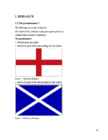
2. Identify this part of the national flag of Great Britain.
Picture 1. The flag of
England3. Identify this part of the national flag of Great Britain.
Picture 2. The flag of
Scotland4. Identify this part of the national flag of Great Britain.
Picture 3. The flag of
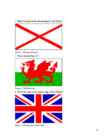
Ireland5.
Whose national flag is it?
Picture
4. The Welsh flag6. What is the name of the national flag of Great Britain?
Picture 5. The flag of the
Union Jack7. Whose patron Saint is St. Patrick? What is the name of their flag?
8. Whose patron Saint is St. George? What is the name of their flag?
9. Whose patron Saint is St. Andrew? What is the name of their flag?
10. Whose patron saint is St. David? What is the name of their flag?
11. What national
holiday is celebrated on 17
March ?
12. What national holiday is celebrated on 23 April?
13. What national holiday is celebrated on 30 November?
14. What national holiday is celebrated on 1 March?
2.2 Analysis of the questionnaire 1
1. What form do you study?Picture 6. What
form do you study?9 class
16
53.3%
10 class
16
53.3%
2. Identify this part of the national flag of Great Britain.Picture 7. Identify this
part of the national flag of Great Britain.National flag of England
21
70%
National flag of Scotland
4
13.3%
National flag of Northern Ireland
3
10%
National flag of Wales
2
6.7%
3. Identify this part of the national flag of Great Britain.Picture
8. Identify
this part of the national flag of Great Britain.National flag of England
1
3.3%
National flag of Scotland
20
66.7%
National flag of Northern Ireland
3
10%
National flag of Wales
6
20%
4. Identify this part of the national flag of Great
Britain.Picture
9. Identify
this part of the national flag of Great Britain.National flag of England
1
3.4%
National flag of Scotland
9
31%
National flag of Northern Ireland
20
69%
National flag of Wales
3
10.3%
5. Whose national flag is it?Picture 10. Whose national
flag is it?National flag of England
2
6.7%
National flag of Scotland
3
10%
National flag of Northern Ireland
8
26.7%
National flag of Wales
17
56.7%
6. What is the name of the national flag of Great Britain?Picture 11. What is the
name of the national flag of Great Britain?Union John
4
13.3%
Union Joy
2
6.7%
Union Jack
25
83.3%
Union Jeffery
3
10%
7. Whose patron Saint is St. Patrick? What is the name of their
flag?Picture 12. Whose patron
Saint is St. Patrick? What is the name of their flag?Don't know
29
100%
Другое
1
3.4%
8. Whose patron Saint is St. George? What is the name of
their flag?Picture 13. Whose patron
Saint is St. George? What is the name of their flag?Don't know
29
100%
Другое
1
3.4%
9. Whose patron Saint is St. Andrew? What is the name of their
flag?Picture 14. Whose patron
Saint is St. Andrew? What is the name of their flag?Don't know
29
100%
Другое
1
3.4%
10. Whose patron saint is St. David? What is the name of their
flag?
Don't know
29
100%
Другое
1
3.4%
11. What national holiday is celebrated on 17 March?
Picture 15. What national
holiday is celebrated on 17 March?Don't know
26
89.7%
Другое
4
13.8%
12. What national holiday is celebrated on 23 April?Picture
16. What
national holiday is celebrated on 23 April?Don't know
26
89.7%
Другое
3
10.3%
13. What national holiday is
celebrated on 30 November?Picture
17. What
national holiday is celebrated on 30 November?Don't know
25
86.2%
Другое
4
13.8%
14. What national holiday is celebrated on 1 March?Picture 18. What national
holiday is celebrated on 1 March?Don't know
26
89.7%
Другое
3
10.3%
2.3 Results of the questionnaire 1
During
the first questionnaire 30 students of the 9th and 10th class of Gymnasium were questioned about the British national symbols.
Surprisingly,
according to the results, more than 50 percent of students are aware
of the national flags of Great Britain, Scotland, Northern Ireland
and Wales. As can be seen, quite a lot of children also know the name
of the Great Britain flag. However, almost all of the students have
no idea about other names of the British flags, as well as about the
patron saints. In addition, almost 90 percent of students are also
unaware about the national holidays.
All things considered, we see
that there is a need for students to pay more attention to Scotland,
Northern Ireland and Wales and to learn more information concerning
those parts of the United Kigdom.
2.4 The questionnaire 2
The following survey was conducted.
30 students of the ninth and tenth grades participated in it.
Students had to answer 19 questions.
The questionnaire:1. What form do you study?
2. Do you know anything about British National symbols?
3. What is the national animal of England?
4. What is the national animal of Scotland?
5. What is the national
flower of England?
6. What is the national flower of Wales?
7. What is the national flower of the Northern Ireland?
8. What is the national flower of Scotland?
9. What do you think is the national tree of England?
10. What do you think is the national tree of Wales?
11. What do you think is the national tree of Scotland?
12. Who is the heroic outlaw in English
folklore ?
13. Do you know that Saint George is the patron saint of England?
14. Do you know that Saint Andrew is the patron saint of Scotland?
15. What do you think is the national drink of Scotland?
16. What do you think is English national food?
17. Do you know the national bird of Wales?
18. Do you know that the Eurasian Wren is the national bird of
England?
19. Are you interested in knowing British National symbols?
2.5 Analysis of the questionnaire 2
1. What form do you study?Picture
19. What
form do you study?9 class 15 50%
10 class 15 50%
2. Do you know anything about British National symbols?Picture 20. Do you know
anything about British National symbols?Yes 6 20%
No 14 47%
Maybe 10 33%
3. What is the national animal of England?Picture 21. What is the
national animal of England?Don’t know 19 63%
The Barbarian Lion 2 7%
The White Lion 9 30%
The Siberian Tiger 0 0%
4. What is the national animal of Scotland?Picture 22. What is the
national animal of Scotland?Don't know 15 50%
Unicorn 13 43%
Cat 2 7%
5. What is the national flower of England?Picture 23. What is the
national flower of England?Don't know 18 60%
The Tudor rose 9 30%
The White rose 3 10%
6. What is the national flower of Wales?Picture 24. What is the
national flower of Wales?Don’t know 18 60%
Daffodil 10 33%
Tulip 2 7%
7. What is the national flower of the Northern Ireland?Picture 25. What is the
national flower of the Northern Ireland?Don’t know 18 60%
Shamrock 12 40%
Tulip 0 0%
8. What is the national flower of Scotland?Picture 26. What is the
national flower of Scotland?Don’t know 18 60%
Thistle 11 37%
Tulip 1 3%
9. What do you think is the national tree of England?Picture 27. What do you
think is the national tree of England?Don’t know 19 63%
Thee oak 11 37%
The
maple 0 0%
10. What do you think is the national tree of Wales?Picture 28. What do you
think is the national tree of Wales?Don’t know 20 67%
The oak 0 0%
The Sessile oak 10 33%
11. What do you think is the national tree of Scotland?Picture 29. What do you
think is the national tree of Scotland?Don’t know 18 60%
Scots
Pine 10 33%
The maple 2 7%
12. Who is the heroic outlaw in English folklore?Picture 30. Who is the
heroic outlaw in English folklore?Don’t know 14 47%
Robin Hood 16 53%
13. Do you know that Saint George is the patron saint of England?Picture 31. Do you know
that Saint George is the patron saint of England?Yes, I know 11 37%
No, I don’t 19 63%
14. Do you know that Saint Andrew is the patron saint of Scotland?Picture 32. Do you know
that Saint Andrew is the patron saint of Scotland?Yes, I know 11 37%
No, I don’t 19 63%
15. What do you think is the national drink of Scotland?Picture 33. What do you
think is the national drink of Scotland?Don’t know 14 47%
Whisky 15 50%
Tequila 1 3%
16. What do you think is English national food?Picture 34. What do you
think is English national food?Don’t know 17 57%
Roast beef and
Yorkshire pudding 13 43%
Другое 0 0%
17. Do you know the national bird of Wales?Picture 35. Do you know the
national bird of Wales?Don’t know 19 63%
Red kite 11 37%
White kite 0 0%
18. Do you know that the Eurasian Wren is the national bird of
England?Picture 36. Do you know
that the Eurasian Wren is the national bird of England?Yes, I know 11 37%
No, I don’t 19 63%
19. Are you interested in knowing British National symbols?Picture 37. Are you
interested in knowing British National symbols?Yes 7 23%
No 23 77%
2.6 Results of the questionnaire 2
During my research work 30 students of Gymnasium were questioned on
their knowledge of British national symbols.
The half of students are in 9th form and another half in 10th form.
As it turns out only 20 percent of the students know something about
British national symbols. For example, only 30 percent of pupils
answered correctly the question about national animal and flower of
England.
Half of questioned students have no idea what is the national
animal of Scotland and 60 percent don't know anything about symbols
of Northern Ireland, Wales, Scotland.
Although, 50 percent of students know the
hero of English folklore,
but not aware of national
birds and patron saints.
According to the questionnaire, we
come to the conclusion that
students of gymnasium, who study English as a
foreign language are
not quite aware of the facts about British national symbols. It seems
they know some facts, but not much.
What is more
crucial and even sad, according to students' answers
they are not interested in knowing British national symbols. That
means there is not much interest in that kind of information.
So maybe there should be another way of motivating them learn more
and
attract their attention.
CONCLUSION
In conclusion, I would like to
emphasize the importance of studying culture. Studying should
allow learners to increase their knowledge of the
target culture in
terms of people’s way of life, values, attitudes, and beliefs,
national symbols etc.
Foreign language learning is comprised of several components,
including grammatical competence, communicative competence, language
proficiency, as well as a
change in attitudes towards one’s own or
another culture. Cultural competence, i.e., the knowledge of the
conventions, customs, beliefs, and systems of meaning of another
country, is indisputably an integral part of foreign language
learning.
At any
rate , foreign language learning is foreign culture learning,
and, in one form or another, culture has been taught in the foreign
language
classroom . Cultural knowledge is not only an aspect of
communicative competence, but an educational objective in its own
right.
Culture and communication are inseparable because culture not only
dictates who talks to
whom , about what, and how the communication
proceeds, it also helps to determine how people encode messages, the
meanings they have for messages, and the
conditions and circumstances
under which various messages may or may not be sent, noticed, or
interpreted... Culture...is the foundation of communication.
We can’t
avoid touching upon
different kinds of national symbols studying world history and
culture.
Having studied national symbols in general, still I
read and analysed a lot of information connected with such national
symbols as flags. Certainly, there
is a lot of interesting and significant information about Britain,
its history and its national symbols and their meanings, that
students of basic and high school should know.
At the same time, the second,
practical part and the analysis made on the basis of the test, shows
how uninformed children are of the
simple facts about Britain.
Thus, under the circumstances and
realizing how crucial the situation is, that research paper could
significantly influence students' perception and realization of their
need in paying more attention to this subject.
In addition, that research can make
them be more interested and
motivated in exploring more facts and to
look for
extra information about Britain and even about other country
symbols. Motivation is
perhaps one of the most important
elements in this situation. It goes
without saying that cultural
competence can
lead to respect towards different
cultures and it is
important to stimulate students’ intellectual
curiosity about the
target culture. I
hope my research might motivate students of Ahtme
gymnasium to know more about British history and culture.
BIBLIOGRAPHY
Brown, S. (1994).
Otherness
and the actor -network: the undiscovered.
London.
Scott, K. (2000).
Scotland
to boost tourism with searches for ancestral roots.
Edinburgh.
Smith, J. (1975).
United
Kingdom: The Noble Lineage of the Union Jack.
London.
Stilling. (1995).
Wales:
Ddraig Goch (Red Dragon). London.
Tilly, C. (1994).
Afterword:
political memories in space and time.
Edinburgh.
wikipedia. (15 April 2015 г.).
Great
Britain.
http://en.wikipedia.org :
http://en.wikipedia.org/wiki/Great_Britain 36
 100 punkti
Autor soovib selle materjali allalaadimise eest saada 100 punkti.
100 punkti
Autor soovib selle materjali allalaadimise eest saada 100 punkti.
 ~ 36 lehte
Lehekülgede arv dokumendis
~ 36 lehte
Lehekülgede arv dokumendis
 2016-02-18
Kuupäev, millal dokument üles laeti
2016-02-18
Kuupäev, millal dokument üles laeti
 8 laadimist
Kokku alla laetud
8 laadimist
Kokku alla laetud
 0 arvamust
Teiste kasutajate poolt lisatud kommentaarid
0 arvamust
Teiste kasutajate poolt lisatud kommentaarid
 NikaVjal
Õppematerjali autor
NikaVjal
Õppematerjali autor
 annaabi.ee




































Kõik kommentaarid