Vajad kellegagi rääkida?
Küsi julgelt abi LasteAbi
Logi sisse

The UK (4)

5 VÄGA HEA
Punktid

THE U.K


Different Parts
The United Kingdom is a short way of saying the United Kingdom of Great Britain and Northern Ireland . The UK is the political name for those countries which share a parliament in London. All of them were at one time independent kingdoms with their own monarch . Now they are all part of the same kingdom and share the same monarch. The UK consists of Northern Ireland, Scotland , England and Wales . The peoples of these countries are British subjects; they hold British passports and therefore their nationality is British.
The british Isles is the geographical name for all the islands off the west coast of Europe . These islands also include The Republic of Ireland, which is politically independent of the Britsh government . Many people refer to the inhabitants of the British isles as ’the English ’, but England is only one of the countries. The other countries are Scotland, Wales and Northern Ireland.
Great britan is the name of the one island which is made up of Scotland, England and Wales. It is calles Great because in some languages the word for Britain is the same as the word for Brittany , which is in France . The word ’Great’ helps to distinguish the two: ’ Grande Bretange’ = Great Britain, ’ Bretagne ’ = Brittany.
Climate
Britain has a variable climate. The weather changes so frequently that it is difficult to frecast. It is not unusual fo people to complain that the weathermen were wrong . Fortunately, as Britain does not experience extreme weather conditions, it is never very cold or very hot. The temperature rarely rises above 32°C in summer , or falls below -10°C in winter.
Summers are generally cool, but due to global warming they are starting to get drier and hotter. Hot weather causes terrible congestion on the roads as Britons rush to the coastal resorts. Winters are generally mild, with the most frequent and prolonged snowfalls in the Scottish Highlands, where it is possible to go skiing . If it does snow heavily in other parts of Britain, the country often comes to a standstill. Trains , buses and planes are late .
Contrary to popular opinion, it doesn’t rain all the time. There is certainly steady rainfall throughout most of the year , but the months from September to January are the wettest. Thanks to the rain Britain has a richly fertile countryside which is famous for its deep green colour .
History
The first inhabitants were Iberians and Celts who settled on the land and were often at war with eaeh other. In AD 43 the Roman Emperor Claudius invaded, and made Britain a Roman province. Julius Caesar had previously visited Britain to have a look around . The Romans stayed for three hundred years , and built villas, roads and towns. Many Roman remains can be visited in Britain today . Later, Christian missionaries ca me from other parts of the Roman Empire to bring Christianity to the people.
The Romans finally abandoned Britain in AD 410 and a long period of invasions by Nordic peoples started. The Angles, Saxons and Jutes began to settle from the sixth to the eighth centuries , and the Angles gave England its name. These invaders introduced a new culture to Britain, and even today British customs and habits are described as 'Anglo- Saxon '. Anglo-Saxon England was one of the most civilised countries in Europe, with organised systems of agriculture and trade. The Vikings ca me from Scandinavia in the tenth eentury; they settled in the north and made the town of York the capital of their kingdom.
The last successful invasion of Britain was in 1066, which is an important date in history books in British schools . Duke William of Normandy (William the Conqueror) defeated the English at the Battle of Hastings, and the Normans and the French settled in Britain over the next three centuries. French became the language of the nobility and, with Latin , the language of the legal system and of government.
POPULATION
Within Europe only the Netherlands has a higher density of population than England.
Historically speaking, the true Britons are descendents of the Celtic tribes who originally came from the Iberian peninsula and settled in the western parts of the British Isles. The re st of the population is generally considered Anglo-Saxon in origin. Nowadays Britain is a multi -racial society. In fact, it has an eth­nic minority population of about 2.58 million corre­sponding to 4.7% of the total population. About 45% of these people were actually born in Britain. Most immigrants originat­ed from the Commonwealth countries, such as the West Indies, India and Pakistan .
FLAG
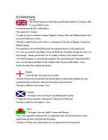
The Union Flag, popularly known as the Union Jack, is the national flag of the United Kingdom. It is the British flag. It is called the Union Flag because it symbolises the administrative union of the countries of the United Kingdom. It is made up up of the individual Flags of three of the Kingdom's countries all united under one Sovereign - the countries of 'England, of 'Scotland' and of 'Northern Ireland'. As Wales was not a Kingdom but a Principality it could not be included on the flag.
Industry
Its economy is traditionally based on coal- mining , iron and steel manufacturing , heavy machinery and textile industries, shipbuildind and trading. More recent industries include pharmaceuticals, artificial fibres, electrical equipment, car ­manufacturing, and high technology industries
Agriculture still plays an important role in the economy, employing about 1 million people. Dairy products are more common in the west while sheep and cattle are reared in the hilly areas of the north and south west. In the south and east , arable farming, pigs, poultry and horticulture dominate.
Government
The party which wins the most seats in the General Election forms the government. The leader of the winning party becomes Prime Minister. As leaders of their political parties and leaders of the country, Prime Ministers are powerful and important people. They are powerful because they have the majority support in Parliamenr and th ey can choose their own ministers and government.The PM chooses a committee of minister s called the Cabinet. This is made up of a selection of senior MPs from the House of Commons and some members of the House of Lords . Each member of the Cabinet is a minister responsible for a government department: for example, the Secretary of State for Education and Science is responsible for all the schools, universities and teachers in Britain. The Cabinet of ministers runs the country. The Cabinet meets at the Prime Minister's house - la Downing Street . The Cabinet works as a team and all ministers must accept the decisions of the 'group'. The team of ministers must always agree in public because they are collectively responsible for the decisions they make. If a minister cannot agree with all the others , he usually resigns from the cabinet. Cabinet meetings are held in private and the details must remain secret for at least 30 years. It has been argu ed that Margaret Thatcher tried to change this st yle of cabinet and she was forced to resign when the other ministers could not agree with her.
Cabinet ministers cannot, however. do as they please! They are responsible to Parliament and must answer questions from. backbenchers in the House of Coinmons. Even the Prime Minister must answer questions every Tuesday and Thursday in the Commons - this is called Prime Minister's Question Time and can be one of the most interesting discussions in British politics . Everyone wants to know what has been decided behind the closed doors of the Cabinet Room!
Britain is administered from the Palace of Westminster in London. This is also known as the Houses of Parliament. Parliament is made up of two chambers - the House of Commons and the House of Lords. The members of the House of Lords are not elected; they qualify to sit in the House because they are bishops of the Church of England. aristocrats who have inherited their 'seats' from their fathers , people with titles, or senior judges of the legal system. There has been ta lk of reform this century because many Britons think that this system is undemocratic. The House of Commons, by contr 'ast, has 651 seats which are occupied by Members of Parliament (MPs) who are elected by the British public. The United Kingdom is divided into constituencies, each of which has an elected MP in the House of Commons. Each of the major political parties appoints a representative ( candidate ) to compete for each seat . Smaller parties may have a candidate in only a few constituencies. There may be five or mare parties fighting for one seat, but onlyone person - the candidate who gets the greatest number of votes - can win. Some parties win a lot of seats and some win very few, or none at all. The Queen , who is the Head of State, opens and clases Parliament. All new laws are debated (discussed) by MPs in the Commons, then debated in the Lords. and finally signed by the Queen. All three are part of Parliament in Britain.
There are 651 MPs in Britain, but the Chamber of the House of Commons is quite small; it has seats for only 437, so when there is something important to discuss it can beeome very crowded and MPs squeeze on to the benches or sit on the steps. The House of Commons has a chairman, called the Speaker, whose job is to keep the House in order , a little like a referee at a football match . He or she shouts 'Order! Order!' when MPs start shouting at eaeh other, or when the discussion gets out of control . The Speaker sits in the centre at the back , on a high chair , and ecn see the whole Chamber from this positian. The office of Speaker is neutral , i.e. he or she is not a voting member of a political party.
There are red lines running along each side of the Chamber. This means that the Chamber is divided in two. Since Britain traditionally has two main political parties, the Conservative Party and the Labour Party, each party can have its own side! The party which is in government sits on the right. The two red lines on the floor must not be crossed, to prevent either side attacking the other during a debate. MPs in Britain do not normally use physical violence, but the red lines are a historical tradition; in the past, MPs used to carry swords into the Chamber and the distance between the two lines is too wide for a sword fight!
The most important MPs sit on the front benches and are therefore called frontbenchers.
Younger and less experienced MPs sit on the back benches and are known as backbenchers. The ministers of the Government sit on the front bench to the right. whilst the Opposition frontbenchers sit on the left . When the Prime Minister or any other leading politician makes a speech , they stand at the table in the centre, below the Speaker's chair. These seating arrangements have existed for hundreds of years.
Biggest Cities
The biggest cities in UK are London, Manchester, Newcastle , Liverpool, Bristol , Glasgow , Cardiff , Edinburgh , Birmingham, Leeds, Southampton.
Chester is a very important town in the north-west of England. It has about sixty thousand inhabitants. In the past it used to be a Roman fort; its name comes from .the Latin
word castra, meaning "fortified camp " .
Oxford is the home of the oldest university in England Most of the oldest colleges are situated just a short walk from each other in the centre of town. The most famous college is Christ Church. It has a great hall dating from the reign of Henry VIII and its chapel has ­become the Cathedral of Oxford.
Cambridge is the home of Britain's second oldest University. It is situated on the river Cam. A beautiful way to visit it is from the river, hiring a punt and going under its beautiful bridges
One third of the population lives in and around the capital of Northern Ireland, Belfast, whish is also the most important port and industrial and commerial centre.
The capital of Scotland is Edinburgh, well known for its monuments and for the International Festival which is held every August.
Glasgow is the industrial capital of Scotland. It lies on the River Clyde and is the third largest city in Great Britain.
London
London is the biggest city in Britain and in Europe. London occupies over 620 square miles. London has a population of 7,172,036 (2001). About 12 per cent of Britain’s overall population live in London. London has the highest population density in Britain, with 4,699 people per square kilometre. London is in the southeast of England. London is the seat of central government in Britain. The tallest building in London is the Canary Wharf Tower. London was the first city in the world to have an underground railway, known as the ' Tube '. Some of the most important people from countries all over the world visit the Queen at Buckingham Palace. There are over 100 theatres in London, including 50 in the West End. London theatre accounts for 45% of all UK theatre admissions and over 70% of box-office revenues. Source: GLA Economics .
The UK #1 The UK #2 The UK #3 The UK #4 The UK #5
Punktid 50 punkti Autor soovib selle materjali allalaadimise eest saada 50 punkti.
Leheküljed ~ 5 lehte Lehekülgede arv dokumendis
Aeg2008-12-07 Kuupäev, millal dokument üles laeti
Allalaadimisi 19 laadimist Kokku alla laetud
Kommentaarid 4 arvamust Teiste kasutajate poolt lisatud kommentaarid
Autor merjekas Õppematerjali autor
everything important you need to know about U.K. The information is from Upstream and no frontiers

Sarnased õppematerjalid

The U K--Suurbritannia
4
doc

The U.K. / Suurbritannia

The UK & London The United Kingdom (or the UK) is a short way of saying the United Kingdom of Great Britain and Norther Ireland. The UK is situated north-west of the European continent between the Atlantic Ocean and the North Sea. The UK consists of England, Wales, Scotland and Northern Ireland. Its highest point is Ben Nevis in Scotland followed by Snowdon in Wales. The Severn is the longest river in the United Kingdom. Other important rivers are the Trent, the Mersey, the Tyne, etc. Lough Neagh which lies in the centre of Northern Ireland is thr UK's largest freshwater lake. The climate in the UK is variable. The weather changes so frequently that it is difficult to forecast. It is not unusual for people to complain that the weathermen were wrong. Fortunately there is no extreme weather conditions, it is never very cold or very hot. The first inhabitants were Iberians and Celts who settled on the land and were often at war with each ot

Inglise keel
The United Kingdom
8
doc

The United Kingdom

The United Kingdom The United Kingdom consists of England, Scotland, Wales and North Ireland and it is situated in the Atlantic Ocean near the mainland of Europe. The population of the UK is 58.6 million and area is 244,110 sq km. Britain has a temperate humid climate. Its characteristic features are mild winters, warm summer, no temperature extremes, abundant rain all year round and frequent changes of weather. The mild climate is partly due to the warm Gulf Stream and partly to the south westerly winds. Occasional winds from the east in winter may bring cold and dry weather. The distribution of rainfall is influenced by the Atlantic Stream. The mountainous areas of the north and west have more rain than the lowlands of the south and east. Wales is located on a peninsula in central-west Britain. The entire area of Wales is about 20,779 km². Wales borders by England to the east and by sea in the other three directions: the

Inglise keel
Suurbritannia ühiskond ja kultuur konspekt
14
doc

Suurbritannia ühiskond ja kultuur konspekt

1. Ancient Britain: the Celtic tribes. 2000 years ago there was an Iron Age Celtic culture throughout the Br Isles. It seems that the Celts, who had been arriving from Europe from the 8th cent BC onward, intermingled with the peoples who were already there. The Celts were extremely talented people, creative and artistic. More than 1 Celtic tribe invaded Br. The descendants of ancient Celts live in Wales, Scotland, Cornwall and Ireland. They lived in primitive society. Druids ­ priests, more powerful than chiefs. Acted like prophets. 2. Stonehenge From prehistoric period. Was built on Salisbury plain between 2500 and 1500 bc. One of the most famous and mysterious archaeological sites in the world. One of the mysteries is how it was built at all with the technology of the time. Another is its purpose. It appears to function as a kind on astronomical clock and we know it was used by the Druids for ceremonies marking the passing of the seasons. It appears in number of novels. T

Suurbritannia ühiskond ja kultuur
British Parliament
6
docx

British Parliament

British Parliament Structure and Functioning of the British Parliament today Britain is a parliamentary monarchy . The British Parliament is a bicameral parliament , that is to say that it is made up of two chambers, or two "Houses"; above the two Houses, but in an essentially formal role , there is the Sovereign - king or queen - also known as "the crown." Role of the Sovereign The British monarch has all authority, but no power. The Sovereign appoints the Prime Minister, and every year opens the sessions of parliament, in a historical and ritual ceremony called the State Opening of Parliament . Historically, this ceremony used to take place in the Autumn; but since 2012, it has been brought forward to May. This is the only regular time when the members of both Houses come together. During the ceremony, the Sovereign reads out the government's intended programme. The "Queen 's Speech" is a summary of the programme "his" or "her" government intends to implement in the next twelve

Inglise keel
Ingliskeelsete maade ühiskond ja kultuur-eksamiküsimused
26
docx

Ingliskeelsete maade ühiskond ja kultuur, eksamiküsimused

1. The Queen’s official title. Elizabeth the Second, by the Grace of God, of the United Kingdom of Great Britain and Northern Ireland and of Her other Realms and Territories Queen, Head of the Commonwealth, Defender of the Faith. 2. The Queen’s working day. Starts after breakfast. Reads the newspapers which are prepared by the Press Secretary, and a report on the previous day’s proceedings in the Parliament and the letters she receives. Also phone calls. Once a month she attends the Privy Council in order to give Royal Assent to various items of government legislation. Discusses domestic matters with the Master of the Household. Towards the end of the day, there is always another pile of official papers and reports waiting to be read or acted upon. The business on constitutional monarchy never ends. 3. Who is the present heir to the throne? Speak about his education. Who are the 2nd and 3rd in line? Pre

Ingliskeelsete maade ühiskond ja kultuur
Suurbritannia üldkokkuvõte
8
doc

Suurbritannia üldkokkuvõte

1) General facts The UK: * the United Kingdom of Great Britain and Northern Ireland was formed in 1801 * it covers 243,610 sq km * everybody from the UK is called British * the capital city is London * is made up of four constituent countries: England, Scotland, Wales and Northern Ireland which in turn are divided into counties * the flag is called the Union Jack which is a combination of the flags of England, Scotland and Northern Ireland * the population is about 60,000,000 people, the population density is 242 people/sq km * its coasts are washed by the Atlantic Ocean, the North Sea, the English Channel, the Celtic Sea, Saint George's Channel, and the Irish Sea. It is linked to France by the Channel Tunnel * the United Kingdom is a constitutional monarchy. The current monarch is Queen Elizabeth II, who is also the Queen and Head of State of fifteen other Commonwealth Realms, such as Canada, Australia, New Zealand and Jamaica.

Inglise keel
Suurbritannia ühiskond ja kultuur quiz 2 mõisted
32
pdf

Suurbritannia ühiskond ja kultuur quiz 2 mõisted

Established church The Church of England is the established church, which means that: 1.)the Monarch is the Supreme Governor of the church, 2.)the Church performs a number of official functions, 3.)Church and State are linked. To disestablish Disestablishmentarianism refers to campaigns to sever links between church and state, particularly in relation to the Church of England as an established church. It was initially a movement in the United Kingdom in the 18th century. The established churches in Wales and Ireland could not count on even nominal adherence by a majority of the population of those countries. In Ireland, the predominantly Roman Catholic population campaigned against the position of the established Anglican Church of Ireland - eventually disestablished in Ireland from 1 January 1871. A broad church The Church of England is a broad church, representing a wide spectrum of theological thought and practice The Church of England is a broad church, represent

Inglise keel
Inglismaa
9
doc

Inglismaa

khTallinn English College The United Kingdom Topic Mari-Liis Pakats Tallinn 2008 2 Table of Contents Introduction..................................................................................................................4 Geographical Position .................................................................................................4 History .........................................................................................................................4 Government..................................................................................................................5 Queen Victoria.............................................................................................................5 Relief............................................................................................................................6 Climate .....................................

Inglise keel


Kommentaarid (4)

merjekas profiilipilt
merjekas: skännimisel on tekkinud tähevead!!!
00:26 30-01-2009
Mariliis0 profiilipilt
Mariliis0: noh suhtselt normull:D
01:05 11-05-2009
SweetGeisha profiilipilt
SweetGeisha: normaalne, sobib :P
18:54 28-05-2010


Sellel veebilehel kasutatakse küpsiseid. Kasutamist jätkates nõustute küpsiste ja veebilehe üldtingimustega Nõustun