The United KingdomThe United Kingdom
consists of
England ,
Scotland ,
Wales and
North Ireland and it is
situated in the
Atlantic Ocean near the mainland of
Europe . The population of the UK is 58.6 million and area is 244,110
sq km.
Britain has a temperate humid climate. Its
characteristic features are
mild winters,
warm summer , no temperature extremes, abundant rain
all
year round and
frequent changes of
weather . The mild climate is
partly due to the warm Gulf
Stream and partly to the
south westerly
winds. Occasional winds from the
east in
winter may bring cold and
dry weather. The distribution of rainfall is
influenced by the
Atlantic Stream. The mountainous
areas of the north and
west have
more rain
than the lowlands of the south and east.
Wales is
located on a peninsula in central-west Britain. The
entire area of Wales is about 20,779 km². Wales borders by England
to the east and by sea in the
other three directions: the
Welsh Channel to the south, St George's Channel to the west, and the
Irish Sea to the north.
There are many bays, peninsulas,
cliffs and
beaches , together Wales has
almost 2000 km of coastline. There are
several islands off the Welsh mainland, the largest being Anglesey in
the northwest.
About 3 million people
live in Wales. The main population and
industrial areas are in South Wales, consisting of the cities of
Cardiff (also the capital), Swansea and Newport and surrounding
areas.
Much of Wales' beautiful and
diverse landscape is mountainous. It has two
major mountain systems:
the
Black Mountains and the Brecon Beacon in the south and the
mountains of Snowdonia in the south. The
highest mountains in Wales
are in Snowdonia and
include Snowdon, which at
1085 m (3,560 ft) is
the highest peak in Wales.
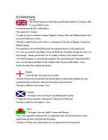
Welsh flag has a red
dragon on a white and
green background. It is
not represented on the Union Jack.
England is
130 000
square kilometres. Its capital is London. The population is
about 50 million people and
growing because of
immigration .
England is
bordered to the north by Scotland
and to the west by Wales.
It is closer to continental Europe than any other
part of Britain,
divided from
France only by a 38 km sea gap.
The
Channel
Tunnel ,
near Folkestone,
directly
links England to the European
mainland.
The
English /
French border is halfway
along the tunnel.
London
is by far the largest English city and one of the largest and busiest
cities in the world. Birmingham
is the second largest. A number of other cities, mainly in central
and
northern England, are of substantial
size and
influence .
These include: Manchester,
Leeds, Liverpool,
Newcastle ,
Sheffield,
Bristol , Coventry,
Leicester ,
Nottingham and
Hull.
England features mostly low
hills and plains. the Lake District in
the north-west features some of England’s most beautiful
landscapes, and includes Scafell
Pike – at 978 m, the highest point
of England. There are also some
important rivers in England and the
most significant
ones are
Thames , Severn (the
longest river in Great
Britain) and
Avon .
The flag of England is a red
cross on a white background. It is also
on the Union Jack.
Scotland is
in the northern part of Britain. It covers a
little less than 80000
square kilometres and this is about one third of Great Britain. The
population of Scotland is about 5 million people. There are three
official languages spoken there: English,
Scots , Gaelic.
Edinburgh ,
the
country 's capital
and second largest city,
is one of Europe's largest financial
centres. The
biggest city is
Glasgow . There is a fierce rivalry
between the most important
football clubs of Glasgow and entire
Scotland – Glasgow
Celtic and Glasgow Rangers.
Scotland has a very picturesque landscape. It may be divided into two
parts: the Lowlands (an are of gentle hills, fields and woodlands,
more densely populated than other parts, they also include plenty of
wild upland country) and the Northern Highland (which are
considered by many people, especially mountain-lovers, to be the most beautiful
part of Scotland and a
real tourist Mecca; they say that there may
even be small patches of
land on which
nobody has ever set
foot ).
Britain’s highest peak, Ben
Nevis (1343 m)
lies not far from Fort
Williams .
The
Scottish flag has a white cross on a
blue background. It is also
on the Union Jack.
Northern Ireland
is the smallest part of the UK as it only covers about 5500 square
kilometres. About
half of the 1.7 million inhabitants live in or
around Belfast , the capital, in the
eastern coastal region .
The centrepiece
of Northern Ireland's geography is
Lough Neagh, at 151 square
miles (392 km²) the largest
freshwater lake
both on the
island of Ireland and in the
British Isles, and the third largest
lake in
Western Europe. A second extensive lake system is centred
on
Lower and
Upper Lough
Erne in Fermanagh.
Northern Ireland don’t have an official flag any more nor a
coat of
arms. Due to the
division of the population along
ethnic , religious
and
political lines, a
wide variety of flags can be
seen flying from
lampposts and private
houses across Northern Ireland.
Government . The British Constitution is an unwritten
constitution, not being contained in a
single legal document . England
and Wales have no
criminal or
civil code . It is case law there. It
contains two main principles – the
rule of law (nobody can
escape from the law) and the supremacy of
Parliament (in theory the
Parliament can do whatever it wishes).
Since the age of absolute
monarchy there has been a gradual decline in the Sovereign’s
power and,
while formally
still the head of the
executive and the
judiciary , commander-in-
chief of all the
armed forces, and temporal
governor of the
Church of England,
nowadays monarchs
reign but they
do not rule.
Parliament is the supreme legislative
authority . There is
usually a
one-
party government. It consists of three separate
elements : the
Sovereign, the House of
Lords and the elected House of Commons. After
passing through the House of Commons, all
bills are debated in the
House of Lords, and after that,
signed by the
Queen . As a result the
bills then become
laws .
There are 650
Members of Parliament in the House of Commons. Leaders
of the Government and the Opposition sit in the
front row and their
supporters sit
behind them . The House is presided over by the
Speaker. He/she is elected by the MPs.
The members of the House of Lords are not elected. This
chamber consists of the Lords
Spiritual . The House of Lords is presided over
by the
Lord Chancellor. There are about 1200 members there.
There are 2 main parties: the
Labour Party and the
Conservative Party. The Labour Party has been in power from 1997 and have had some
shorter spells
before too. The
leader of them is
Tony Blair. He’s
also the
Prime Minister as the
leading figure of the party in power
becomes also the Prime Minister and he can appoint
himself his
Government. The Labour Party is
popular amongst the
middle classes and the Conservative Party has the
support of the wealthier people.
Economy . Britain has a wide range of industries.
Services ,
like finance and business services, have expanded and
account for
about 63% of British national output.
Manufacturing though still
plays a vital
role in the economy. Britain excels in high-
technology industries like
chemicals ,
plastics , pharmaceuticals, aerospace,
electronics,
motor vehicles and
components , offshore
equipment and
paper and
printing . Here the British companies are
among the world`s
biggest and most successful. The British construction industry
continues to be engaged in some of the most prestigious international
projects.
Britain also excels in the
field of
scientific and
technological innovation. The oldest
universities are
Oxford and
Cambridge which
are also centres of scientific research. There have been several
British breakthroughs in genetics research,
including the
identification of genes
linked to
diseases e.g. a form of breast
cancer . In 1997 scientists in Edinburgh succeeded in cloning a
sheep .
Scotland and Northern Ireland have long been noted for their
production of
whisky and textiles, notably tweed and
linen respectively.
Today Scotland is also a major producer of
computers .
The leading manufacturing
regions are
Greater London, Greater
Manchester, West Midlands (Birmingham), Yorkshire, Newcastle,
Glasgow, Bristol.
Britain has relatively few
mineral resources.
Zinc , tin,
iron ore and
copper are all produced in small quantities, together with
tiny amounts of
gold and
silver . Non-metallic minerals include
limestone ,
chalk , clay, sandstone, salt and gypsum. Britain has the richest
energy resources in EU including oil and natural gas, both primarily
found in the North Sea, off eastern Scotland and eastern England
respectively.
About 77% of the
land area of Britain is under agricultural use of
some sort.
Agriculture employs 2 per
cent of the population.
However ,
it achieves high levels of efficiency and productivity.
Large parts of Britain, notably in Scotland and Wales, are
suitable only for grazing. Over half of all
full -time farms are devoted to
dairy- or beef-farming, or sheep raising.
Tourism forms a big part of English economy. Britain is one of the
world’s leading tourist destinations. The industry is a big
business and now about 2 million people are
employed in this area.
The
majority of tourists
come from Western Europe. It is
good to
travel all over Britain because there is a good railway and
road network . It is also possible to travel by inland waterways. People
come to Britain because the things that you can see there are very
famous all over the world e.g.
Stonehenge , Big Ben and of
course the
magnificent natural
beauty .
History. Britain was connected to the European mainland by a
land bridge
until the end of the last Ice Age. Afterwards the ice
started to melt and oceans began to
rise and the
connection was
covered with water. Britain
became a separate island in about 6000
BC. From about 3000 to 2000 BC the British Isles were inhabited by a
group of people called
the Iberians. These
Stone Age people
lived in limestone caves, used stone axes and bones as
tools .
Later groups of people from what are now
Germany , the
Netherlands and
France also settled there.
During the
Bronze Age they mined tin, gold
and copper and made bronze tools. The descendants of the Iberians are
thought to have
built spectacular megaliths including the
world-famous Stonehenge on Salisbury
Plain .
The Celts invaded the British Isles in the 5th
century BC. One
of the Celtic
tribes was called the Brythons from
whom the name
Britain derived. The Celts were miners, traders and
cattle farmers.
They
brought the
knowledge of smelting iron with them. The Celtic
language still
lives in the Welsh language.
While the Celts were still
living in tribes,
the Romans were
the most
powerful people in the world. The
already a common law
system that united the people who
spoke different languages but lived
under the Romans. The language of Romans was
Latin . That became the
basis of many languages,
such as French, Italian and
Spanish . The
foundation for the legal systems of most countries in Western Europe
and Latin America was
Roman law. Their political system later
influenced the
building of governments in the United
States and other
countries.
The Romans invaded Britain in 43 AD under the
Emperor Claudius . They
occupied Britain for almost 4
centuries .
Throughout the 350-year
invasion Britain was ruled as a
province . The free Celts were not
imprisoned but they had to pay
heavy taxes . The Romans brought their
advanced technologies with them and taught the Britons how to
build bridges, houses and paved roads.
Many of Britain’s main towns and cities were
established by the
Romans including
York , Bath and London.
Place names ending with
–cester, -
caster , or
-chester
reveal the
original locations or Roman
military camps. They
built Hadrian’s
Wall in AD 122 to
keep out the raiding Picts who
lived in what is now Scotland.
They also brought Christianity with them and in the
fourth century
the
Christian Church was established.
In 410 AD the Roman forces were
withdrawn from Britain to
protect Rome from the invading barbarian tribes.
When the Roman power declined, Germanic seafaring tribes called
the
Angles, the Saxons and the Jutes came to Britain. They
established settlements in Britain and enslaved the Britons or
sent them to the west and north of Britain. The Anglo-Saxon
period started. The Angles and the Saxons became the most powerful tribes
and the land was divided into little kingdoms. Their language
gradually developed into Old English. This language was not a written
one but the
songs ,
stories ,
poems and epics have been handed down
orally from generation to generation.
In 787
the Vikings began their invasion from
Denmark which was
to leave a lasting
impression on Britain. They were fierce pagan
seafaring warriors who brought with them their own customs and laws.
They
raided mercilessly coastal towns in Britain and defeated all
Anglo-Saxons kingdoms except one –
Wessex . A treaty was signed
between the Danish and Wessex
kings . It divided England, with the
east declared to be Danish territory. The power was regained after
about 200
years and the Anglo-Saxon dynasty lasted until the year
1066.
The period of
Medieval England (1066-1483) started in 1066
when William of Normandy came defeated the Anglo-Saxon
king Harold at
the
Battle of Hastings. Land was handed to the
rich French who came
to live in England. The power of these Norman Barons increased and
they together with the Church began to
challenge the king’s
absolute power. The king was forced to sign the
Magna Carta in
1215 which significantly reduced the king’s
rights .
The most important things that
happened in this time were the
Hundred Years’ War, the Black Death and the Peasants’ Revolt. The
Hundred Years’ War had a devastating effect on English economy. The
Black Death
killed about on third of all the population. The peasants
wanted a better life and they started a revolt that was turned down
but it led to
greatly improved
conditions for the peasant
class .
The Tudor England (1483- 1603 ) started when the war between two
royal families for the English Crown
ended when
Henry VII united the
two rival houses,
giving origin to the Tudor dynasty. The was is
called the War of the
Roses because both families had a
rose as their
symbol .
During Henry’s reign the power of towns and the
importance of
middle classes became to be
felt .
Henry VIII used Parliament to establish himself as the head of the
Protestant Church of England with the
Act of Supremacy in
1534. It greatly strengthened the importance of this institution that
had virtually
lost all its importance under Henry VII.
Elizabeth I (1558-1603) was an outstanding ruler. She
reconciled both Protestants and Catholics. Her reign is considered by
many as the
Golden Age of English History, producing not only poets
of the stature of
Shakespeare and
Spenser , but also prosperity to the
entire
nation . The
discovery of America placed Britain at the
centre of the world’s trading routes and
brilliant naval commanders
(especially Sir Francis Drake and Sir
Walter Raleigh) enabled England
to dominate these trade routes. Parliament was regularly called and
consulted.
Convinced of the divine right of kings, the
Stuart (1603-1714)
kings James I and Charles I followed the medieval notion of monarchy,
ignoring parliament. Charles I raised taxes
without its
permission and prevented it from
meeting for 11 years until he needed its help
to raise the
money to
fight the war against Scotland.
Relations between King and Parliament became so bad that the civil war broke
out in 1642.
The majority of the nobles supported Charles and the majority of the
gentry supported Parliament in this fight over who should have
sovereign power. After Oliver
Cromwell had led the Parliamentarian
Roundheads to victory in 1648, Charles I was executed for treason and
Cromwell became Lord Protector. England was now a
Republic but the
monarchy (together with the Anglican Church and the House of Lords)
was restored in 1660.
The Great Fire of London
took place in
1666 and it destroyed
most of the city.
After the
Stuarts the
House of Hannover came to throne. The
most important ruler of this time was
Queen Victoria. During
Queen Victoria’s sixty-
four year reign (
1837 -1901) the British
Empire, led by an
array of great statesmen and supported by great
industrial expansion, grew to a size so vast that ‘the sun
never sets
upon it’. Victoria’s long reign saw many changes in British
constitutions and the British ‘way of life’. Her rejection of the
amusements and life of the aristocracy enabled the common people to
identify themselves with this
simple wife and
window , which led to a
revival of popular support for the monarchy. She stressed the
value of family and she had middle-class
views and life-style.
The House of Saxe-Coburg Gotha (
the Windsors) are the rulers
of Birtain from 1901 until now. The
current queen is Elizabeth II.
The United Kingdom is one of the most influential countries in the
world. Its
highly developed industry and education make the country
very important. I recommend to
everybody to visit the country because
the history and culture are very
interesting and diverse.
 50 punkti
Autor soovib selle materjali allalaadimise eest saada 50 punkti.
50 punkti
Autor soovib selle materjali allalaadimise eest saada 50 punkti.
 ~ 8 lehte
Lehekülgede arv dokumendis
~ 8 lehte
Lehekülgede arv dokumendis
 2013-09-06
Kuupäev, millal dokument üles laeti
2013-09-06
Kuupäev, millal dokument üles laeti
 9 laadimist
Kokku alla laetud
9 laadimist
Kokku alla laetud
 0 arvamust
Teiste kasutajate poolt lisatud kommentaarid
0 arvamust
Teiste kasutajate poolt lisatud kommentaarid
 wounk
Õppematerjali autor
wounk
Õppematerjali autor
 annaabi.ee







Kõik kommentaarid