Tartu Kivilinna
Grammar School
Netherlands Report Composer: Reino Urbanovitš
Supervisors:
Tiia Krass
Erika Hunt
Tartu, 2003
Table of contents
Table of contents 2
Introduction 3
Chapter 1 4
The Netherlands 4
Chapter 2 7
The history of the Netherlands 7
Conclusion 16
Literature used 17
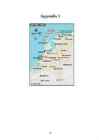
Appendix 1 18
Introduction
The aim of this research is to get
know more about the Netherlands
history and its geographical facts.
This report is describing one of most the most beautiful countries in
the
Europe - Netherlands. Netherlands is famous for its windmills and
flowers. Netherlands is also
known unofficially as
Holland .
Government is constitutional monarchy of
north -
western Europe.
Netherlands is bordered on the north and
west by the North Sea, on
the
east by
Germany and on the
south by
Belgium . The European portion
of the Netherlands has a
total area of 41,528 sq km of which 33,939
sq km is
land surface.
Country ’s capital and largest city is
Amsterdam . Population is about 16 million.
Chapter 1
The Netherlands
1.1 Mainly about the Netherlands
Netherlands is also known unofficially as Holland. Netherlands is
bordered on the north and west by the North Sea, on the east by
Germany and on the south by Belgium. With Belgium and
Luxembourg , the
Netherlands forms the Low, or
Benelux , Countries. The Netherlands
Antilles and Aruba,
islands in the
Caribbean , are
part of the
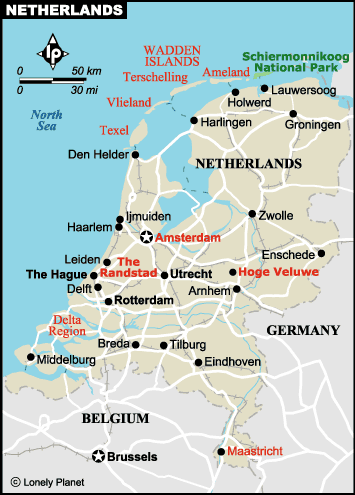
Netherlands. Country’s capital and largest city is Amsterdam (
see
also Appendix 1). National
holiday is
Queen 's Day on 30th
April. And the
mother tongue is
Dutch . (5)
The Kingdom of the Netherlands has three parts and two countries in
the Caribbean, the Netherlands Antilles and Aruba. With an area of
41,528 kilometers and a population of 16 million, The Netherlands
(the European part of the Kingdom) is one of the world's smaller
countries. (6)
The Netherlands is a constitutional monarchy with a parliamentary
system, in which the government consists of the queen and the
ministers. For historical
reasons , The Hague is the
seat of
government, but Amsterdam is the capital. The
current government is a
coalition
between the
Christian democrats (CDA), the liberal
democrats (VVD) and the Pim Fortuyn List (LPF). Jan Peter Balkenende
(CDA) is the
Prime Minister. Queen Beatrix is the head of state. (6)
1.2 Land & Climate
The Netherlands is very
flat . Nearly a
quarter of its surface area is
below sea level. The lowest point in the Netherlands,
near Rotterdam ,
is 6.7
metres below sea level. Its
highest point, the Vaalserberg, is
312 meters above sea level. The Vaalserberg is in the southeast of
the country, where the borders of the Netherlands, Belgium and
Germany meet. The Netherlands has a temperature climate,
thanks to
its long coastline. The
average temperatures are 18 degrees
Celsius in
summer and three degrees Celsius in winter. Average annual
rainfall is 800 millimetres. (6)
1.3 Economy
The Netherlands is a prosperous and
open economy depending heavily on
foreign trade. The economy is noted for stable
industrial relations ,
moderate inflation, a sizable current account
surplus , and an
important role as a European transportation hub. Industrial
activity is predominantly in food
processing , chemicals,
petroleum refining,
and
electrical machinery. A
highly mechanized agricultural sector
employs no more
than 4% of the
labor force but provides large
surpluses for the food-processing industry and for exports. The
Netherlands,
along with 11 of its EU
partners , began circulating the
euro currency on 1
January 2002. The country continues to be one of
the
leading European nations for attracting foreign
direct investment.
Economic growth slowed considerably in 2001-02, as part
of the
global economic slowdown, but for the
four years before that,
annual growth averaged nearly 4%, well above the EU average. (3)
1.4 Population
The great
majority of inhabitants of the Netherlands are Dutch. They
are mainly descended from Franks, Frisians, and
Saxons . Most
residents of Friesland
Province are Frisian, a distinct
cultural group with its own
language . Fearing overpopulation, the government
encouraged Dutch emigration after World War II (1939-1945), and some
500,000 people
left . But an
even larger number of people entered the
Netherlands—Europeans and Asians from the
former Netherlands Indies
dependency (now part of
Indonesia ); industrial
workers from Turkey,
Morocco , and
other Mediterranean countries; and, more recently,
residents of Suriname, also a former Dutch dependency and the
Netherlands Antilles. Consequently, the country’s population,
particularly in the large cities, now includes
several ethnic minorities. (3)
1.5 Language
The
official language is Dutch, but a second official language,
Frisian, is spoken by
approximately 500,000 people in the province of
Friesland. Frisian bears some similarities to
English and the
Scandinavian languages. Dutch is the language of instruction in
schools throughout the Netherlands. (6)
1.6 Interesting facts about Netherlands
There are only 1,000 windmills left in Holland, one-
tenth the
original number.
The Aalsmeer flower
auction sells approximately 14 million flowers a
day from all over the world.
There are approximately 14 million
bicycles in Holland.
20
percent of Holland has been reclaimed from the sea. In the
previous centuries , one of the methods to
protect Holland was to
reflood the drained lands.
Rotterdam has the largest port in the world. Twelve provinces make up
the Netherlands: Groningen, Friesland, Flevopolder,
Drenthe ,
Overijssel, Gelderland, Utrecht, North and South Holland,
Zeeland ,
North Brabant and
Limburg .
The Netherlands is known as Holland because the North and South
Holland provinces are the most internationally
influential .
Holland
means hollow or soaked
land .
Ice
skating is one of the most
popular sports in Holland.
Each
year approximately 45,000 people go to the Waddenzee to be
"mud-walkers". The people essentially
walk around the
muddy canals for fun. There are also places where vacationers can
farm and
dredge canals.
The plough, in its modern form, is a Dutch invention.
The Dutch
invented the thimble.
Many
names used for fabrics and
patterns came from Holland (cambric
came from Cambrai, diaper from d'Apres).
The
shirt , nightdress, bed tick, pocket handkerchief, tablecloth and
napkin were invented in Holland, along with starch. (7)
Chapter 2
The history of the Netherlands
2.1 1st dated historical facts
Historical
accounts of the Netherlands
date from the 1st
century BC,
when
Roman forces led by
Julius Caesar conquered most of the
present area of the country. At the time the
region was inhabited by
Frisians, a
Germanic tribe that lived in the north, and by other
Germanic and
minor Celtic
tribes . (3)
2.2 The Roman Era
Before the conquest, the
Romans had annexed lands to the southeast
extending
beyond the Rhine River. They penetrated the Netherlands
region mainly to
control the several mouths of the Rhine, which were
then farther to the north than they are now. Under Roman
rule ,
general
peace and prosperity
prevailed for more than 250 years. Roman
traders entered the area freely,
selling products from Italy and
Gaul. The Romans
built temples ,
established a number of large farms,
and introduced their civilization to the region.
About AD 300 the
hold by the Romans began to weaken, and no
indigenous
German tribes pushed into the area from the east. The
Frisians, in the north,
held their
ground , but Saxons occupied the
eastern part of the region, and the Franks moved into the west and
south. (3)
2.3 The Middle Ages
The Franks were the most
powerful of the invaders. Their lands
extended southward into what is now
northern France and eastward
across the Rhine. Eventually, the Frankish kings subjugated the
Frisians and the Saxons and converted
them to Christianity. By 800
the
entire territory of the Netherlands was part of the realm of
Charlemagne. After Charlemagne died, his
empire disintegrated, and in
843 the
Treaty of Verdun
divided the empire into three parts. The
Netherlands
became part of Lotharingia (Lorraine) and
still later , in
925, part of the Holy Roman Empire. At that time a Dutch
nation did
not
exist , and the immediate loyalties of the inhabitants were to
local lords. Gradually over the next centuries the
whole region came
to be called the Low Countries, or Netherlands,
including present-day
Belgium. (3)
During the 9th and
10th centuries Scandinavian raiders, called
Vikings, frequently invaded the
coastal areas ,
sailing far up the
rivers in search of
loot . The need for a stronger system of defenses
against
such marauders gradually led to an
increase in the
power of
the local rulers and their vassals, the nobles, who were largely a
warrior
class . Concurrently, the towns began to
grow in importance,
as artisans and merchants settled in them and
improved their
defenses. The gradual
development of powerful towns was a notable
feature of Dutch history during the 12th, 13th, and
14th centuries,
and the area became an important trading
centre . Under the
leadership of wealthy merchants the towns began to
challenge the power of the
nobles who ruled the
countryside . The merchants often supported the
regional ruler in his
campaigns against unruly vassals, at the
same time exacting from him privileges designed to promote commerce and to
strengthen the town and the
position of the
merchant class. (3)
In the
early Middle Ages such
political entities as the counties of
Flanders and Holland, the bishopric of Utrecht, and the duchies of
Brabant and Gelderland were established. In the far north,
however ,
the Frisians did not
submit to a regional ruler but continued to obey
their local headmen. The
association of the Netherlands with the Holy
Roman Empire remained largely
nominal throughout the Middle Ages.
Some trade was conducted with German coastal cities to the east, such
as
Bremen and
Hamburg , but the
major cultural
influence came from
France. (3)
2.4 The Renaissance
Through marriage , war and political manoeuvring, most of the region
comprising the present-day Netherlands, Utrecht, Noord-Brabant, and
Gelderland — came into the
hands of the dukes of Bourgogne during
the 15th and early
16th centuries. By 1519 this area was under the
benevolent control of Holy Roman
emperor Charles V, of the
Spanish branch of the house of Habsburg, who was also
king of
Spain . In 1555,
however, Charles resigned
both Spain and the Netherlands to his son,
Philip II, who was Spanish by
birth and education and had
little liking for his northern European territories. His
oppressive rule led
to the epochal war of independence waged from 1568 to 1648 by the
Dutch against Spain, then the most powerful nation in Europe. (3)
2.5 The Struggle for Independence
The political disaffection between the Low Countries and Spain
coincided with the Protestant revolt against the Roman
Catholic Church , which was the state church of Spain. Calvinism, a Protestant
movement , rapidly gained ground during this
period ; its adherents
established in the Low Countries a well-organized church that was
prepared to challenge the Roman Catholic Church, particularly the
Inquisition, a church institution that sought to control heresy. In
1566
riots in which mobs destroyed images in Catholic churches
spread across the country. In response, a wrathful Philip
sent to the
Netherlands Spanish troops commanded by
Fernando Įlvarez de
Toledo ,
duke of
Alva . The excessively harsh policies of the duke and of the
Inquisition resulted in open revolt in the Low Countries. William I,
the
Silent ,
prince of Orange, who was one of the principal noblemen
of the region, led the revolt. Initially unsuccessful, the Dutch then
concentrated their efforts in the north. After William’s
naval supporters, called the Sea Beggars, seized the Holland port of Brill
(Brielle) in
1572 , the rebels took control of most northern towns,
which became the
bases of the revolt. William tried to maintain the
unity of north and south but was unable to hold the north against the
brilliant campaigns of reconquest led by a new Spanish commander,
Alessandro Farnese. (3)
In 1579 the Union of Utrecht, an anti-Spanish
alliance of all
northern and some
southern territories, was
formed . The union
signified the
final divergence of the northern part of the Low
Countries, which later became the Netherlands, from the southern
part, which later became Belgium. The Union of Utrecht became the
nucleus of the present Dutch nation. In
1581 the Dutch provinces
within the Union of Utrecht proclaimed their independence from Spain.
Subsequently, the new nation suffered a series of reverses in the war
with Spain, sustaining a major loss when William the Silent was
assassinated in 1584. By 1585 the Spanish had reconquered practically
all the south, including the important port of
Antwerp . Eventually,
however, the tide of war turned in favor of the Dutch. From 1585 to
1587 English troops were sent overseas to aid the insurgent
cause ,
and in 1588 the English destroyed the great Spanish Armada, a victory
that drastically curtailed the
ability of Spain to
wage war
abroad .
The
seven provinces in the Union of Utrecht were cleared of Spanish
troops by 1600. (3)
From 1609 to 1621 a truce was in
effect between the Spanish and the
Dutch, but the war subsequently dragged on
until 1648, when the
Spanish signed the Treaty of Münster, by which the sovereignty of
the Dutch
Republic of the United Provinces was recognized. The
republic thus severed all theoretical ties with Spain and the Holy
Roman Empire and became one of the great powers on the
Continent , a
republic in the midst of monarchies. (3)
2.6 The Golden Age
In the early
17th century, when eventual Dutch independence was
assured , an era of great commercial prosperity opened, as did the
so-called
Golden Age of Dutch art, with such painters as
Rembrandt and Jan
Vermeer . By the mid-17th century the Netherlands was the
foremost commercial and
maritime power of Europe, and Amsterdam was
the financial centre of the Continent. (3)
2.7 Exploration and Colonization
About 1600 a Dutch merchant expedition of three vessels sailed from
Amsterdam to
Java . This was the
first of numerous journeys that left
Dutch
geographic names scattered over the
globe , from Spitsbergen to
Cape Horn and from Staten
Island to Tasmania.
These voyages resulted
in the
establishment or acquisition of many trading stations in
Africa , Southeast
Asia , and America. (3)
In 1602 the Dutch
parliament granted to the Dutch East India Company
a
charter that
gave it a trading
monopoly with all countries east of
the Cape of
Good Hope in Africa and west of the Strait of Magellan in
South America. The charter also conferred many sovereign powers on
the company, including the right to wage war and to conclude peace.
The West India Company established
colonies in the West Indies,
Brazil , and North America. (3)
The East India Company established itself first in the Moluccas, or
Spice Islands, and later on West Java, where Batavia (modern Jakarta)
became the centre of the company’s
enterprises . These enterprises
were devoted mostly to trade and to the establishment of trading
posts. Their
functions generally did not
include governing .
Subsequently, pressed by the necessity of maintaining peace
among the
native rulers, the Dutch began to govern the territories (now called
Indonesia) in
order to maintain trade. (3)
2.8 Internal Developments
William the Silent had been succeeded in the position known as
stadtholder and as
military commander by his son Maurice, who in
turn was followed by his
brother Frederick Henry . These men governed in
conjunction with the
States -General, an
assembly composed of
representatives of each of the seven provinces but
usually dominated
by the largest and wealthiest province, Holland. The stadtholder’s
power varied, depending on his personal qualities of leadership, and
the office eventually became hereditary in the house of Orange. (3)
Under Maurice, the republic was divided by a
religion -political
conflict between two factions within the Reformed (Calvinist) church,
over predestination. The Arminian or Remonstrant, cause was
championed by Holland under its
leader , Jan van Olden Barneveldt. The
other provinces and Maurice sided with the Gomarists or High
Calvinists, who prevailed. The dispute
ended with Barneveldt’s
execution for treason in 1619. (2)
Frederick Henry’s son, William II of Orange, became involved in a
bitter quarrel with the province of Holland, and after his
death no
stadtholder was appointed in Holland and four other provinces for
more than 20 years. William III of Orange, who was stadtholder from
1672 until his death in 1702, was also king of
England after 1689.
(3)
2.9 The Decline of the Dutch Republic
Inevitably, the Dutch and the English, the leading maritime trading
nations of the world, came into sharp commercial rivalry and military
conflict. The
issues between the two countries were contested, but
not settled, by the two Anglo-Dutch
Wars , the first waged from
1652 to 1654 and the second from
1664 to 1667. As a
result of the
latter conflict the Dutch
lost New Amsterdam in North America but
acquired Dutch
Guiana (now Suriname). Other wars, costly in
lives and
money ,
followed against England and France. (3)
After the War of the Spanish Succession (1701-1714), in which the
Dutch were
allies of the
British against the
French , the economic and
political power of the Netherlands began to decline. Eventually the
Dutch Republic was overshadowed by the expanding power of Great
Britain on the sea and France on the land. (3)
When William III died
without heirs in 1702, a distant relative of
his, John William Friso, successfully
claimed the Orange title. In
1747 his son became stadtholder in all seven provinces as William IV.
(3)
In the
late 18th century a
struggle broke out between the
party of
the house of Orange, which had become conservative, and the
Patriot Party, which desired
democratic reforms. The Orange Party enjoyed a
brief
triumph with the help of an invading Prussian
army in 1787, but
in 1795 French troops and a force consisting of self-exiled Dutch
citizens replaced the republic of the seven United Provinces with the
Batavian Republic, which was
modeled on the
revolutionary French
Republic. (2)
2.10 The Napoleonic Era and the Union with Belgium
The Batavian Republic survived only until 1806, when
Napoleon transformed the country into the kingdom of Holland. In 1810 he
incorporated it into the French Empire.
While the Dutch were under
French rule, the British seized Dutch colonial possessions. After the
fall of Napoleon, the
Congress of Vienna restored the independence of
the Netherlands in 1815. In
addition , the territory now comprising
Belgium was made part of the kingdom of the Netherlands. (3)
The reunion of the two
regions was not a
happy one, for they had
become widely disparate in political background,
tradition , religion,
language, and economy. In 1830 the Belgians revolted and established
their independence as a sovereign state. A conference in London of
the major European powers formulated the
conditions of separation in
1831 . The Dutch king under
pressure from France and Great Britain
accepted the stipulations. But when they were later revised by the
conference in favor of the Belgians, a Dutch army invaded Belgium and
routed the opposing forces. The conditions of separation were again
revised and were finally accepted by both countries in 1839. (3)
2.11 The Development of Parliamentary Democracy
The second
half of the
19th century was marked by a liberalization of
the Netherlands government under the impact of the revolutions that
had
swept Europe during the 1840s. The seeds of
reform were contained
in the new constitution of 1848, which became the foundation of the
present
democracy . Under its provisions arbitrary personal rule by
the
monarch was no longer possible. The
members of the first chamber
of parliament, who had formerly been appointed by the king, were
thereafter elected by the provincial states (assemblies). All people
paying
taxes in excess of a stipulated sum
chose members of the
states and of the second chamber of parliament. The
almost solidly
Roman Catholic southern provinces of Limburg and Noord-Brabant,
treated as conquered territories under the republic, had been given
equal
status with other provinces under the monarchy, but it remained
for the constitution of 1848 to
remove the
religious restrictions
against their citizens. Thus a powerful Roman Catholic political
party was
able to form and to
contend with the Liberal group and the
emerging conservative Protestant parties. Through the late 19th
century, suffrage was gradually extended, and agitation for
social reform increased markedly. The
rise of a strong Labor Party and the
organization of workers into labor unions resulted in
further social
reforms. (3)
Administration of the colonies was also reformed. In Indonesia, the
area under Dutch control was increased, burdensome
taxation was
gradually abandoned, and, after
1877 , no financial surpluses from
that
colony were used for the
benefit of the
treasury of the
Netherlands. (3)
From about 1880 to 1914 the Netherlands enjoyed an era of economic
expansion. This period ended during World War I (1914-1918), when,
despite remaining militarily
neutral , the nation suffered hardship
through loss of trade as a result of the Allied blockade of the
Continent. The principal postwar problems of the country were
economic, and these were
aggravated by the
depression of the
1930s .
(3)
2.12 World War II and After
At the outbreak of World War II in 1939, the Netherlands again
declared its neutrality, but in 1940 the country was
overrun by the
Germans, following an aerial bombardment that destroyed the
greater part of Rotterdam. Much destruction was also wrought in other parts
of the country, not only by the Germans, but also by the Dutch, who
opened many dikes as desperate
defense measures , and later by the
Allies in aerial assaults on German-held
positions . The Germans
occupied the country until they were ousted during 1944 and 1945. (3)
The years following World War II were marked by
intensive efforts to
rebuild the country and to
restore its trade and industry. In 1945
the Netherlands became a charter
member of the United Nations. In
1948 it
received funds through the European Recovery
Program . The
Netherlands joined with Belgium, France, Great Britain, and
Luxembourg to form the
Brussels Treaty Organization in 1948, and was
a
founding member of the European Coal and
Steel Community in 1952.
The country joined the North Atlantic Treaty Organization in 1949,
the European Defense Community Treaty in 1952, and the London-
Paris accords in 1955, thus becoming a
full -fledged member of the Western
European multinational defense establishment. The late 1940s and
early 1950s were also a time of rising prices, generally unfavourable
trade balances, and governments dominated by the Labor Party. (3)
Meanwhile , the Netherlands lost a war against Indonesian nationalists
in the East Indies, and in 1949 the Netherlands formally transferred
sovereignty in the East Indies (excluding Netherlands New
Guinea ) to
the Indonesian government. Netherlands New Guinea remained under
Dutch rule until 1962. Also, in 1954 Suriname and the Netherlands
Antilles became equal members of the Kingdom of the Netherlands. (3)
2.13 Recent Developments
The Roman Catholic People’s Party came to power in
1959 and
retained pluralities in the
lower house in the elections of 1963 and
1967, but the government coalitions that the party formed in the
1960s proved unstable. Unrest in the Netherlands Antilles beset the
government in 1969, and marines were dispatched to assist
police in
riot control. The inflation of the 1960s continued into the 1970s as
a major political problem. Wage and
price controls were imposed in
1970, and taxes increased in
1971 . In the elections of 1971 the
four-party governing coalition lost its majority, and after two
months of efforts a coalition headed by the Anti-Revolutionary Party
formed a government. This cabinet
fell in 1972, however, and a
caretaker government ruled until May 1973, when
Joop den Uyl, leader
of the Labor Party, was sworn in as prime minister of a
five -party
coalition. When Suriname attained full independence in 1975, hundreds
of thousands of Surinamese immigrants further burdened the Dutch
economy. (3)
In 1977, following parliamentary elections in the
spring , the
governing coalition of den Uyl fell apart over proposed reforms. A
new prime minister, Christian Democrat
Andreas van Agt, was sworn in
later in the year. In 1980 Princess Beatrix succeeded to the throne
on the abdication of her mother, Queen Juliana. Van Agt’s cabinet
lost its parliamentary majority in May 1981, but he formed a new
coalition that lasted from September 1981 to May 1982. Parliamentary
elections were held in September 1982, after which van Agt
unexpectedly resigned his party leadership. His successor as head of
the Christian Democratic Party was Ruud Lubbers, who formed a new
coalition in November 1982 and remained in power until 1994. During
this period the island of Aruba reached an agreement with the
government of the Netherlands separating the island from the
Netherlands Antilles. In 1993 the Netherlands became the first
governmental
body to regulate
euthanasia or mercy
killing . In the May
1994 elections, the Labor Party emerged victorious and assumed
control of the Dutch government for the first time
since 1977. (3)
In early 1995, the Dutch battled
serious flooding. Rivers throughout
north-western Europe overflowed their banks as a result of heavy
rainfall and melting snow. The Netherlands declared a state of
emergency and about 250,000 people were evacuated. Damages and
evacuation expenses were estimated at more than $1
billion . (3)
2.14 Historical dates
58 BC - Julius Caesar conquered the area now known as the
Netherlands.
AD 925 - The Netherlands became part of the Holy Roman Empire.
1100s - Trade and industry
developed in the Netherlands and
the country became a natural trading centre for Western Europe.
1516 - The Netherlands passed under Spanish control as Charles
V, ruler of the Low Countries, became king of Spain.
1581 - The Protestant provinces of the Low Countries declared
their independence. Spain and the Netherlands fought for years, until
Spain recognized Dutch independence in 1648.
1600s - Dutch trade, culture, and empire prospered as the
Netherlands became a leading world power. Amsterdam and Leiden became
important European trading and cultural centers.
1714 - Exhausted by long, costly wars with France, the
Netherlands began to cede control of the seas to England. However,
the Dutch continued to control a vast global trading empire.
1795- 1813 - France captured Amsterdam and occupied the
Netherlands during the Napoleonic Wars.
1815 - The Netherlands became an independent kingdom united
with Belgium.
1830 - Belgium seceded from the Netherlands and became an
independent nation.
1914-1918 - The Netherlands stayed neutral during World War I,
but the country suffered as the war hindered Dutch trade.
1940 - Germany invaded and conquered the Netherlands. The
government fled to London, and the country suffered under Nazi rule
during World War II (1939-1945).
1949 - After four years of fighting, the Netherlands
recognized the independence of its former colony of Indonesia.
1954 - Suriname and the Netherlands Antilles became equal
members of the Kingdom of the Netherlands.
1957 - The Netherlands became a founding member of the
European Economic Community (now the European Union).
1962 - The Netherlands ceded control of its last overseas
colony, Netherlands New Guinea, to Indonesia.
1975 - Suriname left the Kingdom of the Netherlands and became
an independent nation, resulting in a huge influx of Surinamese
immigrants to the Netherlands.
1986 - Aruba separated from the Netherlands Antilles and
became an equal member of the Kingdom of the Netherlands.
1991 - Members of the 12 European Community nations met at
Maastricht to consider a
draft version of a treaty to increase
economic integration and political
cooperation . The Maastricht
Treaty, as it became known, was ratified in 1993, creating the
European Union. (4)
Conclusion
I got to know many important, and
interesting facts about Netherlands
and I learned many new
words . I know now that in Netherlands there
lives approximately 16 million people but interesting fact was that
there are 14 million bicycles in Holland. The shirt, nightdress, bed
tick, pocket-handkerchief, tablecloth and napkin were invented in
Holland.
It was
quit interesting to do this kind of report.
Literature used
ENE IV, © Kirjastus "Valgus", 1988, pg 457-466
Compton ’s ’99 Interactive Encyclopaedia CD
Microsoft Encarta 1998 CD
4. http://encarta.msn.com/encnet/refpages/RefMedia.aspx?refid=701507239
5. http://www.cia.gov/cia/publications/factbook/geos/nl.html
6. http://times.hankooki.com/lpage/special/200303/kt2003031917495611470.ht m
7. http://encarta.msn.com/encnet/refpages/RefMedia.aspx?refid=701507239
Appendix 1
18
 50 punkti
Autor soovib selle materjali allalaadimise eest saada 50 punkti.
50 punkti
Autor soovib selle materjali allalaadimise eest saada 50 punkti.
 ~ 18 lehte
Lehekülgede arv dokumendis
~ 18 lehte
Lehekülgede arv dokumendis
 2010-10-29
Kuupäev, millal dokument üles laeti
2010-10-29
Kuupäev, millal dokument üles laeti
 7 laadimist
Kokku alla laetud
7 laadimist
Kokku alla laetud
 0 arvamust
Teiste kasutajate poolt lisatud kommentaarid
0 arvamust
Teiste kasutajate poolt lisatud kommentaarid
 skoone
Õppematerjali autor
skoone
Õppematerjali autor
 annaabi.ee








Kõik kommentaarid