Table of Contents
1.
Background ..............................................................................................................................2
2.
Business Plan............................................................................................................................2
2.1.
Mission ..............................................................................................................................2
2.2.
Values ...............................................................................................................................2
2.3.
SWOT Analysis of the Organization ................................................................................2
2.4.
Opportunities ....................................................................................................................3
2.5.
Primary Processes .............................................................................................................4
2.6.
Balanced
Score Card.........................................................................................................4
3.
IT
Description ..........................................................................................................................8
3.1.
Hardware Environment.....................................................................................................8
3.2.
Software Environment ......................................................................................................8
3.3.
Working Environment ......................................................................................................8
3.4.
Projects ..............................................................................................................................9
3.5.
Outsourced
Services .........................................................................................................9
3.6.
Structure............................................................................................................................9
3.7.
Management Process ......................................................................................................10
4.
Development Program ............................................................................................................10
4.1.
Expenses .........................................................................................................................10
4.2.
Outstanding Tasks and Projects ......................................................................................10
4.3.
SWOT Analysis of the IT
Department ...........................................................................11
4.4.
Risk Analysis ..................................................................................................................12
5.
IT
Strategy ..............................................................................................................................14
5.1.
Mission............................................................................................................................14
5.2.
Vision ..............................................................................................................................14
5.3.
IT Balanced Score Card ..................................................................................................14
5.4.
GAP Analysis .................................................................................................................18
6.
Infrastructure ..........................................................................................................................19
6.1.
Computers .......................................................................................................................19
6.2.
Servers ............................................................................................................................19
6.3.
Network Devices .............................................................................................................20
6.4.
Employees.......................................................................................................................20
7.
Internal Projects......................................................................................................................21
7.1.
Training
Schedule ...........................................................................................................21
7.2.
Yearly Action Plan..........................................................................................................22
1.BackgroundLee Information Systems is an organization
whose main trade is a
solution -
based development of
business software. The primary area of competence of the organization is IT
domain . Lee IS has
been
active since 2002 and
during that time has successfully provided a
wide range of services
and
solutions . In the past
years the specialty of Lee IS was narrowed down to IS development for
specific business domains due to the rising
demand and profitability.
2. Business Plan2.1.MissionLee IS is set on
catering the most
effective solution to a
given customer and offering the most
effective partnership in its
support .
Effectiveness implies, amongst
other things, information being:
stored without essential use of
paper transmitted without essential
burning of fuel
processed without essential human
labor /endeavor
2.2.Values
Simplicity and
transparency Taking
responsibility for every implemented
piece in appreciation of the
value of long-
term relationships
Free and
creative thinking precedes
rules and standards
Confidentiality and
respect for
others Precision is
valuable ,
ethics and
care are absolutely
necessary 2.3.SWOT Analysis of the OrganizationStrengths Weaknesses SO1:
Good reputation on the
local market WO1: Not enough qualified employees to
SO2: Extensive and varying customer
base support numerous customers
SO3:
Relations with
foreign partners in
WO2:
Project -orientedness implies a
Baltic states , Scandinavia and UK
multitude of
different code to support
SO4: Reliable
employee base
WO3: Unattractive and
obscure web
SO5: Attractive inspiring office
space in the
representation and
interface of
products very
heart of the city
WO4: Too many
areas of services
SO6: WebMountain – the
core for efficient
WO5: Absence of
real international business
and
easy building of information systems
network
WO6: Outdated technological core of the
product
WO7: Absence of real inner
organizational structure,
clear chain of command
WO8: Office only has one big
room without
actual
means to separate and soundproof
sections
OpportunitiesThreatsOO1:
Turn promising projects into products
TO1: Many big software players
already in
and start offering
them worldwide the international market
OO2: Sell some clients to
another companies TO2: Difficult to discover and
approach OO3: Tuning appearances
potential clients.
OO4:
Turning relations in other countries into
TO3: Many employees are working
part -time,
local representatives
and are probably prone to put other
OO5: Collaboration with other local IT
responsibilities
first organizations TO4: It may be
hard to support some clients
OO6: Migrating the core of the projects to the
without actual on-site presence
latest technological
version TO5: Inability to
hire competent workforce
TO6: Foreign
markets are an uncharted
territory hard to map for a small organization
2.4.OpportunitiesThe most prominent and promising opportunites of the organization are elaborated on below.
OO1: Turn promising projects into products and start offering them worldwide
There is an immense unfulfilled potential to the software that’s been catered as solutions to
individual clients. The projects that Lee IS has completed for its customers have
shed light on
demand for certain type of solutions that is not necessarily limited to the company ordering the
solution. The supposition is
such that there are
quite a number of companies that
require specialized solutions of similar – if not
almost identical – functionality. Conversion of a small
number of the most promising solutions into products and their pipelined
delivery to
international customers appears to be a very promising
course of action.
These products should,
ideally,
function out of the box and require minimal assistance from Lee IS to be taken into use
by any given company in any given
country .
OO2: Sell some clients to another companies
As it is becoming apparent that support of some lines of business and certain projects is no
longer well-justified and employees’
skills and
expert knowledge would be more
efficiently applied elsewhere, the
pressing need to
drop these projects and LOBs is manifesting itself. Not
only the time spared by such a disposal would be a
major gain of potential for Lee IS and would
allow it to
focus on more promising projects and clients, but the immediate influx of monetary
resources would be a material
advantage to initiation of OO1 conversion.
OO3: Tuning appearances
Lee IS
image would
benefit a lot from modernization. Superficiality of human
nature is such that
oftentimes the
visual aspects of company’s representation can be
crucial in cultivation of
inclination to trust. Outdated visual
components can be easily associated with usage of
technologies that are not state of the art, whereas neat and modern representation of the company
is likely to produce the contrary effect. The components that require redesign
include but are not
limited to the company’s
website , business cards, company’s products/solutions and their
business websites.
OO4: Turning relations in other countries into local representatives
During the many years of Lee IS
practice a wealth of contacts has been
established all
around the
world. These relationships
could be converted into partnerships to almost self-evident mutual
gain – expansion to foreign markets with a concrete software product would
certainly be
rendered more attainable had there been
even a single
person to
back the expansion up in a given
country and
offer on-site support and assistance to foreign clients if need be.
OO5: Collaboration with other local IT organizations
As the workload seems to be increasing perpetually and
selling all nonpriority LOBs and clients
off to other
service and solution providers would be
highly impractical, it
makes sense to
outsource some of the tasks to other reliable local IT companies that have skilled programmers to
spare. Also, it will be
reasonable to collaborate with top-
notch professionals of the
field on
rewriting the core
platform utilized for new developments for clients as thus development of the
new version of the platform could be accomplished in a more efficient manner, in less time and
would most likely yield
results of
higher quality .
OO6: Migrating the core of the projects to the latest technological version (!)
The platform which is at the core of every Lee IS’s project is
going through a
continuous natural
evolution,
getting perpetually enhanced.
Unfortunately , there is no infrastructure as of now for
these tweaks to be taken effect
across all of the projects at the moment of deployment of
improvement, hence some of the projects have to be updated to the
current version of the
platform manually, and
introduction of such updates is often not high on
priority list of tasks.
Thus, a great discrepancy is
observed between the versions of platform for different projects and
this can be mitigated by initiation of an internal project to make automatic upgrades of the
platform a
reality .
2.5.Primary ProcessesPrimary general processes of Lee IS are:
Software Development
Customer Support
Marketing Sales
2.6.Balanced Score CardObjectives 2013-2015Following objectives of the organization (LO) have been drawn on the
basis of SWOT analysis
and are meant to exploit opportunities in
order to overcome internal weaknesses.
ID Objective SWOT IDLO1 Deliver a product that could be widely distributed and would not
WO1, WO2, OO1,
necessitate presence of company’s representative on site
OO4, TO1, TO2,
TO4, TO6
LO2 Specialize in fewer fields so the limited working
capacity of
WO1, WO4, OO2,
employees could be put to more productive use
OO5
LO3 International expansion -
attainment of a wider
client base that
OO4, OO1, WO5,
would not be limited to geographical proximity
SO3, TO1,TO2, TO4,
TO6
LO4 Attain modern image so that the sought after up-to-
date -ness, to
WO3,WO6, OO3,
which efficiency translates, is recognizable by an
average OO6, SO2, SO5, TO4
customer
LO5 Establish collaboration with other IT companies forming reliable
WO1, WO2, WO4,
partnerships – this implies
both fulfillment of client’s
orders and
OO2, OO5, SO1
development of internal projects
LO6 Introduce a viable organizational structure and
enforce a
WO7, SO4
reasonable chain of command
LO7 Increase efficiency of employees which implies increase of the
WO1, WO2. WO4,
time employees devote to their duties and enhancement of their
WO8, OO2, OO1,
professional skills
OO5, SO4, SO5, TO3
LO8 Increase profitability, which would allow the company to grow as WO1, WO2, WO3,
the influx of funds would allow to hire more professionals or/and
WO4, OO1, OO2,
help motivate current employees
OO3
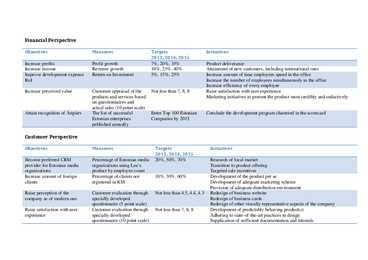
Financial PerspectiveObjectives Measures Targets Initiatives 2013, 2014, 2015Increase profits
Profit growth 7%, 20%, 35%
Product deliverance
Increase
income Revenue growth
10%, 25%, 40%
Attainment of new customers,
including international
ones Improve development expense
Return on Investment
5%, 15%, 25%
Increase
amount of time employees spend in the office
RoI
Increase the number of employees simultaneously in the office
Increase efficiency of every employee
Increase
perceived value
Customer appraisal of the
Not less
than 7, 8, 8
Raise satisfaction with
user experience products and services based
Marketing initiatives to
present the product most credibly and seductively
on questionnaires and
actual sales (10 point
scale )
Attain recognition of Äripäev
The list of successful
Enter Top 100 Estonian
Conclude the development program chartered in the scorecard
Estonian
enterprises Companies by 2015
published annually
Customer PerspectiveObjectivesMeasuresTargetsInitiatives2013, 2014, 2015Become
preferred CRM
Percentage of Estonian media
20%, 50%, 70%
Research of local market
provider for Estonian media
organizations using Lee’s
Transition to product offering
organizations
product by employee
count Targeted
sale incentives
Increase amount of foreign
Percentage of clients not
10%, 30%, 60%
Development of the product per se
clients
registered in KM
Development of adequate marketing scheme
Provision of adequate distribution environment
Raise perception of the
Customer evaluation through
Not less than 4.5, 4.4, 4.3
Redesign of business website
company as of modern one
specially
developed Redesign of business cards
questionnaire (5 point scale)
Redesign of other visually representative aspects of the company
Raise satisfaction with user
Customer evaluation through
Not less than 7, 8, 8
Development of predictably behaving product(s)
experience
specially developed
Adhering to state-of-the-art
practices in design
questionnaire (10 point scale)
Supplication of sufficient documentation and tutorials
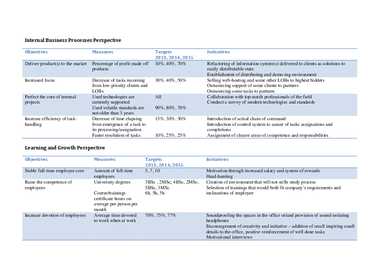
Internal Business Processes PerspectiveObjectivesMeasuresTargetsInitiatives2013, 2014, 2015Deliver product(s) to the market
Percentage of profit made off
10%, 40%, 70%
Refactoring of information system(s)
delivered to clients as solutions to
products
easily distributable state
Establishment of distributing and
demo -ing environment
Increased focus
Decrease of tasks
incoming 30%, 40%, 50%
Selling web-
hosting and some other LOBs to
highest bidders
from low-priority clients and
Outsourcing support of some clients to partners
LOBs
Outsourcing some tasks to partners
Perfect the core of internal
Used technologies are
All
Collaboration with top-notch professionals of the field
projects
currently supported
Conduct a
survey of modern technologies and standards
Used volatile standards are
90%, 80%, 70%
not older than 3 years
Increase efficiency of
task -
Decrease of time elapsing
15%, 30%, 30%
Introduction of actual chain of command
handling from emergence of a task to
Introduction of
control system to assure of tasks assignations and
its
processing /assignation
completions
Faster resolution of tasks
10%, 25%, 25%
Assignment of clearer areas of competence and responsibilities
Learning and Growth PerspectiveObjectivesMeasuresTargetsInitiatives2013, 2014, 2015Stable
full -time employee core
Amount of full-time
5, 7, 10
Motivation through increased salary and system of rewards
employees
Head-
hunting Raise the competence of
University degrees
3BSc , 2MSc; 4BSc, 2MSc;
Creation of environment that will not stifle study process
employees
5BSc, 3MSc
Selection of trainings that would both fit company’s
requirements and
Course/trainings
6h, 5h, 5h
inclinations of employee
certificate hours on
average per person per
month Increase devotion of employees
Average time devoted
70%, 75%, 77%
Soundproofing the spaces in the office or/and provision of
sound -isolating
to
work when at work
headphones
Encouragement of creativity and initiative –
addition of small inspiring small
details to the office,
positive reinforcement of well
done tasks
Motivational interviews
3. IT Description3.1.Hardware EnvironmentThe hardware environment of Lee IS is comprised of following components:
Server
Laptops (
Dell x6) (two privately owned ones)
Work stations (one privately owned by an employee)
Telephone (
Philips )
Network devices: a router and a
switch Portable hard drives
Computer mice, keyboards (Logitech, Defender,
Microsoft )
Displays
Dock connectors (Dell x3)
3.2.Software EnvironmentAs the primary
technology the company is using is ASP.NET and as it is a
part of Microsoft
Partner Program the
majority of software originates from Microsoft:
Microsoft Visual
Studio 2012
Microsoft
Windows XP/7,
Microsoft Windows server 2012/2008 R2
Internet Information Services 7.5
Microsoft SQL Server 2008 R2
Microsoft .NET
Framework 4
Microsoft Visual SourceSafe(VSS)
Microsoft Office 2010
Microsoft
Lync 2010
Microsoft Silverlight 4
Other
important software includes, but is not limited to:
TortoiseSVN
Enterprise architect
GIMP 3.3.Working EnvironmentThe principle of care, which is amongst the values of the company, was applied to the working
space. Taken into
account limited recourses of the
startup , the office
rooms were selected and
furnished in such a way as to promote creative thinking and resourcefulness. The office is
located on the 27th floor overlooking the
vista of
medieval city and the gulf of Tallinn and is
equipped with climate controlling devices, kitchenette and a
bathroom . The rooms receive
adequate amount of daylight and have sufficient means of artificial lightening installed. The
interior is sustained in
mild , natural, “
wooden ” colors. The working space is logically
divided into two sections by a
glass sound-non-isolating shutter; one
section has 3 individual tables of
adjustable height each equipped with the aforementioned 22’ displays and the other one - one big
conference table with a 40’ TV display
mounted on it, rendering the space perfect for meetings
and presentations.
Overall , the office can comfortably accommodate up to 6 people working
simultaneously. Vast majority of chairs are
alas unadjustable.
3.4.ProjectsSupported Projects:Though Lee’s main specialization is to be shifted from domain of providing individual solutions,
values and principles, as well as
economic considerations, prompt the company to continue
support of a number of projects, such as:
AdSail – CRM for media companies
Woodpecker – core IS for
timber trade companies
WebMountain platform development
Estonian Defense Forces field training booking system
European
Patent Office project
Monitek – core IS for traders in metal-parts industry
Deprecated and other projects: Website hosting
Customer support
Figure Friends (
throughout the Baltic States and
Finland )
“IT Koolitus” booking system
Estonian Patent Office core IS
Siemens Estonia Inc. project
Estonian Ministry of Foreign Affairs project
Estonian Ministry of
Agriculture project
Balsnack Inc. project
Baltcom Inc. project
Elektrum Inc. project
3.5. Outsourced Services
Web-design and layouts
Training
Communication (telephone, internet)
Server capacity from
Amazon Hardware
maintenance 3.6.StructureAs the scale of the company is
really miniature there is no defined structure per se. The head of
the IT department – who is also the product
owner and, effectively, the head of the company and
a chairman on
board of directors – presides over vast majority of large-scale IT projects the
company is involved in. All other employees of IT department
report to him. Interning
students ,
if present, get attached to one of the two programmers and do their bidding and operate under
their guidance and tutelage. The programmers generally have certain long-standing projects
attached to them and deal with
further developments and user support in their respective areas of
responsibility. All the IT personnel are involved in advancing the WebMountain platform.
People from other departments of the company, if bidden to
perform some tasks from the realm
of IT department, are reporting directly to the head of IT department,
unless he
places their
expertise directly at one of the programmers’ disposal. As that of a start-up the robustness and
potential of the company is largely in the
ability of its
team to self-regulate which is
expected of
Lee IS’s employees.
3.7.Management ProcessDue to the small scale of the company and its through and through IT nature it is hardly possible
to
draw a defining line between management of the
whole company and IT constituent of it.
Day-to-day management of IT department proceeds in the following way – every week (every
other week at worst) the
backlog of tasks is re-evaluated, had the new tasks/projects emerged,
they’re added to the list and the list is re-prioritized. Ensuing activity is the manning of the tasks
– tasks. This is a joint
venture of head of IT department and marketing assistant. It is also
encouraged for employees to propose improvements and initiatives of their own, especially as
some of them are involved in project managing for some significant customers, although it is
generally advisable to
inform the prioritizing team about such incentives to keep the
picture in
accordance with the real state of things. Periodic reports on accomplishments are also customary.
The control part of the conventional cycle is not,
however , strictly enforced and happens
haphazardly. Should unsatisfactory execution of a task be detected it is discussed by the head of
IT department with the
responsible employee and it is
assured that the
latter is made
aware of
advisable improvements to the execution. As has been mentioned
before , a lot of
stock is put into
ability of employees to govern themselves and adhere to practice of care and devotion.
4. Development Program4.1.ExpensesTypical expenses of IT department can be divided into following categories:
Employee’s monthly salaries
Personal hardware and peripherals (notebooks, displays, keyboards, computer mice etc.)
Professional development (courses, trainings etc.)
Additional hardware procurement (network devices such as routers, switches; cables,
portable hard drives etc.)
Expenses associated with the upkeep of servers (both
native ones and in the
cloud )
Support services
Recruitment
Communication expenses (internet provision, telephone calls)
Cost of software licenses
4.2.Outstanding Tasks and Projects
Upgrading ÕL version of AdSails to the current stable demo condition
Urgent elementary
update of native design of WebMountain
Analysis and implementation of new functionality for AdSails (private ads, localization,
activity threads, salary calculation, accounting system’s integration,
integrated user help)
Transferring the WebMountain core from Amazon’s server to a native server
Providing updates to EDF (Estonian Defense Forces)
Implementation of additional functionality for
Nation Davis (
menu , partner
access )
Analysis and implementation of new functionality for Monitek (integration o
storage environment)
European Patent Office project
Verification and further testing of usability of design of AdSails’ present
functions 4.3.SWOT Analysis of the IT DepartmentStrengthsWeaknessesITS1: IT specialty
ITW1: No
incentive to use
corporate IS or
ITS2: Majority of
workers are very
email as they are inefficient and unattractive
experienced in IT domain
ITW2: Absence of documentation
ITS3: Good
developing equipment of
ITW3: Absence of integration of bookkeeping
employees (business notebooks)and of the
into the IS
office
ITW4: The WebMountain is very old core of
ITS4: Licensed software necessary for
the system, not compliant with contemporary
successful development
UI design approaches
ITS5: Functioning inner IS
ITW5: Absence of (postgrad) formal IT
ITS6: Agility and closeness of the team, as it
education of some core workers
consists of a very few people
ITW6: Limited work capacity due to small
ITS7: Very own web-server
number of employees and low motivation
ITS8: Direction board consists of IT savvy
people,
therefore no background-conditioned
communication problems
OpportunitiesThreatsITO1: Hire some more competent workforce
ITT1: Only one server, without
emergency that would be
able to work on site in the
replacement
office
ITT2: Dependency on a very small number of
ITO2: Upgrade the internal Information
people who actually
know how everything
system to the contemporary core
works ITO3: Upgrade developers’ laptops to state of
ITT3: Possible need to outsource
the art ones
ITT4: Miscommunication due to
ITO4: Unify
intra -organizational
inconsistency of preferred communication
communication
ways methods
ITO5: Upgrade part-time IT employees to full
ITT5: Possible inefficiency of work since
working time
developers are working from home
ITO6: Secure a reliable service for backing-up
ITO7: Enforce documentation practices
ITO8: Bring WebMountain to contemporary
state
ITO9: Refactor project(s) into product(s)
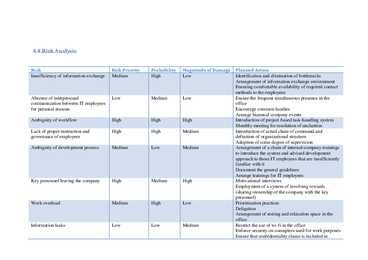
4.4.Risk AnalysisRiskRisk Priority Probability Magnitude of Damage Planned ActionInsufficiency of information
exchange Medium High
Low
Identification and elimination of bottlenecks
Arrangement of information exchange environment
Ensuring comfortable availability of required contact
methods to the employees
Absense of interpersonal
Low
Medium
Low
Ensure the
frequent simultaneous presence in the
communication between IT employees
office
for personal reasons
Encourage common lucnhes
Arrange biannual company
events Ambiguity of workflow
High
High
High
Introduction of project-based task-handling system
Monthly
meeting for resolution of unclarities
Lack of proper instruction and
High
High
Medium
Introduction of actual chain of command and
governance of employees
definition of organizational structure
Adoption of some
degree of supervision
Ambiguity of development process
Medium
Low
Medium
Arrangement of a chain of internal-company trainings
to introduce the system and advised development
approach to those IT employees that are insufficiently
familiar with it
Document the general
guidelines Arrange trainings for IT employees
Key personnel leaving the company
High
Medium
High
Motivational interviews
Employment of a system of involving rewards
(
sharing ownership of the company with the key
personnel)
Work
overload Medium
High
Low
Prioritization practices
Deligation
Arrangement of resting and
relaxation space in the
office
Information leaks
Low
Low
Medium
Restrict the use of wi-fi in the office
Enforce
security on comupters used for work purposes
Ensure that confedentiality clause is
included in
employment contracts
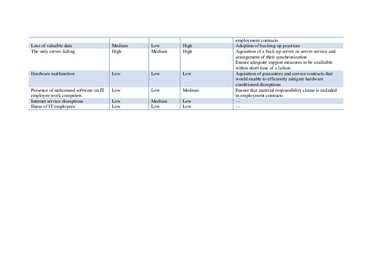
Loss of valuable data
Medium
Low
High
Adoption of backing-up practices
The only server failing
High
Medium
High
Aquisition of a back-up server or server-service and
arrangement of their synchronization
Ensure adequate support measures to be availiable
within short time of a failure
Hardware malfunction
Low
Low
Low
Aquisition of guarantees and service contracts that
would
enable to efficiently mitigate hardware
conditioned disruptions
Presence of unlicensed software on IT
Low
Low
Medium
Ensure that material responsibility clause is included
employee work computers
in employment contracts
Internet service disruptions
Low
Medium
Low
---
Ilness of IT employees
Low
Low
Low
---
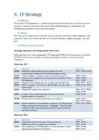
5. IT Strategy5.1.MissionThe mission of IT department is to deliver elegant software solutions that will effectively solve
customer’s problems and cater to their
needs while adhering to privacy requirements and
facilitating the principles of care and responsibility.
5.2.VisionThe vision of IT department is to
provide software solutions unrivaled in their compliance with
customers’ needs and to ensure that the use of catered solutions is highly gratifying to the end
user.
5.3.IT Balanced Score Card Strategic Objectives of IT Department 2013-2015Following objectives of the organization’s IT department (
LITO ) have been drawn on the basis
of SWOT analysis and are meant to exploit opportunities in order to overcome internal
weaknesses
Objectives 2013IDObjectiveSWOT IDLITO1 Establish a reliable and accepted standard for
inter -
ITW1, ITO2, ITO4
organizational communication and information sharing
LITO2 Switch company’s
official e-mail to gmail for businesses
ITW1, ITO4
LITO3 Initiate active upgrade and simultaneous documentation of the
ITW2, ITW4,
WebMountain
ITO7, ITO8
LITO4 Integrate book-
keeping and task-tracking into the native IS
ITO2, ITW1, ITW2
LITO5 Deliver a product software in a distributable and marketable
ITW6, ITO9, ITO7
(demo) state
LITO6 Arrange IT-trainings for employees
ITO5, ITO3, ITW6,
ITW4, ITW5
LITO7 In joint venture with marketing work out
assessment ITW4, ITO8
questionnaires for customers
LITO8 Introduction of designing guidelines and standards
ITW4, ITW2,
ITO1, ITO2, ITO7
LITO9 Increase amount of accumulated work-hours of IT department,
ITO5, ITO1, ITW6
either by hiring new personnel or – preferably – increasing the
workload of part-time programmers and
having them become
full-time employees
Objectives 2014IDObjectiveSWOT IDLITO1 Upgrade the native IS to state of being preferred
ITW1, ITW4,
intraorganizational communication
method ITO2, ITO4
LITO2 Have upgrading of WebMountain to a new generation and its
ITW2, ITW4,
adequate documentation completed
ITO7, ITO8
LITO3 Arrange IT-trainings for employees
ITO5, ITO3, ITW6,
ITW4, ITW5
LITO4 Render project management more efficient and standardized
ITW6, ITO4, ITO7
process
LITO5 Obtain automatic backing-up device and set up the
regular ITO6
procedure
LITO6 Arrange opportunities for mid-day
power -
naps for programmers
ITW6
LITO7 Encourage and facilitate opportunities for employees for
ITW5
procuring postgraduate university degrees
LITO8 Upkeep end-user questionnaires
ITW4, ITO8
LITO9 Expand IT-department to 4-5 full-time programmers
ITO5, ITO1, ITW6
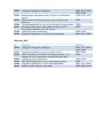
Objectives 2015IDObjectiveSWOT IDLITO1 Arrange IT trainings for employees
ITO5, ITO3, ITW6,
ITW4, ITW5
LITO2 Upgrade the notebooks to the state-of-the-art ones.
ITO3, ITW6
LITO3 Secure luxuriously comfortable working environment – two
ITW6
displays for every programmer, inspiring relaxation space
LITO4 Upkeep end-user questionnaires
ITW4, ITO8
LITO5 Move the IT department to a new, more
spacious office
ITW6
LITO6 Expand IT-department to 7-8 full-time programmers
ITO5, ITO1, ITW6
LITO7 Introduce more products to the market
ITW6, ITO9, ITO7
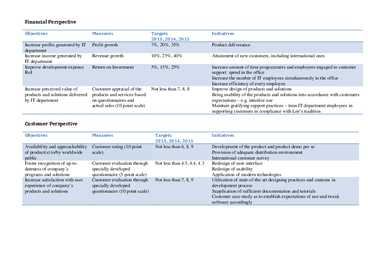
Financial PerspectiveObjectivesMeasuresTargetsInitiatives2013, 2014, 2015Increase profits generated by IT
Profit growth
7%, 20%, 35%
Product deliverance
department
Increase income generated by
Revenue growth
10%, 25%, 40%
Attainment of new customers, including international ones
IT department
Improve development expense
Return on Investment
5%, 15%, 25%
Increase amount of time programmers and employees engaged in customer
RoI
support spend in the office
Increase the number of IT employees simultaneously in the office
Increase efficiency of every employee
Increase perceived value of
Customer appraisal of the
Not less than 7, 8, 8
Improve design of products and solutions
products and solutions delivered
products and services based
Bring usability of the products and solutions into accordance with customers
by IT department
on questionnaires and
expectations – e.g. intuitive use
actual sales (10 point scale)
Maintain gratifying support practices –
train IT department employees in
supporting customers in compliance with Lee’s
tradition Customer PerspectiveObjectivesMeasuresTargetsInitiatives2013, 2014, 2015Availability and approachability
Customer rating (10 point
Not less than 6, 8, 9
Development of the product and product demo per se
of product(s) to/by worldwide
scale)
Provision of adequate distribution environment
public
International customer survey
Foster recognition of up-to-
Customer evaluation through
Not less than 4.5, 4.4, 4.3
Redesign of user-interface
dateness of company’s
specially developed
Redesign of usability
programs and solutions
questionnaire (5 point scale)
Application of modern technologies
Increase satisfaction with user
Customer evaluation through
Not less than 7, 8, 9
Utilization of state-of-the art designing practices and customs in
experience of company’s
specially developed
development process
products and solutions
questionnaire (10 point scale)
Supplication of sufficient documentation and tutorials
Customer
case -study as to establish expectations of use and tweak
software accordingly
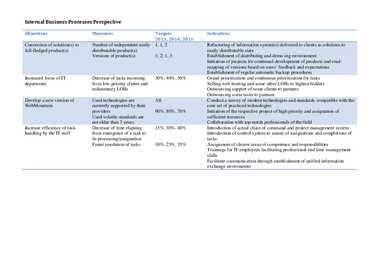
Internal Business Processes PerspectiveObjectivesMeasuresTargetsInitiatives2013, 2014, 2015Conversion of solution(s) to
Number of independent easily
1, 1, 2
Refactoring of information system(s) delivered to clients as solutions to
full-fledged product(s)
distributable product(s)
easily distributable state
Versions of product(s)
1; 2; 1, 3
Establishment of distributing and demo-ing environment
Initiation of projects for continued development of products and
road -
mapping of versions based on
users ’ feedback and expectations
Establishment of regular automatic backup procedures
Increased focus of IT
Decrease of tasks incoming
30%, 40%, 50%
Grand prioritization and continuous prioritization for tasks
department
from low-priority clients and
Selling web-hosting and some other LOBs to highest bidders
rudimentary LOBs
Outsourcing support of some clients to partners
Outsourcing some tasks to partners
Develop a new version of
Used technologies are
All
Conduct a survey of modern technologies and standards compatible with the
WebMountain
currently supported by their
core set of practiced technologies
providers
90%, 80%, 70%
Initiation of the respective project of high priority and assignation of
Used volatile standards are
sufficient resources
not older than 3 years
Collaboration with top-notch professionals of the field
Increase efficiency of task-
Decrease of time elapsing
15%, 30%, 40%
Introduction of actual chain of command and project management system
handling by the IT
staff from emergence of a task to
Introduction of control system to assure of assignations and completions of
its processing/assignation
tasks
Faster resolution of tasks
10%, 25%, 35%
Assignment of clearer areas of competence and responsibilities
Trainings for IT employees facilitating professional and time-management
skills
Facilitate communication through establishment of unified information
exchange environment
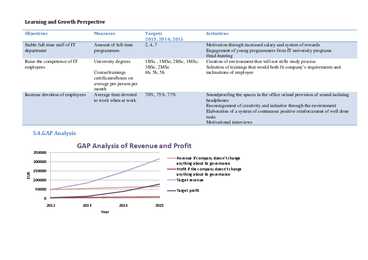
Learning and Growth PerspectiveObjectivesMeasuresTargetsInitiatives2013, 2014, 2015Stable full-time staff of IT
Amount of full-time
2, 4, 7
Motivation through increased salary and system of rewards
department
programmers
Engagement of young programmers from IT university programs
Head-hunting
Raise the competence of IT
University degrees
1BSc , 1MSc; 2BSc, 1MSc;
Creation of environment that will not stifle study process
employees
3BSc, 2MSc
Selection of trainings that would both fit company’s requirements and
Course/trainings
6h, 5h, 5h
inclinations of employee
certificates/hours on
average per person per
month
Increase devotion of employees
Average time devoted
70%, 75%, 77%
Soundproofing the spaces in the office or/and provision of sound-isolating
to work when at work
headphones
Encouragement of creativity and initiative through the environment
Elaboration of a system of continuous positive reinforcement of well done
tasks
Motivational interviews
5.4.GAP AnalysisGAP Analysis of Revenue and Profit250000
Revenue if company doesn't
change 200000
anything about its governance
150000
Profit if the company doesn't change
Ranything about its governance
EU 100000 Target revenue
50000
Target profit
0
2012
2013
2014
2015
Year State of the play: IT department is functioning on project-per-client basis
IT department has 2 full-time employees and 3 employees involved in execution of IT
department’s tasks are working part-time
The clientele of the company consists predominantly of local customers
The majority of company’s current developments are based on WebMountain, a platform
the
greater portion of whose code
dates back to 2005
Usability and
aesthetics of IT department’s output comply with expectations and comfort
of
tech -centric individuals
Important information and files
bound to be easily accessible by all employees of IT
department are stored in 4 different password protected environments
Company’s projects and WebMountain are virtually undocumented, not even by test
cases IT department is dealing with development and support of a multitude of different
projects at a time
Desirable scenario : IT department has products that are in demand and approachable by a broad
audience IT department is
manned by at
least 6
motivated full-time programmers
The products of the company are subscribed to by worldwide audience
Company’s products are based on a natively developed platform, WebMountain, which is
a state of the art advancement
Design of company’s products is extremely user-
friendly and products behave
predictably for the end-user
IT department uses a unified sharing and communication environment
Company’s products have quality user guides and integrated help, WebMountain
platform is adequately documented
IT department is focused on development and support of a small number of large-scale
projects
6. Infrastructure6.1.ComputersAt present there are 4 business-
class notebooks at the disposal of organization’s IT department:
Dell (Windows XP Professional Service pack 3)
Dell (Windows 7 Professional)
Dell (Windows XP Professional)
Dell XPS15z (Windows 7 Professional)
The office space is also facilitated with 3 dock-type connectors
hooked to 3 Dell P2211 22-inch
monitors.
Since the organization is developing products using Microsoft technologies, its clients are bound
to
purchase MS software products and therefore qualifies for Microsoft Partners program. Being
a part of this program the organization possesses licenses to all MS products for its internal
usage.
6.2.ServersThe organization owns exactly one web server of following make and capacity:
Dell PowerEdge 2008 (Intel Xeon(R) 2,33 GHz, 3,37GB RAM)
The organization also makes use of the Amazon Web Services - cloud computing solution and
rents out server capacity from AWS.
6.3.Network DevicesThe
connection with the internet is secured by the TeleWell TW-EA862
modem , provided by
Elisa , who is organization’s Internet Service Provider. The connection is symmetric (!!!) in
speed values:.
6.4.EmployeesThe IT department consists primarily of 4 people with a variable set of
experiences , knowledge
and responsibilities. In general, these are set of roles and duties performed by each person of the
IT department.
The head of the IT department:
Product Owner
Managing customer requirements, including establishment and change thereof
Selection of the development direction for the IT department, e.g. adoption of new
technologies and techniques.
System architect
Project
manager Decision on which IT trainings and conferences employees should attend
Developer of the IT department(x2):
Occasional project management
Module programming
Analysis of requirements and their sensible implementation
Customer support
Customer training
Assisting employees from
outside the IT department
Intern at the IT department:
Minor debugging
Minor uncritical ICT-
related tasks
Remaining employees – financial manager and marketing assistant – are well familiar with ICT
and both have university degrees in Computer
Science . Therefore their IT competence is quite
high for the IT-related tasks they are to perform:
obtaining domain
names dealing with registrars
web redirecting
tweaking css and html
handling minor rework of php code to get the website up properly on a foreign CMS
cms-based management of organization websites
documentation of products
usability testing
Employees frequent various conferences, workshops and conventions
aimed at improving their
skills and broaden the knowledge of state of the art technologies and approaches. The IT related
events and workshops visited this year include (but are not limited to) Agile Saturdays, monthly
Devclub workshops and TechDay 2011.
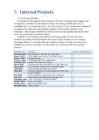
7. Internal Projects7.1.Training Schedule
As the nature of development of the company’s IT core is so
dynamic and is largely to be
developed by multitude of future-dependant factors, the training schedule may only be
established for a very foreseeable future. Also, the
fact that as of yet commissioned trainings do
not appear to be in the zone of proximal development of the company enforces certain
limitations – only trainings scheduled by external
sources can be regarded and naturally these
tend to be announced for immediate months.
In addition to the trainings and qualification enriching practices in the table below,
attendance of monthly DevClub seminars and quarterly Agile Saturdays is to be strongly
encouraged. Moreover, as needed, there are company seminars to be
held to introduce and
establish new practices, standards or to educate the new employees in the Lee’s general
practices.
Scheduled forTrainingNumber of ParticipantsDecember 2012Specification by Example by Gojko Adzic
1
January 2013Web Application Security: Client-Side
Attacks 2
January 2013Market research
1
February 2013Developing .NET Web Applications
2
February 2013Interface and Interaction Design
3
March 2013Administering Microsoft SQL Server 2012
Databases 1
March 2013User-Centered Analysis and Conceptual Design
3
April 2013Querying Microsoft SQL Server 2012
2
May 2013Estonian Conference for Small Businesses 2012: from
1
Small to Bigger!
May 2013Public appearance, speech and
voice modulation
1
July 2013Microsoft Worldwide Partner Conference 2013
1
September 2013How to Motivate Yourself and Others?
2
October 2013Born to be
Global 3
October 2013Microsoft TechDay 2013
2
November 2013TopConf 2013
2
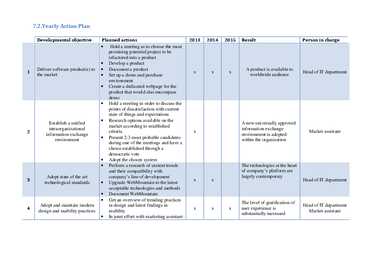
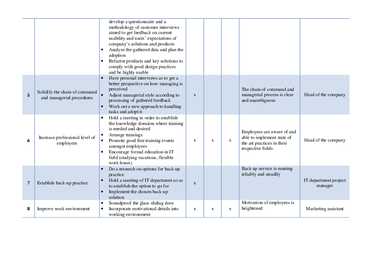
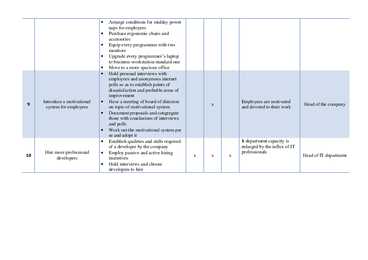
7.2.Yearly Action PlanDevelopmental objectivePlanned actions 2013 2014 2015 Result Person in charge
Hold a meeting as to
choose the most
promising potential project to be
refactored into a product
Develop a product
1Deliver software product(s) to
Document a product
A product is
available to
x
x
x
Head of IT department
the market
Set up a demo and purchase
worldwide audience
environment
Create a dedicated webpage for the
product that would also encompass
demo
Hold a meeting in order to discuss the
points of dissatisfaction with current
state of things and expectations
Research options available on the
Establish a unified
A new universally approved
market according to established
2intraorganizational
information exchange
criteria x
Market assistant
information exchange
environment is adopted
Present 2-3 most probable candidates
environment
within the organization
during one of the meetings and have a
choice established through a
democratic vote
Adopt the chosen system
Perform a research of current trends
The technologies at the heart
and their compatibility with
of company’s platform are
3Adopt state of the art
company’s line of development
largely contemporary
x
x
Head of IT department
technological standards
Upgrade WebMountain to the latest
acceptable technologies and methods
Document WebMountain
Get an
overview of trending practices
The level of gratification of
4Adopt and maintain modern
in design and latest findings in
Head of IT department
x
x
x
user experience is
design and usability practices
usability
Market assistant
substantially increased
In joint effort with marketing assistant
develop a questionnaire and a
methodology of customer interviews
aimed to get feedback on current
usability and users’ expectations of
company’s solutions and products
Analyze the gathered data and plan the
adoption
Refactor products and key solutions to
comply with good design practices
and be highly usable
Have personal interviews as to get a
better perspective on how managing is
perceived
The chain of command and
5Solidify the chain of command
Adjust managerial style according to
x
managerial process is clear
Head of the company
and managerial procedures
processing of gathered feedback
and unambiguous
Work out a new approach to handling
tasks and adopt it
Hold a meeting in order to establish
the knowledge domains where training
is needed and desired
Employees are aware of and
Arrange trainings
6Increase professional level of
able to
implement state of
Promote good free training events
x
x
x
Head of the company
employees
the art practices in their
amongst employees
respective fields
Encourage formal education in IT
field (
studying vacations, flexible
work hours)
Do a research on options for back-up
Back up service is
running practice
reliably and steadily
7 Hold a meeting of IT department so as
IT department project
Establish back-up practice
x
to establish the
option to go for
manager
Implement the chosen back-up
solution
Soundproof the glass sliding
door Motivation of employees is
8Improve work environment
Incorporate motivational details into
x
x
x
heightened
Marketing assistant
working environment
Arrange
conditions for
midday power
naps for employees
Purchase ergonomic chairs and
accessories Equip every programmer with two
monitors
Upgrade every programmer’s
laptop to business-workstation standard one
Move to a more spacious office
Hold personal interviews with
employees and
anonymous internet
polls so as to establish points of
dissatisfaction and probable areas of
improvement
9Introduce a motivational
Have a meeting of board of directors
Employees are motivated
x
Head of the company
system for employees
on topic of motivational system
and devoted to their work
Document
proposals and congregate
those with conclusions of interviews
and polls
Work out the motivational system per
se and adopt it
Establish
qualities and skills required
It department capacity is
of a developer by the company
enlarged by the influx of IT
10Hire more professional
Employ passive and active hiring
professionals
x
x
x
Head of IT department
developers
incentives
Hold interviews and choose
developers to hire
 100 punkti
Autor soovib selle materjali allalaadimise eest saada 100 punkti.
100 punkti
Autor soovib selle materjali allalaadimise eest saada 100 punkti.
 ~ 24 lehte
Lehekülgede arv dokumendis
~ 24 lehte
Lehekülgede arv dokumendis
 2013-05-21
Kuupäev, millal dokument üles laeti
2013-05-21
Kuupäev, millal dokument üles laeti
 58 laadimist
Kokku alla laetud
58 laadimist
Kokku alla laetud
 1 arvamus
Teiste kasutajate poolt lisatud kommentaarid
1 arvamus
Teiste kasutajate poolt lisatud kommentaarid
 Alysanne
Õppematerjali autor
Alysanne
Õppematerjali autor
 annaabi.ee




















Kõik kommentaarid