Miina Härma Gümnaasium
“The aborigines of
Australia Student :Kärt
Erikson Teacher:
Tiia Timma
Tartu 2010
contents2
IntroductionI
selected this
theme because it was the most
interesting one for me.
Aborigines have interested me for a long time now so doing this
essay is
really fun for me.
Australian Aboriginal culture is one of the world's
longest surviving
cultures .
Australian
Aborigines, also
known as Indigenous Australians , are the
native people of
Australia . Many of
them suffered when white people from
Britain arrived in Australia, because of
disease , the loss of their
hunting lands,
and unfair
laws .
Australian
Aborigines
are
those people regarded as indigenous to the Australian
continent .
In the High Court of
Australia, Australian Aborigines have been specifically identified as
a group of people who
share , in common,
biological ancestry
back to
the
original occupants of the continent.
HistoryThe
first people of Australia were nomadic people who
came to Australia
from
south -
east Asia .
Scientists don't
know exactly when they arrived but it is somewhere
between 40000 and
60000 years ago. When British came to Australia in
1788, they called
these native people “aboriginals”,
meaning people who had lived
there since the earliest
times .
Captain James
Cook set the
colonization of Australia into motion by exploring and
mapping the
fertile eastern coast of Australia, but he was not the first to
visit Australia. There is
evidence suggesting Aborigines in
northern Australia maintained trade with some of the Indonesian islands
closest to the coast. Chinese and
Arab 's may have had contact with
the Aborigines in the 15th
century .
When British people came to
live in Australia, they decided that the
land was empty, that there were no people
living there. This was
called "
Terra nullius", Latin
words for "empty land".Under British law, all land belongs to the
king ,who is then able to sell it to
other people. The
sacred sites and other land which had belonged to aboriginal people for thousands
of years were simply taken from them. If they did not leave
peacefully then the new
settlers used
force to get them to leave.
Many aboriginal people were
killed during the settlement of
Australia. The aborigines that were left were made to live on in
special areas , reservations, that the
government set aside for them.
One of these was at Lake
Tyers, Victoria.
Many
church groups set up
missions , to
both look after the
aborigines, and to
3
convert them to Christianity.
With
the help of aboriginal lawyers, aboriginal Australians have battled
to get some of their land back. In 1976, the Australian government
agreed that aboriginal people have rights to their tribal
territories, and some land was
given back. On 3
June , 1992, the High
Court of Australia said
that the
idea of "Terra nullius" was
wrong , and the
government
brought in new laws, to set up Native Title. If aborigines
can
prove they have always used
particular land, it has not been
sold, or changed by government
acts , then the land
could be
claimed as aboriginal land.
ReligionThe
Aboriginal religion is
based heavily on the Dreaming. The Dreaming is
the Aboriginal
creation story. Aborigines believe that at the
beginning of time the world was a shapeless mass of
nothing ,
waiting to be transformed into what we see
today . The mythic beings called
the ancestors arrived, the ancestors took many shapes,
although most
commonly they were great serpants. The ancestors began to
travel across the world
shaping the
landscape and creating new life as they
went . Every
major geographical feature in Australia has an aboriginal
story to
explain it. The Dreaming
gets very abstract, it turns
almost into
another dimension. Aborigines believe that they are constantly
living in the Dreaming and that every time they do
something they
leave an impression on the other reality. The
Ancestor Spirits and their powers have not
gone , they are
present in
the
forms in to which they changed at the end of the 'Dreamtime' or
'Dreaming', as the
stories tell . The stories have been handed down
through the
ages and are an
integral part of an Indigenous
person 's
'Dreaming'.
The ancestors of the
aborigines come in all shapes and sizes, in some
ways they are very
similar to
Greek Gods and
Goddess ', in that they
usually represent a
certain theme.
Such as the sky, or water. During the Dreaming the
ancestors criss-crossed Australia shaping the land into its
current state as the went. The Aborigines also
consider certain
constellations to be ancestors .
Death was always a time of sorrow and supernatural fear
among traditional ATSI people(Aboriginal
and
Torres Strait Islander people.)
.
Wailing or crying was a common occurrence among the mourners who
often painted their bodies with pipe clay, red ochre, or charcoal
when a relative or
friend died. In some districts people wore a head
covering made of feathers.
Others beat their bodies with sticks or
clubs , or cut themselves with shells or stone knives to
cause bleeding. In these instances the
period of sorrow or mourning, was
considered to be at an end when their wounds were
healed . Relatives
and
close friends often sat beside a
grave of a deceased person, but
this was
related to their superstitious beliefs.
4
Sitting beside a grave -
sometimes shaded with a hut or covering to
provide shelter for the
mourner or mourners - involved ensuring that the deceased person's
spirit had gone to the 'sky
camp ' or to its spirit-
place . Obviously
it is impossible to say 'how' they knew or considered when this
happened.
However after the mourning period was completed, a deceased
person's name was
never mentioned
again . This often involved
inventing new words for totems but was based on their superstitious
beliefs in a personal spirit and ghosts.
The
belief in a personal
spirit was based on the Dreamtime stories that told the people that
birth was the
result of a spirit-
child entering a
woman 's
body . Or in
some parts of the
country , birth had been an act of the creators.
The
Aborigines considered some
places to be sacred. In some parts of
Australia the
tribes called the places where initiation ceremonies
were
held ,
bora grounds . They were called Buna grounds in other parts
of the country, but the sites were not randomly chosen and were used
for thousands of years by the
tribe . The bora
ground itself was
identified by two circles that were drawn on the ground or were
formed by rocks or pebbles. The circles were connected by a path and
other
symbols were drawn into the earth or carved into trees
near the
grounds. These symbols were
highly significant in ceremonies and also
warned people (
women and uninitiated youths and strangers), to
stay away from the area.
The
people also believed that a person's spirit could visit living people
to
harm or warn them of danger. This usually resulted in a '
inquiry '
about the death of a person who was considered to have died
prematurely or in
unusual circumstances. The inquiry - usually
undertaken in consultation with an
Elder or a
Clever Man - looked for
actions undertaken by some person that had caused the death of an
individual . Any culprit was severely punished. The belief in a person
spirit also led the people to take great precautions in the
burial or
cremation of the deceased.
Because
Aboriginal society was very
spiritual (in the
sense that spirits were
thought to have made the land and were
responsible for birth and
sometimes death),it is not surprising that Aboriginal people
'believed' in
magic . It
was practised in a number of ways. For example through the pointing
of the bone ( “
singing someone ”) which was believed to cause
death. People who had been 'pointed' often died, not as a result of
the magic itself, but because of their belief that they would die,
death through superstition or imagination. In the
same way, people
were 'cured' of sickness and
illness through the use of magic
stones and crystals.
5
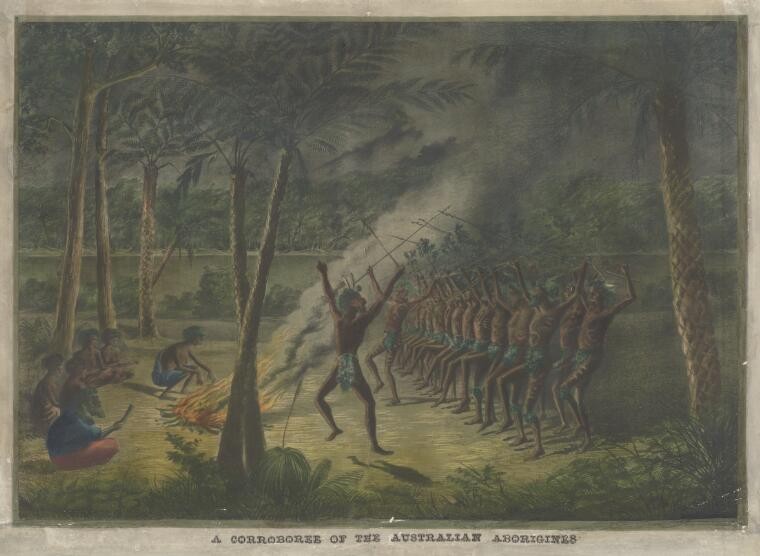
Aborigines held a
corroboreein which there were elements of music,
song and
movement that imitated or replicated
animal movements, hunting prowess,
battles or ceremonies of initiation that had
been
conducted for thousands of years. Corroborees are part of Aboriginal
culture. They were not simply dances, but were highly significant
events and belong to the Australian Aborigines. A
corroboree is a ceremonial
meeting of Australian Aborigines. The word
was coined by the European settlers of Australia in imitation of the
Aboriginal word caribberie. At a corroboree Aborigines interact with
the Dreamtime through
dance , music and costume. Many ceremonies act
out events from the Dreamtime. Many of the ceremonies are sacred and
people from
outside a community are not permitted to participate or
watch.
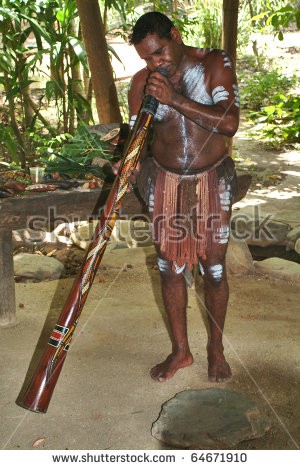
The Australian Aborigines used a limited variety of implements to
make musical sounds. The
didgeridoo (wind
instrument a bit like
trumpet) is probably the
best known, but others
included rattles,
clapping sticks and two boomerangs clapped together. However they do
not appear to have used drums, flutes and whistles. The melodies,
tunes, harmonies and rhythms of Aboriginal music included traditional
ceremonial
songs that were handed down from generation to generation.
It was very
important in Aboriginal thinking, to replicate the songs
that had been first played and
sung by the ancestors in the
Dreamtime. When the traditional music and songs were used, living men
considered themselves to be in the Dreamtime.
Particularly during
initiation ceremonies. However 'new songs' were created from time to
time. They told of important events in the history of the tribe.
Events such as great battles or hunting expeditions. Other songs and
music were for general amusement or entertainment and
early European
observations of the Aborigines included camp life where the people
played
games and
sang songs
around their camp fires.
Almost all of the Koori (preferred name of Australian aborigines)
shaman are initiated
within one large group, called "The
Dreamers". This is due to the
fact that Australia has some of
the strongest, and chaotic magic, around. All of the shaman are
needed to put a
check on that chaos. A Koori shaman
takes only a
small
penalty for some tasks when astrally perceiving. As a trade off
they are unable to mask. Any magician (
full or adept) will
notice this, whether or not he can assence. Mundanes
even can tell when one
of The Dreamers has entered the
room . A Koori shaman will rarely
travel outside of Australia, the need is too great in the outback for
that.
White Australian shamans
cannot join the dreamers, but some are associated with the koori group.
6
The Australian aboriginal shamans
- "clever men" or "men of high
degree " -
described "celestial ascents" to meet with the "sky
gods". Many of the
accounts of ritualistic initiation bare
striking
parallels to modern day UFO
contacted and abduction lore. The aboriginal shamanistic "
experience of death and rising again" in the initiation of tribal "men
of high degree"
finds some fascinating parallels with modern day
UFO abduction lore. The "chosen one" (either voluntarily or
spontaneously) is set
upon by "spirits", ritualistically
"killed", and then experiences a wondrous journey
(generally an aerial ascent to a
strange realm) to met the "sky
god." He is restored to life -- a new life as the tribal shaman.
SocietyAboriginal
Australians were
social beings who lived in a number of social groups
sometimes called bands, clans, sub-tribes and tribes, but essentially
in a family or kinship group who were 1) of the same blood-line and
2) were related to other people through totems. The
larger social
unit known as a tribe, was made up of a number of
smaller social
units (clans and bands). A clan was a family group
made up of a grandfather and his
wife or wives, his
sons and their
wife or wives and their
children . A number of these groups formed a
tribe. The exact number of clans which comprised a tribe cannot be
said precisely, as this varied. The
clans which formed a tribe were those who believed in the same
Dreamtime creation stories,
spoke the same
language and celebrated
the same customs such as initiation rites.
Each
family group had a headman or Elder who was the
leader of the unit.
He decided when to
move camp and settled disputes. Every
tribe in Australia was
divided into a number of small social groups,
but for
marriage purposes, into two main groups sometimes called
marriage moieties. People didn't
marry outside of their group.
Marriage arrangements were made when children were very young and
sometimes
before they were born.
Elders
(who were usually
males ), were people who were considered to be
wise in tribal
knowledge and worldly
matters . They were leaders of family
or kinship groups who made decisions about
moving camp, when
boys would be initiated, when
girls would be
married and settled disputes
among other
members of the social unit.
Senior females were not considered to be Elders in traditional Aboriginal
society. However they did play important roles in tribal matters. For
example they decided when girls would undergo rituals in
preparation for marriage, conducted or organized ceremonies
including those that
males and children participated in (but not initiation ceremonies).
7
They also acted as midwives and
story-tellers.
Aboriginal lore(the facts and
stories about a particular
subject or topic) was an important and
vital aspect of community life. For example Aboriginal people learned
their 'laws' from those Dreamtime stories that informed the listeners
about acceptable and unacceptable behaviour together with the
punishment offenders
received . It also taught and guided the people
to
survive . Some stories informed them about the life
cycle of
birds ,
animals and
insects . Others (often called Song lines) were like
oral road maps and identified tracks that the people followed when moving
around their tribal territory or when visiting other tribes.
Aboriginal lore / law
required a
person who did not 'belong' to a particular area, to be invited or
granted permission , to enter into the territory of a tribe. In other
words, he or she could not simply wander into the land of another
tribe. To do so invited hostility that could result in the death of
the individual(for trespassing).
When someone
wanted to visit
another tribe, they carried a
message stick - a
piece of
bark or
timber that was decorated with symbols. These symbols have sometimes
been said to have been a written form of language. This is not
correct . But they were a form of passport that identified the intent
or authority of the bearer and '
communication ' took place verbally
(or by
sign language), between the '
stranger ' and those whom she/he
wanted to visit. "The
passing of a
boundary line by the blacks
of another territory was considered as an act of hostility against
the denizens of the invaded grounds, and
wars were frequently the
sequence of such transgressions."
Because of their believes there
were never any wars of conquest between Aboriginal tribes. They were
too superstitious to do this and living in the land of another tribe
would have involved them in living among strange and no
doubt hostile
spirits.
Indigenous
Aborigines
understood and cared for their
different environments and
adapted to them. It is the intimate knowledge of the land, its
creatures and
plants that
sits at the
core of traditional Aboriginal
culture. From this
deep and intricate understanding of their
environment, Aboriginal Australians have
developed many
plant and
animal based medicines. Land
was spiritual, but also an
economic resource as it provided the
people with food,
sources of
wood , fibre and glue for
making spears,
utensils and other implements. However the people respected these
aspects of their land and were environmentalists in the sense of
'
taking care' of the land through their practices of performing
increase ceremonies,
8
singing
'Song lines' and relationships with
flora and
fauna through a system
of totemic relationships. Aboriginal
people were social beings as they lived and gathered together in
family groups . Their camps were comprised of a number of gunyas
(bark huts), but the people also lived in caves or in the
open air.
Some camps were comprised of as few as 6 to 10 people
while in others
there were up to 400 people. No doubt the availability of food was a
factor in the
size of a camp.
The
Elder or Elders gunyah (hut) were situated in the
centre of the camp
and others spanned out in circles around the central hut. However,
the people often
slept in the open and in caves, so it is likely that
the Elder decided where he wanted to
sleep with his wife or wives and
everyone one
else spread -out from the
spot he had chosen. No doubt
some people were more important
than others and the most important
ones camped near the Elders.
The
Aborigines 'decorated' their bodies with personal decorations that
included pipe-clay and other e symbols that conveyed messages designs
or
patterns on their arms, legs and
upper body - particularly at
ceremonial times. The patters were not
random . In other words they
were symbols that conveyed messages e.g., they represented the totems
of individuals or denoted information about the tribe itself. The
Aborigines often used the fat of animals to
cover their bodies to
protect them from insects such as mosquitoes. Some
of the early Europeans considered that this practice '
gave them a
most unpleasant odour'. No doubt it did, but it also provided
effective
protection against insect stings.
Aborigines
had initiations. Boys
began a period of initiation from when they were 7 or 8 years of age.
The first initiation ceremonies they attended were
designed to make
them independent on their mothers and other females. At other
ceremonies and meetings with older males they were informed about the
history and customs of the tribe and were taught how to survive and
to be
dependent on other males. Initiation continued over a number of
years and boys gradually
acquired knowledge through learning stories,
attending ceremonies and through education by initiated males.
Girls
did not participate in initiation ceremonies. At puberty they were
married and went to live with their
husband . However, their mothers
and other women prepared them in knowledge about their bodies and
sexual intercourse. Ceremonies included ritual bathing, separation
from the main tribal group for varying periods of time and food
taboos.
The British
In
1770,
the Australian Aboriginals culture and way of life dramatically
changed when
Lieutenant James Cook took possession of the east coast
of Australia and
named it New South
Wales .
9
The
British colonisation of Australia began 18 years
later , which was a
catastrophic event for indigenous Australians. The Europeans spread
epidemic diseases such as chickenpox, smallpox, influenza and
measles .
The
British settlement then appropriated land and water resources from
the Australian Aborigine, and were ignorant in their assumption that
the semi-nomadic Aborigines could be driven off and made to live
somewhere else. In fact, the loss of 'traditional lands,' food
sources and water resources was a
fatal blow to the Aboriginal
communities, who
already weakened by disease, were then forced to
relinquish their deep spiritual and
cultural connection to their
land. As a
direct consequence of the 'invasion,' the enforced move
away from traditional areas adversely impacted upon Aboriginal
cultural and the spiritual practices which had been necessary for
maintaining the cohesion and well-being of the tribal group.
Settlers
also brought venereal disease (which reduced indigenous fertility and
birthrates) and introduced alcohol to the indigenous Aborigine and to
which the Aborigine had no
tolerance and the Aboriginal community had
no
prior experience in dealing with such issues. Substance abuse has
remained a chronic problem for indigenous communities ever since. The
combination of disease, loss of land and direct violence culled the
Aboriginal population by an
estimated 90% between 1788 and 1900.
The Australian Aborigines went through stages of being conquered
through an 'invasion' and taking of their lands. Many adapted to the
new lifestyle (when many became reliant on alcohol, tobacco and
handouts of food and
clothing ). However the settlers were often
contemptuous of the Aborigines and separated them from their society
and the people became the fringe dwellers of society. Others were
removed from their
families and placed into
institutions . From the
late 1830s the remnants of the tribes in the settled areas were moved
onto Reserves and Missions where they were '
managed ' by Whitemen and
were forbidden from teaching their children their language and
custom .
Today the Aborigines are in trouble. Many have left the their
traditional lifestyle, and have moved to suburbs. There is a 40%
unemployment rate in many Aborigines populations, in part because
Aborigines are widely discriminated against which
causes some people
not to
hire them. Even the
police and government discriminate against
aborigines. In many places
bars are segregated into different parts
for Aborigines or Aborigines
aren 't served at all. Some progress was
made recently when an Aboriginal woman was voted into Australia
parliament.
ConclusionIn the end we can say that
aboriginal culture being one of the world's longest surviving
cultures
10
is really interesting . It ´s original believes and
traditions makes
it one of the world´s unconventional culture. Their “dreamtimes”,
dances and music is very original and different from other cultures.
Aborigines took
good care of their land and land was spiritual and an
economic resource .
They also had good knowledge of the land, its creatures and plants.
Because of that they had developed many plant and animal based
medicines. There were no wars for territory because of their strong
believes that by
going into other peoples land they might make the
spirits angry. They also believed in magic and sometimes people were
cured or made sick
throw magic. When the British colonisation began
the aborigines lost their land and many of them got killed by new people and illnesses. Nowadays some aborigines have got their old
family land back but sadly so many of them probably will never get
their old family land back. This interesting culture is
fading but
hopefully there will be enough aborigines who want to continue those
old traditions.
Doing this was really fun and
interesting to me. I found out a lot of new things about aborigines
and their traditions. There were a lot of information about this
theme and the hardest part was selecting the usable important facts
out of other facts. If I would have had made this
report using all
the information about aborigines that I could find this report would
have been about twice as long as it is now, but every thing have it
´s
limits .
Thanks to this report I have learned a lot of new about
aborigines and I will probably bee
looking for new facts about them.
ResourcesAppendix12
http://www.google.ee/imgres?imgurl=http://remotetribes.com/images/tribe/aboriginals.jpg&imgrefurl=http://www.remotetribes.com/aborigines-tribe/&usg=__IOOG0EUR6esRpLVt8MWRAzz0P9E=&h=357&w=283&sz=44&hl=et&start=0&zoom=1&tbnid=XkT2keypRCYBWM:&tbnh=125&tbnw=115&prev=/images%3Fq%3Daborigines%2Bof%2Baustralia%26um%3D1%26hl%3Det%26biw%3D1248%26bih%3D839%26tbs%3Disch:1&um=1&itbs=1&iact=hc&vpx=126&vpy=54&dur=2874&hovh=252&hovw=200&tx=150&ty=163&ei=JEkOTb7kGcW38gO0gumEBw&oei=JEkOTb7kGcW38gO0gumEBw&esq=1&page=1&ndsp=32&ved=1t:429,r:0,s:0http://www.google.ee/imgres?imgurl=http://nla.gov.au/nla.pic-an8957137-v&imgrefurl=http://nla.gov.au/nla.pic-an8957137&usg=__vYNxwF9rTTQz91-94QmDl_F6qpQ=&h=411&w=540&sz=60&hl=et&start=192&zoom=1&tbnid=TYqF4wWzRV6JhM:&tbnh=159&tbnw=212&prev=/images%3Fq%3Dthe%2Baustralian%2Baborigines%26hl%3Det%26sa%3DX%26biw%3D1280%26bih%3D844%26tbs%3Disch:10,5935&itbs=1&iact=rc&dur=650&ei=bPoQTevPOMuZOu6V3LoJ&oei=NPkQTfDALdO38QPh85WEBw&esq=9&page=9&ndsp=21&ved=1t:429,r:14,s:192&tx=70&ty=117&biw=1280&bih=84412
http://www.google.ee/imgres?imgurl=http://www.janesoceania.com/australian_aboriginal_anthropology/aa1.jpg&imgrefurl=http://www.janesoceania.com/australian_aboriginal_anthropology/index1.htm&usg=__7HKwum48LfROj_0eNW61Kc27D8Y=&h=474&w=480&sz=80&hl=et&start=140&zoom=1&tbnid=IjhVbD6-VFccvM:&tbnh=152&tbnw=154&prev=/images%3Fq%3Daborigines%2Bof%2Baustralia%26um%3D1%26hl%3Det%26biw%3D1248%26bih%3D839%26tbs%3Disch:10,4446&um=1&itbs=1&iact=hc&vpx=132&vpy=348&dur=2083&hovh=223&hovw=226&tx=97&ty=96&ei=EUoOTcvgCMmgOvyBueEI&oei=JEkOTb7kGcW38gO0gumEBw&esq=4&page=7&ndsp=21&ved=1t:429,r:10,s:140&biw=1248&bih=839http://www.google.ee/imgres?imgurl=http://i58.photobucket.com/albums/g276/eddieraws/-1.jpg&imgrefurl=http://epidermic.blogspot.com/2007_05_01_archive.html&usg=__FXJBZ4QwpyCSbyVX_uP4aU6GuAA=&h=295&w=450&sz=16&hl=et&start=594&zoom=1&tbnid=a5vw62r-deGFbM:&tbnh=128&tbnw=196&prev=/images%3Fq%3Daborigines%2Bof%2Baustralia%26start%3D246%26um%3D1%26hl%3Det%26biw%3D1248%26bih%3D839%26output%3Dimages_json%26tbs%3Disch:11,19353&um=1&itbs=1&ei=oU0OTc7CL8idOvX9oIQJ&iact=hc&vpx=147&vpy=336&dur=94&hovh=156&hovw=238&tx=88&ty=59&oei=U00OTZCIJoWW8QPexuCEBw&esq=14&page=28&ndsp=22&ved=1t:429,r:0,s:594&biw=1248&bih=83912
http://www.google.ee/imgres?imgurl=http://image.shutterstock.com/display_pic_with_logo/512668/512668,1289233970,34/stock-photo-kuranda-australia-march-unidentified-aborigines-musician-does-a-didgeridoo-performance-in-64671910.jpg&imgrefurl=http://www.shutterstock.com/pic-64671910/stock-photo-kuranda-australia-march-unidentified-aborigines-musician-does-a-didgeridoo-performance-in.html&usg=__RCAVoVwvkuGDTmej7X1ELjWbdb8=&h=470&w=300&sz=91&hl=et&start=353&zoom=1&tbnid=HkA-XDCvEEMB8M:&tbnh=168&tbnw=113&prev=/images%3Fq%3Daborigines%2Bof%2Baustralia%26um%3D1%26hl%3Det%26biw%3D1248%26bih%3D839%26tbs%3Disch:11,11526&um=1&itbs=1&iact=hc&vpx=484&vpy=153&dur=1362&hovh=177&hovw=113&tx=77&ty=164&ei=jkwOTb_8E4WcOvevob8J&oei=akwOTc36O8G38QOAkLWDBw&esq=6&page=17&ndsp=24&ved=1t:429,r:2,s:353&biw=1248&bih=83913
 100 punkti
Autor soovib selle materjali allalaadimise eest saada 100 punkti.
100 punkti
Autor soovib selle materjali allalaadimise eest saada 100 punkti.
 ~ 13 lehte
Lehekülgede arv dokumendis
~ 13 lehte
Lehekülgede arv dokumendis
 2012-05-21
Kuupäev, millal dokument üles laeti
2012-05-21
Kuupäev, millal dokument üles laeti
 6 laadimist
Kokku alla laetud
6 laadimist
Kokku alla laetud
 0 arvamust
Teiste kasutajate poolt lisatud kommentaarid
0 arvamust
Teiste kasutajate poolt lisatud kommentaarid
 Kärt Erikson
Õppematerjali autor
Kärt Erikson
Õppematerjali autor
 annaabi.ee







Kõik kommentaarid