Tartu
Waldorf School
FINLAND Report
Johan
Mähar
Tartu
2008
Contentsp.
1.
Introduction ....................................................................................................1
2.
Nature and
geography .....................................................................................2
3.
Position and
size .............................................................................................2
4.
Climate............................................................................................................3
5.
Flora and
fauna ...............................................................................................4
6.
Main fields of
economy and
industry..............................................................5
7.
The
people......................................................................................................6
8.
Population......................................................................................................6
9.
Traditions and
culture.....................................................................................7
10.
History..........................................................................................................8
11. Conclusion ....................................................................................................9
12.
References....................................................................................................10
IntroductionI
chose finland because
there are
friendly people and beautiful nature.
Finland is bigger
than Estonia.
There lives over 5 milj. people.
Finland capital is Helsingi and there lives about 2 milj. people.
Highest top is 1328m. Finland is bordersed with
Sweden to the
west ,
Russia to the
east and
Norway to the
north . It is the
eight largest
city in
Europe . Most
Finns speak Finnish . The second
language is
Swedish . Finland is rated the
sixth most peaceful
country in the
World. In Finland there are more than
60000 lakes .
Capital:
Helsinki Area: 338145km2
Population: 5200000
Language: Finnish, Swedish
Currency : Euro (EUR)
Goverment:
Parliamentary
republic President :
Tarja Halonen Prime Minister:
Matti Vanhanen
1
Nature
and geographyFinland is a
country of thousands of lakes and
islands ; 187,888 lakes (larger than
500 m²) and 179,584 islands to be precise. One of
these lakes,
Saimaa ,
is the fifth largest in Europe.
The Finnish
landscape is mostly
flat with few
hills and its highest
point, the
Halti at 1,324
metres , is
found in the
extreme north of Lapland
at the border
between Finland and Norway.
The landscape
is covered mostly (
seventy -
five percent of
land area) by coniferous
taiga
forests and fens, with
little arable
land . The most common type of rock is
granite .
It is a ubiquitous
part of the
scenery , visible wherever there is no
soil cover . Moraine
or till
is the most common type of soil, covered by a
thin layer of
humus of
biological origin. The
greater part of the islands are found in southwest in the
Archipelago
Sea, part of the archipelago
of the Åland
Islands, and
along the
southern coast in the Gulf
of Finland.
Finland is one of the few
countries in the world whose surface area is
still growing. Owing to
the post-glacial
rebound that has been taking
place since the last ice
age, the surface area of the country is growing by about 7
square kilometres (2.7 square
miles ) a
year .
The
distance from the most Southern point – Hanko
– to the most
northern point of Finland – Nuorgam
– is 1,445 kilometres
(898 miles)
(driving distance), which would take
approximately 18.5 hours to
drive . This is very similar to Great
Britain (Land's
End to John
o'
Groats – 1,404 kilometres (872 miles) and 16.5 h)
Finland
is a land of all seasons. Its
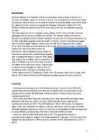
blue and white flag is said to
represent the white snow of
winter and the blue lakes of
summer . In
between the two is the dramatic spring when everything turns green
in a week, and
autumn , full of reds and browns as the leaves swirl
over the city squares.Finland is
certainly Scandinavia`s
least understood and most culturally remote country.
Finland
is covered by a mixture of
forest and marshland. It seems , for every
Finnish family to have an
island or lake of its own, with plenty of
space for visitors too. Inland lakes cover
almost 10 percent of the
country`s entire area. None of Finland`s lakes are very deep,
however ; most of
them averae
around 100m (330ft). (
www.wikipedia.org)
Position
and sizeFinland
is made up of 11 provinces and the autonomous Ǻland Islands. It
lies on the
same latitude as
Iceland , and one
quarter of the country
is inside the
Artis Circle. Its northernmost point is at 70˚5`, the
southernmost at 59˚ 30` (on the same latitude as
Oslo ), the westerly
point at 19˚7`and the easternmost at 31˚35` (on the same line of
Longitude as Ankara). The country covers a
total surface area of
338,000sq km (130,550sq miles), and its coastline is some 4,600km
(2,760 miles) long. (
Finland: Insight compact guides)
2
ClimateThe
climate in
Southern Finland is a northern temperate
climate. In Northern Finland,
particularly in the
Province of Lapland, a subarctic
climate dominates, characterised by
cold , occasionally
severe, winters and relatively warm
summers . The main factor
influencing Finland's climate is the country's geographical position
between the 60th and 70th northern parallels in the Eurasian
continent 's
coastal zone, which shows
characteristics of
both a
maritime and a continental
climate, depending on the direction of air flow. Finland
is
near enough to the
Atlantic Ocean to be continuously warmed by the Gulf
Stream, which explains the unusually warm climate
considering the absolute latitude.
A
quarter of Finland's territory lies
above the
Arctic Circle, and as a consequence the midnight
sun can be
experienced – for more
days , the farther
north one travels. At Finland's northernmost point, the sun does not
set for 73 consecutive days
during summer, and does not
rise at all
for 51 days during winter.(
www.wikipedia.org)
3
Flora and
faunaAll
terrestrial life in Finland was
completely wiped out during the last
ice
age that ended some 10,000
years ago,
following the
retreat of the glaciers and the appearance of vegetation.
Today ,
there are over 1,200
species of vascular
plant , 800 bryophytes
and 1,000 lichen
species in Finland, with flora being richest in the southern parts of
the country. Plant life, like most of the Finnish ecology,
is well adapted to tolerate the contrasting seasons
and extreme
weather. Many plant species,
such as the
Scots Pine, spruce,
birch
spread throughout Finland from Norway
and only reached the
western coast less than three millennia ago. Oak
and
maple grows in nature only in the southern part of Finland.
The Archipelago
Sea, between the Gulf
of Bothnia and the Gulf
of Finland, is the largest archipelago in the world by
number of islands; estimates
vary between 20,000 and 50,000.
Similarly , Finland
has a
diverse and extensive range of fauna. There are at least sixty
native mammalian
species, 248 breeding
bird species, over seventy fish species and
eleven reptile and
frog species
present today, many migrating from
neighbouring countries thousands of years ago.
Large
and widely recognised
wildlife mammals found in Finland are the
Brown Bear (the national
animal ), Gray
Wolf, elk
and
reindeer .
Other common mammals
include the Red
Fox,
Red
Squirrel, and
Mountain Hare. Some rare and
exotic species include the
flying squirrel, Saimaa
Ringed Seal and the Arctic
fox, which is considered the most
endangered . The Whooper
Swan , the national bird of Finland, is a large Northern
Hemisphere swan.
The most common breeding birds are the Willow
Warbler, Chaffinch
and Redwing.
Of some seventy species of freshwater fish, the northern
pike,
perch and
others are plentiful. Salmon
remains the favorite of fly
rod enthusiasts.
The endangered
Saimaa Ringed Seal, one of only three lake seal species in the world,
exists only in the Saimaa
lake system of southeastern Finland, down to only 300 seals today. It
has become the
emblem of the Finnish
Association for Nature
Conservation .
Due to
hunting and
persecution in history, many animals such as the
Golden Eagle, Brown
Bear
and Eurasian
Lynx all experienced significant declines in population.
However, their
numbers have increased again in the 2000s, mainly as a
result of careful conservation and the
establishment of vast
national
parks. (
www.wikipedia.org)
4
Main
fields of economy and industryFinland has an
industrial economy
based on abundant forest resources, capital investments, and high technology.
The Finnish economy has made enormous strides since the severe recession of the
early 1990s. Finland successfully joined the euro zone and has outperformed euro-area partners in
terms of
economic growth and public finance. In the last few years, the Finnish economy has performed reasonably well. Total output was 5%
higher in 2006 than in 2005, but economic
activity leveled off in the
latter half of the year. GDP is predicted to grow by 4.4% in 2007, while 2008 is likely to show a slower
rate of growth,
estimated at 3.3%. Despite the
current favorable
outlook , there is a
degree of uncertainty in the Finnish economy caused by the large fluctuations in electronics industry
production , together with resource
constraints . Cost and
price pressures have increased, and there is a threat of industry’s price competitiveness starting to weaken.
Unemployment decreased significantly from 1994 to 7.7% in 2006 and is
expected to
drop to 6.7% in 2007. A relatively inflexible
labor market and high employer-
paid social security taxes hamper growth in
employment . Labor bottlenecks are becoming more common in certain sectors, and this will increasingly restrict growth in output in the future. The main constraint to
medium -
term economic growth will be the drop in the population of working age
once the post-war baby boomers
reach retirement age.
Exports of goods and
services contribute 32% of Finland's GDP.
Metals and
engineering (
including electronics) and
timber (including
pulp and
paper ) are Finland's main industries. The United States is Finland's third most
important trading partner
outside of Europe. With a 3.8%
share of imports in 2006, the United States was Finland's seventh-largest supplier. The total
value of U.S. exports to Finland in 2006 was $2.6
billion . Major exports from the United States to Finland continue to be machinery, telecommunications
equipment and parts, aircraft and aircraft parts,
computers , peripherals and software, electronic
components , chemicals,
medical equipment, and some agricultural
products . The
primary competition for American
companies comes from Russia,
Germany , Sweden, and
China . The main
export items from Finland to the United States are electronics, machinery, ships and boats, paper and paperboard, refined
petroleum products, telecommunications equipment and parts. In 2006, the United States was Finland's
fourth -largest customer after Germany (11.3%), Sweden (10.5%), and Russia (10.1%), with an export share of 6.5%, or $5 billion. However, trade is only part of the
totality : the 10
biggest Finnish companies in the United States have a combined
turnover that is three
times the value of Finland's total exports to the United States. About 2.3% of the Finnish GDP comes from exports to the United States.
Except for timber and
several minerals, Finland depends on imported raw materials, energy, and some components for its manufactured products. Farms tend to be small, but farmers own sizable timber
stands that are harvested for supplementary income in winter. The country's main agricultural products are
dairy , meat, and
grains . Finland's EU accession has accelerated the
process of restructuring and downsizing of this
sector . (
www.state.gov)
5
The
peopleThe `
Nordic ` image
of a
person with
blond hair and blue
eyes is
quite a rare
sight on
Finalnd; most of the population is dark-haired. This is because of
the Finns` ancestry: the people who moved into the
southwestern corner of today`s Finland from Estonia via the
Baltic are
referred to
as `trans-Ural nomadic`. Three tribes settled in
different areas ; the
Suomalaiset (the Finns` word for themselves) decided to
remain in the
southern coastal provinces, and quikly altered their nomadic
lifestyle; the Häme lääni settled the lake region, and the
Karelians settled the forest regions to the east.
The
name `Finland`
dates back to
Roman historian
Tacitus (AD55-120). In
his
work Germania
he mentioned a primitive people from the north called the Fenni;
which was probably a reference to the Same (
see below ),
who at that time were
living on and around the 60th
parallel. Over the
centuries the Same were gradually pushed
further north, and today they
live in Finnish Lapland.
Whichever
part of the country they
happen to come from, Finns have a lot in
common: they all share deeply ingrained down-to-earth rural
values combined with the
spiritual qualities relating to the sauna. Many of
them come from the land of Karelia which was
split right down the
middle by the
Finno -Russian
frontier after World War II; hardly
anyone lives there now, but the Karelians` pride at being
something quite separate from either Finns or Russians still remains. (
Finland: Insight
compact guides)
Population
Finland currently numbers 5,302,778 inhabitants and has an
average population
density of 17 inhabitants per square
kilometre. This
makes it, after Norway
and Iceland,
the most sparsely populated country in Europe.
Finland's population has always been
concentrated in the southern
parts of the country, which is
even more pronounced after
twentieth-
century urbanisation.
The biggest and most important cities in Finland are the cities of
the Greater
Helsinki metropolitan
area - Helsinki,
Vantaa,
Espoo and Kauniainen
- some of the other big cities include Tampere,
Turku
and Oulu.
The
share of immigrants
in Finland is among the lowest of the European Union countries.
Foreign citizens comprise 2.3 percent of the population. Most of them
are from Russia, Estonia and Sweden.(
www.wikipedia.org)6
Traditions
and cultureFinnish
culture has been greatly
influenced by the
cultures of neighbours,
particulary Sweden. Large numbers of ern coasts of Finland during the
Middle Ages and Swedish is still an important language in the
country. Much of Finnish
literature before the mid-nineteenth century
was written in Swedis. However with the rise of Finnish
nationalismfrom about the 1840s, great impetus was
given to the
Finnish literary
movement . Many distinguished works have been written
in Finnish, including those by the contemporary
authors Sillanpaa,
Waltari and Jotuni. Some authors
prefer tom write in Swedish, thereby
reaching a larger public. The Finns have also been strongly
influenced by
German music. Since the
late nineteenth century,
however,
conscious attempts to produce an indigenous Finnish music
have been successful, such composers as Sibelius, Kajanus, Jarnefelt,
Palmgren and Kilpinen have become widely recognised.
The
Finnish language is part of the Finno-Ugric
branch of the Ural-Altaic
family of languages
related to Hungarian, Estonian and Lapponic. Most
of the people are Lutherans and there is freedom of worship. (
New knowledge library: universal reference encyclopedia)
7
HistoryThe
first inhabitants of Finland were the
Sami (Lapp) people. When Finnish speakers migrated to Finland in the first millennium B.C., the Sami were forced to move northward to the arctic regions, with which they are traditionally associated. The Finns' repeated raids on the Scandinavian coast impelled Eric IX, the Swedish
king , to
conquer the country in 1157. It was made a part of the Swedish kingdom and converted to Christianity.
By 1809 the
whole of Finland was conquered by Alexander I of Russia, who set up Finland as a grand duchy. The
period of Russification (1809–1914) sapped Finnish
political power and made Russian the country's
official language. When Russia
became engulfed by the
March Revolution of 1917, Finland seized the
opportunity to declare independence on Dec. 6, 1917.
The USSR attacked Finland on Nov. 30, 1939, after Finland refused to give in to Soviet territorial demands. The Finns staged a
strong defense for three months before being forced to cede the Soviets 16,000 sq mi (41,440 sq km). Under German
pressure , the Finns joined the Nazis against Russia in 1941, but they were defeated again and forced to cede the Petsamo area to the USSR. In 1948, a
treaty of friendship and mutual assistance was
signed by the two nations. Finland continued to pursue a foreign policy of nonalignment throughout the cold-war era.
Running on a platform to revitalize the economy, Ahtisaari, a Social Democrat, won the country's first
direct presidential election in a runoff in Feb. 1994. Previously, presidents had been chosen by electors. Finland became a member of the European Union in Jan. 1995. On Jan. 1, 1999, Finland, along with ten other European countries, adopted the euro as its currency. In 2000, Tarja Halonen, who had been Finland's foreign minister, became its first woman president.
Since 1998, Finland has been judged to be the world's least corrupt country, according to the annual
survey by the
Berlin -based organization Transparency International. In April 2003, Finland appointed its first female prime minister,
making it the only country in Europe with both a female president and prime minister. But Prime Minister Jaatteenmaki resigned after only two months in office when it was revealed that she had used leaked classified information against her rival in the election (she was acquitted of the charges the following year). In
June , Defense Minister Matti Vanhanen was selected by parliament to
replace her. In Jan. 2006, President Halonen was reelected. Vanhanen's
Centre Party narrowly won parliamentary elections in March 2007, and he was reelected to a second term.
(
www.infoplease.com)
8
ConclusionNew
information for me was: history of Finland , traditions and culture
and main fields
of economy.
Interesting was that the Finns' repeated raids on the Scandinavian
coast was impelled by Eric IX, the Swedish king, to conquer the
country in 1157. It was made a part of the Swedish kingdom and
converted to Christianity. The Finnish language is part of the
Finno-Ugric branch of the Ural-Altaic family of languages related to
Hungarian, Estonian and Lapponic.Most of the people are Lutherans and
there is freedom of worship. Finland has an industrial economy based
on abundant forest resources, capital investments, and high
technology.
Finally I think that Finland is great coutry and I would
like to live there.
9
References1.
Finland: Insight compact guides. Singapore, 1995.
2.
NEW KNOWLEDGE LIBRARY: universal reference encyclopedia.
Sydney , 1981.
vol. 11.
3.
http://en.wikipedia.org/wiki/Finland4.
http://www.state.gov/r/pa/ei/bgn/3238.ht m
5.
http://www.infoplease.com/ipa/A0107513.html 10
 50 punkti
Autor soovib selle materjali allalaadimise eest saada 50 punkti.
50 punkti
Autor soovib selle materjali allalaadimise eest saada 50 punkti.
 ~ 11 lehte
Lehekülgede arv dokumendis
~ 11 lehte
Lehekülgede arv dokumendis
 2009-09-09
Kuupäev, millal dokument üles laeti
2009-09-09
Kuupäev, millal dokument üles laeti
 12 laadimist
Kokku alla laetud
12 laadimist
Kokku alla laetud
 0 arvamust
Teiste kasutajate poolt lisatud kommentaarid
0 arvamust
Teiste kasutajate poolt lisatud kommentaarid
 juha
Õppematerjali autor
juha
Õppematerjali autor
 annaabi.ee






Kõik kommentaarid