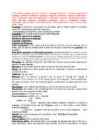
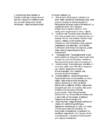
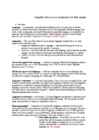
Phonology. Mid-term 2. Syllable - is a phonological unit consisting of one or more phonemes. In phonetics a syllable is a unit which consists of a centre, that has little or no obstruction to airflow; it is comparatively louder than other sounds. In phonology syllables are the possible combinations of phonemes. The syllable consists of - onset, nucleus, coda. (every syllable has a nucleus: vowel, syllabic l, or m, n). Rhyme/rime nucleus + coda; the nucleus and the coda constitute a sub-syllabic unit rhyme. Words rhyme, when their nucleus and coda are identical. (E.g 'cr-o-wn', 'd-o-wn'). The hierarchical structure of the syllable: Onset the beginning of the syllable Nucleus/peak the open part of a syllable, generally a vowel.
Mid-term 1. Terminology. Testi tuleb kindlasti see tabel! Nasal, Bilabial: m Nasal, Alveolar: n Nasal Velar: Plosive, Bilabial: p; b Plosive, Alveolar: t; d Plosive, Velar: k; Affricate, Post-Alveolar: t; d Fricative, Labio-dental: f; v Fricative, Dental: ; Fricative, Alveolar: s; z Fricative, Post-Alveolar: ; Fricative, Velar: x Fricative, Glottal: h Approximant, Alveolar ja Post-Alveolar: Approximant, Palatal: j Approximant, Velar: w Lateral, Alveolar: l Phonetics and Phonology. Mid-term 1. Phonetics the general study of the characteristics of speech sounds: how they may be "strung" together to form meaningful units how they are produced It studies: how to describe the speech sounds in the languages of the world what these sounds are how they fall into patterns how they change in different circumstances Acoustic phonetics the study of the physical properties of the sounds themselves.
described as a back vowel. This distinction can be appreciated by successively articulating "ho-ho, hee-hee, ho-ho, hee-hee," and paying attention to where the vibration is felt most strongly in the oral cavity. The phoneme spelled o in ho is a back vowel, and the phoneme spelled ee in hee is a front vowel. To properly learn which is which, IPA provides: https://www.youtube.com/watch?v=PsfQESpi-Ec Furman University. Phonology: Vowels. Available at http://facweb.furman.edu/~wrogers/phonemes/phono/phvowel.htm, accessed January 19, 2016. Foley, Dan. 2008. IPA back, front and mid vowels. Available at https://www.youtube.com/watch? v=PsfQESpi-Ec, accessed January 19, 2016. University of Manitoba. 2014. Describing English Vowels. Available at http://home.cc.umanitoba.ca/~krussll/phonetics/articulation/describing-vowels.html, accessed January 19, 2016.
Definitions: Phonology is the study that describes the systems and patterns of speech sounds in a language. Phonetics is the general study of the charecteristics of speech sounds – studies how different speech sounds are produced. Phoneme is a meaning-distinguishing sound in a language. E.g. artistic-al-ly To know if a sound is a phoneme use the minimal contrasting pair method where the difference is only one sound: pin vs pen. Allophones are different variations of how a phoneme is pronounced according to the context. E.g. dark and clear l – clear and dull. Segmentation is the act of dividing speech sounds into units. E.g. segment- ation Larnyx (kõri) is the voice box. Glottis is the opening between the vocal cords. Manner of articulation is the way the airstream is blocked when producing a sound – blocked vs partially blocked; vibrating vs no vibration. Different sound types: Velar sounds are produced by the tongue b...
keeles SOV. Ejaki keel on väljasuremisohus keel ning selle elushoidmise nimel tegutseb The Ejak Language Project. Eesti keel ja ejaki keel on väga erinevad keeled ning sellest võib järeldada, et need pole suguluskeeled. Viited 1. Krauss, Michael E. 1965. Eyak: a preliminary report (02.10.2017) 2. http://entsyklopeedia.ee/artikkel/eesti_keel1 (02.10.2017) 3. Krauss, Michael E. (1964). "The proto-AthapaskanEyak and the problem of Na- Dene, I: The phonology". International Journal of American Linguistics. 30 (2): 118 131. 4. https://www.eki.ee/books/ekk09/index.php?p=3&p1=1 (16.10.2017) 5. https://et.wikipedia.org/wiki/K%C3%B5neviis#K.C3.B5neviisid_eesti_keeles (23.10.2017) 6. http://www.emakeeleselts.ee/omakeel/2005_1/01.pdf (17.11.2017) 7. https://www.omniglot.com/writing/eyak.php (17.11.2017) 8. https://en.wikipedia.org/wiki/Eyak_language (17.11.2017)
homeland), but as a generalisation about lexicons, it's certainly valid. Systematic consideration of the lexicon is often left out of language descriptions and doesn't play much of a role in linguistic theory, in part because the lexicon is (or is often thought of as) the repository of everything that is arbitrary and unsystematic about language. Looked at one way, this exclusion makes sense: whether a language has a word for `horse' or not tells us nothing about the language's grammar or phonology. However, the fact that the lexicon reflects the physical and cultural environment in which a language is spoken does have an important corollary, namely that when the environment changes, the lexicon has to change. The history of many languages is greatly marked by the fact that their environments have changed dramatically over the past couple of millennia. Great technological changes have led to great cultural changes, including greater contact between different peoples, which in turn
Common European Framework of Reference for Languages: Learning, Teaching, Assessment. Council of Europe 2001. CROSSLING: https://wiki.uef.fi/pages/viewpage.action?pageId=16586730 Delsing, L.-O. 2007. Scandinavian intercomprehension today. In J.D. ten Thije & L. Zeevaert (eds.), Receptive multilingualism. Linguistic analyses, language policies and dialectic concepts. Amsterdam: John Benjamins, 231246. Eckman, F. 2004. From phonemic differences to contrast ranking: research on second language phonology. In Studies in second language acquisition 26, 514539. Gooskens, C. 2006. Linguistic and extra-linguistic predictors of inter-Scandinavian intelligibility. Linguis- tics in the Netherlands, 101-113. Gooskens, C. 2007. The contribution of linguistic factors to the intelligibility of closely related languages. In Journal of Multilingual and Multicultural Development 28 (6), 445-467. Gooskens, C. & W. Heeringa 2004. The position of Frisian in the Germanic language area. In D. Gilbers, M.
Arvo Eek „Eesti keele foneetika I“ Clark & Yallop „An introduction to PHONETICS AND PHONOLOGY. Second edition“ Foneetika ehk hääldus- ja häälikuõpetus Kõne kirjeldamine Häälikute ja nende käitumise uurimine kõnevoolus - Häälikud esinevad tavaliselt koos ja on üksteisega seotud, võivad esineda sõnas eri positsioonides, olla eri pikkustega, omavahel kombineeruda ja üksteist mõjutada. Häälikuüleste nähtuste uurimine: - Rõhk (seotud silbiga, mis kannab rõhku sõna ulatuses või lause kontekstis ka sõnarõhk)
1. Be ready to explain the terms (lecture 1): language, linguistics, synchronic approach to language, diachronic approach to language, linguistic competence, linguistic performance, what is grammar?, prescriptive grammar vs. descriptive grammar; phonology, phonetics, phone, allophone, phoneme; morphology, morphemes (types of morphemes), morphs, allomorphs, types of affixes, derivational affixes, inflectional affixes; open vs closed class words; syntax. Language: a systematic, conventional use of sounds, signs or written symbols in a human society for communication and self-expression. - human language at all levels is rule- or principle-governed. Linguistics: the scientific study of human natural language Synchronic approach to language:
analysed the principle of economy in linguistics, testing its manifold applications in both phonology and syntax. 1. Defineeri kõik Semantiline mälu on mälu, mis kolm mälu liiki sisaldab üldisi faktilisi teadmisi (semantiline, maailma kohta ning see materjal ei episoodiline, ole kuidagi seotud isiklike protseduuriline). Mis mälestustega. Näiteks see, et kass on tõendab nende kolme kiskja või see, et jooksutossud on erineva mäluliigi jalanõud. olemasolu? Too iga Episoodiline mälu on mälu, mis (3) kohta oma näide
sounds and how they are articulated. Phone is a smallest unit of sound in human speech. Phones can be represented with IPA symbols (International Phonectic Alphabeth). Phonology- The subfield of linguistics that studies the structure and systematic patterning of sounds in human language. Allophone is a sound form of a phone. For example: An Estonian word palk has two possible pronunciation ways. L can be palatalised or not.
 annaabi.ee