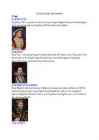
Scotlan History The history of Scotland begins around 10,000 years ago, when humans first began to inhabit Scotland after the end of the Devensian glaciation, the last ice age. Of the Stone Age, Bronze Age, and Iron Age civilization that existed in the country, many artifacts remain, but few written records were left behind.People lived in Scotland for at least 8,500 years before recorded history dealt with Britain. The written history of Scotland largely begins with the arrival of the Roman Empire in Britain, when the Romans occupied what is now England and Wales, administering it as a Roman province called Britannia. To the north was territory not governed by the Romans -- Caledonia, by name. Its people were the Picts. From a classical historical viewpoint Scotland seemed a peripheral country, slow to gain advances filtering out from the Mediterranean fount of civilisation, but as knowledge of the past incr...
Scotland By Ketryn Õun Form 7 Scotland Capital is Edinburgh Populations is 5 100 000 The flag is blue and white Belongs to the United Kingdom The symbol is a thistle Traditional woollen cloth is squares and stripes Scotland flag The Scottish national flag is a white and blue Scotland The United Kingdom consist of England, wales, Scotland and Northern Ireland. Robert Burns th On 25 Janary Scottish people all over the wod celebrate Robert Burns birthday. He was a Scottish poet and a lyricist. Bagpipe A famous traditional Scottish instrument is the Great Highland Bagpipe. Tartan This is a traditional woollen cloth different colours. Scottish kilts almost always have tartan patterns. Scotla...
Population 1. Size, its changes 2. Distribution 3. Towns 4. Ethnic makeup 5. Age breakdown 6. Religion(s) 1. Size. 1 July 2006 population estimates by UK National Statistics: % (mid- Part Population (mid-2006) 2006) England 50,762,900 83.8 Scotland 5,116,900 8.4 Wales 2,965,900 4.9 Northern Ireland 1,741,600 2.9 United Kingdom 60,587,300 100 Although Britain is quite small in terms of land area (245,000 sq km), it has a large population of nearly 61 million, which ranks the 21st in the world (Britain is the 21st most populous state in the world) and the third largest in the European Union. The size of population is chan...
Years 1154-1485 Henry I was the first unquestioned ruler. One of the most important kings in the Middle Ages. He had lands in Britain & France. Then the government was the monarch, a person, not a place. He had more land than any pervious king. After his marriage to Eleanor of Aquitaine, he also ruled the lands south of Anjou. His empire stretched from the Scottish border to the Pyrenees. England provided most of its wealth, but the heart was Anjou. Henry II began to regain royal control. During the war some barons had become very powerful. He pulled down some of their castles. He tried to restore law & order. He wanted the same kind of justice to be used everywhere. He appointed his own judges to travel around the country. They dealt with crimes & disagreements over poverty. Serious offences were tried in the king's court. At first they had no special knowledge or training. They were trusted to use common se...
S C O T L A N D GENERAL OVERVIEW Territory: 31, 510 sq miles Highest peak: Ben Nevis 1343m Population: 5, 055, 000 National emblem: the thistle Capital: Edinburgh National flower: the bluebell Islands: About 790 National instrument: bagpipes Lakes: the best- known is Loch Ness, famous for National dish: haggis Nessie, its mythical monster Scotland is also famous for: whisky, kilts and sheep · One of the four constituent nations which form the UK · They have their own money, system of law, history, stamps, deep- rooted customs, traditions and ancient language- Gaelic · Most people speak the Scottish dialect becoming endangered language · Weather unpredictable · Breat...
Country Nationality Language Austria Austrian German Australia Australian English Belgium Belgian/Flemish French/Flemish The Czech Republik Czech Czech Canada Canadian English/French China Chinese Chinese Denmark Dane Danish Estonia Estonian Estonian Finland Finn Finnish France Frenchman/woman French Germany German German Greece Greek Greek The Netherlands/ Dutchman/woman Dutch Holland Hungary Hungarian Hungarian Iceland Icelander Icelandic Iraq Iraqi ...
The United Kingdom Mari-Liis Ojatamm Kärdla Ühisgümnaasium 10b The United Kingdom Scotland Wales England Northern Ireland Scotland Capital: Edinburgh Area 78,387 km2 Languages: English and Scottish Gaelic Population: 5,313,60 National symbols Thistle Tartam Flag Wales Capital: Cardiff Languages: English and Welsh Area: 20,779 km2 Population: 3,063,456 Flag Northern Ireland Capital: Belfast Languages: Irish and English Area: 13,843 km2 Population: 1,810,863 England Capital: London Language: English Area: 130,395 km2 Population: 53,012,456 Flag Stonehenge ...
Wa l t e r Scott Walter Scott Scottish novelist and poet One of the greatest historical 1771-1832 novelists. Scott wrote twenty-seven historical novels. Early Life o Was born August 15 1771 o Caught polio and survived. o Sent to Sandyknowe , his grandparents farm. o Taught to read and influenced by his aunt Jenny. o Given private tutoring by James Mitchell. o attended grammar school and met James Ballantyne. o At age 12, started studying at the University of Edinburgh. o Began an apprenticeship with his fathers office. o Later became a lawyer in Edinburgh. Literary Career launched Began to write at 25 by translating works from German. Became an ardent volunteer in yeomanry where he met Margaret Charlotte Charpentier in 1791 Had five children together Invested in money over time through various jobs and events. Fo...
Scotland *Scotland is a country in northwest Europe. Capital Edingburgh Population 5.144.200 Patron Saint St.Andrew Monarch Elizabeth 2 Language - English Clans of Scotland · "Clann" means family or children in Gaelic. Each clan was a large group of geographicallyrelated people, theoretically a wideranging family, supposedly descended from one ancestor, and all owing loyalty to the head clan chief. It also included a large group of looselyrelated divisions related families or outside groups, all of whom looked to the clan chief as their head and for their protection . Famous Scottish People William Wallace Rod Stewart King MacBeth Sean Connery Alexander Graham Bell Sir Alexander Fleming James Watt Tartans in Scotland The word 'tartan' is derived from the French 'tiretaine' whic...
Scotland Overview Flag-Saltire Royal Standard of Scotland Edinburgh, Glasgow First Minister Alex Salmond 78,387km² 5,222,100 St Andrew History Picts (Celtic tribe) Romans named scotland Caledonia The Scots Queen Mary was forced to abdicate the Scottish throne in 1567. National Symbols Thistle Declaration of Arbroath Tartan Bagpipes Kilt Honours of Scotland Crown, Sword and sceptre are from late fifteenth and early sixteenth century. Crown was made in 1540. Pope Julius II presented the sword to King James IV in 1507. The sceptre was made in 1494 and was presented to King James IV by Pope Alexander VI Honours of Scotland Language Have spoken Pictish, Scottish Gaelic similar Norse, Norman- to Irish, it is French and Brythonic recognised a...
SCOTLAND Form 7 By Marika SCOTLAND · Capital Edinburgh · Offical language English · Population 5,100,000 · Symbol thistle · Scottish food haggis ROBER BURNS · On 25th January · Greatest poet · Wrote about love, the life of working people LOCH NESS MONSTER · Huge and strange monster TARTAN · Different color · Woollen cloth THISTLE · Scotland symbol is thistle FLAG · Flag is blue and white · Name Saint Andrew's Cross SHEEP · Hundreds or thousands sheep on the hillsides CITIES · Biggest cities Glasgow, Aberdeen and Edinburgh · Aberdeen univercity town · Glasgow on the river Clyde, the biggest cities · Edinburgh capital AREA · Total 78,772 km2 · Land 97% · Water ...
NEWFOUNDLAND AND LABRADOR TRIINU PRANTS GUSTAV ADOLFI GÜMNAASIUM 8. C KLASS GEOGRAPHICAL LOCATION · Country's atlantic region · Most easterly province · Island of Newfoundland and mainland Labrador · Area of 405,212 square kilometres · Capital St. John's http://en.wikipedia.org/wiki/Newfoundland_and_Labrador#/me dia/File:Newfoundland_and_Labrador_in_Canada.svg FLAG http://en.wikipedia.org/wiki/List_of_premiers_of_Newfoundland_and_Labrador POPULATION · In 2013 526 702 people · 92 % of population on the Newfoundland · 40% on population in St. John's city · 97.6% of residents reporting English as their mother tongue · In Labrador local dialects of Innu-aimun and Inuktitut are also spoken. CULTURE · Folk musical heritage based on the Irish, English and Scottish traditions · Much of the region's music focuses on the strong seafaring tradition · Ice Hockey · So...
Report of SCOTLAND Maiki Joakit 10. klass 2008 Etymology Scotland is from the Latin Scoti, the term applied to Gaels. The Late Latin word Scotia (land of the Gaels) was initially used to refer to Ireland. By the 11th century at the latest, Scotia was being used to refer to (Gaelic-speaking) Scotland north of the river Forth, alongside Albania or Albany, both derived from the Gaelic Alba. The use of the words Scots and Scotland to encompass all of what is now Scotland became common in the Late Middle Ages. History Repeated glaciations, which covered the entire land-mass of modern Scotland, have destroyed any traces of human habitation that may have existed before the Mesolithic period. It is believed that the first post-glacial groups of hunter-gatherers arrived in Scotland around 12,800 years ago, as the ice sheet retreated after the last glaciation. Groups of settlers began building the first known permanen...
History of Scotland Karoliina Grentsmann, Katri Hendrikson Viljandi Gümnaasium I VÕ Picts Ancient people Ancient eastern and northern Scotland Extinct Pictish language Art appears on stones Pictish Stones Monumental stelae Remaining evidence of the Picts From the 6th to 9th centuries The purpose of the stones Original sites Wars of Independence The First War 12961328 The Second War 13321357 Between the Kingdom of Scotland and the Kingdom of England Great national crisis Independent nation Union with England 18th century Political union between Scotland and England Treaty of Union It replaced the Scottish systems of currency First World War In 19141918 Provided manpower, ships, machinery, food etc Scotland sent 690,000 men to the war The Battle of Loos They made up 15 per cent of the national armed forces Second World War In 19391945 Shipy...
Europe Great Britain (British English) · Black British English · England (English language in England) o Northern Cheshire Cumbrian (Cumbria including Barrow-in-Furness) Geordie (Newcastle upon Tyne) Lancastrian (Lancashire) Scouse (Merseyside) Mancunian-Salfordian (Manchester & Salford) Mackem (Sunderland) Northumbrian (rural Northumberland) Pitmatic (Durham and Northumberland) Yorkshire (also known as Tyke) In the far north, local speech is noticeably Scots in nature. o East Midlands o West Midlands Black Country English Brummie (Birmingham) Potteries (north Staffordshire) ...
History exam *Stonehenge - is a monument located in England. It is one of the most famous prehistoric sites in the world and is composed of earthworks surrounding a circular setting of large standing stones. The surrounding circular, earth bank and ditch, have been dated to about 3100 BC. Stonehenge was produced by a culture with no written language. Many aspects of Stonehenge remain subject to debate. There is little or no direct evidence for the construction techniques used by the Stonehenge builders. *The Celts in Britain and their legacy The Cets lived in Britain in The Iron Age. They were warring tribes who were battleful amongst themselves as well as inter-tribal war. They were not centrally governed. The Celts brought iron working, iron ploughs and metal swords, horses, wheels and chariots - all these things gave them an instant superiority over the native tribes. The Celts built a number ...
English speaking countries English is world-wide language. Its spoken in very many countries. For example many countries in Europe, Asia, America and even in Africa. In many of them it's spoken as an official language. But it's also spoken as the dominant (domineeriv, valdav) language. Nowadays you can go almost everywhere and you can make through everything when you know some English. But still, no matter in which country you go, they're still very different. For example Australia, United Kindgom and its parts Endland and Scotland. Australia is located in the Pacific ocean and it's sixth country in the world for it's size. It's total area is 7741220 km². This country doesn't have an official language, but it's national language is English. Australia has much lakes and rivers in it. More exactly about 68 920 km² is made up by lakes and rivers. Climate in australia is dampish and warm. Australia's capital is Canberra, but the largest c...
Scotland Scotland · Scotland is a country in the north of Great Britain. It is apart of the United Kingdom. Scotland is divided into three natural regions: the Southern Uplands, the Central Lowlands and the Highlands and islands. A lot of places in Scotland are a natural paradise, still untouched by man. Glasgow · Glasgow is the largest city in Scotland and the third largest in the United Kingdom. Before 1750 Glasgow was a small town. It had a cathedral and a university but it was not a rich town. After 1707 Scottish ships could go to the English colonies in America. Ships brought tobacco to Glasgow and took back Scottish goods. In 1776, the American colonies became independent and the tobacco trade stopped. Heavy industry began to develop. It used coal and iron from the Clyde valley. Glasgow became rich but very dirty. Sport · Scotland is famous for football teams: Rangers and Celtic. Mo...
Stonehenge One of the best known ancient wonders of the world, 5000 years old Megalith monument, built by western mediterraneans during 3000-1600 BC Circular structure, large standing stones, aligned with rising sun at teh solstice Attlers and bones were sued to dig pits that hold the stones The Celts in Britain and their legacy 700-200 BC celts invade Britain Gaels or Goehls(Ireland and Scotland),Cymri(Wales) and Brythons(gave name to Brittany) Fierce fighters,superb horsemen.Most of them farmers, lived in thatched houses Good at art, craftmanship, used iron Divided into tribes, ruled by kings, only in face of danger would they choose a single leader Legacy- hill-forts, farms, churches, field system, woodland, pasture, weapons, iron objects, langugae, culture Caesar in Britain The great Roman Emperor Firts came 55 BC to gather information, celts ...
Outstanding figures in British literature Eva Martina Põder 11.b British literature Refers to all literature produced by British authors from the United Kingdom, which includes England, Scotland, Northern Ireland, Wales, the Channel Islands, and Isle of Man Includes early works written in Gaelic, Welsh, and Latin, works in Old, Middle, and Modern English, each of which represents a different period Full of great works British works in Latin Venerable Bede He lived between 673 and 735 AD The greatest of all the AngloSaxon scholars He's the earliest English historian, whose work has shed light on a period of English history that would have otherwise been unknown ,,The Father of English History" Wrote / translated about 40 books on almost every area of knowledge, i.e. nature, astronomy, and poetry His best known work is "The Ecclesiastical History of the English People" Starting with the Roman invasion in the 5th century, he...
SOCIETY AND CULTURE OF ENGLISH-SPEAKING COUNTRIES Introduction 1. Nowadays, English is so widely spoken that it can hardly be considered "a one nation's" language. The main countries where English is spoken are: the U.K, the U.S, Canada, Australia, the Republic of Ireland, New Zealand, West Indies 2. There are approx. 300-400 million speakers of English in the world. English occupies the 3rd place by its number of speakers; it is right behind Mandarin and Spanish. 3. ESL (English as a Second Language) used in your own country (e.g. India) EFL (English as a Foreign Language) used in a foreign country ESP (English for Specific Purposes) used in business, airlines, hotels etc. 4. Settlement colonies people migrated into them from Britain and started their own communities, they are the present English-speaking countries (USA, Australia, Canada, New...
The Middle Ages The Middle Ages are one of the most turbulent periods in English history. The Middle Ages are so called as the middle period between the decline of the Roman Empire and the Renaissance. The Middle Ages started in 1066. with the Battle of Hastings and the Norman Conquest. William the Conqueror took all the lands from the Saxon English and gave these to French nobles. Normans were known as great builders. This is assured by the fact that many great castles and other buildings, including the Tower of London, were built during the Norman Conquest. In 1086. Domesday Book was compiled. It is a detailed survey of England ordered by William the Conqueror. The reign of King William Rufus who was the son of William started in 1087 and lasted until 1100. Next king was Henry I who was the brother of William Rufus. His reign was from 1100-1135. In 1135 Henry I nephew Stephen got to the throne of Engla...
Society and culture of english-sspeaking countries Introduction 1. The countries of the world where the English language is spoken. 2. Approximate number of mother tongue speakers of English approximately 350-400 million native speakers. Which place does English occupy in the world by its number of speakers?After which language? English occupies second place by its number of speakers after Mandarin Chinese. 3. What is the difference between English as a Second Language, English as a Foreign Language and English for Specific Purposes? Give examples of situations where they are used. English as a Second Language (ESL or TESL) is a traditional term for the use or study of the English language by non-native speakers in an English-speaking environment. That environment may be a country in which English is the mother tongue (e.g., Australia, the U.S.) or one in which English has an established role (e.g., India, Nigeria) English as a...
Brittish Food Kelli Kärsna Form 7a 2007 Teacher: Karin Mitt Wales Traditional Food ...Most popular food for breakfast consists eggs and bacon ...Afternoon tea can be served with Welsh cakes ...Traditional meat for dinner in the evening is Welsh Lamb ...For a snack Welsh Rarebit Scottish Traditional Food ...Breakfast consist of local black pudding ...Haggis a type of rich sausage meat made from ...And bread, the very symbol of food English Traditional food ...Fish and Chips are a traditional take away food or as USa they say "to go" ...Sheaperds Pie ...Breakfast consist from eggs, bacon, and toast ...Bangers and Mash are made with minced lamb and vegetables topped with mashed potato Ireland ...They say that the Irish food is not good ...Colcannon is a good dish made of potato ...O...
REVISION QUESTIONS 1. What do you know about Margaret Thatcher? Winston Churchill? Margaret Thatcher was the first female Prime Minister in Europe. She was a member of the conservative party. She died recently. Winston Churchill was the Prime Minister during WW II. He was excellent in making speeches, but he was a heavy drinker and also smoker. 2. What are the main countries of the UK and their capitals? There are 4: England with London as the capital; Wales with Cardiff as the capital; Scotland with Edinburgh as the capital; and Northern Ireland with Belfast as the capital. 3. What is Remembrance Day all about and why is it celebrated at that time? It is about the men (and women) who lost their lives fighting in the World Wars. It's celebrated then, because that's the day WWI was ended with a treaty. 4. Which powers does the Queen of the UK have? The Queen has to sign all the bills for them to pass. She is the o...
The United States of America is a big country. People speak English in America. Washington is the capital of the United States. New York City is the largest city in the country, the centre of business. Los Angeles is the second largest city, the film capital. Chicago is the third largest city in the country, the world`s tallest building Sears Towers. The flag of the United States has thirteen stripes. These show the number of states in 1776. It has fifty stars that show the number of states now. I love to see the starry flag That floats above my head. I love to see its waving folds With stripes of white and red. "Be brave," say the red stripes. "Be pure," say the white. "Be true," say the bright stars, "And stand for the right." Author Unknown The Bald Eagle is the national bird of the United States...
Halloween in the United Kingdom Seliin Lisett Tomson Form 9 Mustvee School English 2017/2018 When? On October 31st, we celebrate Halloween,thought to be the one night of the year when ghosts, witches, and fairies are especially active. Activities Halloween activities include trick-or- treating, attending Halloween costume parties, carving pumpkins into jack-o'- lanterns. Costumes From at least the 18th century, "imitating spirits" led to playing pranks in Ireland and the Scottish Highlands.Wearing costumes and playing pranks at Halloween spread to England in the 20th century. Symbols Colours orange and black Spiders Bats Black cats Skeletons Ghosts Jack O'Lanterns Witches Trick or treat! In North America, trick- or-treating has been a ...
The Romantic Age. Began in the 18th century. There are some disagreements about when the period began so we can't say the exact year of the beginning. Characteristics of Romantic age: The Romantic Age is a term used to describe life and literature in England in the late eighteenth and early nineteenth centuries. -Imagination was very important Like William Blake an English poet has said "I know that this world is a World of Imagination and Vision" -Belief and appreciating nature -Independency Writers placed the individual, rather than society, at the center of their vision. The assertion of nationalism became a central theme of Romantic age. Literature Emergence of new ideas and positive voices. Emphasis was women and children, the heroic isolation of the artist or narrator, and respect for nature. Some writings were also based on the supernatural. Belief in the possibility of progress. Writers tended to be optimists a...
BRITISH HISTORY 17TH-19TH CENTURY SEVENTEENTH-CENTURY ☄ When James I became the first English king of the Stuart dynasty, he was already king of Scotland, so the crowns of these two countries were united. ☄ The kind of Middle English spoken in lowland Scotland had developed into a written language known as Scots ☄ The Scottish Protestant church adopted English rather than Scots bibles ☄ Religion and politics are inextricably linked ☄ Some people tried to kill the king because he wasn't Catholic enough and another king had been killed, partly because he seemed too Catholic ☄ Anger grew in the country at the way that the Stuart monarchs raised money ☄ Puritanism- ideological Protestantism ☄ Some of them thought the luxurious lifestyle of the king and his followers was immoral. They were also fiercely anti-Catholic and suspicious of the apparent sympathy t...
Dear Meg Thanks a lot for your letter. It was so interesting to hear about English traditions. I wrote about an Estonian holiday. Halloween, or Hallowe'en, is a holiday celebrated on the night of October 31.Halloween activities include trick-or-treating, ghost tours, bonfires, costume parties, visiting "haunted houses" and carving jack-o-lanterns. The term Halloweenis shortened from All-hallow-even, as it is the eve of "All Hallows' Day", which is now also known as All Saints' Day. Irish and Scottish immigrants carried versions of the tradition to North America in the nineteenth century. Other western countries embraced the holiday in the late twentieth century. Halloween is celebrated in several parts of the Western world, most commonly in Ireland, the United States, Canada, Puerto Rico and the United Kingdom and occasionally in parts of Australia and New Zealand. The symbols are pumpkin, mythical monsters, black cats, scare...
Biography A. A. Milne was born in Kilburn, London, to parents Vince Milne, who was Scottish, and Sarah Marie Milne. He grew up at Henley House School, Kilburn. Milne attended Westminster School and Trinity College, Cambridge, where he studied on a mathematics scholarship. While there, he edited and wrote for Granta, a student magazine. Milne's work came to the attention of the leading British humour magazine Punch, where Milne was to become a contributor and later an assistant editor. Milne joined the British Army in World War I and served as an officer in the Royal Warwickshire Regiment and later, after a debilitating illness, the Royal Corps of Signals. After the war, he wrote a denunciation of war titled Peace with Honour (1934). During World War II, Milne was one of the most prominent critics of English writer P. G. Wodehouse. Milne accused Wodehouse of committing an act of near treason by cooperating wit...
Pet therapy. A kind of treatment designed to stimulate people who are withdrawn or uncommunicative has recently been given a new name: pet therapy. It has given difficult children, lonely old people and even anti-social prisoners a completely new outlook on life Even though pet therapy is only now being widely used, it is not a new idea. In the eighteenth century an English doctor, William Tuke, filled the grounds of a hospital for mentally disturbed people with chickens, rabbits and goats. At a time when people were usually punished for strange behavior rather than helped, this was a radical new approach to treating the mentally disturbed. Tuke's idea was that patients could learn self-control by caring for creatures weaker than themselves. This is an idea which has persisted. In New York, horses, cows, cats and dogs were recruited to heal soldiers w...
ENGLAND General overview England is part of the United Kingdom Land borders with Scotland to the north and Wales on to the west The English Channel on south separates it form continental Europe The country includes over 100 smaller islands Capital and largest city is London Its has consitutional monarchy Monarch is Elizabeth II Total area is 130,395 km2 Population is 51,446,000 million, around 84% of the population of the UK Currency is Pound stearling(GBP) Has left-hand traffic Patron saint is ST. George Geography England comprises the central and southern two-thirds of the island of Great Britain, in addition to a number of small islands of which the largest is the Isle of Wight Much of England consists of rolling hills, but it is generally more mountainous in the north with a chain of mountains, the Pennines, dividing east and west Other hilly areas in the north and Midlands are the La...
SCOTLAND Made by · is in northwest Europe that occupies the northwest Europe northern third of the island of Great Britain · part of the United Kingdom · bounded by the North Sea to the east, the Atlantic Ocean to the north and west, and the North Channel and Irish Sea to the southwest Flag Coat of arms Data · Capital: Edinburgh · Largest city: Glasgow · Languages: English, Gaelic, Scots · Demonym: Scottish · Head of State: Queen Elizabeth II · Total area: 78,772 km² (water 1.9%) · Population: 5,144,200 people · Currency: Pound sterling · Patron Saint: St. Andrew National symbols: thistle kilt tartan pattern bagpipe Flower of Scotland (national anthem) O Flower of Scotland, Those days are past now, When will we see And in the past Your like again, they must remain, That fought and died...
Test 15 1 Translate. 1 Maakera kliima on muutunud. The climate of the Earth has changed. 2 Põlisameeriklaste suguharud vahetasid kaupu. Nateive American tribes exchanged goods. 3 Nende põhilised vaated olid sarnased. Their basic views were similar. 4 Nad austasid kõiki eluvorme. They respected every form of life. 5 Valged asukad liikusid läände. The white settlers moved westward. 6 Tänapäeval elavad paljud põlisameeriklased reservaatides. Today lots of Native Americans live in reservations. 7 kellegisse armuma fall in love with sb 8 kellestki / millestki erinema differ from sb/sth 2 Write the missing forms. Noun Adjective Verb Adverb 1 attraction attractive attract attractively 2 danger dangerous X dangerously 3 difference different differ differently 4 happiness ...
Suppletion Present in languages of different families. Present in Old, Middle and Modern English, though the general tendency is towards more regularity/iconicity so the number of suppletive forms has decreased.In the text: goon to go wenden - to turn Gan was suppletive in Old English, past form: eode.Eode was supplanted by went (past form of wenden) at the end of the Middle English period.To wend has survived in Modern English in phrases such as to wend one's way, we wended homewards (ironic usage). Thus: suppletivity- suppletion different parts of one and the same paradigm come from what were originally different paradigms (different words with close meanings or words in different but close dialects).Suppletion embraces verbs, adjectives, nouns. Be was/were been (Old English beon/wesan) (am, art, is, are); in Old English some suppletive forms were used parallel to one another) Good better best Bad worse worst Much more...
Irish History Tallinn 2009 Ireland is the third-largest island in Europe, and the twentieth-largest island in the world. It lies to the north-west of continental Europe and is surrounded by hundreds of islands and islets. To the east of Ireland, separated by the Irish Sea, is the island of Great Britain. Politically, the state Ireland (described as the Republic of Ireland) covers five-sixths of the island, with Northern Ireland, part of the United Kingdom, covering the remainder in the north-east. The first settlements in Ireland date from 8000 BC. By 200 BC Celtic migration and influence had come to dominate the island. Relatively small scale settlement by both the Vikings and Normans in the Middle Ages gave way to complete English domination by the 1600s. Protestant English rule resulted in the marginalisation of the Catholic majority, although in the north-east, Protestants were in the majority. A famine in the mid-1800s...
Ireland Position Ireland is the third largest island in Europe, and the twentieth largest island in the world. It lies to the northwest of Continental Europe and is surrounded by hundreds of islands. To the east of Ireland, separated by the Irish Sea, is the island of Great Britain. Politically, the Republic of Ireland (also known simply as Ireland) covers five sixths of the island, with Northern Ireland, part of the United Kingdom, covering the remainder in the northeast. Climate Overall, Ireland has a mild, but changeable, Oceanic climate with few extremes. The warmest recorded air temperature was 33.3 °C at Kilkenny Castle, County Kilkenny on 26 June 1887, where as the lowest recorded temperature was 19.1 °C at Markree Castle, County Sligo on 16 January 1881. Inland areas are warmer in summer, and colder in winter there are usually around 40 days of below freezing temperatur...
TOPIC 8 The greatest poet of Scotland Robert Burns is loved by all Scotsmen as their greatest poet. The future poet was fortunate in his father who was understanding, friendly and fearless man. So it was probably from him that the poet inherited his great love and undrestanding of people. From his mother he, too, learned something that was to be value to him. His mother often sang the old songs and ballads of the countryside. Although William Burns, Robert´s father, was a poor peasant, he was man who valued knowledge. His greatest wish was to give his children the best education in his power. It was from him where Robert received his love of books. When Robert was six he and his brother Gilbert went to school, but only after a few months the teacher left and the school was closed. Their father persuaded two or three neighburs to join him in engaging another teacher. The new teacher was called John Murdoch. Although he was only eighteen...
Scotland ! Scotland (Gaelic: Alba) is a country in northwest Europe that occupies the northern third of the island of Great Britain. It is part of the United Kingdom, and shares a land border to the south with England. It is bounded by the North Sea to the east, the Atlantic Ocean to the north and west, and the North Channel and Irish Sea to the southwest. In addition to the mainland, Scotland consists of over 790 islands including the Northern Isles and the Hebrides. Edinburgh, the country's capital and second largest city, is one of Europe's largest financial centres. It was the hub of the Scottish Enlightenment of the 18th century, which saw Scotland become one of the commercial, intellectual and industrial powerhouses of Europe. Scotland's largest city is Glasgow, which was once one of the world's leading industrial metropolises, and now lies at the centre of the Greater Glasgow conurbation which dominates the Scottish Low...
1) Standard and non-standard varieties of English Standard varieties of English are the varieties of the English language that are considered to be a norm and are spoken and written by the minority (educated people). This is the optimum for educational purposes. The standard varieties of English are: BrEng (British), EngEng (English), NAmEng (North-America), USEng (United States), CanEng (Canada), AusEng (Australia), NZEng (New Zealand). Standard English (British English) is the most widely accepted and understood among native speakers, learned by foreigners. It is used in broadcasting, TV, news etc. It doesn't concern pronounciation (accent), but grammar and vocabulary. It includes formal and informal styles. British Standard English grammar and vocabulary, together with the RP accent should be called English English. RP (Received Pronounciation) is an accent that originates from South-East of England. A social accent, associated o...
The United Kingdom and London United Kingdom is a political name of the United Kingdom of Great Britain and Northern Ireland. These political names include the countries of England, Scotland and Wales. Every country has its own capital and language. The capital of England is London, the people there are english and the language spoken is English. In scotland live the scots, capital is Edingburg and the languages spoken are English and Scottish. The capital of Wales is Cardiff, the people tehre are welsh and the languages spoken are welsh and English. N. Ireland is the home for the Irish, the capital is Belfast and the language is Irish. The first inhabitants were Iberians and Celts who settled on the land and were often at war with each other. In AD 43 Britain was made a Roman province. The romans stayed there for three hundred years. After the romans left came the Angles, Saxons and Jutes...
HISTORY TEST 5 invasions to Britain until 1066 1) The Celts o Gaels in 600BC; Cymry(Britons) in 300BC o From present-day Austria, Switzerland o The Celtic language survives in the names of many places in England- Dover, Kent, Thames o The Celts are best known for their art- many bronze objects with elaborate designs; brooches; pins; mirrors; Celtic stone crosses o The Celts had 3 social orders: warriors, druids(priests) ordinary people 2) The Romans o (55 BC-Caesar) 43 AD- 410 AD- Claudius o From present-day Italy o Southern Britain became Britannia and was ruled by a roman governor o The Romans built over 20 towns: Colchester, Londinium, Winchester etc. They were good engineers and built roads and villas that had central heating, glass windows and mosaic floors ...
16th century (Tudors) 1. Henry VII - avoided wars, careful with money, didnt have expensive parties, was a rather shadowy figure 2. Henry VIII- brilliant scholar, excellent knight, good-looking, ambitious, self- centered, loved expensive clothes and parties. Wasted his fathers money very quickly and had 6 wives. His first wife couldnt give birth to a baby boy and they only had a daughter. His next wife only gave birth to a girl too. His next wife gave birth to a boy but died after the labor. He didnt like his 4th wife so he sent her back. His fifth wife was young and beautiful but had many lovers and Henry didnt like it so she was sent to the Tower and was beheaded. HIs 6th wife survived. 3. Edward- was sickly and ruled only for a few years and then he died 4. Mary Tudor/Bloody Mary- was catholic and killed many protesntants. Ruled only f...
Princess Diana Ingrid Rohtla 10c Full name: Diana Klõpsake juhtslaidi teksti laadide redigeer Frances Spencer Teine tase Kolmas tase Born: 1 July 1961 Neljas tase Viies tase Colour of eyes: blue Colour of hair: blonde Early life The youngest daughter She has two older sisters and one younger brother Her parents were divorced when she was 8 years old Diana lived with her father Royal descent English, Irish, Scottish and American ancestry Descendant of King Charles II of England Education She attended several schools At the age of 16 she ended her schooling Diana was a talented singer and athlete, wanted to be a ballerina Marriage Diana married Klõpsake juhtslaidi teksti laadide redig...
British kings and queens Kings King Henry VIII King Henry VIII is arguably the most well-known king of England. Famous for beheading his wives, of which he had six, King Henry VIII also had several children. King James I King James I was already King of Scotland when he got the English crown. King James I was the first ruler to call himself King of Great Britain, as he ruled England, Scotland and Wales. King James was the first King of Great Britain. King William I, the Conqueror King William I, otherwise known as William the Conqueror was born in France on 1028. He became friendly with the current English King, Edward the Confessor. He invaded and attacked England on Edward's death, as he was promised the English crown, but then denied it by the Saxon Harold. King George VI King George VI did not expect to become king, he was the shy brother of Edward VIII who only took the thrown when Edward...
Tartu Secondary School of Business New Zealand Report Kati-Liis Karu 10.A - I group TARTU 2009 Contents 1. Introduction ...................................................................................................3 2. Area. Population. Climate.........................................................................................4 3. Economy. Largest Cities........................................................................................5 4. Culture...........................................................................................................6 5. Conclusion .....................................................................................................7 6. References ..................................................................
Literature of the 14th century The highpoint of medieval literature, the best writer of late medieval lived then. William Langland 1332-1376 the last important poet of alliterative verse. His masterpiece "The Vision of Piers Ploughman" how important working hard is, the labour of peasants is the base of the welfare of the people. A passionate protest against social injustice. A time when peasants were slowly rising against their feudal lords. Descriptions of different social classes. Religious mysticism. Two great principles: 1) all men are equal before God; 2) honest labour is dignified. It is a dream allegory. A young maiden named Youth, Greed is an old witch. The greatest writer of this period and the whole of medieval times Geoffrey Chaucer (1340?-1400): · The father of English poetry · The creator of English versification · The first poet to use various metres · Laid the foundation of the new literary English ...
1. What were the two institutions that Henry VII establised? Explain. Henry VII established the Court of Star Chamber to make the barons give up their private armies and overall restored finances by collecting taxes. Also Henry VII extended royal control over local government through the local magistrates called justice of peace. 2. What was the idea of the Act of supremacy? With passing the Act of Supremacy, Henry VIII was made the head of the Church of England and he was now free to divorce Catherine and marry Anne Boleyn. 3. Why did Henry VIII get the title Fidei Defensor? The title was given to him by the pope because Henry VIII was against Protestantism and other religious reforms by J. Calvin and M. Luther. For that, the pope named Henry VIII the Fidei Defensor, meaning Defender of the Faith 4. Why did Mary I get the nickname Bloody Mary? Because during her reign, England became official...
Britain History Pre-Norman Britain The Iberians brought their metal-working skills and the first real civilization to Britain in the third millennium B.C and were overrun by various Celtic invasions that began in the 8th century. The Celts introduced their tribal organization and an early form of agriculture before they were forced westward by the Roman invasion. Forms of Celtic language are still spoken in Britain. Romans (with Julius Caesar in the head of them) first tried to occupy Britain in 55 B.C., but there was a rebellion in Gaul so they had to leave to fight against it. Next time they came in 43 A.D. and their leader was Emperor Claudius. Romans brought a lot with them. Their brought paved roads, the sites of important cities, the seeds of Christianity, the Roman law, Roman baths, language and advanced civilization. They also built Hadrian's Wall in 122 A.D. Romans occupied...
 annaabi.ee