 50 punkti
Autor soovib selle materjali allalaadimise eest saada 50 punkti.
50 punkti
Autor soovib selle materjali allalaadimise eest saada 50 punkti.
 ~ 5 lehte
Lehekülgede arv dokumendis
~ 5 lehte
Lehekülgede arv dokumendis
 2016-09-14
Kuupäev, millal dokument üles laeti
2016-09-14
Kuupäev, millal dokument üles laeti
 5 laadimist
Kokku alla laetud
5 laadimist
Kokku alla laetud
 0 arvamust
Teiste kasutajate poolt lisatud kommentaarid
0 arvamust
Teiste kasutajate poolt lisatud kommentaarid
 liisira
Õppematerjali autor
liisira
Õppematerjali autor
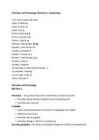
Phonetics and Phonology. Mid-term 1. Terminology. Testi tuleb kindlasti see tabel! Nasal, Bilabial: m Nasal, Alveolar: n Nasal Velar: Plosive, Bilabial: p; b Plosive, Alveolar: t; d Plosive, Velar: k; Affricate, Post-Alveolar: t; d Fricative, Labio-dental: f; v Fricative, Dental: ; Fricative, Alveolar: s; z Fricative, Post-Alveolar: ; Fricative, Velar: x Fricative, Glottal: h Approximant, Alveolar ja Post-Alveolar: Approximant, Palatal: j Approximant, Velar: w Lateral, Alveolar: l Phonetics and Phonology. Mid-term 1. Phonetics the general study of the characteristics of speech sounds: how they may be "strung" together to form meaningful units how they are produced It studies: how to describe the speech sounds in the languages of the world what these sounds are how they fall into patterns how they change in different circumstances Acoustic phonetics the study of the physical properties of the sounds themselves. Auditory phonetics the st
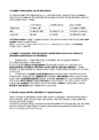
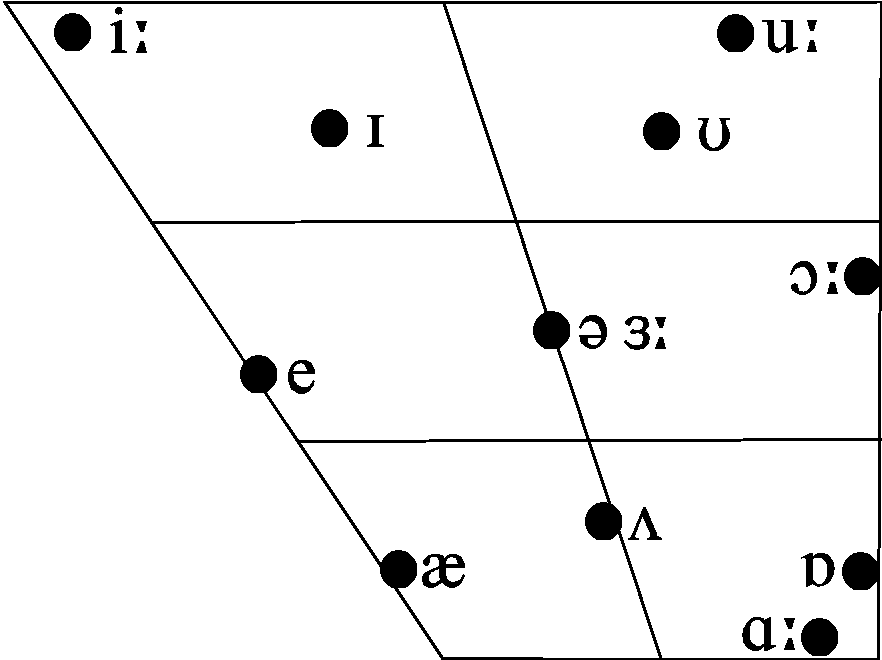
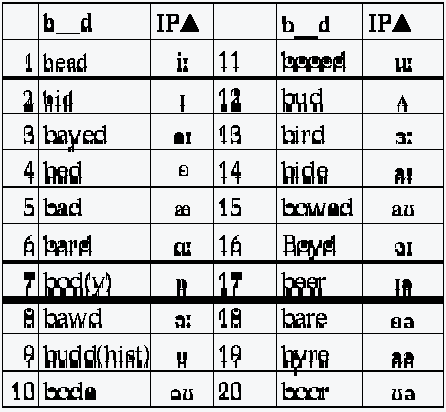
1. English vowel system and its description: A vowel is a letter of the alphabet [a,e,i,o,u and sometimes y (happy)] that represents a speech sound created by the relatively free passage of breath through the larnyx and orav cavity. English has 5 vowels. Front vowels Central vowels Back vowels High/close /i:/ see /i/ sit /u:/ boot /ʊ/ book Mid /e/ bait /Ɛ:/ bird /ə/ sofa /3:/ bird /o/ boat /ɔː/ bought Low/open /æ/ bat /ʌ/ under /a:/ father /ɒ/ sock With front vowels tounge is pushed forward, with central vowels its neutral and with back vowels tongue is pushed back. High/close vowels tongue body is raised, mid vowels its intermediate and low/open tongue body is lowered. 2. English consonants, their description/classification based on (I) manner of articulation and (II) place of articulation: I English has 21 conso
CITATION FORM The citation form of the lexeme is the form that is employed to refer to the lexeme; it is also the form that is used for the alphabetical listing of lexemes in a conventional dictionary. In English, the citation form of a noun is the singular: e.g., mouse rather than mice. For multi-word lexemes which contain possessive adjectives or reflexive pronouns, the citation form uses a form of the indefinite pronoun one: e.g., do one's best, perjure oneself. In many languages, the citation form of a verb is the infinitive: French aller, German gehen, Spanish ir. In English it usually is the full infinitive (to go) although alphabetized without 'to' (go); the present tense is used for some defective verbs (shall, can, and must have only the one form). In Latin, Ancient Greek, and Modern Greek (which has no infinitive), however, the first person singular present tense is normally used, though occasionally the infinitive may also be seen. The pronunciation form in a dictionary
Phonology. Mid-term 2. Syllable - is a phonological unit consisting of one or more phonemes. In phonetics a syllable is a unit which consists of a centre, that has little or no obstruction to airflow; it is comparatively louder than other sounds. In phonology syllables are the possible combinations of phonemes. The syllable consists of - onset, nucleus, coda. (every syllable has a nucleus: vowel, syllabic l, or m, n). Rhyme/rime nucleus + coda; the nucleus and the coda constitute a sub-syllabic unit rhyme. Words rhyme, when their nucleus and coda are identical. (E.g 'cr-o-wn', 'd-o-wn'). The hierarchical structure of the syllable: Onset the beginning of the syllable Nucleus/peak the open part of a syllable, generally a vowel. Coda a consonant sound which ends the syllable. Open syllable - has no coda Closed syllable - has a coda! Texts: [t-e-k-s-t-s]- (Consonant, Vowel, Consonant, Consonant, Consonant, Consonant). Strong syllables - has as its nucleus one of the
CHARACTERISTIC FEATURES OF OLD ENGLISH - 15 monophtongs, (7 long, 7 short, 1 central), 4 diphtongs, 17 consonants. Free variaton of R, and it was pronounced everywhere. Very much Germanic in character. Quite some special consonants that no longer exist. About morphology: synthetic with numerous aglutinating tendencies. System of tenses Germanic, but with a reduction of tenses. Paradigmatic leveling; Stress shift; Word order; Loan words (Old Norse, Old French). Dual pronouns. Determiners - no separate definite article. Strong and weak verbs. Word order relatively free with tendencies towards SVO. SVO, SOV, VSO most common. Adposition and podposition were both possible (eesliide ja tagaliide). About syntax: clauses were joined much simpler than nowadays, using and, then etc. Because of case syncretion the word order in a sentence became much more important to be able to tell the difference between words. FIRST CONSONANT SHIFT (GRIMM'S LAW) Grimm's Law (also known as the First Germanic
Suppletion Present in languages of different families. Present in Old, Middle and Modern English, though the general tendency is towards more regularity/iconicity so the number of suppletive forms has decreased.In the text: goon to go wenden - to turn Gan was suppletive in Old English, past form: eode.Eode was supplanted by went (past form of wenden) at the end of the Middle English period.To wend has survived in Modern English in phrases such as to wend one's way, we wended homewards (ironic usage). Thus: suppletivity- suppletion different parts of one and the same paradigm come from what were originally different paradigms (different words with close meanings or words in different but close dialects).Suppletion embraces verbs, adjectives, nouns. Be was/were been (Old English beon/wesan) (am, art, is, are); in Old English some suppletive forms were used parallel to one another) Good better best Bad worse worst Much more most Little less least Estonian
1) Standard and non-standard varieties of English Standard varieties of English are the varieties of the English language that are considered to be a norm and are spoken and written by the minority (educated people). This is the optimum for educational purposes. The standard varieties of English are: BrEng (British), EngEng (English), NAmEng (North-America), USEng (United States), CanEng (Canada), AusEng (Australia), NZEng (New Zealand). Standard English (British English) is the most widely accepted and understood among native speakers, learned by foreigners. It is used in broadcasting, TV, news etc. It doesn't concern pronounciation (accent), but grammar and vocabulary. It includes formal and informal styles. British Standard English grammar and vocabulary, together with the RP accent should be called English English. RP (Received Pronounciation) is an accent that originates from South-East of England. A social accent, associated only with England. 12-15% of native speakers in Eng
Style The term style is a polysemantic one. The latin word ,,stilus" meant a writing instrument used by the ancients for writing on waxed tablets. Already, in classical latin the meaning of style was extended to denote the manner of expressing one's ideas in written or oral form. One of the abts/the best was given by Jonathan Swift: ,,Proper words in proper places." In present- day english, the world style is used in about half a dozen basic meanings. 1. the characteristic manner in which a writer expresses his ideas. Some speak about the style of Hemingway, Dickens etc. 2. the manner of expressing ideas, characteristic of a literary movement or period. Style of symbolism, romanticism 3. the use of language to pick a literary genre-comedy, novel, drama, O.D (poetic form) etc. 4. the selective use of language that depends on spheres of human activity fiction, scientific prose, newspapers, official documents, business correspondenc et
 annaabi.ee







Kõik kommentaarid