Vajad kellegagi rääkida?
Küsi julgelt abi LasteAbi
Logi sisse

British Parliament (0)

1 Hindamata
Punktid
British Parliament
Structure and Functioning of the British Parliament today
Britain is a parliamentary monarchy . The British Parliament is a bicameral parliament , that is to say that it is made up of two chambers , or two " Houses "; above the two Houses, but in an essentially formal role , there is the Sovereign - king or queen - also known as "the crown ."
Role of the Sovereign
The British monarch has all authority , but no power . The Sovereign appoints the Prime Minister, and every year opens the sessions of parliament, in a historical and ritual ceremony called the State Opening of Parliament . Historically, this ceremony used to take place in the Autumn ; but since 2012, it has been brought forward to May. This is the only regular time when the members of both Houses come together. During the ceremony, the Sovereign reads out the government 's intended programme . The "Queen 's Speech " is a summary of the programme "his" or "her" government intends to implement in the next twelve months; but the speech is prepared and written by the Prime Minister's office, not by the Queen.
The second major function of the sovereign is to sign new laws passed by Parliament. A bill does not become law, or an Act of Parliament, until it has " received royal assent ", meaning that it has been been signed by the Sovereign.
The last major function of the sovereign - in the parliamentary context - is his or her weekly meeting with the Prime Minister. By tradition , the latter informs the Sovereign, who is head of state, about important affairs of state and government business, and asks the sovereign for his or her opinion. With over 60 years of experience , the current Queen Elizabeth II has acquired great experience in managing affairs of state, and an unparalleled experience of international relations , and now acts as an experienced adviser, well liked by her Prime Ministers, of all political persuasions .
The House of Lords
This is the " Upper House" of the British Parliament . It consists of about 750 members (a variable number ) most of whom are Life Peers (i.e. not hereditary lords), or people who have been ennobled for services rendered to the nation . These Life Peers are mostly former members of the House of Commons, or former senior officials, judges, or former business leaders or trade union leaders: each government and opposition party has the right, each year, to propose new Life peers .
The other members of the House of Lords are 96 hereditary Lords from the "nobility" of the United Kingdom, and 26 Bishops of the Anglican Church.
As mentioned above, the House of Lords can not block bills proposed by the Government in the House of Commons, and can only delay some bills . It is rare that the House of Lords use of this prerogative, other than in exceptional cases ; for the Lords to act against the wishes of an elected government would be constitutionally unacceptable. Thus, almost all the bills from the House of Commons are approved quickly by the Lords, and returned for a "second reading " with some proposals for modifications or improvements. It is up to the House of Commons to accept or reject these proposals.
The essential role of the House of Lords is to discuss non controversial subjects, or examine in detail projects for which the House of Commons does not have time. Given its experience of the Life Peers who sit in the House of Lords, the Upper House is an assembly of well experienced former politicians , and is well suited to its parliamentary duties, even if its members are not elected representatives.
In 2012, the Cameron Government proposed to change the status of the House of Lords, making it into a largely elected chamber : but the proposal does not terribly interest the British public, and this change is unlikely to happen in the near future.
The House of Commons
The House of Commons is the main House of the British Parliament in terms of legislative power. It is a chamber composed of 650 members (Members of Parliament or MPs ) elected by universal suffrage. The life of a Parliament is five years.
According to an ancient tradition, MPs are elected by universal suffrage under a system of relative majority , in one round of voting. This means that the candidate with the most votes in an election is elected, whether or not he or she has an absolute majority of votes. This system favors the major political parties , and stable governments - at the expense of smaller parties.
Elected Members of Parliament do not have a deputy, so in the event of the death , resignation or removal of an MP, a "by-election" must be called in order to elect a new MP. Each MP represents a territory, or constituency: the link between an MP and his or her constituency is symbolically and historically very important , and in the House of Commons, Members are not called by their name, but by the name of the constituency from which they have been elected ( or, if they are government ministers, by their function) .
Since 1902 , the British Prime Minister has always been a serving Member of Parliament, elected to the House of Commons; and most ministers - often all ministers - are members of the House of Commons too. The Government is formed by the party (or as currently, by the coalition of parties) that has a majority of seats in the House of Commons. Members of the Government sit in the front row of benches in the House of Commons (called the Front Bench ), directly opposite the leaders of the Opposition .
The chairman of the House of Commons is known as the "Speaker", and he or she presides over each parliamentary session, deciding who can speak .
A significant aspect of the House of Commons is the importance given to the Parliamentary Opposition . It is structured with an official Leader (The Leader of the Opposition ) and a " shadow cabinet ", consisting of spokesmen for the Opposition each with an official portfolio corresponding to that of a government minister.
Most of the time the debates in the House of Commons are devoted to projects of government legislation . Most bills are put formard by the government ministers. However , some time is given to bills tabled by individual MPs (known as Private Members' bills), or to bills tabled by the opposition (known as Opposition motions) . In each session of Parliament, the opposition has 20 days during which it may propose legislation and determine the agenda of the House.
Private Members Bills Bills and Opposition motions may be adopted by the House of Commons, but they must also be approved by the Government, given that the Government has a majority of votes. Thus, new laws can effectively be proposed by the Opposition, and can be accepted by Parliament. This can happen especially if the motion concerns a consensual or non-controversial political project , or even a question for which MPs' will vote according to their "moral convictions", rather than the politics of their party. In such cases, governments traditionally allows members the freedom to vote according to their conscience. Two important examples of Private Members Bills have been passed by Parliament are the law to abolish the death penalty ( Murder Act of 1965 ), and the law authorizing abortion (1967).
Territoriality
The British Parliament is both Parliament of England and Parliament of the United Kingdom. It is sovereign (see Constitution). Parliament has delegated some of its powers to the regional parliaments or assemblies of Scotland, Northern Ireland and Wales .
British Parliament #1 British Parliament #2 British Parliament #3
Punktid 50 punkti Autor soovib selle materjali allalaadimise eest saada 50 punkti.
Leheküljed ~ 3 lehte Lehekülgede arv dokumendis
Aeg2015-11-29 Kuupäev, millal dokument üles laeti
Allalaadimisi 2 laadimist Kokku alla laetud
Kommentaarid 0 arvamust Teiste kasutajate poolt lisatud kommentaarid
Autor eeva21k Õppematerjali autor

Sarnased õppematerjalid

Suurbritannia ühiskond ja kultuur quiz 2 mõisted
32
pdf

Suurbritannia ühiskond ja kultuur quiz 2 mõisted

Read Privy Council: Guide to its origins, powers and members on the BBC website to find out what the Privy Council is, what it does and who can be its member. 165 higher education institutions including universities, university colleges, specialist higher education institutions and other higher education colleges UCAS The Universities and Colleges Admissions Service (UCAS) is a UK-based organisation whose main role is to operate the application process for British universities. It operates as an independent charity, funded by fees charged to applicants and to universities, plus advertising income, and was formed in 1992 through the merger of the former university admissions system UCCA and the former polytechnics admissions system PCAS. Clearing is a way of matching universities needing students to students needing a university, and in 2016 it opened on Tuesday 5 July. If you didn’t receive an offer from any of the five

Inglise keel
The UK
5
doc

The UK

THE U.K Different Parts The United Kingdom is a short way of saying the United Kingdom of Great Britain and Northern Ireland. The UK is the political name for those countries which share a parliament in London. All of them were at one time independent kingdoms with their own monarch. Now they are all part of the same kingdom and share the same monarch. The UK consists of Northern Ireland, Scotland, England and Wales. The peoples of these countries are British subjects; they hold British passports and therefore their nationality is British. The british Isles is the geographical name for all the islands off the west coast of Europe.

Inglise keel
English Parliament and Elections
4
doc

English Parliament and Elections

Describe the British Parliament Works in a large building called the Palace of Westminster aka The Houses of Parliament. There are offices, committee rooms, restaurants, bars, libraries and even some places of residence. Two large rooms: The House of Lords meet in one and the House of Commons in the other. The British Parliament is divided into two houses, but the House of Commons is obviously more important and only they are considered to be the MPs. In the House of Commons there are just two rows of benches facing each other. On the left sit the members of the governing party and on the right sit the opposition. The Speaker sits between them and controls the action. The arrangement of the benches encourages confrontation between the government and the opposition. There is no place for somebody

Inglise keel
Suurbritannia ühiskond ja kultuur konspekt
14
doc

Suurbritannia ühiskond ja kultuur konspekt

progressing to the last. 12.French influence on the English language English language originally sprang from the dialects of three Germanic tribes known by historians as the Angles, Saxons, and Jutes. These peoples settled in Britain around 450 AD. Their language became known as Anglo-Saxon. One of the most important influences ever to shape the English language arrived in 1066 AD-William the Conquerors invasion of the British Isles. The Norman Conquest and its Consequences On William the Conqueror's accession to the throne of England, several important changes took place. Firstly, the French dialect the Normans spoke (Anglo-Norman) became the official language of the court, administration, and perhaps just as importantly, the language of culture. At the same time, English was relegated the common people, and became the language of everyday use. This official

Suurbritannia ühiskond ja kultuur
Ingliskeelsete maade ühiskond ja kultuur-eksamiküsimused
26
docx

Ingliskeelsete maade ühiskond ja kultuur, eksamiküsimused

1. The Queen’s official title. Elizabeth the Second, by the Grace of God, of the United Kingdom of Great Britain and Northern Ireland and of Her other Realms and Territories Queen, Head of the Commonwealth, Defender of the Faith. 2. The Queen’s working day. Starts after breakfast. Reads the newspapers which are prepared by the Press Secretary, and a report on the previous day’s proceedings in the Parliament and the letters she receives. Also phone calls. Once a month she attends the Privy Council in order to give Royal Assent to various items of government legislation. Discusses domestic matters with the Master of the Household. Towards the end of the day, there is always another pile of official papers and reports waiting to be read or acted upon. The business on constitutional monarchy never ends. 3. Who is the present heir to the throne

Ingliskeelsete maade ühiskond ja kultuur
The United Kingdom
8
doc

The United Kingdom

The Scottish flag has a white cross on a blue background. It is also on the Union Jack. Northern Ireland is the smallest part of the UK as it only covers about 5500 square kilometres. About half of the 1.7 million inhabitants live in or around Belfast, the capital, in the eastern coastal region. The centrepiece of Northern Ireland's geography is Lough Neagh, at 151 square miles (392 km²) the largest freshwater lake both on the island of Ireland and in the British Isles, and the third largest lake in Western Europe. A second extensive lake system is centred on Lower and Upper Lough Erne in Fermanagh. Northern Ireland don't have an official flag any more nor a coat of arms. Due to the division of the population along ethnic, religious and political lines, a wide variety of flags can be seen flying from lampposts and private houses across Northern Ireland. Government. The British Constitution is an unwritten constitution, not being

Inglise keel
The House of Commons
6
pptx

The House of Commons

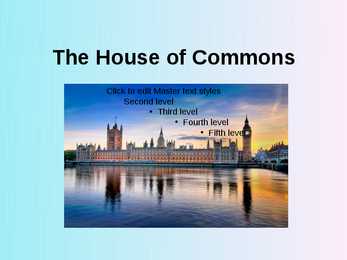
The House of Commons Click to edit Master text styles Second level Third level Fourth level Fifth level The House of Commons is the lower house of the Parliament of the United Kingdom, which also comprises the Sovereign and the House of Lords. It consists of 650 elected members called Members of Parliament. The House of Commons was originally far less powerful than the House of Lords, but today its legislative powers greatly exceed those of the Lords. The full, formal style and title of the House of Commons is The Honourable the Commons of the United Kingdom of Great Britain and Northern Ireland in Parliament assembled. Role The House of Commons main purpose is to make laws by passing Acts of Parliament, as well as to discuss current political issues

British culture (briti kultuur)
Nimetu
10
pptx

Nimetu

UK Parliament Parliament of the United Kingdom The Parliament of the United Kingdom is the highest legislative body in the United Kingdom and British overseas territories. It alone has parliamentary sovereignty over all other political bodies. At its head is the Queen Elizabeth II. The parliament has an upper house, the House of Lords, and a lower house, the House of Commons. The House of Lords plays an important role in checking and challenging the decisions and actions of the government through questions and debates. A House of Commons evolved at some point in England during the 14th century, becoming the House of Commons of Great Britain after the political union with Scotland in 1707. How laws are made

Inglise keel


Kommentaarid (0)

Kommentaarid sellele materjalile puuduvad. Ole esimene ja kommenteeri


Sellel veebilehel kasutatakse küpsiseid. Kasutamist jätkates nõustute küpsiste ja veebilehe üldtingimustega Nõustun