Tallinn´s University Pedagogical College
Department of Youth
Work and Continuing Education
Andra Pant
NT-32
Tallinn 2012
“
Delivery is more important than content.”
–Arch Lustberg,
speech trainer
According to well-known social
anthropologist Edward T. Hall, 60% of our
communication is nonverbal.
That means whenever we
stand before an
audience , our stance, our
posture , our
facial expressions, our
hand gestures , our
whole body
dynamic communicate more than our actual spoken
words . A stiff,
immobile speaker is often a boring and
usually ineffective speaker
as. It is therefore
essential to
know how to be physically relaxed,
which will
allow your
actions to complement your words.
Before we start, two important
definitions: A
podium
is the raised platform at the
front of the
room where speakers stand
to
deliver presentations; it is also called the
dais
(pronounced day-us). The stand used to
hold notes is called the
lectern.
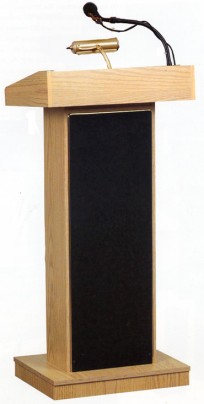
A lectern can be a short stand placed atop a table, or it can be a
free-standing unit with a
light , microphone, and sometimes a clock
attached. The
terms podium and lectern are often interchanged and
misused , and for that
reason , the skilled speechmaker should know
this distinction.
This is a lectern.Within many cultures
around the
world, it is believed that the eyes are the
windows to the
soul . In
public speaking, since we usually want to arouse
both spirit and
soul, the eyes become the most important physical
equipment of all!
Have you ever conversed
with
someone who
kept looking away constantly, avoiding eye contact?
This
behavior often illustrates discomfort or dishonesty. Conversely,
the
person who maintains
good eye contact is displaying sincerity,
attention , and
respect .
The single most important physical action in public speaking is to have direct eye contact with your audience.How can you
practice and learn
good eye contact?
The only way to cultivate good
eye contact is to practice doing it
each
and every time you speak . Here are some tricks for doing that:
- Be aggressive . When speaking, pick out a specific pair of eyes in the audience and bore right into them , for just a few seconds . Then move over to another set; do the same , and on and on.
- Don't allow your eyes to jump around helter-skelter. Do it with purpose. Look left . Make a statement . Look center. Make a statement. Look right. Make a statement. Look at eyes in the back of the room. Make a statement.
- Each time your eyes move, pretend to yourself that you are talking only to that individual.
A number of skillful business
speakers have said that with
these techniques they have been
able to
recapture the attention of a temporarily disinterested listener. When
experienced speakers spot one person in the audience whose eyes are
looking down or off at another part of the room, they
issue a
concentrated
dose of words and look directly at that person. This can
actually coerce the distracted listener to reestablish eye-to-eye
contact with the speaker.
An effective public speaker.When presenting dry,
complex facts or statistics,
odds are that the eyes and heads will stray.
But, if you
raise your
voice , pound the lectern, or tell a story
about
real people and real events, the odds are that you'll
turn heads back in your direction again. A good speaker communicates with
the audience with his or her
eyes.
The
first person to discover he
didn't like the
sound of his own voice was probably
Thomas Edison .
When he
invented the first phonograph, he heard his own
historic words, "
Mary had a
little lamb." Like most of us, Edison
was probably disappointed because our voices sound
different on a
recording and we usually don't like the
result . The reason is that
our voices sound better inside our heads than they do when played
back on recording machines. The two important lessons here are (1)
Your voice probably doesn't sound as bad as you think it does, and
(2) if you are troubled by the sound of your voice, there are
simple ways to
improve its
quality .
Thomas Edison and the phonograph.Nervousness is usually the
reason why are voices are so
affected in public speaking. There are
three simple ways to relax and thus upgrade your voice:
- Slow Down. As with driving a car, control is easier at slower speeds.
- Release the Upper Body. "Take a breath, rotate your shoulders, relax your neck," Rush says. All these actions will create more relaxed vocal chords and make your voice sound deeper and more pleasant.
- Take Breaths from Your Stomach, Not Your Chest. Short breaths reduce vocal quality. Breathing deeply from the diaphragm allows a richer, more relaxed sound.
In
addition , for effective
speechmaking,
avoid the
monotone
voice (
particularly Estonians!).
- When we want to convey something very important and serious , we all tend to talk in a lower tone (and, inciden tally, at a slower pace.)
- In ordinary conversation, we speak in the mid-range between bass and treble.
- And when we are excited or a little silly, our voices creep up to the higher range. The main goal is to vary the sound of your voice, and to have the pitch and modulation complement your delivery!
Accents
Do Southerners or "New
Yorkers" have an
advantage or disadvantage? Rush's rule for
answering that question is as follows: " . . . I don't
mess with
it
unless the accent will
hurt another person's credibility or
render him unintelligible. For example, when someone with a down-home accent
tries to sell stocks in a metropolitan area, the accent might not
help."
Laughter
This
may
surprise you, but as a speaker don't be
afraid to laugh, where
and when appropriate. Laughter is a wonderful sound. And it's
contagious. Have you ever noticed how professsional comedians
such as
Johnny Carson occasionally
join in the laughter
following their own
jokes ? When a speaker laughs at the right moment it can make the
audience feel good.
Dry mouth
syndrome
A
dry mouth obviously hinders good voice quality and is a direct result
of nervousness. Here are three ways to minimize the dry mouth
syndrome. First,
instead of sipping cold water, which tends to tighten the vocal
chords, take a hot
drink instead.
Warm liquids tend to relax the
throat and vocal chords. Second,
try to
force a yawn.
Strange as it seems, yawning tends to stimulate
salivary glands and relieve that terrible dryness. Third,
if neither of these works, as sometimes happens if you are
taking a
medication that causes dry mouth, ask your pharmacist to
supply an
over-the-counter
liquid spray
solution that creates an artificial
saliva, providing temporary relief.
GESTURES
If you know your
subject thoroughly, and believe in it with your heart, good news are to
come !
Gestures will become
automatic , almost instinctive. Then, the only
self-tutoring you need to do is study yourself on videotape to sort
out the
weak gestures from the
strong ones . You'll see them, don't
worry .
What are
examples of "weak
gestures"?
- Fiddling with your spectacles.
- Playing with a pen or paper clip.
- Reaching in your pocket and unconsciously jiggling the change there.
- Repeatedly patting your hair, scratching your head, pulling on an ear, buttoning and unbuttoning a coat. Barack Obama patting his hair while speaking.
- Frequently clearing your throat.
- Using any single gesture over and over and over again.
Why
are these bad? In a single word, they are distracting. They distract
the audience's attention from your
message .
On the
other hand, strong,
forceful, and complementary gestures strengthen your presentation.
Gestures should be physical actions that fit and
support the words.
In short, if you speak with
conviction and take the time to watch yourself on videotape, you'll
be able to sort out and discard weak gestures and
replace them with
stronger ones.
Posture
The
video camera will reveal if you are guilty of any of the following
postural taboos:
- Slouching or hunching over the lectern.
- Repeatedly bouncing on your toes or rocking back on your heels.
- Keeping head and eyes down, rarely looking up. Clenching hands together.
- Clenching hands tightly together.
Some speakers
employ a
special walking technique. Try walking a few
feet away from the lectern to
address one side of the audience; then
walk to the other side to make
another point. This walking movement brings you closer to the
audience, provides
visual variety for them, and is also a physical
way to
signal a relaxed transition from one point to the next. Walking techniques help
insert your whole body into your presentation
and can be
developed with a little practice. It
requires good timing
and must be practiced carefully so that it
looks natural, but it can
be an effective way to use your body to punctuate and underscore your
remarks .
The
Lectern and microphone
The
average speaker ascends a dais, moves to the lectern, taps or adjusts
the microphone, clears the throat, and then remains rooted there for
the
rest of his or her presentation. In contrast, the person who
wishes to be above average will do the following:
The lectern and microphone. - Before the audience arrives, inspect the room to assure everything is in place : lectern, microphone, and any other audio -visual equipment that you'll need.
- Check the height of the lectern; many are adjustable. The lectern should not be so tall that only your head shows, nor should it be so low that it is difficult to read your notes.
- Check the audio-visual equipment to assure that everything is operating properly and that you know how to turn lights on and off, change slides or transparencies, and even change a light bulb quickly if the one you are using happens to b u r n out just before or during your presentation. Most important, if you are using a remote control unit for a slide projector, get thoroughly acquainted and rehearse with each button. I have seen speakers in the middle of their presentation accidentally begin pushing the " reverse " control instead of the " forward " control, continue reading from a script, and create total confusion between words and images on the screen .
- Pay special attention to the microphone. So many speakers step up to the microphone, adjust the "gooseneck" holder (which always creates an ugly, grating sound), and then begin to speak not knowing if the voice is booming or barely being heard. Another tipoff to the skill and experience of speakers is to note if they clear the throat or, worse yet, if their first words are "Can you hear me?" It is far wiser to check out the microphone well in advance, assuring that the volume level is set so that people in the back of the room can hear you comfortably. Remember, too, that a room with an audience absorbs sound, so if you test the microphone in an empty room, boost the volume slightly to compensate for the audience. In such cases , the sound technician responsible for the audio system can become your best friend; ask him or her to check out the system with you before your presentation.
- If you are suspicious that people in the back of the room may not be hearing you, here's a smooth, professional way to handle it. Just say: " Please help me with a speaker check. If you can hear me in the back of the room, raise your hands." That enlists the help of the audience and tells you quickly and efficiently exactly what you need to know.
- Inquire if someone is available to monitor the volume control for the microphone and be prepared to make adjustments while you are speaking. This is especially helpful if "feedback"—that loud screeching noise—should occur . Feedback can happen almost everywhere , no matter how advanced or professional the sound system or the setting might be. It develops when the sound reaches a volume that actually "feeds back" the speaker's voice through the microphone. The only way to stop the resulting assault on the eardrums is to lower the volume level.
- Be careful of standing too close to the microphone. The result, in radio lingo, is called " popping your P's." Every time you use a word beginning with the letter "p," the microphone picks up that little explosion of air from your lips and it comes through the system sounding like a pistol shot .
- Observe where the microphone cord is located , especially if it snakes along the floor to the side or behind the lectern. More than one speaker has tripped over that cord on the walk across the podium.
- Try moving out and around from the lectern. Skilled speakers know that the lectern can represent a barrier between a speaker and the audience. That's why many novice speakers stand rooted behind it, often leaning on it for support. The lectern becomes both a prop and defense barrier. But, if you observe experienced speakers, you'll notice they will move from one side of the lectern to the other as if signaling that they are anxious to make better contact with the audience. Some will also stand at the side and casually put one elbow on the side of the lectern, presenting a friendly , relaxed pose to the audience. When using this technique, here are some tips: Don’t let the lectern become an obstacle between you and your public!
- Be careful not to step out of range of the microphone.
- You may want to arrange in advance to be equipped with either a hand-held microphone, or a "lavalier" mike , which hangs around the neck or clips on to the lapel. The latter offers extra freedom to move out from behind the lectern and also frees up the arms and hands for more gestures.
- Another type of microphone is a "remote" mike. There are two styles: A cordless battery -operated microphone, and a miniature microphone that clips to the tie, blouse, or coat lapel with a wire leading to a portable power pack that clips to the waist .
If
you are
still dubious about how the lectern represents a
shield and
obstruction between you and the audience, start observing the altars
of modern churches, stages for TV
award programs, and the podium
arrangements used by professional
seminar leaders. In each
case , the
speaker either operates without a lectern, or the lectern is a
transparent stand. The reason, as we have learned here, is to avoid
having the speaker partially
blocked from the audience and to allow
the speaker to use the
full body.
A difficult, 180 degrees room arrangement.One of the most difficult room
arrangements for a speaker is when the audience is spread out a full
180 degrees from left to right. In this situation, the tendency is to
look
straight ahead, virtually ignoring the two thirds of the
audience to the left and right. In such cases, it is better to make
the extra effort to
include the whole audience in your eye contact,
addressing some statements to the left, other comments in the middle,
and still more remarks to the people on the far right even though
you'll have the
feeling that you are
turning the back of your head to
part of the audience.
Some factors to look for when
examining the room where you'll be speaking:
- How far is the lectern positioned from the audience? Sometimes it is thoughtlessly placed 10 or even 20 feet away, leaving a physical gulf between you and the audience. In that case, ask for the lectern to be moved forward so that you will be physically closer.
- Where will you be seated prior to your introduction? What path will you take to walk to the podium and then to the lectern? Must you walk from the back of the room, or through people seated on chairs? Must you ascend a podium? (If so, check the height. There is no worse overture to a speech than falling flat on your nose just seconds before you are supposed to speak.)
- If possible, place your notes on top or on a shelf of the lectern in advance, rather than carrying them with you. Having your notes already in place on the lectern is a small touch that avoids having to carry them up, lay them on the stand, and play with or shuffle them. This technique, however , is not foolproof. Someone did that once and the speaker before me inadvertently carried his notes away with him. (One solution is to place your notes underneath , on the small shelf usually located within the lectern.)
- The worst of all room settings is a small audience seated in a large room. Speaking to a small group in the ballroom of a hotel is intimidating to everyone: The speaker is distracted by all the empty space and the audience is reluctant to relax or become involved with the speaker. The only ways to counteract this are (1) try to encourage the audience to come and sit closer together down in front, and (2) try to position yourself as close to the audience as possible. The objective is to reduce, as much as possible, the potential barriers between you and your audience. Conversely, when an audience completely fills a room, the speaker is buoyed because so many have come to hear his or her message, and the audience's response is often better: Laughter and applause seem to be freer, almost contagious.
- Here's something most speakers ignore: Where are you supposed to go when you finish your remarks? Do you sit down on the dais? Do you return to the audience? Are you supposed to retreat to the back of the room? Determine the answer in advance by checking with the program organizer.
 10 punkti
Autor soovib selle materjali allalaadimise eest saada 10 punkti.
10 punkti
Autor soovib selle materjali allalaadimise eest saada 10 punkti.
 ~ 7 lehte
Lehekülgede arv dokumendis
~ 7 lehte
Lehekülgede arv dokumendis
 2012-10-17
Kuupäev, millal dokument üles laeti
2012-10-17
Kuupäev, millal dokument üles laeti
 5 laadimist
Kokku alla laetud
5 laadimist
Kokku alla laetud
 0 arvamust
Teiste kasutajate poolt lisatud kommentaarid
0 arvamust
Teiste kasutajate poolt lisatud kommentaarid
 Andra Pant
Õppematerjali autor
Andra Pant
Õppematerjali autor
 annaabi.ee









Kõik kommentaarid