Vajad kellegagi rääkida?
Küsi julgelt abi LasteAbi
Logi sisse

Homereading - body language (0)

1 Hindamata
Punktid
Body language
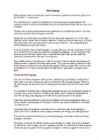
Body language means communication with the movement or position of the human body. It can be conscious – or unconscious.
It is something that is noticed by everybody but is not always given enough attention . We sometimes ignore it and try to hide behind words , but we should never forget that we cannot fool everyone!
Children react to body language because they experience the world through intuition. The same can be true for adults when feelings are involved.
People who are in bad shape emotionally will often place great importance in it. In fact , they often pick up the smallest hint of a lapse in attention in the person they are speaking to. And they frequently jump to the conclusion that they are boring or a nuisance - thus compounding any sense of depression or poor self- esteem .
A way to learn the secrets of body language is to watch television with the sound turned off and try to interpret what is being said simply from reading body language. You will experience that humans say a lot with their mouth which is contradicted by their body, gestures and other channels of communication. Messages are ambiguous.
But a notable feature of the early years of the 21st century is the fact that the body language of different nations is gradually becoming more similar. Thus, a gesture made by someone in (say) South America can often be easily interpreted by people in Russia or Japan. Much of this is due to the effects of TV, which of course shows the same sort of ‘ soap operas’ in all parts of the globe .
Words and body language
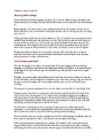
If a child is to believe the parents who say that it's healthy to go to bed early, it usually doesn't make much sense unless the parents express it with both words and body language. Otherwise, the child may get the impression that it is only good for the parents that the child is put to bed early.
It is important to remember that, although body language does give you an additional channel of communication, which sometimes contradicts the spoken word, it should be interpreted with care. For one thing , body language can be affected by particular habits of the speaker.
Apart from individual differences , there are also differences between geographical regions , as well as between cultural groups. For example, in Greece, you nod your head for 'no', and shake your head for 'yes'.
The human brain communicates to the body how it is to position itself. Body language is subconscious and is intended to create a balance between inner feelings and outer appearance.
If we develop increased sensitivity to our own body language, our ability to read others ' body language is increased.
This makes it easier to tell whether a person you are talking to is happy, sad, sullen or irritated. Or whether he or she is lying to you, or is impatient, or bored. You should also be able to register whether the person appears to like you, agrees or disagrees with you, is aggressive to you, or is suspicious, angry or worried.
Observing hidden feelings
Increased attention to body language will allow you to observe hidden feelings, prejudices and sexual intentions; all through your eyes and the other senses we use to perceive the world around us.
Body language is the movements of arms and legs , body posture , the manner in which you sit, facial expressions, gait, eye movements and regular gestures such as stroking your hair, touching your nose , etc.
Tilting your head signals that you are not dangerous . This is claimed to be a consequence of your mother tilting her head when she pitied you as a child. She showed you that she wasn't angry at you but wanted to comfort you. Your mother also patted her hand or your head when she was comforting you. We continue to do this even after we've grown up and don't have our mother there to do so anymore . We pat ourselves on the cheek , on the arm, or rub our hands together.
Perhaps you hold your hands close to your face when you talk - generally, this is a sign of insecurity. The same is true if you roll a beard or moustache with your hands or fix your hair, perhaps pushing or curling it behind an ear.
Are you sitting comfortably?
The way that people sit in chairs is not coincidental. If you are lounging with arms and legs dangling, it is probably a sign that you are relaxed and feeling comfortable. If you are positioned on the edge of the chair with you legs stretched before you and your feet crossed it can signal indifference.
Example: in a country where rules of behaviour in court were very strict, a witness in a trial sat as described above, with his huge boots lumped on top of each other, wearing a big coat and with his arms crossed. The judge said: 'Sit up straight and take your coat off, or I'll hold you in contempt.'
The man got his posture straightened out in no time when he realised that he risked being fined .
Someone going to the dentist or waiting for a job interview might be seated on the edge of the chair with his or her feet together. If it's a woman she'll probably be hugging her handbag, or clutching a hanky. Body tension spreads to the respiratory system, forcing your breathing and making you sound short of breath. When you are in such a position it is easy to lose your head and simply run away if things take a turn for the worse .
On television it's interesting to watch contestants in quiz shows like 'Who wants to be a millionaire'. You can detect their understandable tension from the way they hold their hands till their knuckles turn white and also from observing their quickened breathing.
We do not believe that you can teach people to control their body language completely ; they will lose control at some point or other - when they become too eager or too angry.
Take a discussion between politicians, for example. The control is there, even when they get angry but there will be a small muscle by the mouth that is quivering or a vein that's pulsating and turning red. Cheeks turn red in women who are angry or embarrassed while men's ears often turn red under similar circumstances.
Misunderstanding body language
When you try to interpret body language, you must interpret in relation to what is being said with words; otherwise misunderstandings can easily arise. It must be judged as a whole .
Several elements must be in accordance if you are to draw any firm conclusions about a person. He or she being insecure for example.
In order to reach your conclusion you must also pay attention to facial expression, the mouth's position, eye movements and pupil dilation and retraction.
Research has shown that the speaker's face is the most reliable source of information about the mood of a person.
It is through visual experiences that happiness , surprise , anger or contempt is communicated while auditory experiences communicate fear. In order to ascertain the mood of the speaker you must observe facial muscles..
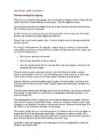
  • How they are tightened and loosened.
  • How the lines around the mouth are softened.
  • How the wrinkles around the eyes can make them shine with happiness when that is the feeling the face has to express.

The same features express anger and contempt, while softer features are taken to express kindness and friendliness - but note : only if the feelings also extend to the eyes. A mouth that smiles without the eyes smiling as well sends signals of falseness and unreliability.
Eyebrows that rise up and down rapidly signal acceptance of social contact. If you raise your eyebrows and keep them raised for a while it signals surprise and astonishment - perhaps even indignation.
When the raised eyebrows are used along with a wink you are flirting. This can cause problems. For example, in Japan where it is considered very inappropriate, practically improper, to use eyebrow raising at all.
Tears and laughter are forms of expression that we think are fairly easy to interpret. However, tears are used to express many different things - sorrow, joy, and anger. Laughter can be a sign of happiness and friendliness, but also of contempt and sarcasm. Sometimes we also laugh if we are scared, or if we experience something very horrifying.
Occasionally, people who work with other people in the welfare or health sectors can happen to laugh if they learn of something particularly tragic - maltreatment, violence , or death. This is likely to be a response to protect their own sanity from the horror of many incidents they face in their work and may also stop them from breaking down and crying.
To be able to read body language is very interesting, but it can be complicated, so watch out! Mistakes can easily be made.
Finally , if you want to know more about body language, there are a number of good books on the subject – notably by Allan and Barbara Pease and also by Dr Desmond Morris .
Homereading - body language #1 Homereading - body language #2 Homereading - body language #3 Homereading - body language #4
Punktid 50 punkti Autor soovib selle materjali allalaadimise eest saada 50 punkti.
Leheküljed ~ 4 lehte Lehekülgede arv dokumendis
Aeg2009-05-10 Kuupäev, millal dokument üles laeti
Allalaadimisi 21 laadimist Kokku alla laetud
Kommentaarid 0 arvamust Teiste kasutajate poolt lisatud kommentaarid
Autor sweety91 Õppematerjali autor
homereading

Sarnased õppematerjalid

A New Earth
378
pdf

A New Earth

............................................................24 Identification with Things........................................................................25 The Lost Ring...........................................................................................26 The Illusion of Ownership........................................................................29 Wanting: The Need for More....................................................................31 Identification with the Body.....................................................................33 Feeling the Inner Body.............................................................................34 Forgetfulness of Being.............................................................................35 From Descartes's Error to Sartre's Insight...............................................36 The Peace that Passes All Understanding................................................37

Psühholoogia
Getting physical
7
docx

Getting physical

GETTING PHYSICAL Tallinn 2012 "Delivery is more important than content." ­Arch Lustberg, speech trainer According to wellknown social anthropologist Edward T. Hall, 60% of our communication is nonverbal. That means whenever we stand before an audience, our stance, our posture, our facial expressions, our hand gestures, our whole body dynamic communicate more than our actual spoken words. A stiff, immobile speaker is often a boring and usually ineffective speaker as. It is therefore essential to know how to be physically relaxed, which will allow your actions to complement your words. Before we start, two important definitions: A podium is the raised platform at the

Intercultural communication
Ärialane suhtus ing-keeles
5
doc

Ärialane suhtus ing. keeles

A feeling of helplessness. Delay or refusal to learn the lg of the host country. Excessive fear of being cheated. Excessive concern over minor pains. Terrible longing to be back home. Reverse CS- re-entry shock- the unexpected confrontation with the familiar. Cultural dimensions. Non-verbal communication Nonverbal communication is usually understood as the process of communication through sending and receiving wordless messages. Such messages can be communicated through gesture; body language or posture; facial expression and eye contact; object communication such as clothing, hairstyles or even architecture; symbols and infographics. Speech may also contain nonverbal elements known as paralanguage, including voice quality, emotion and speaking style, as well as prosodic features such as rhythm, intonation and stress. 1

Ärialane suhtlemine rahvusvahelises kontekstis
CHANGE YOUR THINKING CHANGE YOUR LIFE
580
pdf

CHANGE YOUR THINKING CHANGE YOUR LIFE

ccc_tracy_fm_i-xviii.qxd 7/7/03 3:22 PM Page x x ➤ CONTENTS Bibliography 256 Index 260 Advanced Coaching and Mentoring Program 268 About the Author 269 ccc_tracy_fm_i-xviii.qxd 7/7/03 3:23 PM Page xi Acknowledgments The writing of this book has taken many years of work, reading, teaching, and experience. Many people have contributed to my thinking and have been invisible guides as these chapters came to- gether. I would like to first thank my friend Mark Victor Hansen, who introduced me many years ago to Emmet Fox, perhaps the finest spiritual thinker of the twentieth century. Ernest Holmes, founder of Science of Mind, opened my eyes and heart to the incredible universe

Inglise keel
BODY LANGUAGE
9
pptx

BODY LANGUAGE

BODY LANGUAGE Denis Horenzenko What is Body Language? Body Language is the communication of personal feelings, emotions , attitudes(), thoughts through body movements ­ gestures(), postures() , facial expressions, walking styles, positions & distance - either consciously(c) or involuntarily( ) .Its not only your tongue you communicate with but also you speak with your body movements and gestures. The Main Aspects of Body Language Gestures: A gesture is the verbal or non-verbal body movement used to express or emphasize() an idea , an emotion or a state of mind. Body Movements: This includes the head, eyes, eyebrows , lips , neck , shoulders, fingers and so on. One can distinguish() four main kinds of gesticulation(): Emblem, illustrators, regular and self-touching. Behavior : This refers quite simply , to everything we do which is overt or observable()

Inglise keel
Aforismid-inglise keeles
9
doc

Aforismid (inglise keeles)

associations (Percy and Noxema, go for it ;-) ). 81. Never decline a request that isn't made explicitly. A man is entitled to the dignity of not asking for something he wants. 82. Never placate a bully or a tyrant unless he's got a gun to your head. 83. Never vocalize when you clear your throat. 84. Opt out of the insanity around you. 85. Wear clothes that fit you; it is impossible to disguise the shape of your body. 86. Work as hard as you can, because you won't know whether your life preserver works until the ship sinks. 87. Word hard. Think actively. Investigate thoroughly. Doubt everything. Notice interconnections. 88. Be clear about what you want. Be responsible. Be flexible. Be patient. Be cooperative. 89. Post-modernism is an ideology masquerading as skepticism. 90. Post-modernists defend themselves against their critics by making their arguments so

Inglise kirjandus
600976-teacher-guide-for-writing-c1-advanced
26
pdf

600976-teacher-guide-for- writing-c1-advanced

..................................................................... 3 learners’ writing skills in preparation for the C1 Advanced exam. Key terminology........................................................................................................................................ 4 About C1 Advanced Understanding the Cambridge English Writing Assessment Scale.................................................... 6 ✔ Tests reading, writing, speaking and listening ✔ Comes after B2 First or B2 First for Schools and skills, plus use of English before C2 Proficiency How to assess and develop learners’ writing skills in the classroom...............................................

Kategoriseerimata
English structure revision for the exam
40
docx

English structure revision for the exam

English structure revision for the exam 1. Terms Language → A systematic, conventional (tavakohane) use of sounds, signs or written symbols in a human society for communication and self-expression. Human language at all levels is rule- or principle- governed (valitsema) meaning that language corresponds to the grammar. Natural language is usually spoken, while language can also be encoded into symbols (such as letters, morse etc) For example: Estonian, English. Linguistics → The scientific study of human natural language. Broadly, there are three aspects to the study which are  Pragmatics (studies the use of language → interested in the gap between the sentence’s meaning and the speaker’s meaning).  Semantics (concerned with the meaning of the language aspects and the way they

Inglise keel


Kommentaarid (0)

Kommentaarid sellele materjalile puuduvad. Ole esimene ja kommenteeri


Sellel veebilehel kasutatakse küpsiseid. Kasutamist jätkates nõustute küpsiste ja veebilehe üldtingimustega Nõustun