Vajad kellegagi rääkida?
Küsi julgelt abi LasteAbi
Logi sisse

Teadusfilosoofia valikut (0)

1 Hindamata
Punktid
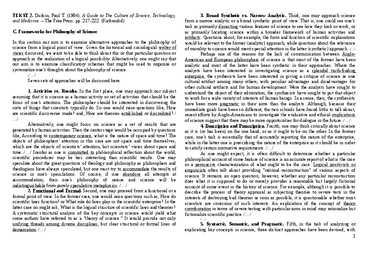
TEKST 2. Durbin, Paul T. (1984). A Guide to The Culture of Science , Technology , and Medicine . – The Free Press. pp. 217-222. (Katkendid)

C. Frameworks for Philosophy of Science


In this section our aim is to examine alternative approaches to the philosophy of science from a logical point of view. Given the historical and sociological welter of views discussed, we want to be able to think about this or that particular question or approach as the realization of a logical possibility. Alternatively, one might say that our aim is to examine classificatory schemes that might be used to organize or systematize one’s thoughts about the philosophy of science.
/…/
Seven sets of approaches will be discussed here .
1. Activities vs. Results . In the first place , one may approach our subject assuming that it is science as a human activity or set of activities that should be the focus of one’s attention . The philosopher should be interested in discovering the sorts of things that scientists typically do. So one would raise questions like, How are scientific discoveries made? and, How are theories established or discredited? /…/
Alternatively, one might focus on science as a set of results that are generated by human activities. Then the center stage would be occupied by questions like, According to contemporary science, what is the nature of space and time? The objects of philosophers’ attention in this case are not space and time themselves, which are the objects of scientists’ attention, but scientists’ views about space and time. /…/ Insofar as one is committed to philosophical reflection about the world, scientific procedures may be less interesting than scientific results. One may speculate about the great questions of theology and philosophy as philosophers and theologians have always speculated, but one must try to accommodate the results of science in one’s speculations. Of course, if one abandons all attempts at accommodation, then one’s philosophy of nature and science will be indistinguishable from purely speculative metaphysics. /…/
2. Functional and Formal . Second, one may proceed from a functional or a formal point of view. In the former case, one would raise questions such as, How do scientific laws function ? or What role do laws play in the scientific enterprise? In the latter case on might ask, What is the logical structure of scientific laws and theories? A systematic structural analysis of the key concepts in science would yield what some authors have referred to as a “theory of science.” It would provide not only unifying threads among diverse disciplines, but clear structural or formal lines of demarcation. /…/
3. Broad Synthetic vs. Narrow Analytic. Third, one may approach science from a narrow analytic or a broad synthetic point of view. That is, one could see one’s task as primarily dissecting various features of science to see how they look or work , or as primarily locating science within a broader framework of human activities and artifacts. Questions about, for example, the form and function of scientific explanations would be relevant to the former (analytic) approach, while questions about the relevance of morality to science would merit special attention in the latter (synthetic) approach. /…/
Perhaps one of the reasons for the lack of communication between Anglo-American and European philosophers of science is that most of the former have been analytic and most of the latter have been synthetic in their approaches. Where the analysts have been interested in investigating science as a splendid truth - finding enterprise, the synthesists have been interested in giving a critique of science as one cultural artifact among many others , with peculiar advantages and disadvantages for other cultural artifacts and for human development. Were the analysts have sought to understand the object of their admiration, the synthesists have sought to put that object to work for a wide variety of interests of human beings. In a sense , then, the synthesists have been more pragmatic in their aims than the analysts. Although , because their immediate goals have been so different , the two schools have found little to talk about, recent efforts by Anglo-Americans to investigate the evaluative and ethical implications of science suggest that there may be more opportunities for dialogue in the future. /…/.
4. Descriptive and Prescriptive. Fourth, one may think critically about science as it is (or has been) on the one hand , or as it ought to be on the other. In the former case, one’s task is essentially that of accurately reporting the nature of the enterprise, while in the latter one is prescribing the nature of the enterprise as it should be in order to satisfy certain normative requirements. /…/
As one might expect, it is often difficult to determine whether a particular philosophical account of some feature of science is an accurate report of what is the case or a persuasive characterization of what ought to be the case. Logical positivists or empiricists often talk about providing “ rational reconstruction” of various aspects of science. It remains an open question, however , whether any particular reconstruction does what it is supposed to do or merely provides a reasonable but largely fictional account of some event in the history of science. For example, although it is possible to describe the process of theory appraisal as subjecting theories to severe tests in the interests of destroying bad theories as soon as possible, it is questionable whether most scientists are conscious of such interests. An explication of the concept of theory corroboration in terms of severe testing with particular aims in mind may rationalize but fictionalize scientific practice . /…/
/…/
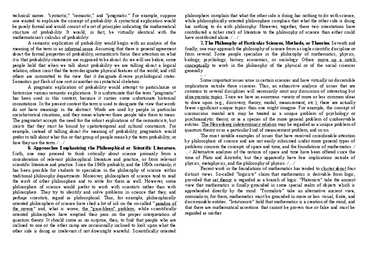
5. Syntactic, Semantic, and Pragmatic. Fifth, in the task of analyzing or explicating key concepts in science, three distinct approaches have been devised, with technical names : “syntactic,” “semantic,” and “pragmatic.” For example, suppose one wanted to explicate the concept of probability . A syntactical explication would be purely formal and would consist of a set of principles indicating the mathematical structure of probability. It would, in fact, be virtually identical with the mathematician’s calculus of probability.
A semantic explication of probability would begin with an analysis of the meaning of the term in an informal sense. Assuming that there is general agreement about the formal properties of probability, semanticists focus their attention on what it is that probability statements are supposed to be about. As we will see below , some people hold that when we talk about probability we are talking about a logical relation; others insist that the term designates physical features of the world; and still others are committed to the view that it designate diverse psychological states. Semantics put flesh of one sort or another on syntactical skeletons.
A pragmatic explication of probability would attempt to particularize or historicize various semantic explications. It is unfortunate that the term “pragmatic” has been used in this context, because it carries some unfortunate historical connotations. In the present context the term is used to designate the view that words do not have meanings in the abstract . Words are used by people in particular sociohistorical situations, and they mean whatever those people take them to mean. The pragmatist accepts the need for the robust explications of the semanticists, but insists that they must be bound by spatiotemporal and cultural constraints. For example, instead of talking about the meaning of probability, pragmatists would prefer to talk about what this or that group of people mean by the term probability, or how they use the term. /…/
6. Approaches Emphasizing the Philosophical or Scientific Literature . Sixth , one may proceed to think critically about science primarily from a consideration of relevant philosophical literature and practice, or from relevant scientific literature and practice. Since the 1940s probably, and the 1950s certainly, it has been possible for students to specialize in the philosophy of science within traditional philosophy departments. Moreover, philosophers of science tend to read the work of other philosophers and to write for them as well. However, some philosophers of science would prefer to work with scientists rather than with philosophers. They try to identify and solve problems in science that they, and perhaps scientists, regard as philosophical. Thus, for example, philosophically oriented philosophers of science have shed a lot of ink on the so-called “paradox of the ravens ” and, what is worse, the “grue-bleen” problem; while scientifically oriented philosophers have emptied their pens on the proper interpretation of quantum theory. It should come as no surprise , then, to find that people who are inclined to one or the other camp are occasionally inclined to look upon what the other side is doing as irrelevant if not downright wasteful. Scientifically oriented philosophers complain that what the other side is doing has nothing to do with science, while philosophically oriented philosophers complain that what the other side is doing has nothing to do with philosophy. However, together, these two orientations have contributed a richer stock of literature to the philosophy of science than either could have contributed alone . /…/
7. The Philosophy of Particular Sciences , Methods, or Theories. Seventh and finally , one may approach the philosophy of science from a single scientific discipline or from several. Some people specialize in the philosophy of mathematics, physics , biology, psychology, history, economics, or sociology. Others move up a notch conceptually to work in the philosophy of the physical or of the social sciences generally.
/…/
Some important issues arise in certain sciences and have virtually no discernible implications outside those sciences. Thus, an exhaustive analysis of issues that are common to several disciplines will necessarily omit any discussion of interesting but idiosyncratic topics. Since we have an enormous variety of more or less common ideas to draw upon (e.g., discovery, theory, model, measurement, etc.), there are actually fewer significant unique topics than one might imagine. For example, the concept of unconscious mental acts may be treated as a unique problem of psychology or psychoanalytic theory, or as a species of the more general problem of unobservable entities. The Heisenberg indeterminacy relation may be regarded as a unique problem of quantum theory or as a particular kind of measurement problem, and so on.
The most notable examples of issues that have received considerable attention by philosophers of science and are not easily subsumed under more general types of problems concern the concepts of space and time, and the foundations of mathematics. /…/ Alternative analyses of the notions of space and time have been offered since the time of Plato and Aristotle, but they apparently have few implications outside of physics, metaphysics, and the philosophy of physics. /…/
Recent work in the foundations of mathematics has tended to cluster about four distinct views. So-called “logicists” claim that mathematics is derivable from logic, provided that set theory is regarded as a branch of logic. “Platonists” take the ancient view that mathematics is finally grounded in some special realm of objects which is apprehended directly by the mind. “Formalists” take an alternative ancient view, nominalism ; for them, mathematics must be grounded in more or less visual , finite, and discriminable entities. “Intutionists” hold that mathematics is a creation of the mind, and that there are mathematical assertions that cannot be proven true or false and must be regarded as neither.
3
Teadusfilosoofia valikut #1 Teadusfilosoofia valikut #2
Punktid 50 punkti Autor soovib selle materjali allalaadimise eest saada 50 punkti.
Leheküljed ~ 2 lehte Lehekülgede arv dokumendis
Aeg2011-10-17 Kuupäev, millal dokument üles laeti
Allalaadimisi 27 laadimist Kokku alla laetud
Kommentaarid 0 arvamust Teiste kasutajate poolt lisatud kommentaarid
Autor nikkolai Õppematerjali autor
Inglise keeles

Sarnased õppematerjalid

Keelefilosoofia raamat
234
pdf

Keelefilosoofia raamat

Philosophy of Language Philosophy of Language: a Contemporary Introduction introduces the student to the main issues and theories in twentieth and twenty-first-century phi- losophy of language, focusing specifically on linguistic phenomena. Topics are structured in four parts in the book. Part I, Reference and Referring, includes topics such as Russell's Theory of Descriptions, Donnellan's distinction, problems of anaphora, the description theory of proper names, Searle's cluster theory, and the causal­historical theory. Part II, Theories of Meaning, surveys the competing theories of linguistic mean- ing and compares their various advantages and liabilities. Part III, Pragmatics and Speech Acts, introduces the basic concepts of linguistic pragmatics, includes a detailed discussion of the problem of indirect force and surveys approaches to metaphor. Part IV, new to this edition, examines the four theories of metaphor. Features of Philosophy of Language include: · new c

Filosoofia
Kaasaegne teaduslik mõtlemine ja filosoofilised meetodid
70
pdf

Kaasaegne teaduslik mõtlemine ja filosoofilised meetodid

What is the real meaning of life? Why prefer one thing to another? Can we trust observation? It’s raining outside - how do you know it is? I can see it’s raining. How to convince yourself its raining? A good reason to doubt - 49 other peaople have the same opinion. Falsifia​ble​ ​→ possible​; ​not falsifi​ed World disappeared in 2012 and got recreated 3 secs later → ​unfalsifiable​ - cannot prove it’s true/wrong, cannot provide any tests to prove it. Or​ - one or another but not both → ​exclusive - one or another (both) → ​inclusive​ (Invited those who are managers or specialists - both) Arguments valid or not - logic is a science where to decide it Different arguments lead to different methods. 1 - Recognizing arguments What is an argument? An ​argument​ is a group of statements, so that one or more of them (called the ​premises​) is said to provide support for one of the others (called the ​conclusion​). When the course sta

Kaasaegne teaduslik mõtlemine ja filosoofilised...
Teaduslik revolutsioon
14
odt

Teaduslik revolutsioon

Teaduslik revolutsioon 15431600 I One of the most important developments in the western intellectual tradition was the Scientific Revolution. The Scientific Revolution was nothing less than a revolution in the way the individual perceives [ tajub ] the world. As such, this revolution was primarily an epistemological revolution it changed man's thought process. It was an intellectual revolution a revolution in human knowledge. Even more than Renaissance scholars who discovered man and Nature, the scientific revolutionaries attempted to understand and explain man and the natural world. Thinkers such as the Polish astronomer Nicholas Copernicus(14731543), the French philosopher René Descartes(15961650) and the British mathematician Isaac Newton(16421727) overturned the authority of the Middle Ages and the classical w

Ajalugu
Education
14
doc

Education

Education Education is so multifaceted that it is difficult for me to know where to begin discussing it, or how to prioritize the many factors. Relaying my own experience is easy: I had a standard classroom approach, supplemented by inordinate reading. In only the briefest and least memorable instances did I receive any individual tutoring. Education is commonly thought of as the job of schools. Adults cry "educate our children!" Everyone has opinions about the best way to do the job. It is of urgent importance, and all the numerous factors are much studied, debated, and new (or old) ideas continually tested or retested. Some people say "it's as simple as . . . " and then name their pet peeve or passion. My view is not of an education specialist, but of one who loves sharing what I learn, and owes much to educators. Since I don't have an educational theory neatly worked-out, nor an outline of my perceptions, my intent is to address each educational ingredient that comes to my m

Inglise keel
Filosoofid-kes räägivad teadusest
5
doc

Filosoofid, kes räägivad teadusest

Philosophy Aristotle - four causes or better "becauses" because they are the 4 ways in which we use the word "because" or answer the question "why?" 1. Material cause: - what it is made of - why is the bridge strong? because made of steel 2. Formal cause: - what form, definition or property it has - why is this salt? because made of sodium and chloride 3. Efficient cause: - what initiated the change or movement - why did the baseball move? because someone hit it 4. Final cause: - what end or goal does it have? - why does he walk? because he wants to be healthy - also nature operates in terms of final causes - things don't happen spontaneously, every action that nature takes is for the sake of something, everything has a purpose - where a series has a completion, all th

Filosoofia
Filosoofia küsimused
6
pdf

Filosoofia küsimused

1. What does the word “philosophy” mean? The study of proper behaviour and the search for wisdom, in greek means love for wisdom 2. Is philosophy a science? Why? What kind of science it is? Yes it is. It tries to understand the meaning of reality. It’s the science of truth. Science, as it exists today, happens within the framework of philosophy. Philosophy, however, is bigger than science. It is also a form of art and discipline…... 3. Name three characteristics of Classical philosophy? deeply rooted in religious traditions ; believes that inferior was created by superior ; more positive ; seeks the real truth ; about intelligence ; reaalsuse üle mõtisklus ; believes that god is truth 4. Name three characteristics of Modern philosophy. believes that superior was created by inferior (!) ; more negative ; about will ; power ; domain of reality ; believes that knowledge is truth ; man is god 5. What was the problem that the first philosophers tried to solve? The problem of m

Inglise keel
Psühholoogia bioloogiline--kognitiivne- ja sotsiaalne vaade
26
doc

Psühholoogia bioloogiline-, kognitiivne- ja sotsiaalne vaade

PSYCHOLOGY PART 1: CORE Biological level of analysis Outline principles that define the biological level of analysis. 1) Behavior can be innate, because it is genetically based. Evolution may play a key role in behavior. 2) Animals may be studied as a means of understanding human behavior. 3) There are biological correlates of behavior. Cognitions, emotions and behaviors are products of the anatomy and physiology of our nervous and endocrine system. Explain how principles of the biological level of analysis may be demonstrated in research. 1) Correlational studies: Study by Buss, who hypothesized that across cultures, men will prefer to marry younger women because of greater reproductive capacity and women will place greater value on a potential mate's earning potential to provide survival advantages. This evolutionary hypothesis was tested in 37 cultures by sending out questioners. 2) Twin studies (type of correlational stud

Psühholoogia
Myers-Kitsuse 2000 Constracting the Future in Planning
6
pdf

Myers, Kitsuse 2000 Constracting the Future in Planning

22 Myers, Kitsuse 2000 Constracting the Future in Planning Planning’s broad relevance and its interdisciplinary inclusiveness have served as both a strength and a vulnerability. One emphasis that has been identified as central to the intellectual and professional identity or mission of planning is “foresight” (Markusen 1998), “a focus on the future and pathways of change over time” (Strategic Marketing Committee of ACSP 1997), or “persuasive storytelling about the future” A Surprising Neglect (hüljatud). “....planning has lost sight of the future....Planning voluntarily is sacrificing its role as visionary and idealist and is abandoning its responsibility to be a source of inspiration and ideas about what might be and what ought to be”. In planning practice, the recent surge of interest in visioning exercises has raised awareness of planners’ role in shaping the future, in some cases 3 bringing the future to the foref

Inglise keel


Kommentaarid (0)

Kommentaarid sellele materjalile puuduvad. Ole esimene ja kommenteeri


Sellel veebilehel kasutatakse küpsiseid. Kasutamist jätkates nõustute küpsiste ja veebilehe üldtingimustega Nõustun