INSTITUTO
POLITECNICO DO PORTOINSTITUTO SUPERIOR DE ENGENHARIA DO PORTOCHEMICAL ENGINEERING DEPARTMENT PORTUGAL Marvin
ÜürikeTallinn University of TechnologyFaculty
of Chemical and Materials TechnologyDepartment
of Chemical EngineeringEstonia ERASMUS PROJECT STUDY OF THE HEAT TRANSFER COEFFICIENT IN A HELICAL COILSupervisor:
Albina RibeiroPorto
2015 Abstract The
following work investigates
overall heat transfer coefficient of a
helical coil and how it
changes in
different situations. The
variables investigated were flow
rate inside a submerged helical coil
and agitation of the
bath .
To
investigate the
change in heat transfer coefficient in different
situations, a
simple experiment was set up. It consisted of a
rectangular isolated
tank , which was
filled with water, submerged
steel coil and an agitator. A rotameter was used to
measure the flow
rate, and a
pump was used to
force the water
through the coil. A
thermocouple was placed at each end of the coil to measure the inlet
and
outlet temperatures and
another thermometer used to measure the
overall temperature of the water inside the bath.
Two
different approaches were taken, one of
them was investigating heat
change coefficient in
steady state and the
other was
studying it in
an unsteady state. In steady state, a
constant flow rate and
agitation was applied
until temperatures stayed constant, then were
the readings taken. In unsteady state, bath was heated up and then
cooled down with
cold water
running through the submerged coil and
temperature readings were taken every
five minutes.
A
theoretical overall heat transfer coefficient was calculated using
different
sources of
literature and then they were compared to
experimental
coefficients . The
difference is explained
based on the
conditions of equations and experimental setup.
The
results showed that overall heat transfer coefficient changed as
expected , it was bigger with
higher flow rates, which directly
results in higher
Reynolds numbers , and higher agitation rates. Some
anomalies did
occur , but they can be explained with atypical details
in experimental setup.
Table of
Contents
Table of Contents 5
1Introduction 1
2Experimental
description 12
2.1Experimental apparatus 12
2.2Experimental procedure 14
2.2.1Steady state experiments 14
2.2.2Unsteady state experiments 15
3Results and discussion 16
3.1Steady state 16
3.2Unsteady state 22
3.3Theoretical 28
4Conclusions and suggestions for future work 32
5Bibliography 34
APPENDICES 31
A.1 Calibration of the rotameter 31
A .2Calibration of Thermocouple and Electronic thermometer 32
A.3 Calculation example 34
1
Introduction 1
2 Experimental
description 12
2.1 Experimental
apparatus 12
2.2 Experimental
procedure 13
2.2.1 Steady
state experiments 13
2.2.2 Unsteady
state experiments 13
3 Results
and discussion 14
3.1 Steady
state 14
3.2 Unsteady
state 20
3.3 Theoretical 25
4 Conclusions
and suggestions for future work 28
5 Bibliography 29
APPENDICES 30
A.1
Calibration of the rotameter 30
A.2Calibration
of Thermocouple and Electronic thermometer 31
A.3
Calculation example 33
List
of figuresFigure 1,
Types of agitators (
http://www.thermopedia.com/content/1176/ 9
Figure 2: Schematic
diagram of the apparatus 12
Figure 3:
Picture of the experimental setup 13
Figure 4: Picture of the agitator
blade 14
Figure 5: Steady state U with the bath temperature
approximately 33C 16
Figure 6: Steady state U with the bath temperature approximately 44C 18
Figure 7:
Comparison of steady coefficient of different state heat transfer bath temperatures at 618 rpm. 20
Figure 8: Comparison of steady state heat transfer coefficient of different bath temperatures at 1703 rpm. 21
Figure 9: Unsteady state U considering no heat loss 22
Figure 10: Bath heat loss 23
Figure 11: Unsteady state U considering heat loss 24
Figure 12: Comparison of steady state and unsteady state heat transfer coefficient at agitations of 618 rpm and 1703 rpm. 26
Figure 13: Theoretical heat transfer coefficient according to Richardson and Coulson 28
Figure 14: Theoretical heat transfer coefficient according to Geankoplis. 29
Figure 15: Calibration curve for the rotameter 31
Figure 16: Calibration curve for the outlet (T1) thermocouple. 32
Figure 17: Calibration curve for the inlet (T2) thermocouple. 33
Figure 18: Calibration curve for electronic thermometer 33
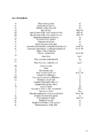
List
of Symbols A
Heat
exchange area
m2
Ai
Inside surface area coil
m2
Ao
Outside surface area coil
m2
cp
Specific heat
J•kg-1•K-1
cpa
Specific heat of the water inside the bath
J•kg-1•K-1
cpb
Specific heat of the water inside the coil
J•kg-1•K-1
deq
Equivalent diameter of the tank
m
da
Diameter of the agitator
m
dc
Diameter of the coil
m
din
Inside diameter of the
tube m
hi
Convective heat transfer coefficient inside the coil
W•m-2•K-1
ho
Convective heat transfer coefficient outside coil
W•m-2•K-1
k
Slope of
linear function k
Thermal conductivity
W•m-1•K-1
Mass flow
kg•s-1
ma
Mass of water inside the bath
kg
Mass flow rate inside the coil
kg•s-1
Nu
Nusselt number
q
Heat
J
Q
Heat transfer rate
J•s-1
U
Heat transfer coefficient
W•m-2•K-1
ΔT
Temperature difference
K
ΔTlm
Log
mean temperature difference
K
Δx
Thickness of coil
wall m
lv
Length of the
square bath side
m
L
Length of the agitator blade
m
N
Agitator
speed rps
μ
Viscosity of water at wall temperature
Pa·s
μ
Viscosity of water
Pa·s
k
Thermal conductivity of water in the bath
W•m-1•K-1
dg
Distance between two
spirals m
cp
Heat
capacity of water
J•kg-1•K-1
dp
Height of the coil
m
W
Height of the blades of the agitator
m
do
Outside diameter of the tube
m
Introduction
Heat
transfer is a very common phenomenon in chemical engineering. Heat
exchangers are one of the most common technological devices used in
different areas of chemical industries. There are a large number of
options available for the exchange of thermal power . The choice usually comes down to different factors, in which the heat exchanger
must be performing. One of the most common heat exchangers structure
is the tubular form. In the field of tubular heat exchangers, one way
is to bend the tube helicoidally, which makes the tube a lot more
compact and less expensive, because less material is needed to jacket
the tube. Due to the increased number of turns of the helix ,
additional turbulence is generated inside the tube and therefore the
heat transfer coefficient of the helical coil is larger that of the
corresponding straight tube. In chemical industries there are many
applications, which use coils as heat exchangers such as in small
nonindustrial boiler systems where water is heated up or steam is
generated inside the helical coil by direct heating via burning fuel
such as diesel oil or other burning materials. Polyethylene is also
manufactured inside helical coils, where oxidation of ethylene takes place . The heat from this exothermic reaction is taken away by
cooling water circulating around the helical coils. In many industrial applications helical coils are used to heat up cold liquid circulating around the coils, by steam condensation inside the coil.
In addition to heating up the liquid around, coils can also be used
to cool it down, if the bulk liquid around the coil acts as a reactor
and the reaction is exothermic. There are many applications for
helical coils that have been used in chemical industries for several decades. (Hewitt, et al., 1994)
The
three basic mechanisms in heat transfer are conduction, convection
and radiation . In chemical engineering conduction and convection are
the mechanisms, which are applied most commonly . When talking about
conduction, the heat can be transferred through gases, liquids or
solids. The heat is transferred by the energy of motion adjacent
molecules. The molecules with higher energy and motion affect adjacent molecules with lower energy and motion, imparting them
energy. In conduction energy can be transferred by free electrons,
which play a big role in heat transfer in metals. Convection stands
for heat transferring through gases and liquids with bulk movements
of them, or the mixing of macroscopic elements of hotter portions
with cooler portions of liquid or gas. It also often involves a solid
surface. It should be noted that there is a difference between forced
convection and natural convection. In forced convection the fluid or
gas is forced to flow over a solid surface with a fan or pump. In
natural convection, the motion of molecules in gas or liquid is not
forced, but natural. Radiation differs from conduction and convection
in that manner , that it does not need any physical medium for its
propagation. Radiation is the transfer of energy through space by means of electronic waves. It is similar how electromagnetic light waves transfer light, which also means that the same laws apply . The
most common example to characterize radiation is the way heat is
transferred to Earth from the Sun. (Geankoplis, 1993)
To
be able to quantify the amount of heat exchanged with different heat
transfer mechanisms or with all of them combined, many coefficients
have developed according to characterize different material’s ability to exchange heat.
Fletcher
has given some representative data on overall heat transfer
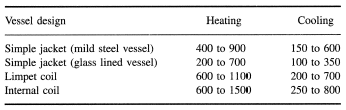
coefficients that may be seen in agitated vessels. The range of these data shown in Table 1, illustrates some of the differences in heat
transfer rates that may be experienced when using different types of
heat exchangers.
(Fletcher,
1987)
To
calculate the amount of heat transferred, two different approaches
must be taken depending on the nature of the heat transfer. Steady
state and unsteady state heat transfers have to be calculated
differently, because steady state heat transfer rate as the name
suggests does not change in time, whereas the unsteady state heat
transfer rate does.
Table 1: Overall heat transfer coefficients for heat transfer systems with coils or jackets. (Fletcher, 1987)
Consider a system consisting of a thermostatic bath with a coil immersed
inside it and if the bath is maintained at a constant temperature and
a cold liquid flows inside the coil, the global heat transfer
coefficient is calculated using equations (1) and (2):
(0)
Where,
Q
– Heat transfer rate, J•s-1
A
– Heat exchange area, m2
ΔTlm
– log mean temperature difference, K
Heat
transfer rate can be calculated from the equation (2), where the
specific heat is assumed to be constant and chosen for the mean
temperature of the inlet and outlet temperatures of the coil.
(0)
Where,
– Mass
flow, kg•s-1
cp
– specific heat, J•kg-1•K-1
ΔT
– temperature difference between the outlet and inlet temperatures
of the fluid inside the coil, K
The
unsteady state is a little more difficult to understand , because the
temperatures are changing with time. The unsteady heat transfer is important because of the vast amount of heating and cooling problems
occurring industrially. In metallurgical processes it is needed to
predict the heating or cooling rates of various geometries of metals
in order to know how much time it will take for them to reach a
certain temperature. In the paper industry logs are immersed in steam
baths before processing . In many processes materials are immersed in
liquids of higher or lower temperatures resulting in unsteady heat
transfer. (Geankoplis, 1993)
Consider
a system formed by a tank filled with a mass of fluid inside which a
helical coil is immersed. Inside the coil flows a cooling liquid at a
given mass flow rate and the system is operating under unsteady state
conditions. It is considered there is no heat loss to the exterior.
The
heat transfer coefficient in an unsteady state was calculated using
the equation (15). The specific heats were considered constants and
chosen for the average temperature. The average temperature for the
bath was calculated from the beginning and end temperatures of the
experiment. Average temperature for the water inside the coil was
calculated by taking the average between the inlet temperatures and
outlet temperatures.
The
equation to calculate the heat transfer coefficient considering there
is no heat loss was derived from the principle equations in heat
transfer (3, 4, and 5).
An
energy balance to the fluid inside the bath at instant t is given by:
(0)
For
the fluid flowing in the coil, the energy balance can be written as:
(0)
The
heat transfer rate for instant t can be expressed in terms of the
global heat transfer coefficient, U, by:
(0)
When
the right sides of equations (4) and (5) are set to be equal.
(0)
(0)
If
U and cpb
are
considered constant, then:
(0)
Which
when inserted into equation (7) results in equation (9)
(0)
If
the right sides of equations (3) and (4) are set to be equal with a
replacement from equation (9)
(0)
(0)
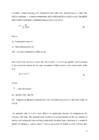
If the equation (11) is integrated between t = 0 and an instant t, which corresponds temperatures of the fluid in the bath Tain and Ta respectively
(0)
(0)
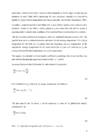
If
a set of data is obtained experimentally, where the variation of the
temperatures is registered as a function of time, then a plot
against t can be made. If there is a linear variation, then the slope
of the straight line is given by:
(0)
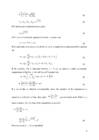
From
the equation (14) U is calculated:
(0)
Where,
mb
–
mass flow rate of water inside coil, kg•s-1
cpb
– specific heat of water inside coil, J•kg-1•K-1
C
– slope of the linear function
ma
– mass of water in bath, kg
cpa
– specific heat of water in bath, J•kg-1•K-1
A
– heat exchange area, m2
Considering
that the thermal system under study is not well insulated and there
was a heat loss, a second approach to calculate the global heat
transfer coefficient can be taken. For each instant, t, the heat
transfer rate received by the fluid flowing inside the coil can be
calculated by:
(0)
Where,
-
mass flow rate, kg.s-1
cp
– specific heat of water inside coil at mean temperature,
J•kg-1•K-1
∆T
- temperature differences at inlet and outlet of the coil, K
(0)
Where,
Q
– heat transfer rate, W
A
– heat transfer area, m2
U
– overall heat transfer coefficient, W•m-2•K-1
∆Tlm
– log mean temperature difference, K
If
a graphical plot of Q against A·∆Tlm
is made and if a linear relation between the two variables is
verified, then the average global heat transfer coefficient
corresponds to the slope of the line. It is considered that the U
does not vary with time.
Prediction
of the overall heat transfer coefficient
In
a tubular heat exchanger where the mechanisms of heat transfer
involved are conduction and convection, the overall heat transfer
coefficient can be predicted by the following equation.
(0)
Where,
hi
–
convective heat transfer coefficient inside the coil, W•m-2•K-1
ho
– convective heat transfer coefficient outside the coil, W•m-2•K-1
Δx
– thickness of the coil wall, m2
k
– thermal conductivity of the steel coil, W•m-1•K-1
Ao
–
surface area outside the coil, m2
Ai
– surface area inside the coil, m2
To
determine if the flow pattern inside the coil was laminar or
turbulent, a critical Reynolds number was calculated. When the
Reynolds number is less than the critical Reynolds number, the flow
pattern is laminar, and if the Reynolds number is greater than the
critical Reynolds number, the flow pattern is turbulent. The critical
Reynolds number is determined with the following equation (19).
(Hewitt, et al., 1994)
(0)
For
laminar flow inside straight tubes, the heat transfer coefficient can
be predicted by. (Geankoplis, 1993):
(0)
Where,
k
– thermal conductivity of the water, W•m-1•K-1
din
– inner diameter of the tube, m
Heat
transfer through tubes is well known and studied. Coils are very
similar to tubes; expect that there is additional turbulence created
in the liquid by the circular motion of the flow. Therefore it is
usual to apply a correction for the inside coil heat transfer
coefficient when compared to straight pipe . Hewitt et al. (1994)
recommends the application of the equation (21).
(0)
Where,
din
– inner diameter of the tube, m
dc
– diameter of the coil, m
The
heat transfer coefficient on the outside of the coil depends strongly
on the rate of agitation and the type of agitator used. There are
many types of agitators. They can be divided into five distinctly
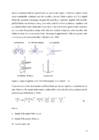
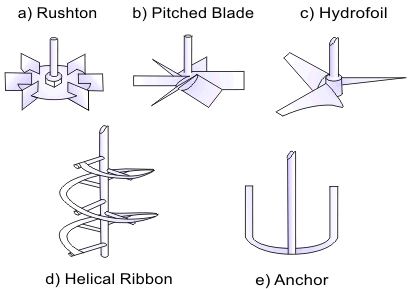
different agitator types, as seen on the Figure 1. A Rushton, turbine which cause considerable turbulence near the impeller, a pitched
blade impeller with flat, angled blades that generates a diverging
but generally axial flow, a hydrofoil impeller with carefully
profiled blades that develop a strong , more truly, axial flow of low
turbulence. Impellers such as a helical ribbon with a blade that
moves close to the wall to force good overall circulation and an anchor that produces strong swirl with poor vertical mixing even when
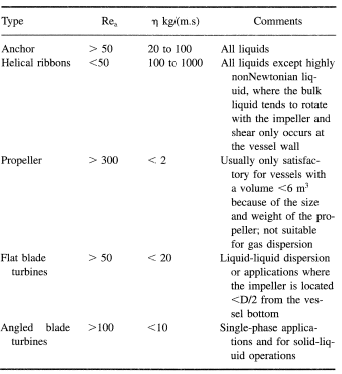
installed with baffles are used with more viscous fluids. The range
of application for different agitators with a comment can be seen on
the table 3. (Hewitt, et al., 1994)
Figure
1, Types of agitators
( http://www.thermopedia.com/content/1176/
To preview the outside heat transfer coefficient there are various
empirical correlations in the open literature. For square tanks using
a simple paddle stirrer the following equations can be used
(Coulson & Richardson, 2004):
(0)
Where:
lv
– length of the square bath side, m
L
– length of the agitator blade, m
N
– agitator speed, rps
μ
– viscosity of water, Pa·s
k
– thermal conductivity of water in the bath, W•m-1•K-1
dg
– distance between two spirals, m
cp
– heat capacity of water, J•kg-1•K-1
dp
– height of the coil, m
W
– height of the blades of the agitator, m
do
– outside diameter of the tube, m
Table
2 - The range of application of agitators. (Hewitt et al, 1994)
Another
correlation to calculate the outside convection heat transfer
coefficient and which is valid for paddle agitators and circular
tanks with no baffles is (Geankoplis,
1993):
(0)
deq
- equivalent diameter of the tank, m
da
– diameter of the agitator, m
μw
– viscosity at wall temperature, Pas
Experimental description
Experimental apparatus
The
experiments
were
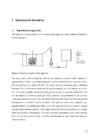
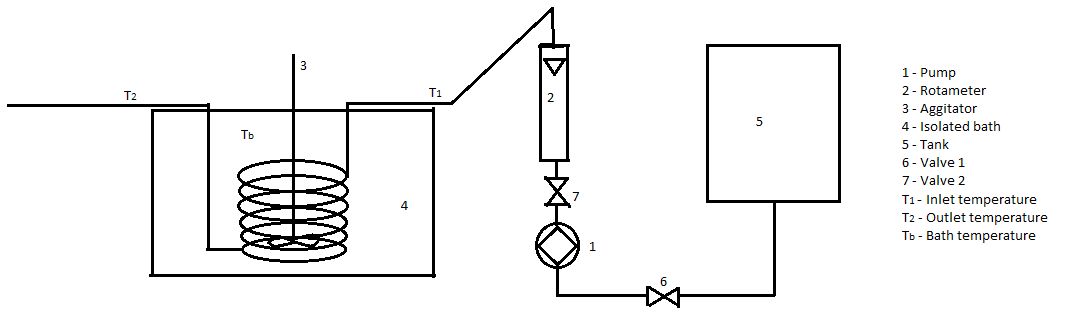
carried out in the experimental apparatus, whose schematic diagram is
shown in Figure 2.
Figure
2: Schematic diagram of the apparatus
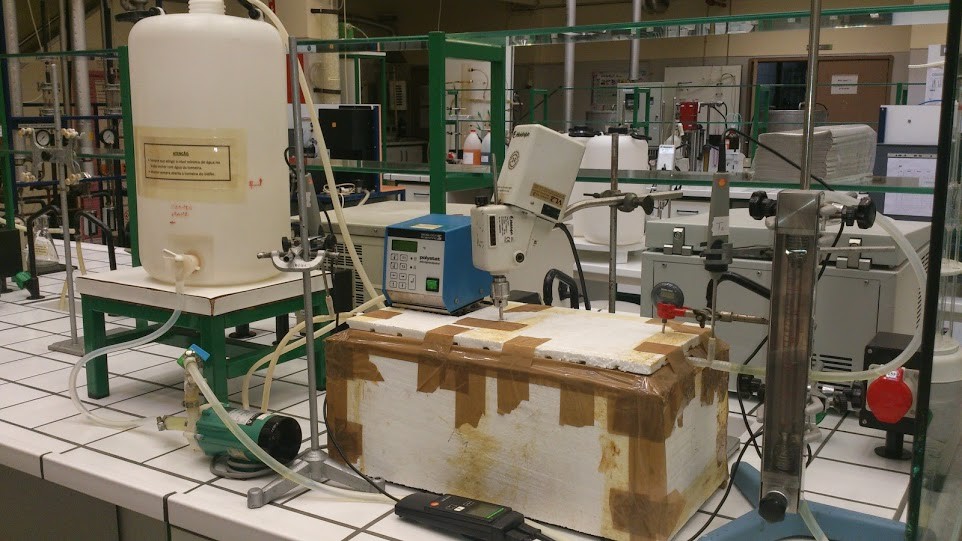
The
water used to flow through the steel coil was held in a reservoir,
with a capacity of approximately 25 liters. A centrifugal pump was
used to circulate the water from the tank to the coil and then to the
drain. The flow rate of the water was measured using a calibrated
rotameter. The coil was located inside the hot water rectangular bath
with dimensions of 45,5 X 21,1 cm with no baffles. The height of the
coil was 6,2 cm, the diameter of helix was 17,4 cm, the length of the
tube in spiral was 4,72 m, and the internal diameter of the tube was
7,3mm and external diameter 1,1cm. The bath was heated with a
Bioblock Scientific polystat microprocessor controlled electrical resistance . The agitation system was composed by a propeller fitted
to a Heidloph Type RZR1 mixer. The speed of the agitator could be
changed with the speed reducing controller. The temperature of the
bath was measured with a simple Micro- tech electronic thermometer.
The inlet and outlet temperatures of the water flowing inside the
coil were measured with a calibrated thermocouples K type, which were
linked to Testo 922 device .
Figure
3: Picture of the experimental setup
Figure
4: Picture of the agitator blade
Experimental procedure
Steady state experiments
The vessel was filled with a constant mass (13,92 kg) of water. The water
in the bath was heated up to approximately 35 oC.(experiments without insulation ) When the water reached the given temperature,
which was measured using a calibrated thermometer, the valve of the
rotameter was opened to set the intended flow rate of water through
the coil. The water was left to flow through the coil with a constant
flow rate and constant bath temperature, until the inlet and outlet
temperatures were constant, indicating that a steady state had been
achieved. Following this the readings from the three calibrated
thermocouple were taken, (temperature of the bath and inlet and
outlet temperatures of the water flowing inside the coil). This
procedure was repeated with different flow rates of 0,00833 kg·s-1,
0,0113 kg·s-1,
0,0143 kg·s-1,
0,0173 kg·s-1
respectively
and also with different agitations of 618 rpm, 980 rpm, 1342 rpm,
1703 rpm. When the outside of the bath was thermally isolated and the
same experiment was carried out, the temperature of the bath reached
a temperature of approximately 44oC
Unsteady state experiments
The
water in the isolated bath was heated up to approximately 80 oC,
which was measured with a calibrated thermometer. The electrical
heater was then switched off and a given flow rate of water was set
inside the coil. The experiment began with starting a timer from zero and reading the three temperatures (temperature of bath and the inlet
and outlet temperatures of the water flowing inside the coil). Every
other reading was taken with a five minute interval, until the bath
had been cooled down to approximately 25 oC.
It was repeated with four different agitation rates of 618 rpm, 980
rpm, 1342 rpm and 1703 rpm, respectively and each tested with five
different flow rates of 0,008133 kg·s-1,
0,0113 kg·s-1,
0,0143 kg·s-1,
0,0173 kg·s-1.
Results and discussion
Steady state
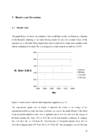
The graph (Figure 5) shows the variation of the overall heat transfer
coefficient as a function of the Reynolds referring to the water
flowing inside the coil, for constant values of the agitation rate of
the bath. These experiments were carried out for steady state
conditions and with no insulation of the bath. The bulk temperature
of the water in the bath was 33.5ºC.
Figure
5: Steady state U with the bath temperature approximately 33C
The
experimental points seen in Figure 5 represent the values of an
average of six experiments performed under the same conditions. As
seen on the graph (Figure 5) the effect of the Reynolds number is clear . For an agitation rate of 618 rpm and with the change of
Reynolds number, Re, from 1993 to 3855 the overall heat transfer
coefficient, U, changes from 636 W•m-2•K-1
to 730
W•m-2•K-1.
For 980 rpm and Reynolds numbers from 1993 to 3855 the U changes from
687
W•m-2•K-1
to
787 W•m-2•K-1.
For an agitation rate of 1342 rpm and for Re being in the range of
1993 to 3855, the overall heat transfer coefficient is in the range
of 618 W•m-2•K-1
and
775
W•m-2•K-1.
For an agitation rate of 1703 rpm and with the Reynolds number
increasing from 1993 to 3855, the global heat transfer coefficient
changes from 666 W•m-2•K-1
to
816
W•m-2•K-1.
The higher Reynolds number results in higher overall heat transfer
coefficient. This is expected because of the velocity of the water
inside the coil increases , the convective heat transfer resistance
decreases, the internal heat transfer coefficient rises , and
consequently so does the overall heat transfer coefficient.
The
effect of the agitation rate is not as clear. For a Reynolds number
of 1993 and with the change of agitation from 618 rpm to 1703 rpm the
overall heat transfer coefficient changes form 636 W•m-2•K-1
to
666 W•m-2•K-1.
For a Reynolds number of 2628 and with the agitation changing from
618 rpm to 1703 rpm, the global heat transfer coefficient changes
from 661 W•m-2•K-1
to
725
W•m-2•K-1.
For the Reynolds number of 3245 with the change of the agitation from
618 rpm to 1703, rpm the overall heat transfer coefficient changes
from 688 W•m-2•K-1
to
757
W•m-2•K-1.
For the Reynolds number of 3855 and with the change of agitation from
618 to 1703 the overall heat transfer changes from 731 W•m-2•K-1
to
816
W•m-2•K-1.
It can be observed , that the heat transfer coefficient with the highest agitation rate of 1703 is higher than with the heat transfer
coefficient with the lowest agitation rate of 618 rpm. With other
agitation rates there are some anomalies seen, but the differences
are very small. The biggest percentage error seen on the graph (Figure 5)
is with the Reynolds number of 1993 and between agitation rates of
980 rpm and 1343 rpm, the percentage of the error is 11%. It is
expected that higher agitation rates would lead to higher global heat
transfer coefficients, because the outside heat transfer coefficient
should be higher. However during the present experiments this
behavior was not always observed, possibly because the experimental
set up used is not a standard one.
The
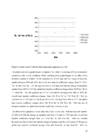
following graph (Figure 6) shows the results obtained for the overall
heat transfer coefficient under steady state conditions and, when the
bath was insulated, the temperature of the water in the bath was
maintained at 44oC.
Figure
6: Steady state U with the bath temperature approximately 44C
The
points seen on the graph (Figure 6) represent the value of an average
of three experiments carried out under similar conditions. When
analyzing at the graph (Figure 6), the effect of the Reynolds number
is evident. For the agitation rate of 618 rpm and for a range of
Reynolds number between 1993 and 3855, the overall heat transfer
coefficient changes from 551 W•m-2•K-1
to
666
W•m-2•K-1.
For the agitation rate of 980 rpm and with the change of Reynolds
number from 1993 to 3855 the global heat transfer coefficient changes
from 594 W•m-2•K-1
to
715
W•m-2•K-1. For the agitation rate of 1342 and with Re changing from 1993 to
3855, the overall heat transfer coefficient changes from 626
W•m-2•K-1
to
782
W•m-2•K-1.
For the agitation rate of 1703 rpm and the Reynolds number changing
from 1993 to 3855, the global heat transfer coefficient changes from
594 W•m-2•K-1
to
804 W•m-2•K-1.
With the rise of Reynolds number, the global heat transfer
coefficient increases as well.
The
effect of the agitation is not as clear, but a trend can be seen.
With the Reynolds number of 1993 and with the change in agitation
rate from 618 rpm to 1703 rpm the overall heat transfer coefficient
changes from 551 W•m-2•K-1
to
594 W•m-2•K-1.
With the constant Reynolds number of 2628 but with the change of
agitation rate from 618 rpm to 1703 rpm the global heat transfer
coefficient changes from 607 W•m-2•K-1
to
689 W•m-2•K-1.
With the Reynolds number of 3245 and with the change of agitation
rate from 618 rpm to 1703 rpm the global U varies from 635 W•m-2•K-1
to
731 W•m-2•K-1.
With the highest Reynolds number of 3855 and with the change of
agitation rate from 618 rpm to 1703 rpm the overall heat transfer
coefficient changes from 666 W•m-2•K-1
to
804 W•m-2•K-1.
The highest agitation rate always results a higher global heat
transfer coefficient than the lowest agitation rate. The biggest
percentage error noticed on the graph Figure 6 can be seen with the
Reynolds number of 1993 between the agitations of 1342 rpm and 1703
rpm which is 5, 3%.
When
comparing the two charts, Figures 5 and 6, it is expected that the
value of the overall heat transfer coefficient should be similar, since the only difference between the experiments was an increase of
ten degree in bath temperature.
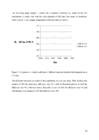
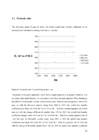
The
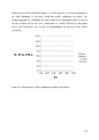
following graph (Figure 7) shows the comparison between the results
of the two experiments in steady state with the same agitation of 618
rpm. One using the insulation, which allowed to use a higher
temperature of the bath and one without.
Figure
7: Comparison of steady coefficient of different state heat transfer
bath temperatures at 618 rpm.
The
difference between the results of the experiments was not very large.
With the Reynolds number of 1993 the percentage difference was 15%,
with the Reynolds number of 2628 the difference was 9%, with the
constant Reynolds number of 3245 the difference was 8% and with the
Reynolds number of 3855 the difference was 10%.
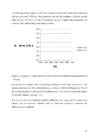
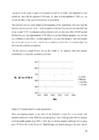
The
following graph (Figure 8) shows the comparison between the steady
state experiments with the agitation of 1703 rpm. One experiment was
with the insulation of the bath and the other was not. The result of
using the insulation was that a higher bath temperature was achieved, while still reaching steady state conditions.
Figure
8: Comparison of steady state heat transfer coefficient of different
bath temperatures at 1703 rpm.
For
the Reynolds number 1993
the percentage difference of the value of the overall heat transfer
coefficient was 12%, with the Reynolds number of 2628 the difference
was 5%, for the constant Reynolds number of 3245 the difference was
2, 4% and for the Reynolds number of 3855 the difference was only 1,
5%.
It
is noticed, that the overall heat transfer coefficients were bigger
with the experiments without using the insulation, therefore with the
lower bath temperature. However, the difference is not significant.
Unsteady state
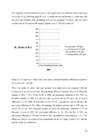
The
following graph (Figure 9) shows the result overall heat transfer
coefficient of the unsteady state calculated assuming there was no
heat loss.
Figure
9: Unsteady state U considering no heat loss
The
points on the graph represent a result from a single experiment in unique conditions. The conditions that varied between the experiments
were flow rate and agitation. When looking at the effect of the
Reynolds number, a clear trend is seen. With the constant agitation
rate of 618 rpm but with the Reynolds number rising from 1993 to
3855, the global heat transfer coefficient rises from 368 W•m-2•K-1
to
521
W•m-2•K-1.
With the constant agitation rate of 980 rpm and with the change of
Reynolds number from 1993 to 3855, the overall heat transfer
coefficient changes from 390 W•m-2•K-1
to
554
W•m-2•K-1.
With the constant agitation rate of 1342 but with the Reynolds number
rising from 1993 to 3855 the global heat transfer coefficient rises
from 435 W•m-2•K-1
to
545
W•m-2•K-1.
With the agitation rate of 1703 and with the change of Reynolds
number from 1993 to 3855 the global heat transfer coefficient changes
from 447 W•m-2•K-1
to
684
W•m-2•K-1.
Bigger Reynolds number results in bigger global heat transfer
coefficient values.
The
effect of the agitation is well seen also. With the constant Reynolds
number of 1993 but with the change of agitation rate from 618 rpm to
1703 rpm, the overall heat transfer coefficient changes from 389
W•m-2•K-1
to
448 W•m-2•K-1.
With the Reynolds number of 2628 and with the rise of the agitation
rate from 618 rpm to 1703 rpm, the global heat transfer coefficient
rises from 457 W•m-2•K-1
to
526 W•m-2•K-1.
With the Reynolds number constant at 3245 and with the change of
agitation rate 618 rpm to 1703 rpm, the overall heat transfer
coefficient changes from 500 W•m-2•K-1
to
595 W•m-2•K-1.
With the Reynolds number of 3855 and the agitation rate changing from
618 rpm to 1703 rpm, the overall heat transfer coefficient changes
from 521 W•m-2•K-1
to
684 W•m-2•K-1.
As seen, when comparing the highest and the lowest agitation rates,
the trend is evident.
On
the following graph (Figure 10) it is shown that in reality there was
some heat loss through the bath walls, therefore another way to
calculate the global heat transfer coefficient was used.
Figure
10: Bath heat loss
The
points on the graph (Figure 10) represent the heat lost in Watts . Two
experiments were carried out, one with the agitation of 618 rpm, the
other with the agitation of 1342 rpm. As shown, the effect of the
agitation to heat loss is not noticed.
The
heat loss rate was much higher in the beginning of the experiment,
with zero time the heat loss rate was around 214 W. 10 000 seconds later the heat loss rate was less than half , and it was
around 75 W. It continued declining but not with such fast rate.
After 30 000 seconds the heat loss rate was approximately 35 W.
When comparing different agitation rates the heat loss difference is
not evident. Another approach to calculate the unsteady state heat
transfer was taken and the results from calculations considering no
heat loss are acknowledged but dismissed from further comparisons .
On
the following graph (Figure 11) are the results of the unsteady state
heat transfer calculated by the way when considering heat loss.
Figure
11: Unsteady state U considering heat loss
When
investigating Figure 11 the effect of the Reynolds number, Re, to the
overall heat transfer coefficient is clear. With the constant
agitation rate of 618 rpm but with the increase of the Reynolds
number from 1993 to 3855, the overall heat transfer coefficient (U)
increases from 477 W•m-2•K-1
to
603
W•m-2•K-1.
With 980 rpm and with the change of Re from 1993 to 3855, the U
changes from 528 W•m-2•K-1
to
719
W•m-2•K-1.
With the constant agitation rate of 1342 rpm and the rise of Re from
1993 to 3855, the global heat transfer coefficient rises from 513
W•m-2•K-1
to
779
W•m-2•K-1.
With the highest agitation rate of 1703 and with the change of
Reynolds number from 1993 to 3855, the overall heat transfer
coefficient changes from 628 W•m-2•K-1
to
839 W•m-2•K-1.
The higher velocity of the liquid inside the coil results in higher
Reynolds number. Higher Reynolds number results in higher inside coil
convective heat transfer coefficient, which causes the overall heat
transfer coefficient to rise as well.
The
effect of the agitation on Figure 11 is clearest of all the results
from the experiments carried out during this particular work. With
the constant Reynolds number of 1993, but with the agitation rate
changing from 618 rpm to 1703 rpm, the overall heat transfer
coefficient changes from 477 W•m-2•K-1
to 628 W•m-2•K-1.
With the Re of 2628 and with the increase of the agitation rate from
618 rpm to 1703 rpm, the U increases from 578 W•m-2•K-1
to
731
W•m-2•K-1.
For the constant Reynolds number of 3245 and for the change in
agitation rate from 618 rpm to 1703 rpm, the global heat transfer
coefficient changes from 619 W•m-2•K-1
to
820
W•m-2•K-1.
With the constant Reynolds number of 3855 and with the agitation rate
rising from 618 rpm to 1703 rpm, the overall heat transfer
coefficient rises from 603 W•m-2•K-1
to
839
W•m-2•K-1.
It is expected, that with higher agitation rates the overall heat
transfer coefficient is higher as well. Since higher agitation rates reduce the convective heat transfer resistance outside the coil,
increasing the convective heat transfer coefficient. This influences
the overall heat transfer coefficient. As seen on Figure 11, in this case the expected can be observed.
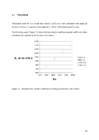
It
is expected, that the results from steady state experiments and
unsteady state experiments are similar. In the following graph (Figure 12)
results for the experiments of steady state with insulation and
unsteady state considering heat loss are compared. For clarity only
the lowest agitation rate of 618 rpm and the highest agitation rate
of 1793 are compared.
Figure
12: Comparison of steady state and unsteady state heat transfer
coefficient at agitations of 618 rpm and 1703 rpm.
When
the results of steady state and unsteady state experiments are
compared with the constant agitation rate of 618 rpm, the percentage
difference between them at the Reynolds number of 1993 is 15%. When
the Re is 2628, the percentage difference is 5%, With the Reynolds
number of 3245 and with the same agitation rate of 618 rpm, the
percentage difference is 2, 5%. With the Reynolds number of 3855 at
the agitation rate of 618 rpm, the percentage difference is 10%. When
investigating the highest agitation rate of 1703 rpm, the results are
similar. With Reynolds number of 1993, the percentage difference is
5%.At Reynolds number of 2627, the percentage difference is 6%. With
the Re of 3245, the percentage difference is 11% and with Re of 3855,
the difference in percentage is 4, 4%. The differences between the
results of two experiments are not very large; therefore it is
believed that the results are satisfactory.
Theoretical
Theoretical
result for the overall heat transfer coefficients were calculated
with empirical equations. One set of equations were taken from a book
by Richardson and Coulson.
The
following graph (Figure 13) shows the theoretical overall heat
transfer coefficient values calculated with equation by Richardson
and Coulson.
Figure
13: Theoretical heat transfer coefficient according to Richardson and
Coulson
After
investigating the results from Figure 13, another source for the
empirical equations to use when calculating the theoretical overall
heat transfer coefficients was chosen. The empirical equations by
Geankoplis give closer results to the experimental results (which can
be seen on Figure 14) than the ones by Richardson and Coulson.
Therefore the theoretical results from Richardson and Coulson are
acknowledged but dismissed from further comparison.
Figure
14: Theoretical heat transfer coefficient according to Geankoplis.
Theoretical numerical results calculated with data from different authors , differ slightly, but the trend is clearly seen on Figure 13 and Figure 14.
The overall heat transfer coefficient is bigger with higher Reynolds
number and the effect of the agitation is also very straight forward .
Overall heat transfer coefficient is higher with faster agitation
rates.
The
results, of the overall heat transfer coefficients for the coil
should be similar with all the experiments. When investigating the
change of overall heat transfer coefficients between different
experiments a similar trend can be found with all the experiments.
For the steady state with the bath at 44oC
(Figure 6), the heat transfer coefficient changes from 551
W•m-2•K-1
to 804
W•m-2•K-1.
For unsteady state calculated with equations, that do consider heat
loss (Figure 11), the overall heat transfer coefficient differs from
477
W•m-2•K-1
to 839
W•m-2•K-1
According to (Geankoplis,
1993)
the overall heat transfer coefficients (Figure 14) varies from 627
W•m-2•K-1
to 1180
W•m-2•K-1.
The theoretical values from Table 1 suggests that the number of
overall heat transfer coefficient while cooling the water inside the
bath should be between 250 W•m-2•K-1
and
800
W•m-2•K-1.
A
common trend can be seen in all the graphs, the heat transfer
coefficient grows with higher agitation rates and with higher
Reynolds number. The experimental results do not show the effect of
the agitation as clearly as expected, but the effect of the Reynolds
number is certain. When comparing the numerical values of
experimental and theoretical overall heat transfer coefficient
results, it is seen, the difference is rather large, the theoretical
results overpredicts the value of overall heat transfer coefficient
by 31% to 41%. The biggest difference in percentage terms between the
lowest U of experimental results (Figure 11) and theoretical results
(Figure 14) is 31%. The biggest difference between the highest
experimental U (Figure 11) and the highest experimental U (Figure 14)
is 41%.
It
may be caused by multiple things, but the most obvious seems to be,
that the difference comes from the outside convection. To use the
equation to calculate theoretical outside convection, many
modifications were used. The equation was meant to be used with
paddle agitators and in a cylindrical tank with no baffles, in this
case, the tank was rectangular. Instead of a diameter, an equivalent
diameter was used. The agitator that was used to carry through this
particular experiment was not considered as „standard“ as you can
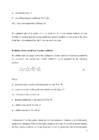
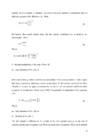
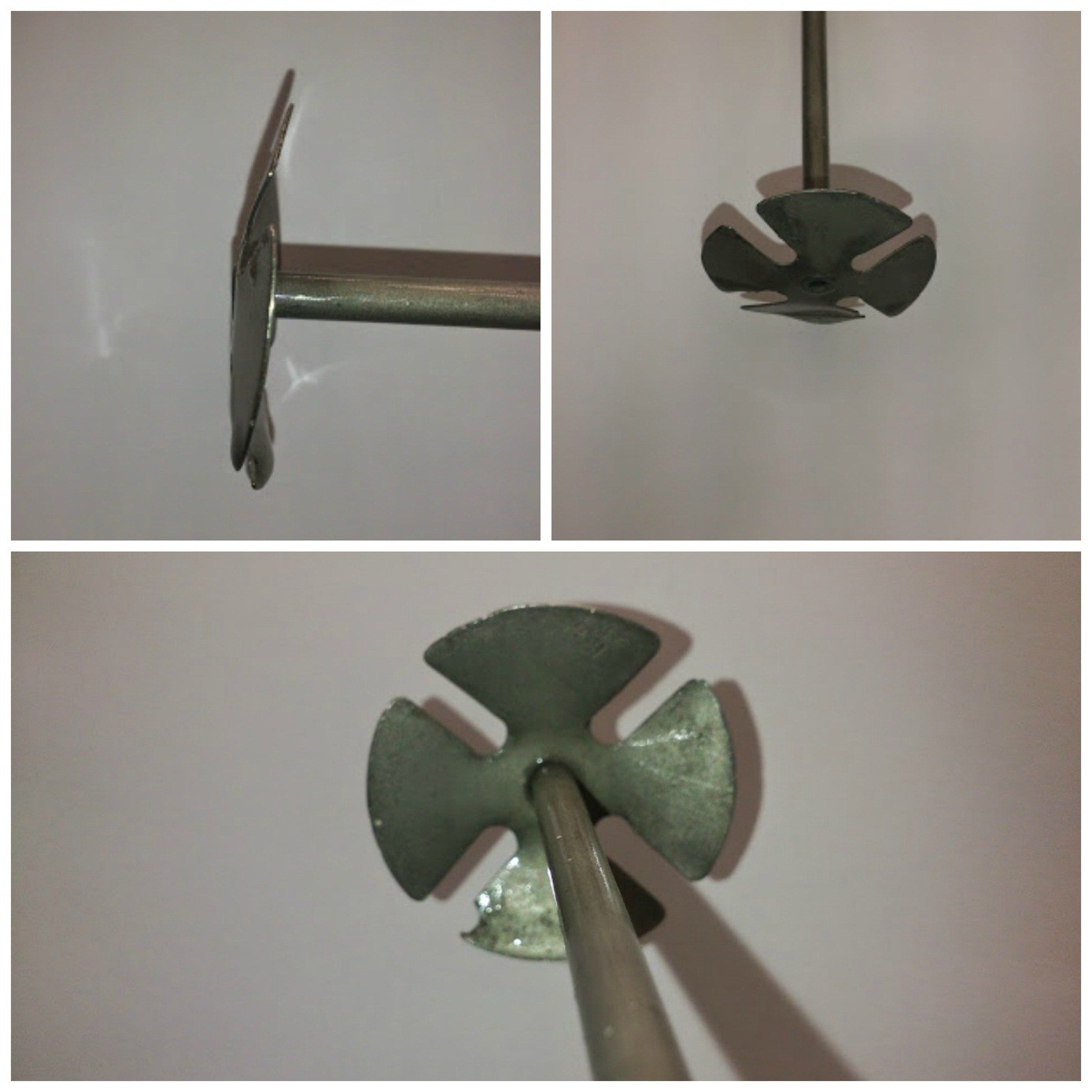
see on the Figure 4Error: Reference source not found,
it is more close to a turbine than a paddle. It is believed that the
effect of the agitator speed in the experiment does not match the
effect expected while engaging empirical equations from the
literature. Due to the turbine agitators blades were small; the
effect of the agitation is thought to be a lot less that the
equivalent paddle agitator.
The
experimental results fit the values given in Table 1 by Fletcher. The
values of overall heat transfer coefficients in case of internal coil
and cooling of the bath as can be seen in Table 1 are between 250
W•m-2•K-1and
800
W•m-2•K-1,
which can also be seen in the experimental results. U grows bigger
than the number of 800
W•m-2•K-1
only on rare occasions, most of the results stay in the boundaries
given by Fletcher.
Conclusions and suggestions for future work
From
the experimental work carried out, conclusions can be made:
- The heat transfer coefficient is mostly formed by convective heat transfers, rather than conduction. This means, that when exchanging heat between two fluids through a low heat resistance coil, the key things to improve overall heat transfer coefficient are to increase the Reynolds number inside the coil and the agitation in the bulk fluid.
- The Reynolds number inside the coil affects the convection heat transfer coefficient proportionally. In fact in many cases the effect of the Reynolds number on the overall heat transfer coefficient was found to be linear.
- In this experiment, the effect of the agitator was not drawn out very clearly. Although , it was seen that when the highest (1703 rpm) and the lowest (618 rpm) agitation rates were applied, the overall heat transfer coefficient was always higher with the highest agitation rate of 1703 rpm than the one with the lowest agitation rate of 618 rpm. Therefore it is believed that the agitation inside the bath increases the overall heat transfer coefficient, but it is not very sensitive to small changes in agitation.
For
future work, it is suggested to use a „standard“ agitator blade
and as well a „standard“ bath, for which there are more equations
to be found in the literature therefore a more reliable comparison
with the theoretical results can be made. Another detail, which could
make the experiment more consistent, is fixing the coil, also fixing
the space between the coil’s spirals. It might be interesting to
understand, by which correlation the Reynolds number inside the coil
changes the overall heat transfer coefficient.
Bibliography
Coulson,
J. M. & Richardson, J. F., 2004. Coulson and Richardson's
Chemical Engineering Volume 1 - Fluid Flow, Heat Transfer and Mass
Transfer.
Fletcher,
P., 1987. Heat transfer coefficients for stirred batch reactor
design.
Geankoplis,
C. J., 1993. Transport Processes and Unit Operations, Third
Edition.
Hewitt,
G. F., Shires, G. L. & Bott, T., 1994. Process Heat Transfer,
chapter 31.
Jeschke,
D., 1925. Wärmeübergang und Druckverlust in Rohrschlangen.
http://www.thermopedia.com/content/1176/
APPENDICES
A.1 Calibration of the rotameter
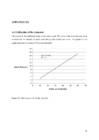
The
rotameter was calibrated using a timer and a scale . The value of the
rotameter was set to constant and the amount of water went through
the system was scaled. The points on the graph represent an average
of three measurements.
Figure
15: Calibration curve for the rotameter
A .2Calibration of Thermocouple and Electronic thermometer
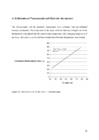
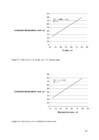
The
thermocouples and the electronic thermometer were calibrated with
pre-calibrated mercury thermometer. The temperature of the water
inside the bath was changed and all the thermometers were placed into
the water at same temperature, while changing temperature of the
water, calibration curves for the thermocouple and electronic
thermometer were formed.
Figure
16: Calibration curve for the outlet (T1)
thermocouple.
Figure
17: Calibration curve for the inlet (T2) thermocouple.
Figure
18: Calibration curve for electronic thermometer
A.3 Calculation example
The
following calculation example is shown, how heat transfer coefficient
was calculated for steady state heat transfer with the flow rate of
0,008556 kg/s and with the agitator in position 8, or at 1703,41 rpm.
The
equations (1) and (2) were used.
From
equation (2), the amount of heat exchanged is calculated:
This
is inserted to equation (1)
The
logarithmic mean temperature was calculated by equation:
(0)
Calculations
for unsteady state considering there is no heat loss are following.
Using
the equation (15) a calculation example is shown for unsteady state
with flow rate 0,00574 kg/s and with the agitation at 617,83 rpm.
To
calculate the heat transfer coefficient considering the heat loss, a
little different approach was taken. Using the equation following,
the amount of heat gained in the coil was calculated.
Then,
the calculated value of Q was replaced into equation
and with the series of results on the same agitation rate and flow
rate, in this case flow rate 0,0057 kg/s and agitation 617,83 rpm a
linear graph was conducted.,
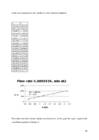
where y equals to Q and x equals to A•∆Tlm
which makes k equal to U.
In
the case examined here the variables of linear function conducted.
y
x
1224,004
1,894311
1082,748
1,798533
939,0853
2,112095
850,5479
1,810088
752,403
1,598259
649,659
1,576971
606,5281
1,164128
539,5923
1,150495
482,2187
1,164068
432,0168
0,959698
384,1552
0,855494
336,3992
0,783912
298,161
0,754559
278,9918
0,598414
250,3591
0,556669
226,4072
0,521141
200,1129
0,565006
180,9888
0,531864
161,8325
0,544722
From
these variables a linear function was formed and on the graph the
slope is equal to the overall heat transfer coefficient, U.
To
calculate the theoretical overall heat transfer coefficient an
equation (18) was used, which represents the connection between
resistance and heat transfer coefficient. An example is shown for
reading at the flow rate of 0,00866 kg/s and at the agitation rate at
1703,41.
The
convection inside coil was calculated with the equation (20), an
equation (21) was fitted because equation (20) is for straight pipes
and equation (21) correlates it to coil.
Calculation
for the critical Reynolds number is based on the equation (19) the
following:
The
Nusselt number was calculated using the following formula (28). When
using the equation (20) it is considered, that inside the coil there
was a laminar flow.
(0)
The
correlation between a straight pipe and a coil.
To
calculate the convection outside coil was a bit more difficult,
because of the large amount of variables. Nevertheless an equation
(22) was found in a book from Richardson and Coulson which was
exactly about convection outside coil. It should be noted, that this
formula is meant to be used with square tanks, the one in
experimental setup was rectangular.
Another
equation (23) to calculate the theoretical outside coil convective
heat transfer coefficient was found by Geankoplis.
 50 punkti
Autor soovib selle materjali allalaadimise eest saada 50 punkti.
50 punkti
Autor soovib selle materjali allalaadimise eest saada 50 punkti.
 ~ 52 lehte
Lehekülgede arv dokumendis
~ 52 lehte
Lehekülgede arv dokumendis
 2015-03-31
Kuupäev, millal dokument üles laeti
2015-03-31
Kuupäev, millal dokument üles laeti
 2 laadimist
Kokku alla laetud
2 laadimist
Kokku alla laetud
 0 arvamust
Teiste kasutajate poolt lisatud kommentaarid
0 arvamust
Teiste kasutajate poolt lisatud kommentaarid
 marvinrike
Õppematerjali autor
marvinrike
Õppematerjali autor
 annaabi.ee











































Kõik kommentaarid