Vajad kellegagi rääkida?
Küsi julgelt abi LasteAbi
Logi sisse

The Seaplane Harbour of Tallinn (0)

1 Hindamata
Punktid
Mustamäe College
Tallinn’s Seaplane Harbour
Report
Anna Elise Rohtmets G2K
Tallinn 2010
Table of Contents
1. Introduction .................................................................................................3
2. History.........................................................................................................4
3. Early History...............................................................................................4
4. The Post-War Years ....................................................................................5
5. Recent History.............................................................................................6
6. Estonian Maritime Museum and the Seaplane Harbour.............................6
7. Comments on the Seaplane Hangars...........................................................7
8. Restoration..................................................................................................7
9. Interesting Facts..........................................................................................8
10. Summary...................................................................................................9
11. Materials Used..........................................................................................10
12. Appendices...............................................................................................11
Introduction
I chose the Tallinn’s Seaplane Harbour because of its secluded nature combined with great value. I want know to why it was forgotten for such a long time, what makes it unique and what are the future plans concerning this architectural wonder.
History
Early History
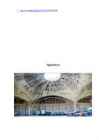
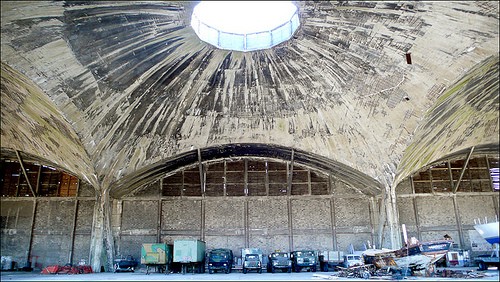
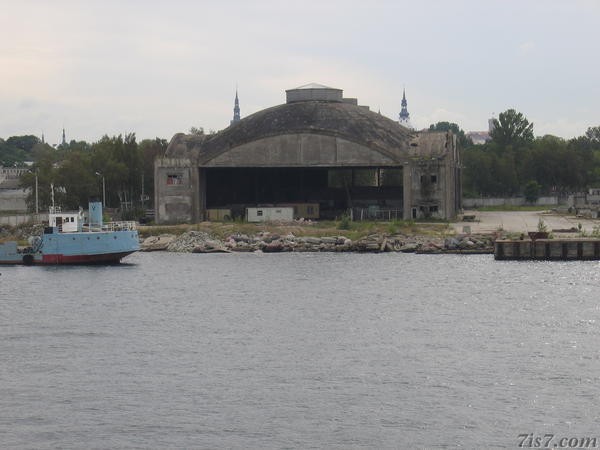
At the end of 1913, research work commenced on constructing an airfield which was to be built as part of the Peter the Great’s sea fortress (nowadays Patarei ). For this purpose , 6,000 square fathoms of land was appropriated a couple of hundred meters in the direction of Paljassaare. The construction of Noblessner’s shipyard had already begun on the adjacent plot and pursuant to the basic principles and plans of Tallinn’s fortifications as approved by Nikolai II in 1911; the plan foresaw the construction of two identical and adjacent hangar complexes . At the beginning of March in 1916, Colonel Aleksandr Jaron, who was responsible for the construction works, sent 11 local and foreign companies calls for proposals for designing these hangars, which were then modestly referred to as reinforced concrete sheds. The deadlines were quite short due to the ongoing World War and bids were already expected by the end of March. Construction was set to start during the period of April 15th and June 1st, 1916. However , things did not go so smoothly and the successful project was chosen in the course of negotiations held on April 29th. The winning project was submitted by a Danish company, Christiani & Nielsen (project manager Herluf Trolle Forchhammer and constructor Sven Schulz ) and it comprised of three shell concrete domes with a general plan of 50x100 meters. On June 9th the same company, “Christiani & Nielsen” was also given the task of constructing the hangars. The company had an advantage , because it had a representative office in St. Petersburg and was involved in the construction of Noblessner’s slipway.
The actual construction commenced on July 5th, 1916 on the site officially named as Tallinn’s Seaplane Harbour and in parallel with the hangars port piers were also constructed.
On October 13th, 1917, the construction team received an order to suspend all construction due to the war. Fortunately the hangars were almost ready by that time (only short of large-scale sliding doors, ramps for launching the planes and the floors had no wood cover). These seaplane hangars are unique shell concrete structures , which demonstrate engineering 20 years ahead of its time.


The Post-War Years


On January 24th, 1945, the secret decision No 010 of the ESSR National Economy Council granted the military a 14.2 ha premises in the area located on Küti and Noole streets. From then on until the end of the 1980s, the whole territory was under the control of the Baltic Shipping Administration and other Soviet military contingents. In addition , the roadstead fleet was based at the harbour. For decades the area remained closed off for regular citizens.
 
In 1951 a new pier No 36A was constructed on the former piers No 36 and 37 which were built during the time of hangar construction for the purpose of shielding the water area from north winds. In 1962, Professor Heinrich Laul of the Tallinn Polytechnic Institute published, „Reinforced Concrete II“, where he discusses Tallinn’s seaplane hangars as unique construction objects of great importance, which have been unfortunately overlooked. In 1979, Jevgeni Kaljundi compiled the first comprehensive historical overview of the construction of seaplane hangars.
On December 29th, 1989, a small enterprise SEK (the company was liquidated in 1998) was formed with the ESSR Construction Committee , which obtained control over industrial buildings in military use (wood processing ) located on Küti street. On December 24th, 1991, SEK allegedly transferred the property (except the piers and hangars) to the joint company B&E.
On October 5th, 1993, the premises were transferred by the order of the Government to the Ministry of Defence (MoD) and on March 15th, 1994, the ministry took control of piers 37, 36 and 36a (located at Küti 15a.). A year later the premises was transferred to the Ministry of the Environment and thus the historical territory of the Seaplane Harbour was halved. On December 14th , 1994, the MoD unilaterally assumed the hangars and piers No 38 and 39 as well as other structures (Küti 17). However, the repossession was only formal and lead to prolonged court proceedings. On June 4th, 1996, the premises on Küti 17 and 17A were transferred by a government order under the jurisdiction of the Ministry of Justice which revealed a serious conflict between the authorities and illegal private possessors. On November 14th, 1997, the Ministry of Justice filed a suit with the Tallinn City Court with the request to confirm the state as the legal owner of the premises located at Küti 17 and 17A and retrieve them from illegal possessors. On August 30th , 1996, the hangars were taken under protection by the order of the Ministry of Culture.
Recent History
On June 5th, 2000, President Lennart Meri tried to visit the premises, but was obstructed from entering the territory by a non-Estonian speaking security guard.
 
On August 25th, 2000, the Tallinn City Court decided in favour of the state. However, the decision was appealed by the defendant citing a violation of process regulations. In September-October 2001, the repairs of the roof cover of the central dome and the rain system were financed by the Tallinn Cultural Heritage Department. At the same time the court proceedings continued between the state and the illegal possessors. In July 2006, the Estonian authorities finally repossessed the Seaplane Harbour and ended the court saga that had lasted for 10 years.


Estonian Maritime Museum and the Seaplane Harbour

For years the Estonian Maritime Museum had been searching for a harbour for its growing museum fleet, which as a result was scattered. The idea and opportunity to develop a harbour for the museum arose in August 2003, when it became clear that the contract to keep the ice breaker „Suur Tõll“ at the Admiralty basin in the city centre was about to expire. Part of the seaplane harbour belonged to the Ministry of the Environment and the ownership of the other part was under dispute. The seaplane harbour was in a very bad condition , but after some basic maintenance the first ship was ready to be transferred. The ice breaker „Suur Tõll“ arrived there on January 26th, 2004.
By October 2004, all other museum’s ships – submarine „Lembit“, mine vessel „Kalev“, patrol boat „Grift“ and the research vessel „Mare“ - were brought to the Seaplane Harbour. By July 2006, the complications surrounding ownership had come to a favourable end and from then on the museum has been able to develop the harbour in a comprehensive manner . The reconstruction design of the harbour was finished in the autumn of 2007. The new project foresees the construction of an additional pier. The first phase of renovations was started in February 2008 and ended in June. The harbour’s capacity was enlarged by the instalment of floating piers. The museum plans to reconstruct the whole harbour in the coming years, renovate the seaplane hangars for the submarine „Lembit“ and occupy the barracks and staff HQ. In addition, the museum plans to enlarge its open air exposition at the harbour. In the future the Seaplane Harbour will be the starting point of the coastal promenade stretching to the centre of the city.
Comments on the Seaplane Hangars
“The seaplane hangars are the most unique architectural monument in Estonia from an engineering and technical point of view,” explained KOKO Arhitekid director Andrus Kõresaar. “We’re planning to be very tactful in the way we restore it. In the way we set up the exhibition we’re taking international visitors into account, so in world terms it will be an entirely modern and very exciting museum.”
“The museum, or part of it, should be in close proximity to the water, or even better: own the port,” said maritime historian and museum director Urmas Dresen. “You don’t have to look very far for precedents: Karlskrona, Stockholm , Turku, Kaliningrad, Gdansk, Gothenburg, Roskilde, Bremerhaven, Kiel , Flensburg, Liverpool, Rotterdam , Amsterdam... The only option for us at the Maritime Museum is the historical area of the old Lennusadama port.”
“It’s important to keep the place attractive and give it a happy imago , thus making the place profitable for investment,” said Veronika Valk. “Maybe we should make room even for a sea academy ?”
“One of the most interesting challenges is the piece of property between the hangars and Patarei prison. It should maximize its potential as the link between the two historical sites.” – Veronika Valk.
Restoration
Restoration of the seaplane hangars at the Lennusadama port and the construction of the innovative new exhibition are being financed from the European Structural Funds. The work has been budgeted at 130 million kroons and represents the second stage of the plans for the reconstruction of the port.
The ideas of young architects are flying high: near the hangars there is going to be stop for the sea taxi. The sea unites most of the districts of Tallinn from Rocca al Mare to Merivälja: Stroomi, Pelgurand, Kopli, Kalamaja, city centre, Kadriorg , Pirita. Alternative public transport over the sea would help to speed up development near the coast.
Interesting facts
The rate of development in the airplane industry during the building of the hangars was more than rapid . Since the air force industry was developing so quickly, new room for it to system had to be made. Let it be noted that during World War I the Russian air force had more plains than any other country . (let us remember the famous flight instructor Igor Sikorski (1889-1972) who after the revolution founded a sea plane factory in America)
Only construction workers with Russian citizenship were allowed to build the hangars. One of the founding workers was young Georg Meri, a future diplomat and a great translator of Shakespeare .
Summary
I learned that the hangars were built during World War I and as a part for Peter the Great’s sea fortress. They were comprised of three shell concrete domes modestly referred to as double crusted concrete. We know now that those structures were about 20 years ahead of their time. Its seclusion was due to the fact that the whole territory was under the control of the Baltic Shipping Administration and other Soviet military contingents. In addition, the roadstead fleet was based at the harbour. For decades the area remained closed off for regular citizens. The hectic times of the 90’s led to confusion in ownership and after a long series of court trials the hangars are finally in the phase of reconstruction. The future plans include a sea taxi and a renovation by the Maritime Museum.
Materials Used
  • http://www.ap3.ee/?PublicationId=31503ED6-39D4-4163-9D974AA1E3959CE&code=3204/new_eri_artiklid_320404 26.05.2010
  • http://www.telliskiviselts.info/meiekant/55 26.05.2010
  • http://www.meremuuseum.ee/?op=body&id=84 26.05.2010
  • http://www.tallinn2011.ee/?id=247 26.05.2010
    Appendices
  • Vasakule Paremale
    The Seaplane Harbour of Tallinn #1 The Seaplane Harbour of Tallinn #2 The Seaplane Harbour of Tallinn #3 The Seaplane Harbour of Tallinn #4 The Seaplane Harbour of Tallinn #5 The Seaplane Harbour of Tallinn #6 The Seaplane Harbour of Tallinn #7 The Seaplane Harbour of Tallinn #8 The Seaplane Harbour of Tallinn #9
    Punktid 50 punkti Autor soovib selle materjali allalaadimise eest saada 50 punkti.
    Leheküljed ~ 9 lehte Lehekülgede arv dokumendis
    Aeg2010-08-25 Kuupäev, millal dokument üles laeti
    Allalaadimisi 9 laadimist Kokku alla laetud
    Kommentaarid 0 arvamust Teiste kasutajate poolt lisatud kommentaarid
    Autor sahtlihiir Õppematerjali autor
    Lihtne ja konkreetne inglisekeelne referaat Tallinna vesilennukite angaaride kohta. Miks see on eriline, kus see asub, miks linn selle renoveerimisega varem ei tegelenud ning kellele see nüüd kuulub. Raamatuallikaid pole selles referaadis kasutatud.

    Kasutatud allikad

    Sarnased õppematerjalid

    CLOSING KALARAND FOR PUBLIC
    14
    docx

    CLOSING KALARAND FOR PUBLIC

    TALLINN UNIVERSITY OF TECHNOLOGY Department of International Relations CLOSING KALARAND FOR PUBLIC. Essay in Expository Writing Supervisor: Tallinn 2015 Kalarand is a part of Kalamaja district in Tallinn, it is a unique beach in the city centre, only few hundred meters from the Old Town. While being close to the city centre, it still has a remote area atmosphere to it where people could enjoy the seaside and views in a car-free environment. While not officially a public beach, the locals have still put in great effort into keeping it a clean and enjoyable public area (Klementi, 2011). In August 2015 historic

    Inglise keel
    Powerpointi esitlus vanalinna objektidest
    17
    ppt

    Powerpointi esitlus vanalinna objektidest

    On the northern portion of the passage you can find what's left of St. Catherine's Church (hence the passage name) and various large, ancient tombstones that used to line the inside of the sanctuary. On the southern portion of the passage, you'll find numerous artisan workshops, where you'll even get see them hard at work creating new items. City wall Tallinn's medieval city wall is a sub-facility that was built to protect the lower Tallinn and upper Tallinn (Toompea). The building of the city wall began in 1310th years, and by improving over time it formed the city wall with defensive buildings (towers). It was finished by the end of the 1561. Then it was 2.35-kilometer-long circular wall, which had 27 wall gate, 8 tower gate and 21 other stone fortifications. Many parts of the town wall have survived until today Great Coastal Gate (Suur Rannavärav) and Fat Margaret's Tower (Paks Margareeta)

    Inglisekeelne geograafia
    Tallinn Old Town
    9
    docx

    Tallinn Old Town

    Kunda Ühisgümnaasium Tallin Old Town Report Student: Kristin Karu Teacher: Kristi Aron Kunda 2012 The Alexander Nevsky Cathedral The Alexander Nevsky Cathedral is an orthodox cathedral in the Tallinn Old Town,Estonia. It was built to a design by Mikhail Preobrazhensky in a typical Russian Revivalstyle between 1894 and 1900, during the period when the country was part of theRussian Empire. The Alexander Nevsky Cathedral is Tallinn's largest and grandest orthodox cupola cathedral. It is dedicated to Saint Alexander Nevsky who in 1242 won the Battle of the Ice on Lake Peipus, in the territorial waters of present-day Estonia. The late Russian patriarch, Alexis II, started

    Inglise keel
    Bridges presentation
    22
    docx

    Bridges presentation

    This is within the functional tradition of some bridge types and should not be viewed as a negative factor in determining the integrity of a relocated structure. The definition of authenticity is in the process of being expanded to include intangible values such as a bridge that embodies the spirit or character of a people or place, as New York City is embodied in the Brooklyn Bridge, San Francisco in the Golden Gate, London in Tower Bridge, Sydney (Australia) in the Harbour Bridge, or Bosnia-Herzegovina in the recently destroyed Stari Most in Mostar. Bridges nominated for World Heritage listing also must have legal protection and management mechanisms to ensure their conservation. The existence of protective legislation at the national, provincial, or municipal level is therefore essential and must be clearly stated in the nomination. Guidelines for nominations state that each property should be compared with properties of the same

    Inglise keel
    Art Museum of Estonia
    10
    docx

    Art Museum of Estonia

    Kadriorg Art Museum The Kadriorg palace and park were founded by the Russian czar Peter I. According to the designs of the architect Niccolo Michetti, invited from Rome, the palace was built after the Italian villas, consisting of a main building and of two annexes. The well-preserved great hall is one of the best examples of Baroque architecture not only in Estonia but also in the whole Northern Europe. Besides Russian and Italian artists, masters from Stockholm, Riga and Tallinn took part in its building work. The two-storied hall is decorated with rich stucco work and ceiling paintings. The vestibule and some other rooms in the main building, as well as some of the stoves have retained their 18th-century appearance. The park was named Kadriorg (Catherine's Valley) after the empress Catherine I. Most of the Russian rulers, from Peter's daughter Elizabeth, to the last Romanov emperor Nicholas II, have visited this imperial summer residence.

    Inglise keel
    London
    10
    doc

    London

    London History The Romans AD 43- AD 410 The Romans finally invaded Britain in AD 43 from Kent. The Romans lead by Julius Caesar attempted to invade Britain twice before that in 55 and 54 BC but the invasions were unsuccessful. They made their way to the river Thames and sailed up it. The Romans knew it was important to control a crossing point at the river Thames, so they decided to build a settlement on the north bank. Although small settlements had been built on the banks of the Thames, the Romans were the ones who built the first city. They called their city Londinium. The Roman engineers noticed that the point where the swampy river narrowed would make an ideal crossing point, they built London Bridge. Less than 20 years later the native Iceni tribe, led by Queen Boudicca, rose up against the Romans in revenge for mistreatment and burnt Londinium to the ground. The well disciplined Roman army defeated her forces and Londinium was rebuilt. By AD 100 it had also become the capital o

    Inglise keel
    Estonia
    6
    doc

    Estonia

    is the smallest of the three Baltic countries. Estonia has land borders with Latvia (339 km) to the south and Russia (229 km) to the east. It is separated from Finland in the north by the narrow Gulf of Finland and from Sweden in the west by the Baltic Sea. Estonia has been a member of the European Union since May 1, 2004 and of the NATO since March 29, 2004. The area of Estonia is about 45000 square kilometres and the population is about 1.4 million people. The capital of Estonia is Tallinn and the official language is Estonian. The currency is Eesti kroon. The main religion is Lutheran. Anniversary of the republic is celebrated on February 20. The national flower is cornflower, national bird is barn swallow and national stone is limestone. It is a land of great natural beauty with a long and varied history and rich culture. It has served as a junction of international trade routes for centuries. History

    Inglise keel
    Kuidas muudab mudelprojekteerimine teraskonstruktsioonide valmistamist ja ehitamist
    228
    pdf

    Kuidas muudab mudelprojekteerimine teraskonstruktsioonide valmistamist ja ehitamist

    Ehitustootluse instituut KUIDAS MUUDAB MUDELPROJEKTEERIMINE TERASKONSTRUKTSIOONIDE PROJEKTEERIMIST, VALMISTAMIST JA EHITAMIST? HOW ARE 3D AND BIM CHANGING THE DESIGN, FABRICATION AND CONSTRUCTION OF COMPLEX STEEL STRUCTURES? EPJ 60 LT Üliõpilane: Tanel Friedenthal Juhendaja: Prof. Roode Liias Kaasjuhendaja: Prof. Carrie S. Dossick Tallinn, 2010.a. Olen koostanud lõputöö iseseisvalt. Kõik töö koostamisel kasutatud teiste autorite tööd, olulised seisukohad, kirjandusallikatest ja mujalt pärinevad andmed on viidatud. …………………………………………….. (töö autori allkiri ja kuupäev) Üliõpilase kood: 041399 Töö vastab magistritööle esitatud nõuetele ………………………………………………

    Ehituskonstruktsioonid


    Meedia

    Kommentaarid (0)

    Kommentaarid sellele materjalile puuduvad. Ole esimene ja kommenteeri


    Sellel veebilehel kasutatakse küpsiseid. Kasutamist jätkates nõustute küpsiste ja veebilehe üldtingimustega Nõustun