Vajad kellegagi rääkida?
Küsi julgelt abi LasteAbi
Logi sisse

Tallinn Old Town (1)

1 Hindamata
Punktid

Kunda Ühisgümnaasium
Tallin Old Town
Report
Student : Kristin Karu
Teacher: Kristi Aron
Kunda 2012
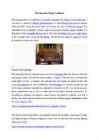
The Alexander Nevsky Cathedral
The Alexander Nevsky Cathedral is an orthodox cathedral in the Tallinn Old Town,Estonia. It was built to a design by  Mikhail Preobrazhensky in a typical  Russian Revivalstyle between 1894 and 1900, during the period when the country was part of theRussian Empire . The Alexander Nevsky Cathedral is Tallinn's largest and grandest orthodox cupola cathedral. It is dedicated to Saint Alexander Nevsky who in 1242 won the  Battle of the Ice on Lake Peipus, in the territorial waters of present -day Estonia. The late Russian patriarch, Alexis II, started his priestly ministry in the church .
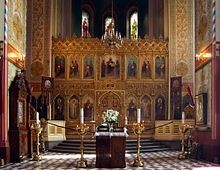
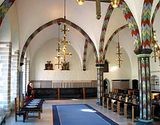
Interior of the Cathedral.
The Alexander Nevsky Cathedral crowns the hill of Toompea where the Estonian folk hero Kalevipoeg is said to have been buried according to a legend. ( There are many such legendary burial places of him in Estonia.) The cathedral was built during the period of late 19th century  Russification and was so disliked by many  Estonians  as a symbol of oppression that the Estonian authorities scheduled the cathedral for demolition in 1924, but the decision was never implemented due to lack of funds and the building 's massive construction . As the USSR was officially non- religious , many churches including this cathedral were left to decline. The church has been meticulously restored since Estonia regained independence from the  Soviet Union in 1991.
http://en.wikipedia.org/wiki/Alexander_Nevsky_Cathedral,_Tallinn
The church's towers hold Tallinn's most powerful church bell ensemble, consisting of 11 bells , including the largest in Tallinn, weighing 15 tonnes. You can hear the entire ensemble playing before each service .
http://www.tourism.tallinn.ee/eng/fpage/explore/churches#!p_307
Old Town
 
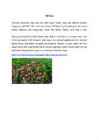
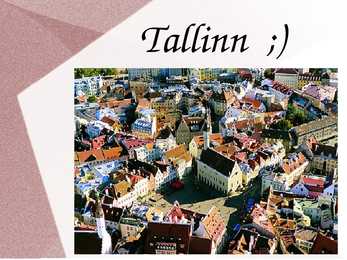
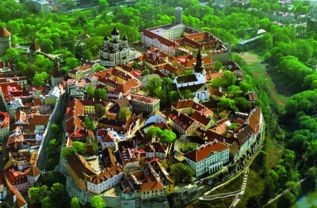
Twisting cobblestone lanes and iron street lamps. Gothic spires and medieval markets. Cappuccino and Wi-Fi. This is the city's famous Old Town. If you're looking for that mix of historic ambience and cutting-edge culture that defines Tallinn, you'll find it here .
Built up from the 13th to 16th centuries , when Tallinn – or Reval as it was known then – was a thriving member of the Hanseatic trade league , this enclosed neighbourhood of colourful, gabled houses , half- hidden courtyards and grandiose churches is, quite rightly, the city's biggest tourist draw. And the fact that it's all neatly packaged within a mostly- intact city wall and dotted with guard towers gives it an extra dose of fairytale charm
http://www.tourism.tallinn.ee/eng/fpage/explore/attractions/old_town
  • Kiek in de Kök


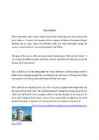
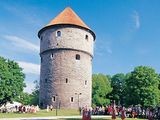
    Those interested in walls, towers, cannons and the like should drop into this museum of the town’s defences. Visitors of this museum will see examples of Medieval fire power, displays detailing how the city's system of fortification walls and towers developed through the centuries and an exhibit on crime and punishment in old Tallinn. 
    The name of this massive, 38m-high cannon tower literally means “Peek into the Kitchen .” It was so high that Medieval guards joked they could see right down the chimneys and into the kitchens of the houses below. 
    Kiek in de Kök is also the starting place for visitors interested in the fascinating system of hidden tunnels ( Bastion tunnels) that run underneath the old bastions of Toompea hill. Make sure to pay a visit to the top floor café for beautiful Old Town views.  
    Kiek in de Kök was originally built in the 1470s, but quickly expanded and strengthened, now the walls are four metres thick. The investment paid off: During the Livonian war in the late 1500s, Ivan the Terrible's forces managed to blow a huge hole through the top storey , but the tower held . During post-war repairs, a row of four cannon balls was placed in the newly patched stone wall as a memorial . You can still see them on the tower's south east side.
    http://www.tourism.tallinn.ee/eng/fpage/explore/attractions/old_town#!p_174740
    Tallinn Town Hall
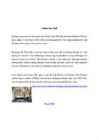
    Nothing says power like the impressive, Gothic Town Hall that dominates Medieval Tallinn's main square. It was built in 1402-1404 as a meeting place for the ruling burgermeisters and has been a show piece of the city ever since. 
    Nowadays the Town Hall is the only intact Gothic town hall in Northern Europe . It's used mainly for concerts or for entertaining visiting kings or presidents. In July and August it's open to visitors as a museum. The structure's interior is truly impressive, featuring colourful meeting halls, vaulted ceilings, intricate wood carvings and some of the city's most prized art treasures . Head down to the cellars for exhibitions during the summer season.
    Look closely at the top of the spire to spot the Old Thomas (in Estonian Vana Toomas) weather vane, a symbol of Tallinn who has been standing at attention here since 1530 . From June to August climb up the 64-metre tower to get some amazing Old Town views.
    http://www.tourism.tallinn.ee/eng/fpage/explore/attractions/old_town#!p_174683
  • Great Coastal Gate and Fat Margaret tower


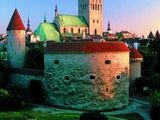
    Standing guard at the north end of Pikk street are two of Tallinn's most impressive defensive structures , the Great Coastal Gate (Suur Rannavärav) and Fat Margaret tower (Paks Margareeta). They were built not only to defend the city from the seaward side of town, but also to impress any visitors arriving via the harbour.
    The Great Coastal Gate, along with the Viru Gates , are the last of six gates that controlled access to the town in Medieval times . The gate system here on Pikk street originated in the 1300s, but it was during reconstruction in the early 16th century that the Fat Margaret cannon tower was added. Built from 1511 to 1530, this hefty, round tower has a diameter of 25 metres, a height of about 20 metres, and walls up to 5 metres thick.
    The origins of Fat Margaret's name are a mystery . Some theories insist it was named for one of its larger cannons, while others hint at a cook called Margaret who once worked here.
    In any case , the tower has served a number of different functions throughout its history. It has been used a storehouse for gunpowder and weapons, and as a prison .
    Now it's home to the Estonian Maritime Museum, which provides a detailed look at the nation 's seafaring past. Visitors should be sure to climb up to its rooftop viewing platform to get a lovely view of Old Town and the bay.
    http://www.tourism.tallinn.ee/eng/fpage/explore/attractions/old_town#!p_174824
    Song Celebrations and Song Festival traditions
    Song Celebrations and Song Festival traditions are among the best known trademarks of Estonia. No wonder, as the scale of our Song festivals is unique in the world.
    Once every five years , the Estonian song festival grounds (Lauluväljak in Tallinn) are filled with folk costumes and smiling people. Imagine tens of thousands of singers forming one huge choir and hundreds of thousands of people sitting on the grass to hear traditional choir music – no wonder it shocks, surprises and mesmerises overseas visitors!
    What makes it even more special is that, due to the small population of Estonia, there are less than million Estonian speakers and yet, a tenth of them attend the event. Long established song festival traditions are most likely the reason why Estonians – not known for our pop-music or global musical prowess – are still referred to as the “ singing nation”.
    Singing and songs have played a very important role in Estonian history. Songs were sung when cottagers tilled the manor land, singing sparked the “ awakening ” era in Estonia, our troops sang national songs fighting through the world wars and during the end of eighties, the Singing Revolution (which started right here on the Song Festival grounds) enabled us to regain our independence from the Soviet Union.  The Estonian national collection of folk songs comes second only to Ireland . 2007, the first -ever  punk -song-choir festival was organised in Estonia. In 2010 the first ever  digital song festivalwas held in Estonia. Our Night Song Festivals (Öölaulupidu) and (M)Ärkamisaeg (Awakening Time/Noticing Time), are events held to honour our independence, and are the world’s largest music events in the world in terms of the percentage of population (over 25%) participating! The joint choir on General Song Celebrations (consisting over 20 000 singers) also owns the title of being the world’s largest permanent choir.
    Tallinn’s song festival grounds, Lauluväljak (the Song Festival Grounds), have been visited by  virtually every single Estonian. The stage under the “song arch ” accommodates nearly 30 000 singers at once and there is room for almost 200 000 spectators. It is difficult to imagine Song festivals taking place anywhere else but here. But the tradition itself was born in Southern Estonia, in the second city Tartu and the first joint Song Celebration, held in Tartu in 1869, is considered to be the beginning of the Song Festivals as we know it.
    The Song Festival moved to its current location, Lauluväljak, in between the wars in 1928. The stage was a lot smaller then and the hill surrounding it accommodated far fewer people, so during major renovations a new stage was constructed to take double the number of singers and a higher tower for the “Song Festival live Fire” was built. Our song festival stage – the Song Arch – has a very unique architectural structure and the arch actually lifts higher when the sound is loud enough!
    http://www.visitestonia.com/en/things-to-see-and-do-in-estonia/cultural-holiday-in-estonia/song-celebrations-and-song-festival-traditions
    Conclusion
    I wrote a report about Tallinn. I brought out some attractions, activities and places. Like Old Tallin, Town wall and towers, Town Hall, Alexander Nevsky Cathedral and Song Festival Grounds. Usually I go in Tallinn when I want to visit my friends or relatives. Sometimes I just walk around at the Old Town in Tallinn with my friends or family, because it is very beautiful. After that we usually go and eat at some fancey restaraunt.
  • Vasakule Paremale
    Tallinn Old Town #1 Tallinn Old Town #2 Tallinn Old Town #3 Tallinn Old Town #4 Tallinn Old Town #5 Tallinn Old Town #6 Tallinn Old Town #7 Tallinn Old Town #8 Tallinn Old Town #9
    Punktid 50 punkti Autor soovib selle materjali allalaadimise eest saada 50 punkti.
    Leheküljed ~ 9 lehte Lehekülgede arv dokumendis
    Aeg2012-05-30 Kuupäev, millal dokument üles laeti
    Allalaadimisi 14 laadimist Kokku alla laetud
    Kommentaarid 1 arvamus Teiste kasutajate poolt lisatud kommentaarid
    Autor Kristin Karu Õppematerjali autor
    Tallinna vanalinn, selle vaatamisväärsused ja kohad

    Kasutatud allikad

    Sarnased õppematerjalid

    Old Tallinn
    5
    doc

    Old Tallinn

    Kunda Gymnasium Rait Türkel Old Tallinn Report Instructor:Teacher Kristi Aron Kunda 2012 Introduction Like most cities with an eight-hundred-year-old past, Tallinn is a patchwork of historic areas. The city's pride and joy is without a doubt its Medieval Old Town, but equally enchanting is the Kadriorg district, a throwback to the time when Estonia was ruled by the Russian Tsars. Tallinn is the capital and largest city of Estonia. It occupies an area of 159.2 km2 with a population of 416,470. It is situated on the northern coast of the country, on the shore of the Gulf of Finland, 80 km south of Helsinki, east of Stockholm and west of Saint Petersburg. Tallinn's Old Town is in the list of UNESCO World Heritage Sites

    Inglise keel
    Tallinn
    6
    ppt

    Tallinn

    Tallinn ;) The fundaments of Tallinn were laid some 4,500 years ago, but the city really came to life in the Middle Ages, during which it was occupied by Danes, Swedes, Germans, Russians. After being part of the Russian Empire and the Soviet Union, it became the capital of an independent Estonia in 1991. The old town now is a wellpreserved testimony of Tallinn's past, a small island in a sea of the modern city. A large part of what gives Old Town its character is the system of walls and towers that surrounds it. The current outline of the wall dates to the 14th century

    Inglise keel
    Giidindus Final Test kordamine
    8
    docx

    Giidindus Final Test kordamine

    2 Towns (Upper & Lower Town) Tallinn used to be divided into 2 parts - Upper Town where lived the aristocracy, gentry and the clergy; and Lower Town with traders, craftsmen and merchants. Legend says the Toompea Hill is actually the tumulus mound of the great Kalev. Linda carried rocks to his grave. It is a naturally- formed limestone hill. Lower Town was a merchantile centre, Tallinn also belonged to the Hansaetic League (1285). It is often referred to as the town of citizens. Any grown-up, married and economically independent person, born in a legal marriage between two free people and having lived in the town for at least 3 months, could apply to the Magistracy for citizenship. Serfs could escape from serdom after having successfully hidden in town for a year and a day. Two parts remained separated until the end of the 19th century. Four Names Lyndanise - mentioned by Henricus de Lettis in his Chronicle; derives from the name Linda -

    Giidindus
    Estonian holidays-festivals-cultural events
    12
    doc

    Estonian holidays, festivals, cultural events

    Holidays, Festivals, Cultural events TALLINN - If you're looking for entertainment in Estonia this summer, you are really spoiled for choice. Festivals and events dedicated to the consumption of beer are a lot of fun, but if you want to get the true feel of the country, you need something a little more ethnic. Like a town fair. Just as July becomes August, the seaside town of Haapsalu will host a grand spectacle of rural Estonian entertainment. The White Lady Days is a summer celebration filled with amusement for all the family. Held in and around the remains of the Teutonic-knights-era castles, the fair combines enchanting medieval legends with modern countryside charm to create a comprehensive experience of Estonia beyond the big cities. But the legend of the White Lady of Haapsalu, which is at the heart of the festival, is perhaps the most famous tall tale

    Inglise keel
    Tallinn
    10
    doc

    Tallinn

    Tallinn English College English Sergo Vainumäe 9A TALLINN Report Supervisor: Inge Välja Tallinn 2006 Order of contents: 1.Introduction 2.Toompea 3.Lower Town 4.Kadriorg and Pirita 5.Museums 1. Introduction Tallinn, the capital of Estonia, lies on the Baltic Sea. It is on almost the same latitude east St. Petersburg in Russia, Stockholm in Sweden and Stavanger in Norway, and covers 158 sq km. Tallinn was first marked on a map of the world by the Arab geographer al-Idrisi in 1154, its name then being Kolyvan (probably derived from the name Kalev). In the 13th-century Chronicle of Henricus de Lettis the town was called Lyndanise. Later came Reval (presumably after the old county

    inglise teaduskeel
    Sights of Estonia
    6
    doc

    Sights of Estonia

    1 1. Steamer-icebreaker Suur Tõll The ship was built in 1914 in Stettin (Szczecin) by Vulkan-Werke A. G. Suur Tll is the only pre-war steam ship of the Republic of Estonia remained up to now and, at the same time, the biggest icebreaker in the world preserved through two world wars. All the 3 original steam engines as well as most of the original arrangement of space and late Jugendstil interior of the officers' rooms are preserved. In 1914 the first home port of the ship was Tallinn. The ship ensured a regular winter sea navigation for Tallinn up to the end of the independency period. 2. The Tallinn Song Festival Grounds The Tallinn Song Stage was built in 1959 for arranging the Song Festivals. The stage was meant to hold over 15 000 singers. Indoor rooms can be used as a backstage area during the concerts but those are also suitable for all kind of events, parties, concerts, 2 banquettes, fairs, exhibitions etc

    Inglise keel
    Powerpointi esitlus vanalinna objektidest
    17
    ppt

    Powerpointi esitlus vanalinna objektidest

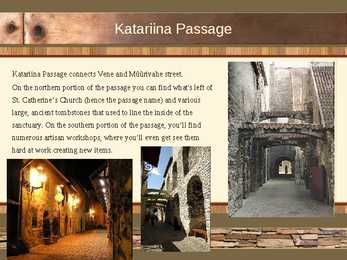
    On the northern portion of the passage you can find what's left of St. Catherine's Church (hence the passage name) and various large, ancient tombstones that used to line the inside of the sanctuary. On the southern portion of the passage, you'll find numerous artisan workshops, where you'll even get see them hard at work creating new items. City wall Tallinn's medieval city wall is a sub-facility that was built to protect the lower Tallinn and upper Tallinn (Toompea). The building of the city wall began in 1310th years, and by improving over time it formed the city wall with defensive buildings (towers). It was finished by the end of the 1561. Then it was 2.35-kilometer-long circular wall, which had 27 wall gate, 8 tower gate and 21 other stone fortifications. Many parts of the town wall have survived until today Great Coastal Gate (Suur Rannavärav) and Fat Margaret's Tower (Paks Margareeta)

    Inglisekeelne geograafia
    Tallinn-topic
    7
    doc

    Tallinn-topic

    Introduction Tallinn, the capital city of the Republic of Estonia and of the Harju county, is a town in North Estonia on the coast of the Gulf of Finland. It has nearly half a million inhabitants and covers an area of almost 160 sqkm. It is also an important economic and cultural centre and one of the main ports in the Baltic States. Tallinn is one of the oldest cities on the Baltic Sea. It is unique for its well-preserved architecture from the 13-15 centuries. In contrast to the ancient town-walls and towers, Tallinn of today offers modern hotels, restaurants, sport and cultural centres. Every five years national song and folk dance festivals take place in Tallinn. The yachting regatta of the 1980 Moscow Olympic Games was held at Pirita. History Tallinn means in English "Danish town"

    Inglise keel


    Meedia

    Kommentaarid (1)

    siilid02 profiilipilt
    marko aade: väga hea
    13:32 04-10-2013


    Sellel veebilehel kasutatakse küpsiseid. Kasutamist jätkates nõustute küpsiste ja veebilehe üldtingimustega Nõustun