 50 punkti
Autor soovib selle materjali allalaadimise eest saada 50 punkti.
50 punkti
Autor soovib selle materjali allalaadimise eest saada 50 punkti.
 ~ 6 lehte
Lehekülgede arv dokumendis
~ 6 lehte
Lehekülgede arv dokumendis
 2010-02-03
Kuupäev, millal dokument üles laeti
2010-02-03
Kuupäev, millal dokument üles laeti
 40 laadimist
Kokku alla laetud
40 laadimist
Kokku alla laetud
 2 arvamust
Teiste kasutajate poolt lisatud kommentaarid
2 arvamust
Teiste kasutajate poolt lisatud kommentaarid
 yevonda
Õppematerjali autor
yevonda
Õppematerjali autor
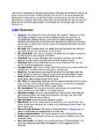
Plot Overview Jane Eyre is a young orphan being raised by Mrs. Reed, her cruel, wealthy aunt. A servant named Bessie provides Jane with some of the few kindnesses she receives, telling her stories and singing songs to her. One day, as punishment for fighting with her bullying cousin John Reed, Jane’s aunt imprisons Jane in the red- room, the room in which Jane’s Uncle Reed died. While locked in, Jane, believing that she sees her uncle’s ghost, screams and faints. She wakes to find herself in the care of Bessie and the kindly apothecary Mr. Lloyd, who suggests to Mrs. Reed that Jane be sent away to school. To Jane’s delight, Mrs. Reed concurs. Once at the Lowood School, Jane finds that her life is far from idyllic. The school’s headmaster is Mr. Brocklehurst, a cruel, hypocritical, and abusive man. Brocklehurst preaches a doctrine of poverty and privation to his students while
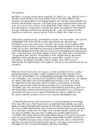
Jane Eyre I decided to read the book Jane Eyre. Jane Eyre was an orphan who lived with Mrs. Reed, her cruel, wealthy aunt. Only a servant named Bessie was gind to Jane, who told her stories and sang songs to her. One day, Jane’s cousin John Reed bullied Jane and Jane got mad. They were caught fighting and Jane aunt, imprisoned Jane into the red room, were Jane’s uncle had died. Jane was really scared of that room because, she believed that her uncle’s ghost was still in there. In the room Jane was screaming and so scared that she fainted. When she waked up, Mrs. Reed decided to send Jane to the Lowood School, Jane was also happy to leave. When Jane arrived to the school she found out that her life was better in her aunt house than in that school. The school’s headmaster was Mr. Brocklehurst, a cruel, hypocritical, and abusive man, who treated the students really bad
14KS1 Maarja Tobreluts Jane Eyre Analysis of book and movie “Jane Eyre'' Juhendaja: Kai Hermann Vana-Vigala 2014 Overview ''Jane Eyre'' was published in 1847 and brought fame to its author, Charlotte Bronte. The book incorporates many themes: the relations between men and women, gender equality, the treatment of children and of women, religious faith and religious life and the notion of true love
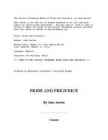
The Project Gutenberg EBook of Pride and Prejudice, by Jane Austen This eBook is for the use of anyone anywhere at no cost and with almost no restrictions whatsoever. You may copy it, give it away or re-use it under the terms of the Project Gutenberg License included with this eBook or online at www.gutenberg.org Title: Pride and Prejudice Author: Jane Austen Release Date: August 26, 2008 [EBook #1342] [Last updated: August 11, 2011] Language: English Character set encoding: ASCII *** START OF THIS PROJECT GUTENBERG EBOOK PRIDE AND PREJUDICE *** Produced by Anonymous Volunteers, and David Widger PRIDE AND PREJUDICE By Jane Austen Contents Chapter 1 Chapter 22 Chapter 2 Chapter 23 Chapter 43
Pride and Prejudice by Jane Austen. Jane Austens one of the best novels is ,,Pride and Prejudice" it was released in year 1813. Book starts with that sentence : "It is a truth universally acknowledged, that a single man, in possession of a good fortune, must be in want of a wife" this already tells us what is ,,Pride and Prejudice" about. The book begins by introducing Bennets family, Mr and Mrs Bennet and their five unmarried daughters. In their family they had no boys to give the Bennets legacy
Old Mr. Dashwood is the owner of a large estate in Sussex called Norland Park. Following the death of his sister, Mr. Dashwood invites his nephew Mr. Henry Dashwood to come live with him at Norland. The younger Mr. Dashwood brings John Dashwood, his son from a previous marriage, as well as the three daughters born to his present wife. John Dashwood is grown and married, and has a four-year-old son, Harry. When Old Mr. Dashwood dies, he leaves his estate to John and little Harry, who had much endeared himself to the old man. But now John's father, Henry Dashwood, is left with no way of supporting his wife and three daughters, and he too dies one year later, leaving only ten thousand pounds for his family. Just before his death, he makes his son John promise to care for his stepmother and three half-sisters. Mr. John Dashwood initially intends to keep his promise and treat his female relatives generously, but his wife Fanny, a narrow-minded and selfish woman, convinces him to leave them
Jane Austen "Pride & Prejudice" Pride and Prejudice, first published on 28 January 1813, has consistently been Jane Austen's most popular novel. Austen sold the copyright for Pride and Prejudice to Thomas Egerton. Egerton published the first edition of Pride and Prejudice in three hardcover volumes in January. The tone is light and a little humoristic. Pride and Prejudice is a humorous story of love and life among English gentility. At first the book was called "First impressions" and this gives a better expression to the requests of the author, than the later heading
Jane Eyre Dark Characters The famous novel by Charlotte Bronte is a classic that in my opinion all people should be familiar with. I personally have seen even several movies based on it and also enjoyed reading the book. The novel mainly talks about a girl named Jane and her life as a guverness in Thornfield. When Jane reaches adulthood, she decides to work for the wealthy Mr.Rochester and teach his child who he himself is not that fond of. Jane as a person is shy but doesn't let people take advantage of her and after some time manages to charm the other wise cold hearted Mr.Rochester with her out spoken mind. Despite catching Mr.Rochesters eye their love story developes slowly because besides being both from a completely different class, Mr.Rochester
 annaabi.ee









Kõik kommentaarid