Vajad kellegagi rääkida?
Küsi julgelt abi LasteAbi
Logi sisse

English Tenses - theory (0)

5 VÄGA HEA
Punktid
Inglise keel - Kõik luuletused, mis on inglise keeles
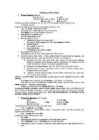
Present Simple · Korduv, regulaarne tegevus: I WORK every day / each Monday / only on Wednesdays. · Üldine, tavapärane tegevus; loodusseadused / füüsika etc. reeglid: I usually DO NOT WORK in summer . She DOES NOT WORK at night . Magnet ATTRACTS iron . · !!! Spordikommentarid: ... and now he PASSES the ball ... and off he GOES towards the goal ... · 1pv (+s/es Å he/she/it); ? DO(ES)+ 1pv ; - DO(ES) not + 1pv
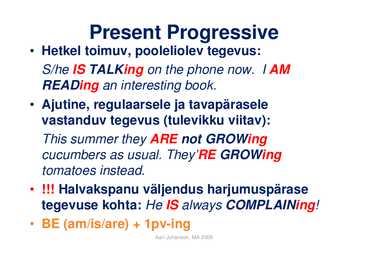
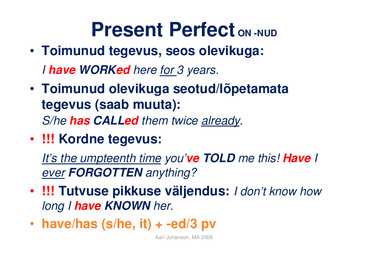
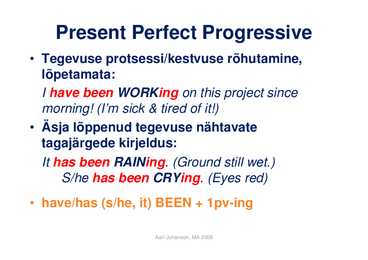
Aari Juhanson , MA 2008 Present Progressive · Hetkel toimuv, pooleliolev tegevus: S/he IS TALKing on the phone now. I AM READing an interesting book. · Ajutine, regulaarsele ja tavapärasele vastanduv tegevus (tulevikku viitav ): This summer they ARE not GROWing cucumbers as usual. They'RE GROWing tomatoes instead. · !!! Halvakspanu väljendus harjumuspärase tegevuse kohta: He IS always COMPLAINing ! · BE (am/is/are) + 1pv-ing Aari Juhanson, MA 2008 Present Perfect ON -NUD · Toimunud tegevus, seos olevikuga: I have WORKed here for 3 years . · Toimunud olevikuga seotud/lõpetamata tegevus (saab muuta): S/he has CALLed them twice already . · !!! Kordne tegevus: It's the umpteenth time you've TOLD me this! Have I ever FORGOTTEN anything ? · !!! Tutvuse pikkuse väljendus: I don't know how long I have KNOWN her. · have/has (s/he, it) + -ed/3 pv Aari Juhanson, MA 2008 Present Perfect Progressive · Tegevuse protsessi/ kestvuse rõhutamine, lõpetamata: I have been WORKing on this project since morning ! (I'm sick & tired of it!) · Äsja lõppenud tegevuse nähtavate tagajärgede kirjeldus: It has been RAINing. ( Ground still wet.) S/he has been CRYing. ( Eyes red) · have/has (s/he, it) BEEN + 1pv-ing
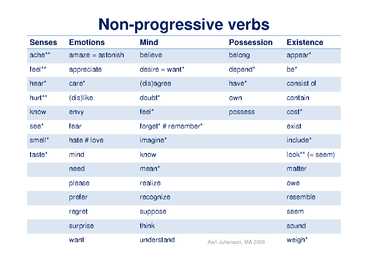
Aari Juhanson, MA 2008 Non-progressive verbs Senses Emotions Mind Possession Existence ache** amaze = astonish believe belong appear*
feel ** appreciate desire = want* depend* be*
hear * care* (dis) agree have* consist of
hurt ** (dis)like doubt* own contain
know envy feel* possess cost *
see* fear forget * # remember * exist
smell* hate # love imagine* include *
taste* mind know look ** (= seem )
need mean * matter
please realize owe
prefer recognize resemble
regret suppose seem
surprise think* sound
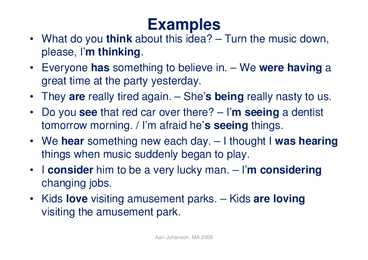
want* understand Aari Juhanson, MA 2008 weigh * Examples · What do you think about this idea ? ­ Turn the music down, please, I'm thinking . · Everyone has something to believe in. ­ We were having a great time at the party yesterday. · They are really tired again . ­ She's being really nasty to us. · Do you see that red car over there ? ­ I'm seeing a dentist tomorrow morning. / I'm afraid he's seeing things. · We hear something new each day. ­ I thought I was hearing things when music suddenly began to play. · I consider him to be a very lucky man. ­ I'm considering changing jobs . · Kids love visiting amusement parks . ­ Kids are loving visiting the amusement park.
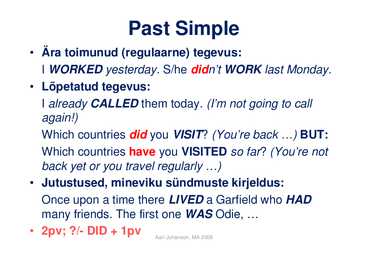
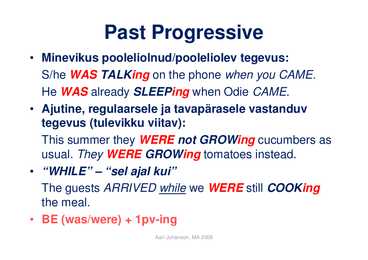
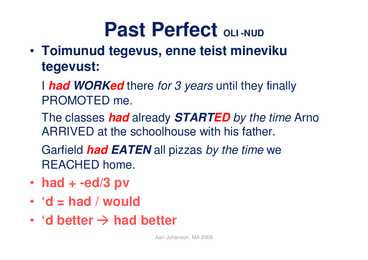
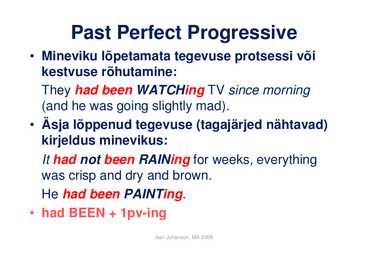
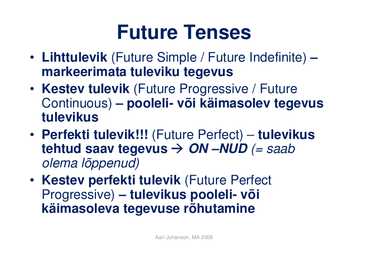
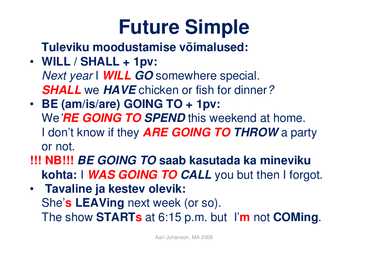
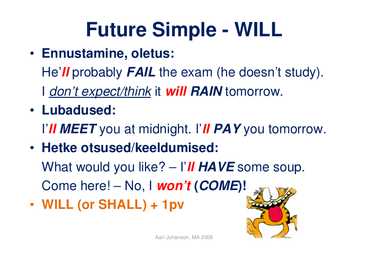
Aari Juhanson, MA 2008 Past Simple · Ära toimunud (regulaarne) tegevus: I WORKED yesterday. S/he didn't WORK last Monday. · Lõpetatud tegevus: I already CALLED them today . (I'm not going to call again!) Which countries did you VISIT ? (You're back ...) BUT: Which countries have you VISITED so far? (You're not back yet or you travel regularly ...) · Jutustused, mineviku sündmuste kirjeldus: Once upon a time there LIVED a Garfield who HAD many friends . The first one WAS Odie, ... · 2pv; ?/- DID + 1pv Aari Juhanson, MA 2008 Past Progressive · Minevikus pooleliolnud/pooleliolev tegevus: S/he WAS TALKing on the phone when you CAME . He WAS already SLEEPing when Odie CAME. · Ajutine, regulaarsele ja tavapärasele vastanduv tegevus (tulevikku viitav): This summer they WERE not GROWing cucumbers as usual. They WERE GROWing tomatoes instead. · " WHILE " ­ "sel ajal kui" The guests ARRIVED while we WERE still COOKing the meal . · BE (was/were) + 1pv-ing Aari Juhanson, MA 2008 Past Perfect OLI -NUD · Toimunud tegevus, enne teist mineviku tegevust: I had WORKed there for 3 years until they finally PROMOTED me. The classes had already STARTED by the time Arno ARRIVED at the schoolhouse with his father . Garfield had EATEN all pizzas by the time we REACHED home. · had + -ed/3 pv · `d = had / would · `d better Æ had better Aari Juhanson, MA 2008 Past Perfect Progressive · Mineviku lõpetamata tegevuse protsessi või kestvuse rõhutamine: They had been WATCHing TV since morning (and he was going slightly mad). · Äsja lõppenud tegevuse (tagajärjed nähtavad) kirjeldus minevikus: It had not been RAINing for weeks, everything was crisp and dry and brown . He had been PAINTing. · had BEEN + 1pv-ing Aari Juhanson, MA 2008 Future Tenses · Lihttulevik (Future Simple / Future Indefinite ) ­ markeerimata tuleviku tegevus · Kestev tulevik (Future Progressive / Future Continuous ) ­ pooleli - või käimasolev tegevus tulevikus · Perfekti tulevik!!! (Future Perfect) ­ tulevikus tehtud saav tegevus Æ ON ­NUD (= saab olema lõppenud) · Kestev perfekti tulevik (Future Perfect Progressive) ­ tulevikus pooleli- või käimasoleva tegevuse rõhutamine Aari Juhanson, MA 2008 Future Simple Tuleviku moodustamise võimalused: · WILL / SHALL + 1pv: Next year I WILL GO somewhere special . SHALL we HAVE chicken or fish for dinner ? · BE (am/is/are) GOING TO + 1pv: We'RE GOING TO SPEND this weekend at home. I don't know if they ARE GOING TO THROW a party or not. !!! NB!!! BE GOING TO saab kasutada ka mineviku kohta: I WAS GOING TO CALL you but then I forgot. · Tavaline ja kestev olevik : She's LEAVing next week (or so). The show STARTs at 6:15 p.m. but I'm not COMing . Aari Juhanson, MA 2008 Future Simple - WILL · Ennustamine, oletus : He'll probably FAIL the exam (he doesn't study ). I don't expect /think it will RAIN tomorrow. · Lubadused : I'll MEET you at midnight. I'll PAY you tomorrow. · Hetke otsused/keeldumised: What would you like? ­ I'll HAVE some soup . Come here ! ­ No, I won't (COME)! · WILL (or SHALL) + 1pv
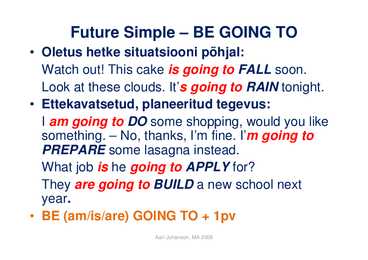
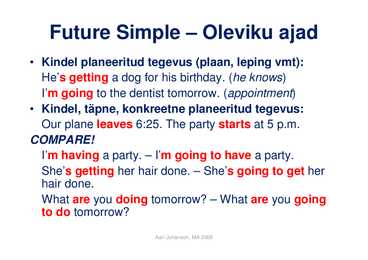
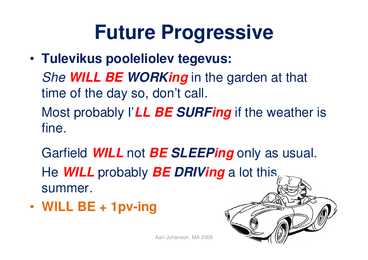
Aari Juhanson, MA 2008 Future Simple ­ BE GOING TO · Oletus hetke situatsiooni põhjal: Watch out! This cake is going to FALL soon. Look at these clouds. It's going to RAIN tonight . · Ettekavatsetud, planeeritud tegevus: I am going to DO some shopping , would you like something. ­ No, thanks , I'm fine. I'm going to PREPARE some lasagna instead. What job is he going to APPLY for? They are going to BUILD a new school next year. · BE (am/is/are) GOING TO + 1pv Aari Juhanson, MA 2008 Future Simple ­ Oleviku ajad · Kindel planeeritud tegevus (plaan, leping vmt): He's getting a dog for his birthday . (he knows) I'm going to the dentist tomorrow. (appointment) · Kindel, täpne, konkreetne planeeritud tegevus: Our plane leaves 6:25. The party starts at 5 p.m. COMPARE ! I'm having a party. ­ I'm going to have a party. She's getting her hair done . ­ She's going to get her hair done. What are you doing tomorrow? ­ What are you going to do tomorrow? Aari Juhanson, MA 2008 Future Progressive · Tulevikus pooleliolev tegevus: She WILL BE WORKing in the garden at that time of the day so, don't call. Most probably I'LL BE SURFing if the weather is fine. Garfield WILL not BE SLEEPing only as usual. He WILL probably BE DRIVing a lot this summer. · WILL BE + 1pv-ing
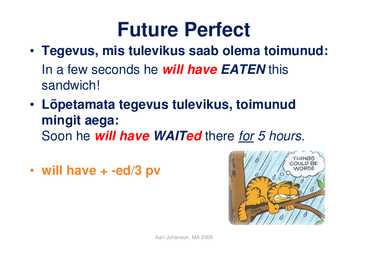
Aari Juhanson, MA 2008 Future Perfect · Tegevus, mis tulevikus saab olema toimunud: In a few seconds he will have EATEN this sandwich ! · Lõpetamata tegevus tulevikus, toimunud mingit aega: Soon he will have WAITed there for 5 hours .
· will have + -ed/3 pv
Aari Juhanson, MA 2008
Vasakule Paremale
English Tenses - theory #1 English Tenses - theory #2 English Tenses - theory #3 English Tenses - theory #4 English Tenses - theory #5 English Tenses - theory #6 English Tenses - theory #7 English Tenses - theory #8 English Tenses - theory #9 English Tenses - theory #10 English Tenses - theory #11 English Tenses - theory #12 English Tenses - theory #13 English Tenses - theory #14 English Tenses - theory #15 English Tenses - theory #16 English Tenses - theory #17
Punktid 10 punkti Autor soovib selle materjali allalaadimise eest saada 10 punkti.
Leheküljed ~ 17 lehte Lehekülgede arv dokumendis
Aeg2011-08-23 Kuupäev, millal dokument üles laeti
Allalaadimisi 39 laadimist Kokku alla laetud
Kommentaarid 0 arvamust Teiste kasutajate poolt lisatud kommentaarid
Autor Aari Juhanson Õppematerjali autor
Kuidas moodustada inglise keeles erinevaid oleviku, mineviku ja tuleviku aegu.

Sarnased õppematerjalid

English grammar tenses intro
18
pdf

English grammar tenses intro

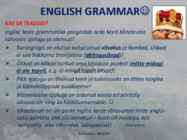
 Pikk ajalugu on lihvinud keelt ja tulemuseks on lihtne loogika ja käändelõppude puudumine!  Mitmekesine ajalugu on aidanud kaasa eri päritolu sõnavarale ning ka hääldusmuredele.   Väidetavalt on üle poole inglise keele sõnavarast mitte anglo- saksi päritolu, ehk siis laenatud – kontrolli hoolega, kas ‘sympathy’ ikka tähendab ‘sümpaatiat! kaastunne Aari Juhanson, MA 2009 Tenses – Tegusõna ajad • Olevik (Present) • Minevik (Past) • Tulevik (Future) • Kaudne tulevik (Future-in-the-Past) Aari Juhanson, MA 2009 Present Tenses • Lihtolevik (Present Simple / Present Indefinite) – regulaarne, korduv tegevus • Kestev olevik (Present Progressive / Present Continuous) – pooleliolev, ühes tükis tegevus • Täisminevik !!! (Present Perfect) – tehtud, *lõpetamata* tegevus

Inglise keel
Past tenses
16
pdf

Past tenses

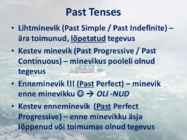
Past Tenses • Lihtminevik (Past Simple / Past Indefinite) – ära toimunud, lõpetatud tegevus • Kestev minevik (Past Progressive / Past Continuous) – minevikus pooleli olnud tegevus • Enneminevik !!! (Past Perfect) – minevik enne minevikku   OLI -NUD • Kestev enneminevik (Past Perfect Progressive) – enne minevikku äsja lõppenud või toimumas olnud tegevus Created by Aari Juhanson, MA 2009 Past Simple • Ära toimunud (regulaarne) tegevus: I WORKED yesterday. S/he didn’t WORK last Monday. • Lõpetatud tegevus: I already CALLED them today. (I’m not going to call again!) Which countries did you VISIT? (You’re back …) BUT: Which countries have you VISITED so far? (You’re not back yet or you travel regularly …) • Jutustused, mineviku sündmuste kirjeldus: Once upon a time there LIVED a Garfield who HAD many friends. The first one WAS Odie, … • 2pv; ?/-

Inglise keel
Inglise keele ajavormid ja nende kasutamine
8
xls

Inglise keele ajavormid ja nende kasutamine

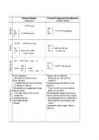
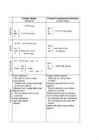
Ing Present Simple Present Progressive/Continuous (lihtolevik) (kestev olevik) I vorm (play) am JAATAV he is I vorm+ing (playing) she I vorm+s (plays) are it do not I vorm (don't play) am EITAV he is not I vorm+ing she does not I vorm are (not playing) it (doesn't play) Do I vorm (Do ... play ... ?) KÜSILAUSE

Inglise keel
Inglise keele ajavormid ja nende kasutamine
8
xls

Inglise keele ajavormid ja nende kasutamine

Ing Present Simple Present Progressive/Continuous (lihtolevik) (kestev olevik) I vorm (play) am JAATAV he is I vorm+ing (playing) she I vorm+s (plays) are it do not I vorm (don't play) am EITAV he is not I vorm+ing she does not I vorm are (not playing) it (doesn't play) Do I vorm (Do ... play ... ?) KÜSILAUSE

Inglise keel
Ajavormid
8
xls

Ajavormid

Ing Present Simple Present Progressive/Continuous (lihtolevik) (kestev olevik) I vorm (play) am JAATAV he is I vorm+ing (playing) she I vorm+s (plays) are it do not I vorm (don't play) am EITAV he is not I vorm+ing she does not I vorm are (not playing) it (doesn't play) Do I vorm (Do ... play ... ?) KÜSILAUSE

Inglise keel
Tenses tabel
5
pdf

Tenses tabel

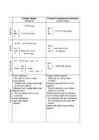
englisch-hilfen.de ­ LEARNING ENGLISH ONLINE Examples Examples Examples Tense Signal words Use Form affirmative negative interrogative every day something happens repeatedly sometimes

Inglise keel
Kõik Inglise keele ajad
5
doc

Kõik Inglise keele ajad

TENSES. ACTIVE VOICE. 1. Present Simple (üldolevik) I (he, she, it ­s) he works Eitav,küsiv do (I, you, we, they) he does not work does (he, she, it) does he work? Verbidele, mis lõpevad infinitiivis ­ss, -sh, -ch, -x või ­o, lisatakse ainsuse 3. pöördes ­es he touches, she goes Verbidel, mis lõpevad y-ga, mille ees on konsonant, muutub y->ies carry - he carries Vrdl: play ­he plays 1. Harjumuspärane, korduv tegevus või seisund olevikus. Tom drinks tea every day. He lives in Brussels. 2. Üldtuntud tõed, loodusseadused The earth goes round the sun. 3. Tulevikus toimuv tegevus a) Sõiduplaanid, planeeritud programmid. The train for Tallinn leaves at 10. The course begins on Monday. b) Tingimuslausetes

Inglise keel
Inglise keele jaotusmaterjal
37
doc

Inglise keele jaotusmaterjal

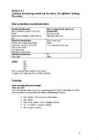
MODULE 1 Greeting. Introducing oneself and the others. The alphabet. Spelling. The tenses. How to introduce yourself and others Formal introductions How to respond and reply to an May I introduce myself? I am John introduction Smith. How do you do. Allow me to introduce John Smith to Pleased to meet you. you. Standard introduction Nice to meet you. I'd like you to meet John Smith. Hello. I want you to meet John Smith. I'm so pleased to meet you.

Inglise keel


Kommentaarid (0)

Kommentaarid sellele materjalile puuduvad. Ole esimene ja kommenteeri


Sellel veebilehel kasutatakse küpsiseid. Kasutamist jätkates nõustute küpsiste ja veebilehe üldtingimustega Nõustun