 Tasuta
Faili alla laadimine on tasuta
Tasuta
Faili alla laadimine on tasuta
 ~ 8 lehte
Lehekülgede arv dokumendis
~ 8 lehte
Lehekülgede arv dokumendis
 2018-01-28
Kuupäev, millal dokument üles laeti
2018-01-28
Kuupäev, millal dokument üles laeti
 7 laadimist
Kokku alla laetud
7 laadimist
Kokku alla laetud
 0 arvamust
Teiste kasutajate poolt lisatud kommentaarid
0 arvamust
Teiste kasutajate poolt lisatud kommentaarid
 Aari Juhanson
Õppematerjali autor
Aari Juhanson
Õppematerjali autor
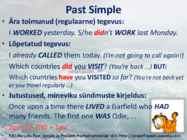
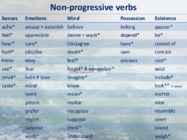
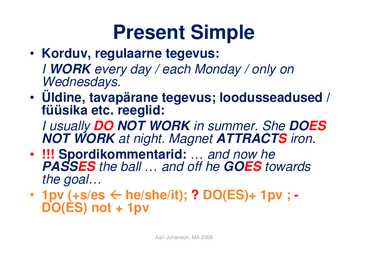
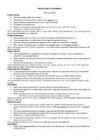
She's being really nasty to us. · Do you see that red car over there? I'm seeing a dentist tomorrow morning. / I'm afraid he's seeing things. · We hear something new each day. I thought I was hearing things when music suddenly began to play. · I consider him to be a very lucky man. I'm considering changing jobs. · Kids love visiting amusement parks. Kids are loving visiting the amusement park. Aari Juhanson, MA 2008 Past Simple · Ära toimunud (regulaarne) tegevus: I WORKED yesterday. S/he didn't WORK last Monday. · Lõpetatud tegevus: I already CALLED them today. (I'm not going to call again!) Which countries did you VISIT? (You're back ...) BUT: Which countries have you VISITED so far? (You're not back yet or you travel regularly ...) · Jutustused, mineviku sündmuste kirjeldus: Once upon a time there LIVED a Garfield who HAD many friends. The first one WAS Odie, ... · 2pv;
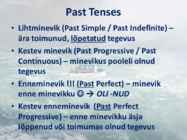
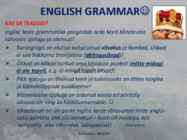
Pikk ajalugu on lihvinud keelt ja tulemuseks on lihtne loogika ja käändelõppude puudumine! Mitmekesine ajalugu on aidanud kaasa eri päritolu sõnavarale ning ka hääldusmuredele. Väidetavalt on üle poole inglise keele sõnavarast mitte anglo- saksi päritolu, ehk siis laenatud – kontrolli hoolega, kas ‘sympathy’ ikka tähendab ‘sümpaatiat! kaastunne Aari Juhanson, MA 2009 Tenses – Tegusõna ajad • Olevik (Present) • Minevik (Past) • Tulevik (Future) • Kaudne tulevik (Future-in-the-Past) Aari Juhanson, MA 2009 Present Tenses • Lihtolevik (Present Simple / Present Indefinite) – regulaarne, korduv tegevus • Kestev olevik (Present Progressive / Present Continuous) – pooleliolev, ühes tükis tegevus • Täisminevik !!! (Present Perfect) – tehtud, *lõpetamata* tegevus
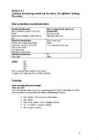
MODULE 1 Greeting. Introducing oneself and the others. The alphabet. Spelling. The tenses. How to introduce yourself and others Formal introductions How to respond and reply to an May I introduce myself? I am John introduction Smith. How do you do. Allow me to introduce John Smith to Pleased to meet you. you. Standard introduction Nice to meet you. I'd like you to meet John Smith. Hello. I want you to meet John Smith. I'm so pleased to meet you.
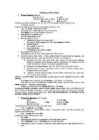
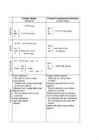
Kõneleja rõhutab tegevuse kestust; ajamäärustega for, since, all morning/day/year etc. He has been doing his homework for two hours. 2. Minevikutegevus, mis kestis mõnda aega ja millel on nähtavad tagajärjed olevikus. He has been digging in the garden. His clothes are dirty. 3. Väljendab viha, ärritust. Somebody has been giving away our plans. Ajamäärused for, since, how long, recently, lately 5. Past Simple (lihtminevik) II (-ed) he worked Eitav,küsiv did+I he did not work did he work? 1. Lõpetatud minevikusündmused , mis toimusid mingil täpselt määratletud ajamomendil. She left for Paris last Monday. 2. Üksteisele vahetult järgnevad minevikusündmused. He put on his coat, took his bag and left. 3. Harjumuspärane või korduv tegevus minevikus. Tihti kasutatakse väljendit used to
UNTIL FROM - TO We use until/till to say how long a situation continues We use from - to + beginning and end of a period Let's wait until it stops raining. I stayed in bed until half past Last evening we watched TV from 5 to 8 o' clock. nine. QUESTIONS WORDS Exercises: 1. http:// www.english-4u.de/question_word
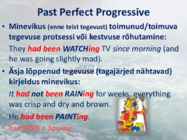
.) · Fixed arrangements in the near future (I'm going to the dentist tomorrow) · Currently changing ang developing situations (The number of burgularies is increasing) · With ,,Always" to express anger or irritation at a repeated action (You're always forgetting..) TIME EXPRESSIONS USED WITH PRESENT CONTINUOUS: now, at the moment, at present, these days, nowadays, still, today, tonight etc. Present Perfect · Action happened at an unstated time in the past. Emphasis on the action, time is unimportant or unknown. (I have washed the car) · Action started in the past and continues up to the present, especially with stative verbs (I have known her for six years) · Recently completed action (I have finished my essay) TIME EXPRESSIONS USED WITH PRESENT PERFECT: for, since, already, always, just, ever, never, so far, today, this week/month etc. lately, recently, still (in negations) etc. Present Perfect Continuous
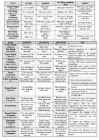
done Present Simple Am/is/are + Every day, year, often, I pv + do/does Have/ get + sth+ III pv Lihtolevik III pv usually, always Past Simple Yesterday, last year, II pv(-ed)+ did Was/ were + III pv Had/got + sth + III pv Lihtminevik last week Present Am/is/are + Am/ is/ are + being + Am/ is/are + have/get At the moment, this Continuous
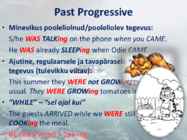
Spordiülekanded their wedding anniversary next Juhised month. Pahameelt näitav sageli toimuv tegevus. Inglise keele ajavormid ja nende kasutamine (9. klassi seisuga) Past Simple Past Progressive/Continuous (lihtminevik) (kestev minevik) II vorm was played - reeglipärane I vorm+ing (playing) wrote - ebareeglipärane were did not I vorm was (didn't play / write) not I vorm+ing were (not playing) Did I vorm (Did ... play ...
 annaabi.ee











Kõik kommentaarid