Vajad kellegagi rääkida?
Küsi julgelt abi LasteAbi
Logi sisse

Famous castles of Scotland (0)

5 VÄGA HEA
Punktid
Edinburgh Castle is an ancient stronghold which dominates the sky-line of the city of Edinburgh from its position atop Castle Rock. It is Scotland 's second most visited tourist attraction. Human habitation of the site is dated back as far as the 9th century BC. As it stands today though, few of the castle's structures pre- date the Lang Siege of the 16th century, with the notable exception of St Margaret 's Chapel, the oldest surviving building in Edinburgh, which dates from the early 12th century.As with all castles , Edinburgh's fortress has been a centre of military activity. As an ancient fortress Edinburgh Castle is one of the few that still has a military garrison, albeit for largely ceremonial and administrative purposes. The New Barrack Block is now home to the official headquarters of the Royal Regiment of Scotland and 52 Infantry Brigade, as well as home to the regimental museum of the Royal Scots and Royal Scots Dragoon Guards. The Governor of Edinburgh Castle is Major General David McDowall, GOC of the British Army 's 2nd Division . The Governor of the Castle has always been the head of the Army in Scotland. Direct administration of the castle by the War Office only came to an end in 1923 when the army formally moved to the city's new Redford Barracks. Nevertheless, the Castle continues to have a strong connection with the Army. Sentries still stand watch at the castle gatehouse after opening hours , with responsibility for guarding the Honours of Scotland.
Fyvie Castle in the village of Fyvie, is a castle near Turriff in Aberdeenshire, Scotland.The earliest parts of Fyvie Castle date from the 13th century - some sources claim it was built in 1211 by William the Lion . Fyvie was the site of an open -air court held by Robert the Bruce , and Charles I lived there as a child . Following the Battle of Otterburn in 1390 , it ceased to be a royal stronghold and instead fell into the possession of five successive families - Preston, Meldrum, Seton , Gordon and Leith - each of whom added a new tower to the castle.Inside, the castle stronghold features a great wheel stair, a display of original arms and armour, and a particularly fine collection of portraits. Manus O'Cahan and Montrose fought a successful minor battle against the Covenant Army at Fyvie Castle on August 24th 1644 . Following Victorian trends, the grounds and adjoining Loch Fyvie were landscaped in the 19th century. The American industrialist Alexander Leith bought the castle in 1885. It was sold to the National Trust for Scotland in 1984 by his descendants.The castle (like many Scottish castles) is said to be haunted . A story is told that in 1920 during renovation work the skeleton of a woman was discovered behind a bedroom wall . On the day the remains were laid to rest in Fyvie cemetery, the castle residents started to be plagued by strange noises and unexplained happenings. Fearing he had offended the dead woman, the Laird of the castle had the skeleton exhumed and replaced behind the bedroom wall, at which the haunting ceased.Today, the castle is open to tourists during the summer months.
Crookston Castle is located in the Crookston area of south - west Glasgow , Scotland. The castle is located some 5 miles (8 km) south-west of the city centre, and 3 miles (5 km) east of Paisley, overlooking the Levern Water, just before its confluence with the White Cart Water.Crookston is surrounded by a defensive ring-ditch that dates back to the 12th century when Sir Robert de Croc, built a timber and earth castle. Remains of a chapel founded by de Croc in 1180 have been uncovered. Evidence of an even earlier fortification on the same site has also been found . The lands of Crookston were bought by Sir Alan Stewart in 1330 , and passed to Sir John Stewart, 1st Lord Darnley, in 1361. The Darnley Stewarts replaced the early castle with the present stone structure around 1400 .In 1489 the Stewart Earl of Lennox rebelled against James IV. James responded by bringing the cannon Mons Meg from Edinburgh, and bombarding the castle, virtually destroying its western end, and ensuring a quick surrender. In 1544 the castle was besieged and taken by the Earl of Arran and Cardinal Beaton, while the then Earl of Lennox was defending Glasgow Castle.Charles, the Earl of Lennox.The castle passed through several owners, until in 1757 it was sold by the Graham Duke of Montrose to the Maxwells of Pollok. Following several years of abandonment, the castle was partially restored by the Maxwells in 1847, to honour Queen Victoria's visit to Glasgow. In 1931, Crookston became the first property acquired by the National Trust for Scotland, having been presented by Sir John Maxwell Stirling-Maxwell Today, Crookston Castle is a Scheduled Ancient Monument, and a Category A listed building. Its maintenance is the responsibility of Historic Scotland.Crookston Castle sits atop a natural hill .To the north is a steep drop to the Levern Water. The castle has a rectangular main block, which was strengthened by a tower at each corner . This formed an irregular 'X-plan' shape , an unusual layout also seen at Hermitage Castle. Only the north-east corner tower survives to its former height, as well as the basement of the south-east tower. The two western towers were destroyed in the 15th century and never rebuilt, repairs in the 19th century have obscured even the remains of these . The main body of the castle measures about 19m by 12m, with walls up to 3.7m thick, and the north-east tower is around 6m square . The entrance is on the north side, adjacent to the north-east tower, and defended by a portcullis and two doors . A straight mural stair leads up to the right, while ahead is a barrel-vaulted basement with slit windows and a well. The hall is at first- floor level, and was also vaulted, rising to 8.3m high. A turnpike stair in the south-east corner gave access to another storey above the hall, as well as upper rooms in the eastern towers. The towers had one room on each floor. In the basement of the north-east tower is a prison only accessible from above, while at the top there is access to the four storeys of the tower, via modern iron ladders, opening onto an impressive view from the roof . The top of the north-east tower, including corbels, was also rebuilt in the 19th century.
Rothesay Castle is a ruined castle in Rothesay, the principal town on the Isle of Bute, in western Scotland.The castle has been described as "one of the most remarkable in Scotland" for its long history dating back to the beginning of the 13th century, and its unusual circular plan.The castle comprises a huge curtain wall, strengthened by four round towers, together with a 16th century forework, the whole surrounded by a broad moat. Built by the Stewart family, it survived Norse attacks to become a royal residence. Though falling into ruin after the 17th century, the castle was repaired by the Marquess of Bute before passing into state care last century.The castle was built either by Alan, High Steward of Scotland (d.1204), or by his son Walter Stewart (d.1246), ancestor of the House of Stuart or Stewart. Alan was granted the lands of the Isle of Bute by William I in 1200. A wooden castle was constructed first, but the stone circular curtain wall was in place by the 1230s, when the castle was attacked and taken by Norsemen under Gillespec MacDougall ( known as Uspak in Norse), grandson of Somerled. According to The Saga of Haakon Haakonsson, the Norsemen fought for three days to take the castle, breaking down part of the eastern wall by hewing the stone with their axes, and certainly the eastern wall shows signs of damage. This saga is the earliest recorded account of an assault on a Scottish castle. In 1263, Rothesay was taken again by the Norse under Haakon IV before the Battle of Largs. Although the Battle of Largs was indecisive, Haakon's campaign was unsuccessful, and effectively ended Norse influence in western Scotland.The 13th century curtain wall seen from the south-east, across the moat. The bases of the south-east and south-west towers can be seen.The early castle comprised only the roughly circular curtain wall, 3m thick and around 43m across, built on a low mound, with a battlement on top accessed by open stairs. The moat was connected to the sea, the shoreline being some 100m further south than today. The broad crenellations can be made out within the walls, which were later raised. Holes in the upper wall would have supported a timber bretasche, a projecting structure serving as an extended battlement. This curtain wall was built of coursed ashlar, and had only two openings in its length . The main gate was an arched opening with a simple timber door . The second opening was a small postern gate in the west wall, later blocked.In the later part of the 13th century, the castle was strengthened by the addition of four round towers, of which only the north-west survives intact. These three-storey towers had strong splayed bases, with arrow slits below the crenellated parapet. A portcullis was added to the main gate.
Craigievar Castle is a pinkish harled castle six miles south of Alford, Aberdeenshire, Scotland. It is currently the seat of the Clan Sempill. The setting is among scenic rolling foothills of the Grampian Mountains. The contrast of its massive lower story structure to the finely sculpted multiple turrets, gargoyles and high corbelling work create a classic fairytale appearance.An excellent example of the original Scottish Baronial architecture, the great seven-storey castle was completed in 1626 by the Aberdonian merchant William Forbes , ancestor to the "Forbes-Sempill family" and brother of the Bishop of Aberdeen. Forbes purchased the partially completed structure from the impoverished Mortimer family in the year 1610 . William Forbes nickname was Danzig Willy, a reference to his shrewd international trading success. The Forbes family resided here for 350 years until 1963, when the property was gifted to the National Trust for Scotland.Designed in the L plan, as was Muchalls Castle, which is located in the same region, Craigievar is noted for its exceptionally crafted plasterwork ceilings. Craigevar, Muchalls Castle and Glamis Castle are generally considered to have the three finest ceilings in Scotland. The Clan Forbes family were close friends of the Clan Burnett of Leys, who built both Crathes Castle and Muchalls Castle.The castle originally had more defensive elements including a walled courtyard with four round towers; only one of the round towers remains today. In the arched door to that round tower are preserved the carved initials of Sir Thomas Forbes, William Forbes' son. There was also a massive iron yett or gate covering the entrance door.The castle interior boasts a Great Hall that has the Stuart Arms over the fireplace ; a musicians gallery ; secret staircase connecting the high tower to the Great Hall; Queen's Bedroom; servants' quarters and of course several splendid plasterwork ceilings. There is a collection of Forbes family portraits inside as well as a considerable quantity of Forbes furnishings dating to the 17th and 18th centuries.As of 2006, the castle, its estate , and over 200 acres of adjoining farmlands and woodlands are owned by the National Trust for Scotland. They are open to tourists during the summer months. The castle is closed to tour buses and large groups, but may be accessed by guided tour. Also, the castle will be closed from the end of August 2007, due to restoration work being carried out on its exterior.
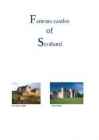
Famous castles
of
Scotland
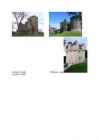
Edinburgh Castle Fyvie Castle
Crookston Castle Rothesay Castle
Craigievar Castle
Famous castles of Scotland #1 Famous castles of Scotland #2 Famous castles of Scotland #3 Famous castles of Scotland #4 Famous castles of Scotland #5 Famous castles of Scotland #6
Punktid 10 punkti Autor soovib selle materjali allalaadimise eest saada 10 punkti.
Leheküljed ~ 6 lehte Lehekülgede arv dokumendis
Aeg2008-02-16 Kuupäev, millal dokument üles laeti
Allalaadimisi 28 laadimist Kokku alla laetud
Kommentaarid 0 arvamust Teiste kasutajate poolt lisatud kommentaarid
Autor kristin93 Õppematerjali autor
referaat kuulsatest šotimaa lossidest.Edinburgh Castle, Fyvie Castle, Crookston Castle, Rothesay Castle, Craigievar Castle. 5lk

Sarnased õppematerjalid

Giidindus- Toompea
6
docx

Giidindus- Toompea

Toompea (from German Domberg – Cathedral Hill ) is a limestone hill with an area of about 7 hectares in the central part of Tallinn. It towers about 30-40 m above the surrounding areas. According to the legend it´s the tumulus mound over the grave of the national hero Kalev, erected stone by stone in his memory by his grieving wife Linda. It is the birthplace of Tallinn - a place where in 1229 the Knights of the Sword built a fortress instead of the wooden Estonian stronghold. Toompea Castle is also one of the most potent symbols of the reigning power. Today Toompea is the seat of the Government of Estonia as well as the Riigikogu, both of which are often simply colloquially referred to as Toompea. For centuries there was only one access to Toompea - Pikk Jalg - but there is also another way leading up to Toompea - Lühike Jalg, which was made in the 14th century. At present Pikk Jalg and Lühike Jalg are used only by pedestrians. Until

Inglisekeelne geograafia
Scotland
14
pptx

Scotland

SCOTLAND Sandra Järvala GEOGRAPHY & POPULATION · Scotland is a country that is part of the United Kingdom and coers the northern third of the Island of Great Britain. · The Scotland capital city is Edinburgh. MAJOR CITIES · The largest city is Glasgow. Glasgow has a population of 598,830. The city has an area of 175.5 km ². · Aberdeen, Dundee, Paisley, East Kilbride and Livingston are are also large cities. · There is a Glasgow bus tours for tourists SCOTLAND FLAG · The Flag of Scotland, also known as Saint Andrew's Cross or the Saltire, is the national flag of Scotland. · Scottish flag is blue · On the flag is a white X-shaped cross. NATIONAL SYMBOLS

Inglise keel
UK- United Kingdom
4
docx

UK ( United Kingdom)

escalators, this is one of the most accessible theatres in Britain today. Tower of London The ancient stones reverberate with dark secrets, priceless jewels glint in fortified vaults and ravens strut the grounds. The Tower of London, founded by William the Conquerer in 1066-7, is one of the world´s most famous fortresses, and one of Britain ´s most visited historic sites. Despite a grim reputation for a place of torture and death, there are so many more stories to be told about the Tower. This powerful and enduring symbol of the Norman Conquest has been enjoyed as a royal palace,

Inglise keel
Scotland
3
doc

Scotland

S C O T L A N D GENERAL OVERVIEW Territory: 31, 510 sq miles Highest peak: Ben Nevis 1343m Population: 5, 055, 000 National emblem: the thistle Capital: Edinburgh National flower: the bluebell Islands: About 790 National instrument: bagpipes Lakes: the best- known is Loch Ness, famous for National dish: haggis Nessie, its mythical monster Scotland is also famous for: whisky, kilts and sheep · One of the four constituent nations which form the UK · They have their own money, system of law, history, stamps, deep- rooted customs, traditions and ancient language- Gaelic · Most people speak the Scottish dialect ­ becoming endangered language · Weather ­ unpredictable · Breathtaking scenery Scottish Industries

Inglise keel
Scotland overview
17
odp

Scotland overview

Scotland Overview Flag-Saltire Royal Standard of Scotland Edinburgh, Glasgow First Minister Alex Salmond 78,387km² 5,222,100 St Andrew History Picts (Celtic tribe) Romans named scotland Caledonia The Scots Queen Mary was forced to abdicate the Scottish throne in 1567. National Symbols Thistle Declaration of Arbroath Tartan Bagpipes Kilt Honours of Scotland Crown, Sword and sceptre are from late fifteenth and early sixteenth century. Crown was made in 1540. Pope Julius II presented the sword to King James IV in 1507. The sceptre was made in 1494 and was presented to King James IV by Pope Alexander VI Honours of Scotland Language Have spoken Pictish, Scottish Gaelic similar Norse, Norman- to Irish, it is French and Brythonic recognised as an

Inglise keel
Tallinn
10
doc

Tallinn

In the Middle ages, it was the place where the bishops and the nobility resided. Here the landed gentry built their beautiful town houses. Most of the remaining buildings were erected after the big fire on Toompea in 1684. Historically, the fortress on Toompea consisted of two parts : the small fortress (today's Toompea Castle) and the big fortress (The rest of Toompea). Pikk Hermann is the best-known corner tower among the three surviving ones of Toompea Castle. It is 46 metres high and serves as one of Estonia's landmarks. Tall Hermann was a traditional name given to the main towers of German castles. After the 50-year long Soviet occupation, the Estonian blue-black-white tricolour was once again hoisted on Pikk Hermann on 24 February 1989. The Cathedral of St. Mary the Virgin (Toomkirik or the Dome Church) was consecrated as a single- nave church with a rectangular chancel in 1240, and rebuilt into a Gothic basilica thereafter. The

inglise teaduskeel
Toompea castle
14
pptx

Toompea castle

TOOMPEA CASTLE Toompea Castle is a castle on Toompea hill Perched on a limestone cliff and towering over the rest of the city Time has been generous to Toompea castle -the well-protected fortress has been almost impregnable Location History Story of rulers and power in Estonia As times and rulers changed so did power and mentalities Today, we can find here buildings mostly dating from 3 periods: - the medieval order's stronghold with its impressive western wall and towers - the Russian-era government administration building with a facade representing classical styles and opening onto Castle Square

Inglise keel
London
10
doc

London

He built a wooden palace at Westminster, were the parliament met later. This is why Westminster became the seat of government not the city of London itself. Edward the Confessor also built Westminster Abbey. He ruled until his death in 1065, after which King Harold was crowned. Norman period( Medieval London) 1066 In 1066 in the Battle of Hastings the Normans were victorious and William was crowned King. William granted the citizens of London special privileges, but he also built a castle in the southeast corner of the city to keep them under control. This castle was expanded by later kings until it became the complex we now call the Tower of London. The Tower acted as royal residence, and it was not until later that it became famous as a prison. In 1176 the first stone London Bridge was built. This bridge was to remain the only one in London until 1739. Because the passage across this one bridge was narrow and clogged with

Inglise keel


Meedia

Kommentaarid (0)

Kommentaarid sellele materjalile puuduvad. Ole esimene ja kommenteeri


Sellel veebilehel kasutatakse küpsiseid. Kasutamist jätkates nõustute küpsiste ja veebilehe üldtingimustega Nõustun