Bob Marley
This article is about the
reggae musician. For the comedian, see Bob
Marley (comedian).
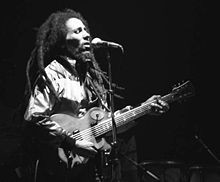
Bob MarleyBob Marley in
concert , Zürich, 1980.
Background information Birth nameRobert Nesta Marley
Also known asTuff
Gong BornFebruary 6, 1945(1945-02-06)
Nine Mile, Saint Ann Parish,
Jamaica DiedMay 11, 1981 (aged 36)
Miami,
Florida , United
States Genre(s)Reggae, Reggae Rock, Ska, Rocksteady
Occupation(s)Singer , songwriter, guitarist
Instrument(s)Guitar, vocals, percussion
Years active 1962 – 1981
Label(s)Studio One, Beverley's, Upsetter/
Trojan ,
Island /Tuff Gong
Associated
actsThe Wailers
Band , The Wailers
Website www.bobmarley.com
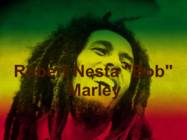
Robert "Bob" Nesta Marley OM
(February
6, 1945
– May
11, 1981)
was a Jamaican
singer,
songwriter,
guitarist,
and activist.
He is the most widely known performer of reggae
music. A faithful
Rastafari ,
Marley is regarded by many as a prophet
of the
religion .[1]
Marley is
best known for his reggae
songs , which include the hits "I
Shot the Sheriff", "No
Woman , No Cry", "Three
Little Birds ", "Exodus", "
Could You Be Loved", "Jammin'", "Redemption
Song", and "One
Love".[2]
His posthumous compilation album
Legend
(1984) is the best-selling reggae album ever, with
sales of more
than 12 million copies.[2]
Early
life and career
Marley was born in the small village of Nine Mile in Saint
Ann Parish, Jamaica.
His
father , Norval
Sinclair Marley, (born in 1895), was a Jamaican of
English
descent, with
parents from Sussex.
Norval was a
Marine officer and
captain , as well as a plantation
overseer, when he married Cedella
Booker , a
black Jamaican then eighteen years old.
Norval provided financial support for his
wife and
child , but seldom
saw
them , as he was often away on
trips . Marley was ten years old
when his father died of a
heart attack in 1955 at age 60.
Marley suffered racial
prejudice as a
youth , because of his mixed
racial origins,[3]
and faced questions about his own racial identity
throughout his
life. He
once reflected :
I don't have prejudice against myself. My father was a white and my
mother was black. Them
call me half-caste or whatever. Me don't dip
on
nobody 's side. Me don't dip on the black man's side nor the white
man's side. Me dip on God's side, the one who create me and
cause me
to come from black and white.
Marley and his mother moved to
Kingston 's
Trenchtown
slum after Norval's
death . He was forced to learn self-defense,
as he
became the
target of bullying because of his racial makeup and
small stature (5'4" or 163 cm
tall ) [
citation
needed]. He gained a reputation
for his
physical strength, which earned him the
nickname "Tuff
Gong".
Marley became friends with Neville "Bunny" Livingston
(
later known as Bunny
Wailer), with whom he
started to play music. He
left school at the age of 14 and started as an apprentice at a
local welder's
shop . In his free time, he and Livingston made music with
Joe
Higgs, a local singer and devout Rastafari
who is regarded by many as Marley's mentor. It was at a jam
session with Higgs and Livingston that Marley met
Peter McIntosh (later known as Peter
Tosh ), who had
similar musical ambitions.
In 1962, Marley recorded his
first two singles, "Judge
Not" and "One Cup of
Coffee ", with
local music producer Leslie
Kong .
These songs,
released on the Beverley's
label under the pseudonym of Bobby
Martell ,[4]
attracted little
attention . The songs were later re-released on the
album
Songs
of Freedom , a posthumous
collection of Marley's
songs.
Musical
career
In 1963, Bob Marley, Bunny Livingston, Peter
McIntosh, Junior
Braithwaite, Beverley
Kelso, and
Cherry Smith
formed a ska
and rocksteady
group,
calling themselves "The
Teenagers ". They later
changed their name to "The Wailing Rudeboys", then to "The
Wailing Wailers", and
finally to "The
Wailers". By 1966, Braithwaite, Kelso, and Smith
had left The Wailers, leaving the
core trio of Marley, Livingston,
and McIntosh.
Marley
took on the
role of leader, singer, and main songwriter. Much
of The Wailers'
early work , including their first
single Simmer
Down, was produced by Coxsone
Dodd at Studio
One. Simmer Down topped Jamaican Charts in 1964 and
established The Wailers as one of the hottest groups in the
country .
They followed up with songs such as "
Soul Rebel" and "400
Years".
In 1966, Marley married
Rita Anderson , and moved
near his mother's residence in
Wilmington,
Delaware for a few months. Upon returning to Jamaica,
Marley became a
member of the Rastafari movement, and started to wear
his trademark dreadlocks
(
see the religion
section for more on Marley's religious views).
After a conflict with Dodd, Marley and his band teamed up with Lee
"
Scratch "
Perry and his studio band, The
Upsetters. Although the
alliance lasted less than a
year , they recorded what many consider The Wailers' finest work.
Marley and Perry split after a dispute regarding the assignment of
recording
rights , but they would
remain friends and work together
again .
Between 1968 and 1972, Bob and Rita Marley, Peter McIntosh and Bunny
Livingston re-cut some old tracks with JAD
Records in Kingston and London
in an attempt to commercialize The Wailers' sound. Livingston later
asserted that these songs "should never be released on an album
… they were just demos for
record companies to
listen to."
The Wailers' first album,
Catch
A Fire , was released worldwide in 1973, and
sold well. It was followed a year later by
Burnin',
which
included the songs "Get
Up,
Stand Up" and "I
Shot The Sheriff". Eric
Clapton made a hit
cover of "I Shot the Sheriff"
in 1974, raising Marley's international profile.
The Wailers broke up in 1974 with each of the three main
members going on to pursue solo careers. The
reason for the breakup is
shrouded in conjecture; some believe that
there were disagreements
amongst Livingston, McIntosh, and Marley concerning performances,
while others claim that Livingston and McIntosh simply
preferred solo
work. McIntosh began recording under the name Peter
Tosh, and Livingston continued as Bunny Wailer.
Bob Marley & The Wailers
Despite the breakup, Marley continued recording as "Bob Marley &
The Wailers". His new backing
band included brothers Carlton
and Aston
"Family Man" Barrett on drums and
bass respectively, Junior
Marvin and Al
Anderson on lead guitar, Tyrone
Downie and
Earl "Wya" Lindo on keyboards, and
Alvin "Seeco" Patterson on percussion. The "I
Threes", consisting of Judy
Mowatt,
Marcia Griffiths, and Marley's wife, Rita, provided backing
vocals.
In 1975, Marley had his international breakthrough with his first hit
outside Jamaica, "No
Woman, No Cry" from the
Natty
Dread album. This was followed by his breakthrough
album in the US,
Rastaman
Vibration (1976), which
spent four weeks on the
Billboard
charts Top Ten.
In December 1976, two
days before "
Smile Jamaica", a free concert organized by the
Jamaican Prime Minister Michael
Manley in an attempt to
ease tension between two
warring
political groups, Marley, his wife, and
manager Don Taylor
were wounded in an assault by unknown gunmen inside Marley's home.
Taylor and Marley's wife sustained serious
injuries , but later made
full recoveries. Bob Marley
received only minor injuries in the
chest and arm. The shooting was
thought to have been politically
motivated ,
as many
felt the concert was
really a support
rally for Manley.
Nonetheless, the concert proceeded, and an injured Marley performed
as scheduled.
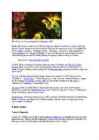
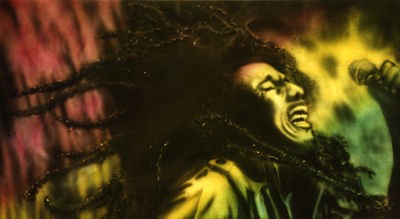
Bob Marley Live a painting by Steve Brogdon 1992
Marley left Jamaica at the end of 1976 for
England ,
where he recorded his
Exodus
and
Kaya
albums.
Exodus stayed on the
British album charts for 56
consecutive weeks. It included four UK hit singles: "Exodus",
"
Waiting In Vain", "Jamming", "One Love",
and a rendition of Curtis
Mayfield's hit, "People
Get
Ready ". It was
here that he was arrested and
received a conviction for possession of a small quantity of
cannabis while traveling in London.
Main article: One
Love Peace ConcertIn 1978, Marley performed at
another political concert in Jamaica,
the One
Love Peace Concert, again in an effort to calm warring
parties. Near the end of the
performance , by Marley's request, Manley
and his political rival, Edward
Seaga, joined each
other on stage and shook hands.
Survival ,
a defiant and politically charged album, was released in 1979. Tracks
such as "
Zimbabwe ", "
Africa Unite ", "Wake Up and Live", and
"Survival" reflected Marley's support for the struggles of
Africans.
In early 1980,
he was invited to perform at the April
17 celebration of Zimbabwe's
Independence Day.
Uprising
(1980) was Bob Marley's
final studio album, and is one of his most
religious productions, including "Redemption
Song" and "
Forever Loving Jah". It was
in "Redemption Song" that Marley
sang the
famous lyric,
Confrontation,
released posthumously in 1983, contained unreleased
material recorded
during Marley's
lifetime , including the hit "
Buffalo Soldier" and new mixes of singles previously only
available in Jamaica.
Later
years
In
July 1977, Marley was
found to have malignant
melanoma in a
football wound on his right hallux
(big toe). Marley refused amputation, citing worries that the
operation would
affect his dancing, as well as the Rastafari belief
that the
body must be "
whole ":
Marley may have seen
medical doctors as
samfai (tricksters, deceivers). True
to this belief Marley went against all surgical possibilities and
sought out other means that would not break his religious beliefs. He
also refused to
register a will,
based on the Rastafari belief that writing a will is acknowledging
death as inevitable, thus disregarding the everlasting (or
everliving, as Rastas say)
character of life.
Collapse and treatment
The cancer
then metastasized
to Marley's
brain ,
lungs,
liver ,
and stomach.
After
playing two
shows at Madison
Square Garden as
part of his
fall 1980 Uprising
Tour , he collapsed while jogging in NYC's
Central
Park. The remainder of the tour was subsequently
cancelled.
Bob Marley played his final concert at the
Stanley Theater in Pittsburgh,
Pennsylvania on September
23, 1980.
The live version of "Redemption
Song" on
Songs
of Freedom was recorded at this show.[5]
Marley afterwards sought medical help from Munich
specialist Josef
Issels, but his cancer had
already progressed to the
terminal stage.
Death and posthumous reputation
While flying home from
Germany to Jamaica for his final days, Marley became ill, and landed in Miami
for immediate medical attention. He died at Cedars of Lebanon
Hospital in Miami,
Florida on the
morning of May
11, 1981
at the age of 36. His final
words to his son Ziggy
were "
Money can't buy life."[6]
Marley received a state
funeral in Jamaica, which combined
elements of
Ethiopian
Orthodoxy and Rastafari tradition. He was
buried in a crypt near his
birthplace with his
Gibson Les Paul, a soccer ball, a Cannabis bud, a ring that
he wore every day that was
given to him by the
Prince Asfa Wossen of
Ethiopia (eldest son of HIM),
and a
Bible .
A month before his death, he was awarded the Jamaican
Order of
Merit .
Bob Marley's music has continuously grown in
popularity in the years
since his death, providing a
stream of revenue for his
estate and
affording him a mythical status in
20th century music history. He remains enormously
popular and well-known all over the world, particularly so in Africa. Marley
was inducted into the Rock
and Roll Hall of
Fame in 1994.
Time
magazine
chose Bob Marley & The Wailers'
Exodus
as the
greatest album of the 20th century.
In 2001, the
same year that Marley was posthumously awarded the
Grammy
Lifetime
Achievement Award, a feature-length
documentary about his life, Rebel Music, was nominated for
Best Long Form Music Video documentary at the
Grammys. It won various other
awards . With
contributions from Rita, the Wailers, and Marley's lovers and
children , it also tells much of the story in his own words.
In Summer 2006,
the City of New
York renamed a portion of
Church Avenue from Remsen
Avenue to
East 98th
Street in the East
Flatbush Section of Brooklyn
Bob Marley Blvd.[7]
Religion
Bob Marley was a member of the Rastafari
movement,
whose culture was a key element in the
development of reggae. Bob Marley became the
leading proponent of the
Rastafari, taking their music out of the socially deprived
areas of
Jamaica and onto the international music
scene .
Now
considered a "Rasta" legend, Marley's adoption of the
characteristic Rastafari dreadlocks, famous use of cannabis
as a sacred
sacrament, and vegetarianism
[8],
which in the
late sixties were an integral part of his
persona . He is
said to have entered every performance proclaiming the divinity of
Jah
Rastafari.
On November
4, 1980
Marley was baptized by the Archbishop of the Ethiopian
Orthodox Church in Kingston, Jamaica. Here is what Archbishop Abuna Yesehaq
had to say on Marley:
"Bob was really a good
brother , a child of God, regardless of
how people looked at him. He had a
desire to be baptised long ago,
but there were people close to him who controlled him and who were
aligned to a
different aspect of Rastafari . But he
came to Church
regularly. I remember once while I was conducting the Mass, I looked
at Bob and
tears were streaming down his
face ...When he toured Los
Angeles and New York and England, he preached the Orthodox faith, and
many members in those cities came to the Church because of Bob. Many
people think he was baptised because he knew he was dying, but that
is not so...he did it when there was no longer any
pressure on him,
and when he was baptised, he hugged his family and
wept , they all
wept together for about half an
hour ."
Many of Marley's songs contained Biblical references, sometimes using
wordplay to fuse activism and religion, as in "
Revolution "
and "Revelation":
“
Revelation reveals the
truth …
”
“
It takes a revolution to make a
solution …
”
ChildrenBob Marley had 13 children: three with his wife Rita,
two adopted from Rita's
previous relationships, and the remaining
eight with separate
women .[9]
His children are, in order of birth:
Imani Carole, born May 22, 1963, to Cheryl Murray ;
Sharon, born November 23, 1964, to Rita in previous relationship;
Cedella Marley born August 23, 1967, to Rita;
David "Ziggy", born October 17, 1968, to Rita;
Stephen , born April 20, 1972, to Rita;
Robert "Robbie", born May 16, 1972, to Pat Williams ;
Rohan, born May 19, 1972, to Janet Hunt;
Karen, born 1973 to Janet Bowen;
Stephanie, born August 17, 1974; according to Cedella Booker she was the daughter of Rita and a man called Ital with whom Rita had an affair ; nonetheless she was acknowledged as Bob's daughter;
Julian, born June 4, 1975, to Lucy Pounder;
Ky-Mani, born February 26, 1976, to Anita Belnavis;
Damian, born July 21, 1978, to Cindy Breakspeare;
Makeda, born May 30, 1981, to Yvette Crichton.
 50 punkti
Autor soovib selle materjali allalaadimise eest saada 50 punkti.
50 punkti
Autor soovib selle materjali allalaadimise eest saada 50 punkti.
 ~ 7 lehte
Lehekülgede arv dokumendis
~ 7 lehte
Lehekülgede arv dokumendis
 2010-06-06
Kuupäev, millal dokument üles laeti
2010-06-06
Kuupäev, millal dokument üles laeti
 9 laadimist
Kokku alla laetud
9 laadimist
Kokku alla laetud
 0 arvamust
Teiste kasutajate poolt lisatud kommentaarid
0 arvamust
Teiste kasutajate poolt lisatud kommentaarid
 marek043
Õppematerjali autor
marek043
Õppematerjali autor
 annaabi.ee








Kõik kommentaarid