 10 punkti
Autor soovib selle materjali allalaadimise eest saada 10 punkti.
10 punkti
Autor soovib selle materjali allalaadimise eest saada 10 punkti.
 ~ 5 lehte
Lehekülgede arv dokumendis
~ 5 lehte
Lehekülgede arv dokumendis
 2009-02-26
Kuupäev, millal dokument üles laeti
2009-02-26
Kuupäev, millal dokument üles laeti
 41 laadimist
Kokku alla laetud
41 laadimist
Kokku alla laetud
 0 arvamust
Teiste kasutajate poolt lisatud kommentaarid
0 arvamust
Teiste kasutajate poolt lisatud kommentaarid
 kertupiiga
Õppematerjali autor
kertupiiga
Õppematerjali autor
.page 7 Alcohol................................................................................................page 7 Used sources..........................................................................................page 8 2 Smoking Smoking is a very addictive and risky hobby. So why do people start doing it in the first place? Firstly sometimes people try their first cigarette, they like it and so they start doing it more regularly. Secondly some people start smoking because there's a rumour saying that it's slimming. And another reason may be that it may relieve stress. After three or four cigarettes you get addicted to it because of nicotine. It is a drug that stimulates the brain. When the level of nicotine falls in your blood and you're a regular smoker, you usually develop withdrawal
Addictions summary 2011 Table of contents 1. Addictions 3 Drug addiction 3 Behavioural addiction 3 2. Drug addictions 3 Smoking 3 Drinking alcohol 4 Doing drugs 4 3. Behavioral addictions 4 Playing video games 4 Use of the internet 5 Cutting 5 4
Cigarettes Enemies Or Friends? A cigarette is distinguished from a cigar by its smaller size, use of processed leaf, and white paper wrapping. There are about 1.2 billion smokers in the world who are absolutely attracted to the cigarettes. As the new generation is growing up, the so-called "smoking-cult" is a normal matter and that enormous number of smokers is only increasing. But as a matter of fact smoking is just a bad habit and very dangerous for your health. So can we call cigarettes our friends? Most countries in the world have a legal smoking age of 18. That means that when you are not and adult you should not smoke or consume any products related to tobacco and cigarettes. But if to look into our street picture, there are seen so many under age smokers that it is really threatening. It all starts from the home how you have been raised, how strict were the rules a child had to follow and how much did your parents trust you
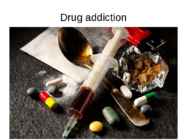
Drug addiction Definition ● Drug addiction, also called substance use disorder, is a dependence on a legal or illegal drug or medication. Keep in mind that alcohol and nicotine are legal substances, but are also considered drugs. Consequences of using drugs ● Drug addiction can cause serious, long-term consequences, including problems with physical and mental health, relationships, employment, and the law. Best known drugs ● Cannabis ● Heroin ● Cocaine ● LSD ● Ecstasy Cannabis ● Weed effects include losing interest in health, life, school activities, old friends and goals. Heroin ● Heroin is highly addictive and dangerous. Heroin is injected by a needle which usually is used by many addicts, which causes diseases like HIV to spread. Cocaine ● Cocaine is mostly used because of it's mental
deaths by fentanyl are raising and current drug policy is not doing its job. According to the most recent data, Estonia's overdose mortality rate is seven times the average in the EU. This is a big concern for a country as little as Estonia, and also a reason why the decriminalizing cannabis topic has grown so popular lately. Cannabis, as a soft drug, is criminalized in Estonia and that fact leads people to go after stronger drugs because by the law they are on the same scale. The popularity of “China white” is growing in Estonia, as it is so easily accessible, but so does the mortality rate because it is very easy to overdose on fentanyl. Estonia should re- form its drug policy because stricter laws and punishments do not change society for the better and current drug policy is not showing any positive effect either. The reason why Estonia should consider decriminalizing cannabis is that the history of
25 Part of the reason caffeine is classified by the Food and Drug Administration as generally 26 recognized as safe is that toxic doses (over 1000 mg for an average adult) are much higher than 27 typically used doses. Ordinary consumption has low health risks, even when carried on for 28 years there may be a modest protective effect against some diseases, including Parkinson's 29 disease, heart disease, and certain types of cancer. Some people experience sleep disruption if 30 they consume caffeine, especially during the evening hours, but others show little disturbance 31 and the effect of caffeine on sleep is highly variable. 32 Caffeine is quickly and completely removed from the brain. Its effects are short-lived and it 33 tends not to negatively affect concentration or higher brain functions. However, continued 34 exposure to caffeine leads to developing a tolerance to it. Tolerance causes the body to become
The amount you would problibly find in a 12 ounce can of beer, 4 ounce glass of table wine, 1 ounce shot of 100% destilled spirits such as whiskey or vodka. Generally this is the amount of alcohol a person can metabolize in about an hour. But of course it also depends on other stuff. The way to see the amount of alcohol in someone is the Blood Alcohol Content. The Blood Alcohol Content is measured in milligrams percent. For example, a BAC of 10 means that one-tenth of 1% of your total blood content is alcohol.This means that a BAC of 0.5 and below may give you a little buzz;a BAC of .50 or greater may cause death. Blood Alcohol Content depends on two things size,the bigger you are the more blood you have to delute the alcohol, and it also depends on how fast you drink it, the faster you drink the more your BAC goes up because your body doesn't have as long to delute the alcohol. BINGE DRINKING
3) Experiment: Split-brain experiments by Gazzaniga & Sperry, brain plasticity experiments by Rosenzweig and Bennett. Neurotransmission experiment by Martinez and Kesner. 4) Case studies: Phineas Gage studied by Dr John Harlow and Oliver Sack's study on Dr P. Discuss how and why particular research methods are used at the biological level of analysis. Biological researchers often adopt a reductionist approach to the study of human behavior. They work on a micro-level of research, breaking down complex behavior into its smallest parts (e.g. genes, neurotransmitters or proteins). This approach is sometimes criticized for being overly simplistic, but it is important to have detailed information of the components of human behavior in order to understand the interaction of several factors. Kasamatsu and Hirai studied a group of Buddhist monks who went on a 72-hour pilgrimage to a holy mountain in Japan
 annaabi.ee





















Kõik kommentaarid