INGLISE KEELE
PÕHITÕED C.K
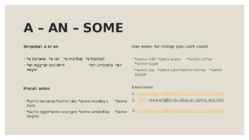
2017 A – AN – SOME Singular : a or anUse some for things you can't count ◦ *a banana *a car *a
monkey *a football
◦ *some
milk *some water
*some coffee
◦ *an egg*an
accident *an umbrella *an
*some sugar
eagle ◦ *some tea *some juice*some money *some
butter
Plural : some Exercises :
1.
http://www.english-4u.de/a_an_some_ex1.ht m
◦ *some bananas *some
cats *some monkeys
*some 2.
http://www.english-4u.de/a_an_some_ex3.htm balls
◦ *some
eggs *some oranges *some
umbrellas *some 3.
http://www.english-4u.de/a_an_some_ex6.ht m
eagles
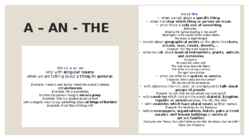
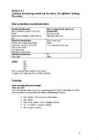
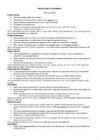
We us
the• when we
talk about a
specific thing .
A – AN - THE• when it is
clear which thing or person we mean .
• when
there is
only one of something .
Examples : What is the highest building in the world?Washington is the capital of the United States .The moon is bright tonight.• to talk about
geographical points on the
globe like
rivers, oceans, seas, canals, deserts,... Example: The Nile is the longest river.• when we talk about
musical instruments, plants , animals and currencies.
Examples: He plays the piano wel .The rose is my favourite flower.We us
a or anThe dol ar is a strong currency.only with
singular nouns .
The tiger lives in Asia .when we are
talking about a
thing in general.
• when we refer to a
system or service .
Examples: When does the train arrive?We should cal the ambulance.Example: I need a new laptop . Hand me a pencil, please.• with adjectives like rich,
poor , or unemployed to
talk about with professions.groups of people.
Example: He is a postman.Example: Do you think the rich should pay more taxes?to show the person / thing is one of a group.• with
countries which contain the
words state(s), kingdom, Example: She is a student at our school. republic or unionExamples: the UK, the USA
with a singular noun to say something about all things of that kind.• with
countries which have plural nouns as their
names Example: A cat likes drinking milk.Example: the Netherlands, the Bahamas•
before newspapers,
organisations,
hotels,
pubs and
restaurants,
well known buildings or
works of art and
families.
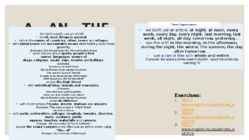
Examples: the Times, the United Nations, the Ritz, the Mona Lisa, the Eiffel Tower, the SimpsonsA – ANTime Expressions •
we don't use an article:
at night , at noon, every We don't
usually us
-e an ar
ticl
THe
Eweek, every day, every night, last morning , last • to talk about
things in general.
week, all night, all day, tomorrow , yesterday,...
• before the
names of countries, cities, towns and
villages.
• with
plural nouns and
uncountable nouns when talking about
them •
use
the with
in the morning, in the afternoon, generally.
during the night, the winter , the summer , the day Examples: She has got long hair . He wears black shoes.after tomorrow,...
• when talking about
sports,
people's first names,
languages,
names of •
use
a /an or
the with
whole and entire .
shops,
religions,
meals,
days ,
months and
holidays.
Examples: We spent a whole week in Madrid. I spent the whole day Examples: watching TV.Sandra is her best friend. Mount Everest is the highest mountain.She speaks Spanish fluently.Sunday is my favourite day of the week.What would you like for breakfast?except
the High Street • with
individual lakes , islands and mountains .
Examples:She lives near Lake Superior.Have you ever visited Long Island.Exercises:Mount Everest is the highest mountain.except the Matterhorn1. http://
• with most names of
towns,
streets,
stations and
airports.
www.
english -4u.de/articles_e
Examples: They have a shop in Oxford Street.He lives in Rome.
x1.htm
• with
parks,
universities,
colleges,
hospitals,
temples,
churches,
2. http://
malls,
stadiums,
public www.english-4u.de/articles_e
squares,
beaches,
waterfalls and
canyons.
x4.htm
Example: We also visited St Paul's Cathedral.3. http://
except
the Grand Canyonbut we often use an article when using
"
the...of"
www.english-4u.de/articles_e
Example: the University of Edinburghx6.htm
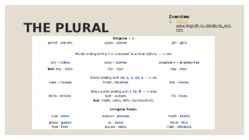
Exercise :THE PLURAL1. http://
www.english-4u.de/plural_ex6.
htm
Singular + sparrot – parrot
sapple – apple
sgirl – girl
s Words
ending with
y if a
consonant is written before. ---->
ieslolly – loll
iesstory – stor
iesstrawberry – strawberr
iesbut: boy –
boys toy -
toys bay -
bays Words ending with
ch, x, s, sh, o ---->
esclass – class
esbrush – brush
esbox – box
es Some words ending with
f, fe, lf ---->
vesknife – kni
veswolf – wol
veslife – li
vesbut: chiefs, safes,
cliffs , handkerchiefs
Irregular forms man -
menwoman -
womentooth -
teethgoose -
geeseox -
oxenlouse -
licefoot -
feet mouse -
micechild -
children Exercises:
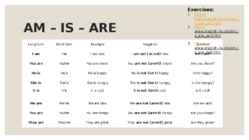
1. http://
www.english-4u.de/am_i
AM – IS – AREs_are_ex1.htm
2. http://
www.english-4u.de/am_i
s_are_ex3.htm
Long form
Short form
Example
Negation
3.
Q
htue
tps:ti
//on
www.english-4u.de/am_i
I amI
'mI am
late .
I
am not ('m not) late.
Am I
s_ar la
e te
_e ?x6.htm
You areYou
'reYou are
clever .
You
are not ( aren 't) clever.
Are you clever?
He isHe
'sHe is
happy .
He
is not (isn't) happy.
Is he happy?
She isShe
'sShe is hungry.
She
is not (isn't) hungry.
Is she hungry?
It isIt
'sIt is
cold .
It
is not (isn't) cold.
Is it cold?
We areWe
'reWe are late.
We
are not (aren't) late.
Are we late?
You areYou
'reYou are sleepy.
You
are not (aren't) sleepy.
Are you sleepy?
They areThey
'reThey are great.
They
are not (aren't) great.
Are they great?
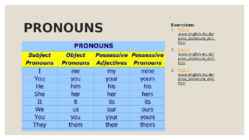
PRONOUNS Exercises:
1. http://
www.english-4u.de/
poss_pronouns_ex1.
htm
2. http://
www.english-4u.de/
poss_pronouns_ex3.
htm
3. http://
www.english-4u.de/
poss_pronouns_ex6.
htm
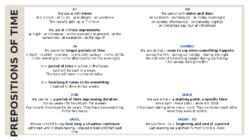
AT ONWe use at with
times We use on with
dates and daysEat 5 o'
clock - at 11.45 - at midnight - at lunchtime
on 12
March - on
Friday (s) - on Friday morning(s)
Tom usually
gets up at 7 o'clock.
on Sunday afternoon(s) - on Saturday night(s)
on
Christmas Day (but at Christmas)
IMWe use at in
these expressions:
at night - at Christmas - at the moment / at
present - at the
Tsame time - at weekends - at the age of...
FIN DURINGWe use in for
longer periods of time We use during +
noun to say when something happensin April - in 1986 - in winter - in the
19th century - in the 1970s
during the
film - during our
holiday - during the night
O- in the morning(s) / in the afternoon(s) / in the
evening (s)
We met a lot of
interesting people during our holiday.
I fell asleep during the film.
SIn +
period of time = a time in the future:
NJack will be back in a week.
The train will leave in a few minutes.
IOIn +
how long it takes to do something I learned to
drive in
four weeks.
ITFOR SINCE SWe use for +
a period of time expressing duration We use since +
a starting point, a specific timefor six
years - for two
hours - for a week
since April - since 1992 - since 8 o' clock
O I've lived in this house for six years. They have been watching
It has been raining since one o' clock. They've known each
other TV for two hours.
since they were at school.
P UNTIL FROM - TOEWe use until/till to say
how long a situation continues We use from - to +
beginning and end of a periodLet's
wait until it stops raining. I stayed in bed until half past
Last evening we watched TV from 5 to 8 o' clock.
R nine .
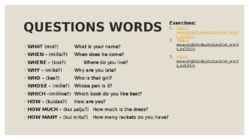
PQUESTIONS WORDS Exercises:1. http://
www.english-4u.de/question_word
s_ex1.htm
2. http://
◦
WHAT (mis?)
What is your name?
www.english-4u.de/question_word
s_ex3.htm
◦
WHEN – (millal?)
When does he
come ?
3. http://
◦
WHERE – (kus?)
Where do you
live ?
www.english-4u.de/question_word
s_ex6.htm
◦
WHY – (miks?)
Why are you late?
◦
WHO – (kes?)
Who is that girl?
◦
WHOSE – (mille?) Whose pen is it?
◦
WHICH –(milline?) Which book do you like best?
◦
HOW – (kuidas?)
How are you?
◦
HOW MUCH – (kui palju?) How much is the
dress ?
◦
HOW MANY – (kui mitu?) How many rackets do you have?
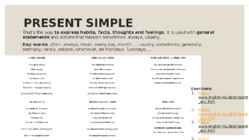
PRESENT SIMPLE ◦ That's the way
to express habits, facts, thoughts and feelings . It is used with
general statements and
actions that
happen sometimes, always, usually,...
◦
Key words: often, always, never, every day,
month ,..., usually, sometimes, generally,
normally, rarely, seldom, whenever, on Mondays, Tuesdays,...
I, YOU + PLURALDON'T (do not)
+ VERB TO BE, CAN, MUST --> VERB + NOT They
go to school.
They
don't go to school.
They
are not (aren't) at home.
I
like oranges.
I
don't like oranges.
The boys
are not (aren't) in the park.
We
hate peppermint.
We
don't hate peppermint.
I
am not (I
'm not) hungry.
You
have a cold.
You
don't have a cold.
We
can not ( cannot / can't) swim .
Monkeys (= They)
eat bananas.
Monkeys
don't eat snakes.
I
must not (mustn't) go out.
Bob and I (= We)
go shopping.
Bob and I
don't go shopping.
Exercises:Jim and
Carol (=They)
sing a song.
Jim and Carol
don't sing a song.
1. http://
www.english-4u.de/present
HE, SHE, IT + SDOESN'T (does not)
+ VERBVERB + NOT_ex1.htm
He
wants an ice
cream .
He
doesn't want an ice cream.
She
is not (isn't) at school.
2. http://
She
likes hot
dogs .
She
doesn't like hot dogs.
It
is not (isn't) hungry.
www.english-4u.de/present
It
drinks milk.
It
doesn't drink milk.
He
can not (cannot / can't) sing.
_ex3.htm
The dog (= It)
hates cats.
The dog
doesn't hate cats.
Susan
is not (isn't) angry.
3. http://
www.english-4u.de/present
Ann (= She)
hates chewing gums.
Ann
doesn't hate chewing gums.
HE/SHE/IT –GA MUUTUVAD:_ex5.htm
do - does / go - goes / have – has
Bob (= He)
speaks English.
Bob
doesn't speak German.
4. http://
www.english-4u.de/pres_ne
g_ex1.htm
5. http://
www.english-4u.de/pres_ne
g_ex4.htm
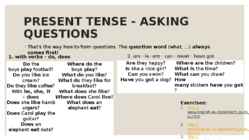
PRESENT TENSE - ASKING QUESTIONS
◦ That's the way how to form questions. The
question word (what, ...)
always comes first!1. with verbs - do, does2. am - is -are - can - must - have got Do the
Where do the
Are they happy?
Where are the children?
boys
play football?
boys
play?
Is she a
nice girl?
What is the time?
Do you
like ice
What do you
like?
Can you swim?
What can you draw?
cream?
What do they
like for
Have you
got a dog?
How Do they
like coffee?
breakfast?
many stickers
have you
gotWith
he, she, it What does she
like?
- doesWhere does Carol
live?
Does she
like hamb
What does an
Exercises:urgers?
elephant eat?
1. http://
Does Carol
play the
www.english-4u.de/present_ques_e
guitar?
x1.htm
Does an
2. http://
elephant
eat nuts?
www.english-4u.de/present_ques_e
x3.htm
3. http://
www.english-4u.de/present_ques_e
x6.htm
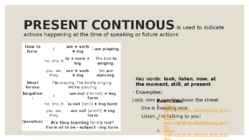
PRESENT CONTINOUS-is used to indicate
actions
happening at the time of speaking or future actions
How to am + verb I
I
am playing .
form:
+ ingis + verb + The
bird is he, she, it
ing singing .
you, we,
are + verb We
are they
+ ingdancing.
◦ Key words:
look ,
listen ,
now,
at Short I
'm playing. The bird
's singing.
the moment,
still ,
at presentforms:We
're dancing
Negationam not (I'm not)
+ ing ◦
Examples:I
:formLook, Ann is r
Ex unning
ercise d
s: own the street.
he, she, it
is not (isn't)
+ ing formShe is sle
1. ehptting
p:// now.
you, we,
are not (aren't)
+ ing www.english-4u.de/pres_prog_ex1.h
they
formListen, I'mt t
malking to you!
2. http://
Question:Are they learning for the test?
www.english-4u.de/pres_prog_ex9.h
Form of to be -
subject -
ing formtm
3. http://
www.english-4u.de/pres_prog_ex10.
htm
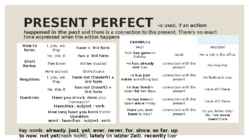
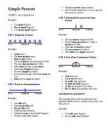
PRESENT PERFECT -is used, if an
action happened in the past and there is a
connection to the present. There's no exact
time expressed when the action happened.
EXAMPLESHow to I, you, we,
have + 3rd formPAST
PRESENT
form:they
Nick has gone on
he, she, it
has + 3rd formresult
He is not in the office.
holiday.
Short I
've been
We
've studied
He
has already connection with the
forms:He likes her.
met Sue.
present
He
's worked
She
's found
I, you, we,
have not ( haven 't) + He
has just connection with the
He feels sick now.
Negation:eaten something bad.
present
they
3rd formhas not (hasn't) + He
has lived in
connection with the
he, she, it
He is still there.
3rd formSpain
for ten days.
present
Question:Have you already
done your
He
has been in
connection with the
homework ?
He is still there.
Spain
since Friday.
present
Have/Has -
subject -
verbHave you
ever connection with the
How long have you been there?
Do you
know Italy ?
been to Italy?
present
Question No, I
've never word -
have/has -
subject -
verbbeen there
Key words:
already,
just,
yet,
ever,
never,
for,
since,
so far,
up
to now,
not yet(
noch nicht ),
lately (in letzter
Zeit ),
recently (vor
kurzem
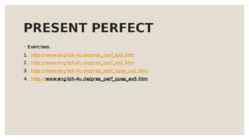
PRESENT PERFECT◦ Exercises:
1.
http://www.english-4u.de/pres_perf_ex1.ht m
2.
http://www.english-4u.de/pres_perf_ex2.ht m
3.
http://www.english-4u.de/pres_perf_ques_ex1.ht m
4.
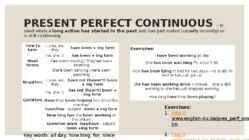
http://www.english-4u.de/pres_perf_ques_ex3.htm PRESENT PERFECT CONTINUOUS - is
used when a
long action has started in the past and has just ended (usually recently) or
is still continuing.
How to I, you, we,
have been + ing formform:
they
Examples: he, she, it
has been + ing formI
have been working all day.
Short I
've been
reading / They
've been
She
has been watching TV since 7.30.
forms:listening She
's been dancing / He
's been
Nick
has been lying in bed for two days.- He is still in
watching
bed or has just got up.
I, you, we,
have not (haven't) been Negation:they
+ ing formShe
has been working since 4 o'clock. - She is still
has not (hasn't) been + working or she has just stopped working.
he, she, it
ing formHow long
have they
been playing?
Question: Have they
been helping you since this
morning?
Have/Has - subject -
been + ing formExercises:
1. http://
How long has she
been working at
the office?
www.english-4u.de/pres_perf_prog_ex1.h
Question word -
has/have - subject
tm
-
been +ing form Key words: all day, how long, for, since
2. http://
www.english-4u.de/pres_perf_prog_ex2.h
tm
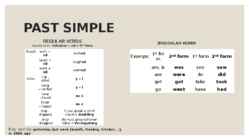
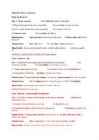
PAST SIMPLE REGULAR VERBSIRREGULAR VERBSHow to form:
Infinitive + ed =
2nd formExapls
walk
+ walk
eded1st for
Examps:
2nd form 1st form
2nd formlaugh
+ m
laugh
ededwant
+ am, is
wassee
saw want
ededare
weredo
didcr
y -
Note :
y » icr
ied
get
gottake
took carr
y y » i- carr
ied
go
went have
hadlov
e no e- loved
hop
e no e- hoped
stop -
if you speak a short
sto
pped
vowel
» doublingdrop
Bei kurz gesprochenen
-dro
pped
Vokal
» VerdopplungKey words:
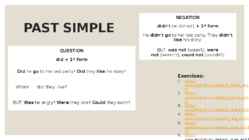
yesterday, last week (month, Monday , October,...), in 1984, agoNEGATIONPAST SIMPLEdidn't (= did not)
+ 1st formHe
didn't go to her last party. They
didn't like his story.
QUESTIONBUT:
was not (wasn't),
were not (weren't),
could not (couldn't)
did + 1st formDid he
go to her last party?
Did they
like his story?
Exercises:
1. http://
Where
did they live?
www.english-4u.de/past_tense_ex1.ht
m
2. http://
www.english-4u.de/past_tense_ex5.ht
BUT:
Was he angry?
Were they late?
Could they swim?
m
3. http://
www.english-4u.de/past_neg_ex1.htm
4. http://
www.english-4u.de/past_neg_ex4.htm
5. http://
www.english-4u.de/past_ques_ex1.ht
m
6. http://
www.english-4u.de/past_ques_ex6.ht
m
Exercises:
1. http://
www.english-4u.de/past_prog_ex7.ht
PAST CONTINUOUSm
2. http://
www.english-4u.de/past_prog_ex8.ht
m
3. http://
Key words: while (
während ),
when (als)
How to
I, he, was (not) +
was (not)
www.english-4u.de/past_prog_ex9.ht
form:
she, iting-form
working
m
Examples:
you, were (not) + were (not)
we, What
were they
doing yesterday?
ing-form
working
they While I
was she
was watering the flowers.
repairing my
bike ,
1.
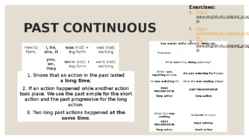
Shows that an action in the past lasted
a
long time.
He
was watching TV
while she
was reading a book.
PAST 2. If an action happened while
another action
PAST PROGRESSIVEPROGRESSIVEtook place. We use the past simple for the short
long actionlong actionaction and the past progressive for the long
action.
3. Two long past actions happened
at the When Tom
was he
burnt his hand.
cooking,
same time.
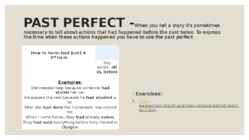
PAST PAST SIMPLEPROGRESSIVElong actionshort actionPAST PERFECT -When you
tell a story it's sometimes
necessary to tell about actions that had happened before the past tense. To express
the time when these actions happened you have to use the past perfect.
How to form: had (not) + 3rd formKey
words:
after, before Examples:She needed help because someone
had stolen her car.
◦
Exercises: He passed the test because he
had studied a
lot.
1. http://
After she
had done her homework, she visited
www.perfect-english-
grammar .com/past-perfect-exerci
me.
se-1.html
When I came home, they
had already
eaten.
They
had sold everything before they moved to
Glasgow .
MIX
◦
Present simple or progressive:
-
http://www.english-4u.de/pres_prog_ex3.htm -
http://www.english-4u.de/pres_prog_ex5.ht m
-
http://www.english-4u.de/pres_prog_ex8.ht m
◦
PAST SIMPLE OR PROGRESSIVE:◦
PRESENT PERFECT SIMPLE OR -
http://www.english-4u.de/past_prog_ex1.htm PROGRESSIVE:-
http://www.english-4u.de/past_prog_ex3.ht m
-
http://www.english-4u.de/pres_perf_ex3.ht m
-
http://www.english-4u.de/past_prog_ex6.ht m
-
http://www.english-4u.de/pres_perf_ex8.ht m
◦
PAST TENSE OR PAST PERFECT:-
http://www.english-4u.de/pres_perf_ex12.htm -
http://www.english-4u.de/past_perfect_ex1.htm -
http://www.english-4u.de/past_perfect_ex3.ht m
-
http://www.english-4u.de/past_perfect_ex6.htm LISA 1Document Outline
- Slide 1
- A – AN – SOME
- A – AN - THE
- A – AN - THE
- THE PLURAL
- AM – IS – ARE
- PRONOUNS
- PREPOSITIONS OF TIME
- QUESTIONS WORDS
- PRESENT SIMPLE
- PRESENT TENSE - ASKING QUESTIONS
- Slide 12
- Slide 13
- PRESENT PERFECT
- Slide 15
- PAST SIMPLE
- PAST SIMPLE
- PAST CONTINUOUS
- Slide 19
- MIX
- Slide 21
 50 punkti
Autor soovib selle materjali allalaadimise eest saada 50 punkti.
50 punkti
Autor soovib selle materjali allalaadimise eest saada 50 punkti.
 ~ 21 lehte
Lehekülgede arv dokumendis
~ 21 lehte
Lehekülgede arv dokumendis
 2017-12-09
Kuupäev, millal dokument üles laeti
2017-12-09
Kuupäev, millal dokument üles laeti
 34 laadimist
Kokku alla laetud
34 laadimist
Kokku alla laetud
 0 arvamust
Teiste kasutajate poolt lisatud kommentaarid
0 arvamust
Teiste kasutajate poolt lisatud kommentaarid
 carrro
Õppematerjali autor
carrro
Õppematerjali autor
 annaabi.ee






Kõik kommentaarid