Vajad kellegagi rääkida?
Küsi julgelt abi LasteAbi
Logi sisse

Margaret Thatcher (1)

5 VÄGA HEA
Punktid
Elu - Luuletused, mis räägivad elus olemisest, kuid ka elust pärast surma ja enne sündi.
Tallinn Järveotsa Gymnasium
MARGARET THATCHER
Maria Ignatenko
Form 11.B
Tallinn 2008
Margaret Thatcher
(1925-...)
General Data
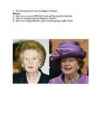
Margaret Hilda Thatcher was born on the 13th of October, 1925 in London. She is a British politician who served as Prime Minister of the United Kingdom and Leader of the Conservative Party . Margaret is the first woman who has ever held these posts.
Childhood and Education
Margaret Hilda Roberts was born on the 13th of October, 1925 in Grantham in Lincolnshire, England . Her parents were Alfred Roberts and Beatrice Stephenson Roberts. Thatcher spent her childhood in the town of Grantham in Lincolnshire. The Roberts family ran a grocery business, bringing up their two daughters in a flat over the shop . Her father was active in local politics and religion and this played a large role in forming her political convictions. Margaret attended Huntingtower Road Primary School and later Kesteven and Grantham Girl’s School. She was keen in her studies and outside school enjoyed swimming and playing hockey . After finishing school during the Second World War she applied for a scholarship to attend Somerville College, Oxford and was luckily accepted. She started studying Chemistry in 1944 in Oxford. Later Margaret became President of the Oxford University Conservative Association . Thatcher graduated from Oxford in 1947 with a B.Sc. in Natural Sciences and also gained a MA in 1950.
Early Interest in Politics
Although Margaret studied chemistry, politics interested her more. Following graduation, Margaret Roberts moved to Colchester and worked as a chemist. She became a member of the Association of Scientific Workers . During this period she joined the local Conservative Association when a friend of hers apprised that they were looking for candidates to strong Labour seats of Dartford. To support herself during the period of elections, she went to work for J. Lyons and Co., where she helped to develop methods for preserving ice cream and was paid 10 000 Krones per year . Margaret won national publicity as the youngest woman candidate in the country . Unlike many Conservatives at that time, she had no difficulties in presenting her speeches as she talked with force and confidence on issues that mattered to the voters.
Starting a Family and Career
In Dartford Margaret met her future husband Denis Thatcher who was a local businessman. The couple married in 1951 and they had twins Mark and Carol in 1953.
In the 1950s Margaret Thatcher trained as a lawyer , specialising in taxation . She was elected to Parliament in 1959 as Member of Parliament for Finchley, which was a constituency represented in the House of Commons. In 1961 Thatcher became the Parliamentary Secretary at the Ministry of Pensions and National Insurance . She also got the job of Conservative spokeswoman on housing and land . Thatcher was one of few Conservative Members of Parliament to support decriminalising male homosexuality, and she voted in favour of legalising abortion.
When the Conservative party under Edward Heath won the 1970 general election, Thatcher became an Education Minister. During her first months of work she was forced to make a cut in the education budget and therefore she abolished universal free milk for school- children . This caused a huge protest that gave her the name of "Thatcher Thatcher, Milk Snatcher". However , she also successfully stood against the introduction of library book charges. Within her term she also supported the proposals to close grammar schools and adopt comprehensive secondary education. Furthermore , Mrs. Thatcher also insisted that universities should accept not only school-leavers, but also adults.
When Margaret became the Leader of Conservative Party, she made a speech where she made a scathing attack on the Soviet Union. In response the Soviet newspaper gave her the nickname of “ Iron Lady ” due to her steadfast character.
The Prime Minister of UK
The Labour Government of 1974-79 was one of the most crisis - prone in British history and so during the General Elections of May 1979, the Conservatives won a Parliamentary majority of 43. The next day on the 4th of May 1979, Margaret Thatcher became Prime Minister of the United Kingdom. She became a very close ally with President Ronald Reagan, elected in 1980 in the United States. Margaret was in office for three terms , 1979-1983, 1983-1987 and 1987-1990.
In her first term she tried to enact her ideas about running the economy better, but it did not work out at once . Due to the Falklands War with Argentina in 1982, she received popularity and when the General Elections came in June 1983, the government was re-elected with its Parliamentary majority more than trebled (144 seats). With the wave of patriotism she stayed in power up to 1983 and a short upturn in the economy returned her to third term in office in 1987.
Throughout all three terms she pursued economic policies that reduced the power of the unions, decreased public spending, increased personal tax cuts, increased privatization of public utilities and industry. Thatcher is recognized for reducing runaway inflation, public spending and the power of the British unions. However, her programmes, known as " Thatcherism ," produced high unemployment (which nearly tripled in her first two terms), high interest rates and increased class differentiation, as well as growth of the underclass.
Resignation
Despite winning the general election in 1987, Thatcher resigned in November 1990 because of increasing opposition concerning her economic policies. She held a parliamentary seat as a representative of Finchely until 1992, when she did not stand for re-election. In 1992 she entered the House of Lords and was mad a Baroness Thatcher. Since her resignation, Thatcher has remained active in the politics of the United Kingdom, as well as the world. Thatcher had already been honoured by the Queen in 1990, shortly after her resignation as Prime Minister with the Order of Merit, one of the UK's highest distinctions.
Interesting facts
Margaret Thatcher has got a number of honours:
  • Lady of the Most Noble Order of the Garter (LG)
  • Member of the Order of Merit (OM)
  • Member of Her Majesty's Most Honourable Privy Council (PC)
  • Fellow of the Royal Society (FRS)
  • Honorary member of the Carlton Club, and the only woman entitled to full membership rights.

A public holiday Margaret Thatcher’s Day is held on the 10th of January on the Falkland Islands.
She has written a number of books :
  • Statecraft: Strategies for Changing World by Margaret Thatcher
  • The Collected Speeches of Margaret Thatcher by Margaret Thatcher
  • The Path to Power by Margaret Thatcher
  • The Downing Street Years by Margaret Thatcher

Sources:
  • http://www.cnn.com/SPECIALS/cold.war/kbank/profiles/thatcher/
  • http://en.wikipedia.org/wiki/Margaret_Thatcher
  • http://www.margaretthatcher.org/essential/biography.asp#ess78-83
    Wordlist of Margaret Thatcher Project
    Conviction (n) - a fixed or strong belief ; viewpoint
    Apprise (v) – inform
    Decriminalise (v) – allow , permit , legalise
    Abolish (v) - to destroy completely ; cancel; lose
    Snatcher (n) – a person who steals or grasps something suddenly
    Scathing (adj.) - harmful or painful; injurious; critical
    Steadfast (adj.) – firmly loyal; steady
    Crisis-prone (adj.) – affected by dangerous situation
    Enact (v) – to establish by law
    Treble (v) - to make or become three times as much or as many
    Wordlist of Margaret Thatcher Project
    Conviction (n) - a fixed or strong belief; viewpoint
    Apprise (v) – inform
    Decriminalise (v) – allow, permit, legalise
    Abolish (v) - to destroy completely; cancel; lose
    Snatcher (n) – a person who steals or grasps something suddenly
    Scathing (adj.) - harmful or painful; injurious; critical
    Steadfast (adj.) – firmly loyal; steady
    Crisis-prone (adj.) – affected by dangerous situation
    Enact (v) – to establish by law
    Treble (v) - to make or become three times as much or as many
    Wordlist of Margaret Thatcher Project
    Conviction (n) - a fixed or strong belief; viewpoint
    Apprise (v) – inform
    Decriminalise (v) – allow, permit, legalise
    Abolish (v) - to destroy completely; cancel; lose
    Snatcher (n) – a person who steals or grasps something suddenly
    Scathing (adj.) - harmful or painful; injurious; critical
    Steadfast (adj.) – firmly loyal; steady
    Crisis-prone (adj.) – affected by dangerous situation
    Enact (v) – to establish by law
    Treble (v) - to make or become three times as much or as many
    Wordlist of Margaret Thatcher Project
    Conviction (n) - a fixed or strong belief; viewpoint
    Apprise (v) – inform
    Decriminalise (v) – allow, permit, legalise
    Abolish (v) - to destroy completely; cancel; lose
    Snatcher (n) – a person who steals or grasps something suddenly
    Scathing (adj.) - harmful or painful; injurious; critical
    Steadfast (adj.) – firmly loyal; steady
    Crisis-prone (adj.) – affected by dangerous situation
    Enact (v) – to establish by law
    Treble (v) - to make or become three times as much or as many
    Wordlist of Margaret Thatcher Project
    Conviction (n) - a fixed or strong belief; viewpoint
    Apprise (v) – inform
    Decriminalise (v) – allow, permit, legalise
    Abolish (v) - to destroy completely; cancel; lose
    Snatcher (n) – a person who steals or grasps something suddenly
    Scathing (adj.) - harmful or painful; injurious; critical
    Steadfast (adj.) – firmly loyal; steady
    Crisis-prone (adj.) – affected by dangerous situation
    Enact (v) – to establish by law
    Treble (v) - to make or become three times as much or as many
    Wordlist of Margaret Thatcher Project
    Conviction (n) - a fixed or strong belief; viewpoint
    Apprise (v) – inform
    Decriminalise (v) – allow, permit, legalise
    Abolish (v) - to destroy completely; cancel; lose
    Snatcher (n) – a person who steals or grasps something suddenly
    Scathing (adj.) - harmful or painful; injurious; critical
    Steadfast (adj.) – firmly loyal; steady
    Crisis-prone (adj.) – affected by dangerous situation
    Enact (v) – to establish by law
    Treble (v) - to make or become three times as much or as many
    Wordlist of Margaret Thatcher Project
    Conviction (n) - a fixed or strong belief; viewpoint
    Apprise (v) – inform
    Decriminalise (v) – allow, permit, legalise
    Abolish (v) - to destroy completely; cancel; lose
    Snatcher (n) – a person who steals or grasps something suddenly
    Scathing (adj.) - harmful or painful; injurious; critical
    Steadfast (adj.) – firmly loyal; steady
    Crisis-prone (adj.) – affected by dangerous situation
    Enact (v) – to establish by law
    Treble (v) - to make or become three times as much or as many
    Wordlist of Margaret Thatcher Project
    Conviction (n) - a fixed or strong belief; viewpoint
    Apprise (v) – inform
    Decriminalise (v) – allow, permit, legalise
    Abolish (v) - to destroy completely; cancel; lose
    Snatcher (n) – a person who steals or grasps something suddenly
    Scathing (adj.) - harmful or painful; injurious; critical
    Steadfast (adj.) – firmly loyal; steady
    Crisis-prone (adj.) – affected by dangerous situation
    Enact (v) – to establish by law
    Treble (v) - to make or become three times as much or as many
    Wordlist of Margaret Thatcher Project
    Conviction (n) - a fixed or strong belief; viewpoint
    Apprise (v) – inform
    Decriminalise (v) – allow, permit, legalise
    Abolish (v) - to destroy completely; cancel; lose
    Snatcher (n) – a person who steals or grasps something suddenly
    Scathing (adj.) - harmful or painful; injurious; critical
    Steadfast (adj.) – firmly loyal; steady
    Crisis-prone (adj.) – affected by dangerous situation
    Enact (v) – to establish by law
    Treble (v) - to make or become three times as much or as many
  • Vasakule Paremale
    Margaret Thatcher #1 Margaret Thatcher #2 Margaret Thatcher #3 Margaret Thatcher #4 Margaret Thatcher #5 Margaret Thatcher #6 Margaret Thatcher #7
    Punktid 50 punkti Autor soovib selle materjali allalaadimise eest saada 50 punkti.
    Leheküljed ~ 7 lehte Lehekülgede arv dokumendis
    Aeg2008-05-15 Kuupäev, millal dokument üles laeti
    Allalaadimisi 36 laadimist Kokku alla laetud
    Kommentaarid 1 arvamus Teiste kasutajate poolt lisatud kommentaarid
    Autor mysska Õppematerjali autor
    elulugu, teened

    Kasutatud allikad

    Sarnased õppematerjalid

    GETTING TO KNOW THE TOEFL
    368
    pdf

    GETTING TO KNOW THE TOEFL

    CHAPTER 1 GETTING TO KNOW THE TOEFL WHAT IS THE TOEFL? The TOEFL is a comprehensive English language examination required by more than 3,000 colleges and universities in the United States, Canada, and other parts of the world. In addition, foreign born professionals frequently need a TOEFL score for certification to practice their profession in the United States or Canada. The TOEFL is a timed test that consists of the three sections listed here. THE TOEFL Section 1 Listening Comprehension 50 questions 35 minutes Part A Statements 20 questions Part B Short Dialogs 15 questions Part C Minitalks and Extended Conversation

    Inglise keel
    How has Margaret Thatcher affected Britain
    1
    doc

    How has Margaret Thatcher affected Britain

    How has Margaret Thatcher affected Britain Margaret Thatcher is former British politician who served as Prime Minister of the United Kingdom from 1979 to 1990 and leader of the conservative party from 1975 to 1990. She is the first and only woman to hold either post. Since her resignation, Thatcher has remained active in the politics of the United Kingdom, as well as the world. She was raised to the House of Lords by the conferment of a life peerage as Baroness Thatcher. Margaret Thatcher has affected Britain in many ways. Thatcher was committed to reducing the power of the trades unions. Several unions launched strikes in response to legislation introduced to curb their power, but these actions eventually collapsed, and gradually Thatcher's reforms reduced the power and influence of the unions. Also, though an early backer of decriminalization of male homosexuality, Thatcher, at the 1987

    Inglise keel
    Unit 4 HEALTH AND CARE
    2
    pdf

    Unit 4 HEALTH AND CARE

    Unit 4 HEALTH AND CARE 17.conventional medicine n - the usual form of medicine Language Leader Advanced practised in most European and North American countries [= western medicine] tavameditsiin 1. alternative medicine ['meds()n] n - medical 18.cough v - [kf] to suddenly push air out of your throat treatment that is not based on the usual western with a short sound, often repeatedly: Matthew methods: Acupuncture is widely used by practitioners coughed and cleared his throat. köhima of alternative medicine. 19.discharge v - to officially allow someone to leave 2. anonymous ['nnims] adj - unknown by name: Our somewhere, especially the hospital or the army, navy client prefers to remain anonymous. etc, or to tell them that they mu

    Inglise keel
    Queen Victoria and her time
    11
    docx

    Queen Victoria and her time

    QUEEN VICTORIA & HER TIME Project Mari Murakas Class 11A 2011 Early life of Queen Victoria Victoria was born in London on 24 May 1819, the only child of Edward, Duke of Kent, and Victoria Maria Louisa of Saxe-Coburg. [1] The Duke of Kent was the fourth son of George III and Victoria Maria Louisa was the sister of King Leopold of Belgium. The Duke and Duchess of Kent selected the name Victoria but her uncle, George IV, insisted that she be named Alexandrina after her godfather, Tsar Alexander II of Russia. [2] Victoria's father died when she was eight months old. The Duchess of Kent developed a close relationship with Sir John Conroy, an ambitious Irish officer. Conroy acted as if Victoria was his

    British history (suurbritannia ajalugu)
    Revision Questions 2013
    4
    doc

    Revision Questions 2013

    REVISION QUESTIONS 1. What do you know about Margaret Thatcher? Winston Churchill? Margaret Thatcher was the first female Prime Minister in Europe. She was a member of the conservative party. She died recently. Winston Churchill was the Prime Minister during WW II. He was excellent in making speeches, but he was a heavy drinker and also smoker. 2. What are the main countries of the UK and their capitals? There are 4: England with London as the capital; Wales with Cardiff as the capital; Scotland with Edinburgh as the capital; and Northern Ireland with Belfast as the capital. 3

    Inglise keel
    Nimetu
    10
    pptx

    Nimetu

    Countess Constance de Markievicz(first female MP elected in 1918). Nancy Astor was the first elected female MP to take up her seat in Parliament (1919). She was the Conservative MP for Plymouth Sutton until 1945. Margaret Bondfield was the first woman to hold a ministerial position in government. She was then promoted by Prime Minister Ramsay MacDonald in 1929 as the Minister for Labour, also making her the first female member of the cabinet. Margaret Thatcher was the longest serving prime minister of the 20th century. Baroness Janet Mary Young was the first woman to hold the role of Leader of the House of Lords. The Leader of the House of Lords is responsible for organising House business and representing the House of Lords on formal occasions. The first and only female Speaker of the House of Commons was Betty Boothroyd. The Speaker keeps order and oversees the business of the House of Commons.

    Inglise keel
    Inglise keelt kõnelevate maade ajalugu lühikonspekt
    168
    odp

    Inglise keelt kõnelevate maade ajalugu lühikonspekt

    Establishment of Scottish Kingdom in Pictland called Dalriada. It was a confederation of tribes, based on a system of governement in their native land Kenneth McAlpin and the unification of Scotland Was the king of the Scots in Dalriada 843 he united the Pictish and Scottish kingdom and had himself crowned United Scotland became known as Kingdom of Alba For two C-s Scotland developed under Pictish rule Malcolm III Canmore and Queen Margaret He was the king of Scotland He married to Margaret of the house of Wessex, whose favour secured Anglo-Norman secular They had several children Queen Margaret became a saint Malcolm fought wars against the Kingdom of England, had to acknowledge the overlordship of the English King Malcolm´s accession to the throne is the The Anglo-Norman invasion of Scotland Queen Margaret invited the Anglo-Normans to settle in

    Inglise keel
    Inglise keelt kõnelevate maade ajaloo eksamiküsimused
    28
    doc

    Inglise keelt kõnelevate maade ajaloo eksamiküsimused

    Kenneth MacAlpin, defeated the Picts. MacAlpin was not immediately recogninzed as the King of Scots and Picts for some years. Before defeating the Picts, he defeated the Vikings, driving them from the land. Once the warfare had ended between Scot and Pict, MacAlpin turned his attention to reforming laws, repressing and punishing crime, as well as improvements in the administration of justice. MacAlpin is credited with a code of laws known as "Code MacAlpin". *Malcolm III Canmore and Queen Margaret ­ Malcolm married Margaret, who was his second wife, the great-niece of Edward the Confessor. Margaret's impact was dramatic. She favoured the Roman Catholic church to the Celtic Church. To allow her to feel more at home, Malcolm ordered that the language used at court should be Anglo-Saxon rather than Gaelic. As a result Malcolm III was the first to be called "King of Scotland" in his own time. Margaret also had built what is today called St Margaret's Chapel, in the highest part of

    Inglise keel kõnelevate maade ajalugu


    Meedia

    Kommentaarid (1)

    TR profiilipilt
    TR: Sain palju teada:)
    14:21 17-11-2009


    Sellel veebilehel kasutatakse küpsiseid. Kasutamist jätkates nõustute küpsiste ja veebilehe üldtingimustega Nõustun