Vajad kellegagi rääkida?
Küsi julgelt abi LasteAbi
Logi sisse

Passive (0)

1 Hindamata
Punktid
Inglise keel - Kõik luuletused, mis on inglise keeles


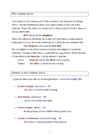
The Passive Voice 
 
Table of Contents 
 
 
The Passive Voice.................................................................................2 
Tenses in the Passive Voice................................................................2 
Modal Verbs and Future in the Passive Voice .................................3 
The Passive with ’get/have’ ................................................................4 
When to use the Passive .....................................................................5 
Verbs with two objects ........................................................................5 
The Passive with ’by/with’..................................................................6 
Talking about what other people say................................................6 
 
The Passive Voice 
  
The subject is the starting point of the sentence, the thing we are talking 
about. The new information about the subject comes at the end of the 
sentence. When the subject is the person or thing doing the action , then we 
use an active verb
 
 
Bell  invented  the telephone
When the subject is not doing the action, but something is happening or 
being done to it, or the action is directed at it, then we use a passive verb
 
 
The telephone was invented by Bell
NB! The  object  of an active sentence becomes the subject of a passive 
sentence. The doer of the action is indicated by a by phrase . When the doer 
of the action is not important , the ’by phrase’ is omitted: 
Active:  
Someone  locks the office every evening
Passive:  
The office is locked  every evening. 
  
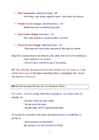
Tenses in the Passive Voice 
  
 A passive verb is the verb be in the right tense + a Past Participle (PP) 
  
•   Present Simple : am/are/is + PP  
The office is locked every evening. 
   
•  Past Simplewas/were + PP 
My car was stolen  last night .  
 
•  Future Simplewill be + PP 
  No 
disciplinary 
action 
will be taken against you. 
 
•  Present Continuous : am/are/is being + PP  
The house is being painted at the moment. 
  
 
2
•  Past Continuous: was/were being + PP  
The bridge  was being repaired when I was there last month
  
•  Present Perfect Simplehave/has been + PP  
Sarah  has been invited to the party
  
•  Past Perfect Simple: had been + PP  
The room  had been cleaned   before I arrived
 
•  Future Perfect Simple: will have been + PP 
 The room will have been cleaned by the time you arrive .  
 
Negatives and  questions  are formed in the same way as in active sentences
  When 
was your car stolen
 
 
haven ’t been invited to any of his parties. 
  
NB! The rules for choosing tenses in the Passive are the same as in the 
Active Voice (e.g. to talk about something that is in progress now, we use 
the Present Continuous). 
  
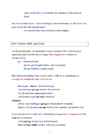
Modal Verbs and Future in the Passive Voice 
  
We use be + Past Participle after willbe going tocanmusthave to
should, etc. 
 
 
This door  must be kept locked. 
           
This job can’t be done
  The 
new 
shop  
will be opened next week. 
  
It can also be used after some other structures (want towould like to, 
going to). 
I don’t want to be disturbed
  
 He’s going to be interviewed on Friday .  
 
3
  Jane  
would like to be elected the President of the Student  
Union. 
 
We can use have been + Past Participle after modal verbs to talk about the 
past events that did not take place
We should have been told  about the dangers. 
 
 
The Passive with ’get/have’ 
  
In informal English , we sometimes use get instead of be in the Passive, 
especially when we talk about things that happen by accident or 
unexpectedly. 
get + Past Participle 
  My 
flat 
got burgled when I was on holiday
 
 
He got killed in a plane crash. 
  
Have (get) something done can be used to talk about something we 
arrange for somebody else to do for us. 
          
have (get) object + Past Participle 
I am  having  a garage   built  at the moment. 
You should have your eyes  tested
I would like to get my eyes checked
Compare
Active: I am building  a garage at the moment. (I myself) 
Passive: I’m having a garage built at the moment. (somebody else) 
  
It can also be used to talk about something unexpected or unpleasant that 
happens to someone. 
I had my leg  broken  in a football match. 
Kate had her wallet stolen in the bus yesterday
 
4
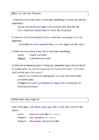
When to use the Passive 
  
1) when we do not know who or what does something or it does not add any 
information. 
My car was stolen last night. (I do not know who stole the car) 
 The 
criminal 
has  finally  been arrested. (by the police
  
2) when we are not interested in who or what does something or it is not 
important. 
This factory  has been painted twice. (It is not important who did it.) 
  
3) when we do not want to say who or what does something.  
Active:  
made a mistake. 
Passive:  
A mistake was made
  
4) when we are speaking about a thing (an inanimate object) and not about 
its author (when we want to emphasize the  result  of the action or the action 
itself, not the doer of the action ) 
Hamlet ’ was written by Shakespeare . It is one of the most often-
performed plays
Refugees were given permission to stay in the country  by the 
Swedish government
 
  
Verbs with two objects  
  
Some verbs (give, tell , show, send, pay, offer , teach, etc.) can have two 
objects. 
Active:  
Someone gave Joe the money
         Passive 1:   Joe was given the money
         Passive 2:   The money was given to Joe
  
 
5
The Passive with ’by/with’ 
  
In a passive sentence, we sometimes mention the  agent  (the person or thing 
doing the action) when it is important.  
Use    
by + person 
The radio was invented by Marconi
with + instrument  
 
 
The tin was opened with a knife
Compare: 
I was hit by an old lady . (agent) 
I was hit with an umbrella . (instrument) 
with + material  to talk about materials or ingredients 
The cake was made with dried fruit
          
The safe was blown open  with dynamite
  
Talking about what other people say 
 
When we talk about what other people say, believe, etc., we can use two 
possible passive forms
Compare:  
Active:  
People say that Mr Ross is a millionaire
Passive 1:   It is said that Mr Ross is a millionaire. 
Passive 2:   Mr Ross is said to be a millionaire. 
It is used in formal style with verbs such as: say, think, believe, consider
know, claim, report, expect , understand, etc. 
 
When the action is in the past, we use the “Perfect Infinitive ”  
(to have + PP) 
The fire  is believed to have started  last night. 
It was thought  that two prisoners  had escaped
Two prisoners were thought to have escaped
 
6
Vasakule Paremale
Passive #1 Passive #2 Passive #3 Passive #4 Passive #5 Passive #6
Punktid 50 punkti Autor soovib selle materjali allalaadimise eest saada 50 punkti.
Leheküljed ~ 6 lehte Lehekülgede arv dokumendis
Aeg2014-12-14 Kuupäev, millal dokument üles laeti
Allalaadimisi 29 laadimist Kokku alla laetud
Kommentaarid 0 arvamust Teiste kasutajate poolt lisatud kommentaarid
Autor 213757 Õppematerjali autor
Reeglid Akadeemilises inglise keeles teemal Passive

Sarnased õppematerjalid

Chpt 12 Verb Tenses
38
ppt

Chpt 12 Verb Tenses

Charles dickens was a nineteenthcentury author whose work is well known today. One of the reasons Dickens remained so popular is that so many of his stories are remains available not only as books but also as movies, plays, and television productions. We all knew from our childhood the famous story of uncle Scrooge and Tiny Tim. know We often saw a television version of A Christmas Carol at see holiday time. Voice: Passive v. Active (pg 225) In the active voice, the subject is doing something. Subject Verb The committee made the decision. _________ _____ In the passive voice, something is being done to the subject. Subject Verb The decision was made by the committee. _______ _________ Why choose one over the other? In general, choose the active voice to achieve direct, economical, and forceful

Inglise keel
Inglise keele struktuur
29
docx

Inglise keele struktuur

finite: the 3rd person singular present tense: She walks a mile every day. 3. the -ing participle: calling, singing, walking, etc. non-finite: a) the progressive aspect: He's reading a book now. b) ­ing clauses: Calling early, I found her at home. 4. the past form: called, sang, walked, etc. finite: the past tense: I walked a mile yesterday. 5. the -ed participle: called, sung, walked, etc. non-finite: a) the perfect aspect: He has called twice today. b) the passive voice: Her sister is called Sally. c) ­ed participle clauses: Called early, he ate a quick breakfast. Lexical classification: Fragment Lexical class My article father noun gave verb me pronoun a article nice adjective gift noun Finite and non-finite verb phrases: The non-finite forms of the verb occur not only in non-finite verb phrases, but also in non- initial positions in finite verb phrases (e.g. She [is reading]VP a book now).

Inglise keel
Passive voice-
24
ppt

Passive voice

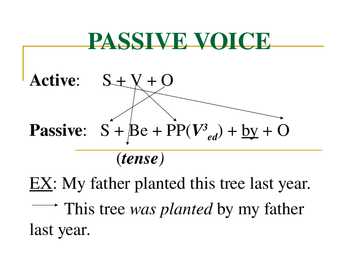
PASSIVE VOICE Active: S + V + O Passive: S + Be + PP(V3ed) + by + O (tense) EX: My father planted this tree last year. This tree was planted by my father last year. TABLE OF ENGLISH TENSES IN PASSIVE VOICE The Simple Present Tense Active: S + V(s/es) + O Passive: S + am/is/are + PP + by + O EX: He reads books every day. Books are read (by him) every day. TABLE OF ENGLISH TENSES IN PASSIVE VOICE The Present Continuous Tense Active: S + am/is/are + Ving + O Passive: S + am/is/are + being +PP + by + O EX: He is writing a novel at the moment. A novel is being written (by him) at the moment. TABLE OF ENGLISH TENSES IN PASSIVE VOICE The Present Perfect Tense Active: S + Has/Have + V3ed + O Passive: S + has/have + been +PP + by + O EX: He has just finished a novel. A novel has just been finished (by him). TABLE OF ENGLISH TENSES

Inglise keel
Golden Grammar rules
10
doc

Golden Grammar rules

) I'll see you on Friday ­ or rather, Saturday. 3. Use the simple present ­ play(s), rain(s) etc ­ to talk about habits and repeated actions. I play tennis every Saturday. (NOT I am playing tennis every Saturday.) It usually rains a lot in November. 4. Use will ..., not the present, for offers and promises. I'll cook you supper this evening. (NOT I cook you supper this evening.) I promise I'll phone you tomorrow. (NOT I promise I phone you tomorrow.) 5. Don't drop prepositions with passive verbs. I don't like to be shouted at. (NOT I don't like to be shouted.) This needs to be thought about some more. (NOT This needs to be thought some more.) 6. Don't use a present tense after It's time. It's time you went home. (NOT It's time you go home.) It's time we invited Bill and Sonia. (NOT It's time we invite Bill and Sonia.) 7. Use was/were born to give dates of birth. I was born in 1975. (NOT I am born in 1975.) Shakespeare was born in 1564. 8. Police is a plural noun.

Inglise keel
English structure revision for the exam
40
docx

English structure revision for the exam

verb and subject/object)  Active voice – When the subject is an agent (the doer of the action), the verb is in an active voice. For example: The cat ate the mouse. Cat is the agent and the subject.  Passive voice – When the subject is patient (the person who is influenced by the action, the verb is in the passive voice. For example: The mouse was eaten by the cat.  Agreement → He/she/it is sleeping. I am/ you/we are sleeping. 2.3.2 Adjectives

Inglise keel
Inglise keele grammatika reeglid
4
docx

Inglise keele grammatika reeglid

1. Active/Passive Active - the professor teaches the students. Passive - The students are taught by the professor 2. Present Simple [VERB] + s/es in third person. Tegevus on korduv või tavapärane. You speak English. I play tennis. Cats like milk. The train leaves tonight at 6 PM. I am here now. Active= Once a week, Tom cleans the car. Passive= Once a week, the car is cleaned by Tom. 3. Present Continuous [am/is/are + present participle]. Tegevus toimub/ei toimu praegusel hetkel. You are watching TV. You are learning English now. I am studying to become a doctor. I am meeting some friends after work. Active= Right now, Tom is writing the letter. Passive= Right now, the letter is being written by Tom. 4. Past Simple [VERB+ed] or irregular verbs. Tegevus algas/lõppes minevikus täpsel ajal. . You called Debbie. I saw a movie yesterday. I finished work, walked to the beach, and found a nice place to swim. I lived in Brazil for two years. I studied French when I was a child. Active

Inglise keel
Big grammar theory 2
5
doc

Big grammar theory 2

ought to shall shan't should will won't would wouldn't Can and be able to: · Can you play the piano? · I'm not able to come to the game on Friday. Must and have to: · The tennis match must be over by now. (I'm sure it is). · I have to get up early tomorrow to catch the train to the office. 9. The passive voice: The Passive uses the SUBJECT + TO BE + PAST PARTICIPLE Subject verb `to be' past participle Simple present: The house is cleaned every day. Present continuous: The house is being cleaned at the moment. Simple past:

Inglise keel
Inglise keele jaotusmaterjal
37
doc

Inglise keele jaotusmaterjal

MODULE 1 Greeting. Introducing oneself and the others. The alphabet. Spelling. The tenses. How to introduce yourself and others Formal introductions How to respond and reply to an May I introduce myself? I am John introduction Smith. How do you do. Allow me to introduce John Smith to Pleased to meet you. you. Standard introduction Nice to meet you. I'd like you to meet John Smith. Hello. I want you to meet John Smith. I'm so pleased to meet you. This is Jane Smith. I'm Jane Smith. My name's John Smith. Informal introduction Hi. John. Jane. Hello. Titles: Mr Mrs Miss Ms Ms is a modern form of address for women. It replaces the traditional forms of Mrs and Miss. Greetings Good morning/afternoon/evening! 'How are you?' Very often people expect you to s

Inglise keel


Kommentaarid (0)

Kommentaarid sellele materjalile puuduvad. Ole esimene ja kommenteeri


Sellel veebilehel kasutatakse küpsiseid. Kasutamist jätkates nõustute küpsiste ja veebilehe üldtingimustega Nõustun