Leidsid 33 sarnast õppematerjali, mis on seotud failiga "Passive". Need materjalid aitavad sul teemat sügavamalt mõista.
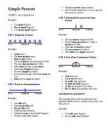
passive, thing, action, verb, talk, active, voice, something, verbs, object, simple, subject, stole, other, important, tense, present, stolen, perfect, tenses, modal, talking, person, doing, invented, done, someone, evening, locked, night, continuous, going, happen, garage, compare, know, given, money, open, ross, millionaire, expect, comes, telephoneMoved to Cali 2005 Was Born Traveled to Europe Husband 1978 School graduates @ Oxford 1999 Started Got married School 1983 2008 2 The Six English Verb Tenses Three Simple Tenses Simple continuous Present You walk. You are walking I run. I am running. Past You Walked You were walking. I ran. I was running. Future You will walk. You will be walking. I will run. I will be running. Three Perfect Tenses Perfect continuous
consider, considers, considered Open vs. Closed class words: In linguistics, a closed class (or closed word class) is a word class to which no new items can normally be added, and that usually contains a relatively small number of items. Typical closed classes found in many languages are adpositions (prepositions and postpositions), determiners, conjunctions, and pronouns.[1] Contrastingly, an open class offers possibilities for expansion. Typical open classes such as nouns and verbs can and do get new words often, through the usual means such as compounding,derivation, coining, borrowing, etc. [2] Syntax: studies how words group together to make phrases and sentences. Sentences are not simply random strings of words; they conform to specific patterns determined by the syntactic rules of the language. The syntactic rules in a grammar must account for the grammaticality of sentences, word
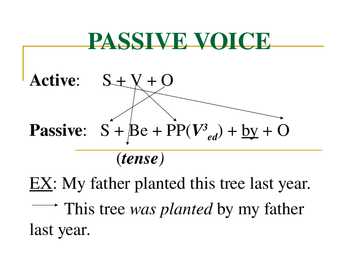
PASSIVE VOICE Active: S + V + O Passive: S + Be + PP(V3ed) + by + O (tense) EX: My father planted this tree last year. This tree was planted by my father last year. TABLE OF ENGLISH TENSES IN PASSIVE VOICE The Simple Present Tense Active: S + V(s/es) + O Passive: S + am/is/are + PP + by + O EX: He reads books every day. Books are read (by him) every day. TABLE OF ENGLISH TENSES IN PASSIVE VOICE The Present Continuous Tense Active: S + am/is/are + Ving + O Passive: S + am/is/are + being +PP + by + O EX: He is writing a novel at the moment. A novel is being written (by him) at the moment. TABLE OF ENGLISH TENSES IN PASSIVE VOICE The Present Perfect Tense Active: S + Has/Have + V3ed + O Passive: S + has/have + been +PP + by + O EX: He has just finished a novel. A novel has just been finished (by him). TABLE OF ENGLISH TENSES IN PASSIVE VOICE
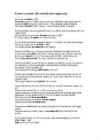
Golden Grammar rules 1. Don't use an with own. Sue needs her own room. (NOT Sue needs an own room.) I'd like a phone line of my own. (NOT ... an own phone line.) 2. Use or rather to correct yourself. She's German or rather, Austrian. (NOT She's German or better, Austrian.) I'll see you on Friday or rather, Saturday. 3. Use the simple present play(s), rain(s) etc to talk about habits and repeated actions. I play tennis every Saturday. (NOT I am playing tennis every Saturday.) It usually rains a lot in November. 4. Use will ..., not the present, for offers and promises. I'll cook you supper this evening. (NOT I cook you supper this evening.) I promise I'll phone you tomorrow. (NOT I promise I phone you tomorrow.) 5. Don't drop prepositions with passive verbs. I don't like to be shouted at. (NOT I don't like to be shouted.)
grammatical shape of the word, the meaning of the word stays the same. For example: consider, considered, considers. Open class words (content words) → These are the word classes that take in new words, for example by adding affixes to them or borrowing words from other languages. In English these words are most commonly nouns, verbs (not auxiliaries), adjectives and adverbs. Closed class words (function words) → These are words that do not take in any new words. In English the word classes are prepositions, pronouns, determiners and conjunctions. Syntax is the study of how sentences are formed in a language. For example what is the word order ( in English it’s usually subject, verb object) or how words relate to
I am here now. Active= Once a week, Tom cleans the car. Passive= Once a week, the car is cleaned by Tom. 3. Present Continuous [am/is/are + present participle]. Tegevus toimub/ei toimu praegusel hetkel. You are watching TV. You are learning English now. I am studying to become a doctor. I am meeting some friends after work. Active= Right now, Tom is writing the letter. Passive= Right now, the letter is being written by Tom. 4. Past Simple [VERB+ed] or irregular verbs. Tegevus algas/lõppes minevikus täpsel ajal. . You called Debbie. I saw a movie yesterday. I finished work, walked to the beach, and found a nice place to swim. I lived in Brazil for two years. I studied French when I was a child. Active = Tom repaired the car. Passive= The car was repaired by Tom. 5. Past Continuous [was/were + present participle]. Pikalt kestev tegevus katkestati minevikus. You were studying when she called. I was watching TV when she called. Last night at 6 PM, I
7. Verb: The principal forms of the verbs: Verbil on 4 põhivormi: Regular verb Irregular verb 1. the base form Talk Speak üldoleviku tüvivorm 2. the past form/ -ed form Talked Spoke üldmineviku vorm 3. the past participle (-ed Talked Spoken participle) mineviku kesksõna 4. the present participle (- Talking Speaking ing participle) oleviku kesksõna The tenses: Expressing the future:
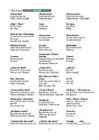
I want you to meet John Smith. I'm so pleased to meet you. This is Jane Smith. I'm Jane Smith. My name's John Smith. Informal introduction Hi. John. Jane. Hello. Titles: Mr Mrs Miss Ms Ms is a modern form of address for women. It replaces the traditional forms of Mrs and Miss. Greetings Good morning/afternoon/evening! 'How are you?' Very often people expect you to say something positive. Here's a breakdown of how you can express how you really are without complaining too much. · Fine, thanks. / On top of the world, thanks. · OK, thanks · Not so bad, thanks. / Can't complain, thanks. · So so, thanks. / So and so, thanks. · Not so good, actually 1 The English alphabet Spelling
· He is constantly talking. I wish he would shut up. USE 2 Longer Actions in Progress Now · I don't like them because they are always complaining. REMEMBER Non-Continuous Verbs/ Mixed Verbs Examples: (All of these sentences can be said while Examples: eating dinner in a restaurant.) · She is loving this chocolate ice cream. Not · I am studying to become a doctor. Correct · I am not studying to become a dentist. · She loves this chocolate ice cream. Correct · I am reading the book Tom Sawyer. Simple Past [VERB+ed] or irregular verbs
All rights reserved. No part of this book may be reproduced in any form or by any means, electronic or mechanical, including photocopying, recording, or by any information storage and retrieval system, without the written permission of the publisher. ISBN 1-59905-201-6 Printed in the United States of America 13 12 11 10 09 08 07 9 8 7 6 5 4 3 2 1 Introduction Grammar is a very old field of study. Did you know that the sentence was first divided into subject and verb by Plato, the famed philosopher from ancient Greece? That was about 2,400 years ago! Ever since then, students all over the world have found it worthwhile to study the structure of words and sentences. Why? Because skill in speaking and writing is the hallmark of all educated people. Lesson by lesson, this book provides basic instruction in the eight parts of speech--nouns, pronouns, verbs, adjectives, adverbs, prepositions, conjunctions, and
Concrete nouns refer to physical entities that can be observed and measured (cat, garage, soldier). Abstract nouns refer to abstractions that cannot be observed and measured (competition, conscience). verb tegusõna, In a clause, the verb is an obligatory and the most walk, put, do, be, must pöördsõna, verb central element. It denotes actions, events, processes and states. Verbs are either regular (cough, coughs, coughing, coughed) or irregular (speak, speaks, spoke, speaking, spoken). There are three main grammatical
ACTIVE TENSES Active form You use an active verb when you want to say that the subject of a sentence does something. · [Thing doing action] + [verb] + · +[thing receiving action] · Examples The professor (subject doing action) teaches (verb) · the students (object receiving action). · Mary (subject doing action) · washes (verb) · the dishes ( object receiving action). The tenses of the verb 1.Present (olevik) 2.Past (minevik) 3.Future (tulevik) 4.Future in the past (kaudne tulevik) Iga aeg võib esineda neljas eri rühmas 1.IndefiniteTenses (üldajad) 2.Continious Tenses (kestvad ajad) 3.Perfect Tenses (perfekti ajad) 4.Perfect Continious Tenses (perfekti kestvad ajad) Indefinite Tenses (üldajad) used to describe actions but do not state whether the action is completed or on- going märgivad tegevuse sooritamise fakti Peter visits us every day.
garden. Kui me tahame teada, kes või mis oli tegija, saame moodustada passiivi küsimuse Who/ What ... by?: Who was the book written by? Passiivi moodustatakse be (is/ was jne) + mineviku kesksõna (past participle) ehk III põhivorm (done/ cleaned/ seen jne). Aktiivilause sihitisest saab passiivilause alus. Aktiivilause tegusõna jääb samasse ajavormi, kuid muutub passiivseks. Aktiivilause alus ehk tegija jäetakse ära või pannakse lause lõppu prepositsiooni by järele: Present simple passive am/ is/ are + III pv (cleaned/ seen jne) Many accidents are caused by careless driving. Present simple active: Somebody cleans this room every day. passive: This room is cleaned every day. Past simple passive was/ were + III pv (cleaned/ seen jne) We were woken up by a loud noise during the night. Past simple active: Somebody cleaned this room yesterday. passive: This room was cleaned yesterday. These rooms were cleaned yesterday.
Active Voice, Passive Voice There are two special forms for verbs called voice: 1. Active voice subject verb object active > Cats eat fish. 2. Passive voice The active voice is the "normal" voice. This is the voice that we use most of the time. You are probably already familiar with the active voice. In the active voice, the object receives the action of the verb: The passive voice is less usual. In the passive voice, the subject receives the action of the verb: subject verb object passive < Fish are eaten by cats. subject verb object active Everybody drinks water. passive Water is drunk by everybody.
http://www.english-4u.de/a_an_some_ex1.htm ◦ *some bananas *some cats *some monkeys *some 2. http://www.english-4u.de/a_an_some_ex3.htm balls ◦ *some eggs*some oranges *some umbrellas *some 3. http://www.english-4u.de/a_an_some_ex6.htm eagles We us the • when we talk about a specific thing. • when it is clear which thing or person we mean. A – AN - THE • when there is only one of something. Examples:
The Passive Voice Passive voice is used, when the focus is on the action. It is not important or not known, hovewer, who or what is performing the action. Passiivi kasutatakse siis, kui tegevust teostav isik on teadmata või tema mainimine ei ole oluline, või siis, kui tähelepanu on pööratud sellele, mida tehakse. Passiivi ajavormid moodustatakse abiverbi be pöördelistest vormidest vastavas ajas ja põhiverbi mineviku kesksõnast (III pv-past participle). BE vastav aeg+ Verbi III pv Tegevuse sooritaja näitamiseks kasutatakse eessõna by. Kui aktiivlause aluseks on asesõna (I, you, he, we, you, they, somebody...), siis jäetakse by-
Performing the presentation Introducing yourself and your talk Greeting, name, position, opening formalities Good morning, ladies and gentlemen. Good afternoon, everyone. Good morning. My name's (...). I'm the new Finance Manager. Good morning. Let me start by saying just a few words about my own background. I started out in... Welcome to Standard Electronics. I know I've met some of you, but just for the benefit of those I haven't, my name's (...). It's very nice to see you all here today. I'm very pleased to be here. I'm glad you could all make it.
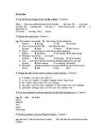
PASSIVE VOICE TEST FOR FORM 10 NAME: Task 1. Turn active voice sentences into passive voice. Only keep the agent (by phrase= where absolutely necessary. Please remember that tense form (tegusõna aeg) should remain the same when the sentence is transformed into passive. E.g. Chimps eat bananas (Present Simple Active) Bananas are eaten by chimps. (Present Simple Passive) They were playing the piano. (Past Continuous Active) Piano was being played. (Past Continuous Passive) 1. They will finish the house next month. 2. The house will be finished next month. 3. Susan has completed the essay. 4. The essay has been completed by Susan. 5. People should have left the bird alone. 6. The bird should have been left alone. 7
I live in Tallinn. I do not live in Tallinn. I never watch soap operas. INTERROGATIVE sentences end with a question mark ( ? ) : Do you live in Tallinn? Why do you never watch soap operas? EXCLAMATORY and IMPERATIVE sentences end with an exclamation mark ( ! ) : What a beautiful day! Do your homework at once! Parts of the Sentence The basic parts of the sentence are: THE SUBJECT (WHO? WHAT?) , THE PREDICATE (does, is doing, has done, etc – action/statement), THE OBJECT (WHO/WHAT is the action/statement directed at?) : Marion (who?) has a boy-friend (who?). She (who?) likes to read books (what?). The earth (what?) is a planet (what?). Besides, there are: THE ATTRIBUTE (WHAT?/WHAT KIND?) and THE ADVERBIAL (WHEN? - adverbial modifier of time/WHERE? – adverbial modifier of place/ HOW? – adverbial modifier of manner) Attributes modify nouns and stand in front of them. Adverbials modify verbs and usually stand behind them:
Use the ese forms to mean that when what you are talking about is near the person you are addressing. Use the aquel forms when what you are talking about is far from both you and the person you are addressing. Esto and eso are the neuter forms of this and that. They can be used in general and abstract ways. Demonstrative adjectives (listed above) are used before a noun; if you want to use the demonstrative pronouns, which are used before a verb, add an accent on all of the first e's: éste, ésta, éstos, éstas, ése, ésa, ésos, ésas, aquél, aquélla, aquéllos, aquéllas. 5. Subject Pronouns nosotros / noh-soh-trohs / yo yoh I we nosotras noh-soh-trahs
' 2.Prediction based on opinion: 2.Prediction based on present I think the Conservatives will win the evidence: next election. Look at those boys playing football! 3.A future fact: They're going to break the window. He will be ten next year. 4.Promises / requests / refusal / willingness: I'll help you with your homework. Will you give me a hand? 5.In the same way as the future continuous, but with state verbs: I'll be at the station when you arrive. 'Shall' is used mainly in the forms 'shall I ?' and 'shall we?' in British English. These forms are used when you want to get someone's opinion, especially for offers and suggestions: •Shall I open the window? (=do you want me to open the window). •Where shall we go tonight? (=what's your opinion?). PRESENT CONTINUOUS PRESENT SIMPLE AM/IS/ARE + ING (AM INFINITIVE (WORK;WORKS)
............................................................................................................................................. 6 Active & passive (isikuline ja umbisikuline kõneviis) ................................................................
Get/ Have something TENSE ACTIVE PASSIVE WHEN? done Present Simple Am/is/are + Every day, year, often, I pv + do/does Have/ get + sth+ III pv Lihtolevik III pv usually, always
adjective + preposition omadussõna + eessõna proud of, good at, married to adverb particle Some verbs are followed by adverb particles. Examples are: put on, take off, give away, bring up, call in. Sometimes the particle is detached from the verb and put after the object. •He took his boots off. •They called the doctor in. apposition a grammatical construction in which two usually adjacent nouns having the same referent stand in the same syntactical relation to the rest of a sentence (as the poet and Burns in “a biography of the poet Burns”) back-reference In grammatical analysis, the term reference is often used to state a relationship of identity which exists between grammatical units, e.g. a pronoun 'refers' to a noun or noun phrase
Tests Superstar 1 Luke Prodromou Test 1 Name____________________ Class_______ Use your English 1 Complete these sentences using the correct form (present simple or present continuous) of the verb in brackets. _ 1 She is in a band and she _________________________________ (record) a CD at the moment. _ 2 She is an actress and often _________________________________ (appear) on television. _ 3 At the moment she _________________________________ (have) a rest because she is tired. _ 4 Mike is a doctor and he _________________________________ (live) in Manchester. _ 5 I _________________________________ (start) work at 8.30 every morning.
PAST TENSES Past Simple Used to talk about a completed past action which happened at a completed time in the past. We went to Tallinn yesterday. I saw him a long time ago. We met last week. Used to talk about a series of events that happened one after another. He walked to school, took off his coat, went to class and fell asleep. Used to report what people said. He said that he was tired. He asked to go home. Used after "It's time" (even though we're talking about now) It's time we talked about the past (now). After "I'd rather" (even though we're talking about now) I'd rather you drove (now). (But "I'd rather drive" if talking about yourself)
8) We had to go........foot. 9) Yesterday we met Bob........the street. 10) Phone me tomorrow morning! I`ll be........home. 11) Next summer I am going........Spain. 12) Susan has been living........this street........1998. 13) The little dog was sitting........the bed. 14) I told them that they really don`t know anything ........me. 15) Are you interested........literature? 16) It depends........the weather. 17) Do you agree........me? 7. Translate using the Modal Verbs. ( 5 points ) 1) Kas sa oskad malet mängida?( oskus ) 2) See on saladus. Sa ei tohi seda kellelegi rääkida.( keeld ) 3) Me peame kiirustama.( käsk ) 4) Kate peaks vähem maiustusi sööma.( soovitus ) 5) Kas ma tohin sinuga kaasa tulla?( luba ) 8. Complete these sentences by adding suitable Personal and Possessive Pronouns. ( 5 points ) e.g. Mary and I do our homework together. 1) If you can`t ski, we will teach........ 2) How will you spend.......
going totulevikku. Üldtulevik väljendab: · Ühekordset, korduvat või harjumuspärast tegevust tulevikus. I will meet John in the station. My birthday will come again. · Tegevust või situatsiooni, mis kestab tulevikus. He will hate you for that. She will love you some day. · Otsust, mis on tehtud kõnelemise hetkel. The window is closed. I will open it. They are hungry. They will eat something. Pane tähele! Me kasutame going totulevikku siis, kui oleme juba enne otsustanud midagi teha või vastavalt olukorrale näeme, et midagi on varsti juhtumas. Mary and John have decided to organise a party. They are going to invite lots of friends. Look! They are breaking up. I am sure that Nancy is going to burst into tears. Future Continuous Kestva tuleviku moodustamine Jaatav vorm Eitav vorm Küsiv vorm
In this type of conditional we can use when instead of if. E.g., If/When you mix blue and red, you get purple. If/When you don't water flowers, they die. (present simple in both parts of the sentence) If/When I asked her to come with us, she always said no. (past simple in both parts of the sentence) 1 First conditional If-clause present simple; Main clause future tense (or: can, must, may, etc., + bare infinitive) Used to talk about the consequences of a possible action (a real or very probable situation in the present or future). E.g., If I write my essay this afternoon, I will have time to go out tonight. (or: I might go out tonight). (It is still morning, and it is quite possible that I will do this.) NOTE: With type 1 conditionals we can use unless + affirmative verb (= if + negative verb). E.g., I will not be able to come unless Joe gives me a lift. (= If Joe does not give me a lift, ...)
English Grammar - The most common tenses in English Tense Signal words Use Estonian Form Examples · something happens repeatedly *korduv tegevus every day · how often something happens *püsiv olukord sometimes, *tulevikus · one action follows another I work Present twice a week toimuv, seotud · things in general infinitive he works Simple always, often sõiduplaanidega · after the following verbs (to love, he/she/it + s I go
The gerund form -ing The gerund form -ing is used: After some main verbs. (admit, appreciate, consider, delay, deny, detest, dislike, enjoy, escape, face, feel like, finish, forgive, give up, imagine, involve, mention, mind, miss, postpone, practise, prefer, put off, recommend, resent, risk, suggest, understand) I do not recommend going to that restaurant. After an adjective, verb or noun followed by a preposition. She is really good at swimming. He apologised to arriving late. I quite like the thought of working in a travel agency. In some fixed expressions I can not bear listening to people who complain. I can not help feeling that he is cheating us. That book is not worth reading. The infinitive with to The infinitive with to is used: After some main verbs
etc, at night/the weekend, on Fridays etc. Present Continuous · Actions taking place at or arount the moment of speaking (The kids are watching TV..) · Fixed arrangements in the near future (I'm going to the dentist tomorrow) · Currently changing ang developing situations (The number of burgularies is increasing) · With ,,Always" to express anger or irritation at a repeated action (You're always forgetting..) TIME EXPRESSIONS USED WITH PRESENT CONTINUOUS: now, at the moment, at present, these days, nowadays, still, today, tonight etc. Present Perfect · Action happened at an unstated time in the past. Emphasis on the action, time is unimportant or unknown. (I have washed the car) · Action started in the past and continues up to the present, especially with stative verbs (I have known her for six years)
3. In an informal letter, begin with Dear John and end with Love/Regards/Best wishes/Yours, Mike. 4. Remember that it is not necessary to write addresses in the exam. Style in formal and informal letters Formal letters Greeting: Dear Sir/Madam / Mr bobbins, Informal letters · impersonal style Greeting: Dear Julie, · complex sentence structure - frequent · personal, short, zappy style use of Passive Voice - single word · use of slang or colloquial English use of verbs - non-colloquial English -- formal idioms/phrasal verbs language · pronouns are often omitted · each paragraph develops one specific · chatty, wide use of descriptive adjectives topic · use of short forms
 annaabi.ee