Francisco Vázquez de Coronado y Luján
(
1510 – 22 September
1554 )
Coronado
sündis Salamanca linnas rikka kaupmehe perre. Kuna ta oli peres
teine poeg, siis ei saanud ta perekonna vara pärijaks olla.
Seepärast läks ta Püha-
Rooma keisri Charles V (
Hispaania Charles
I) alluva
Mehhiko asevalitseja Antonio de Mendoza alluvusse tööle.
Pärast
Mehhikosse jõudmist 1535. aastal ta kiirelt tõusis asevalitseja
soosingusse. 1537. aastal ta abiellus Dońa Beatriz de Estrada’ga,
kes oli Uus Hispaania endise rahandusbossi tütar. 1538. aastal
Mendoza määras noore Coronado põhjapoolse
Nueva Galicia provintsi
kuberneriks .
Kuulsa
ja katastroofilise Narvaezi ekspeditsiooni üks viiest ellujääjast,
Alvar Nuńez Cabeza de Vaca, ühel hetkel jõudis asevalitseja
õukonda juttudega, et ta oli
kuulnud seitsmest imelisest linast
Cibola piirkonnas kaugel põhjas. Mendoza, kes ärevalt tahtis leida
ja vallutada selle väidetavalt
kuldse maa, seejärel saatis
kirikuisa Marcos de Niza (Marcos Hea ? – niza = nice ing. k) ja de
Vaca kaaslase Estevanico põhja seda kohta
otsima . Kui Isa de Niza
1939a naases teatades, et ta oli need linnad leidnud, siis
asevalitseja Mendez otsekohe pani kokku suure ekspeditsiooni ja
määras Coronado seda
juhtima .
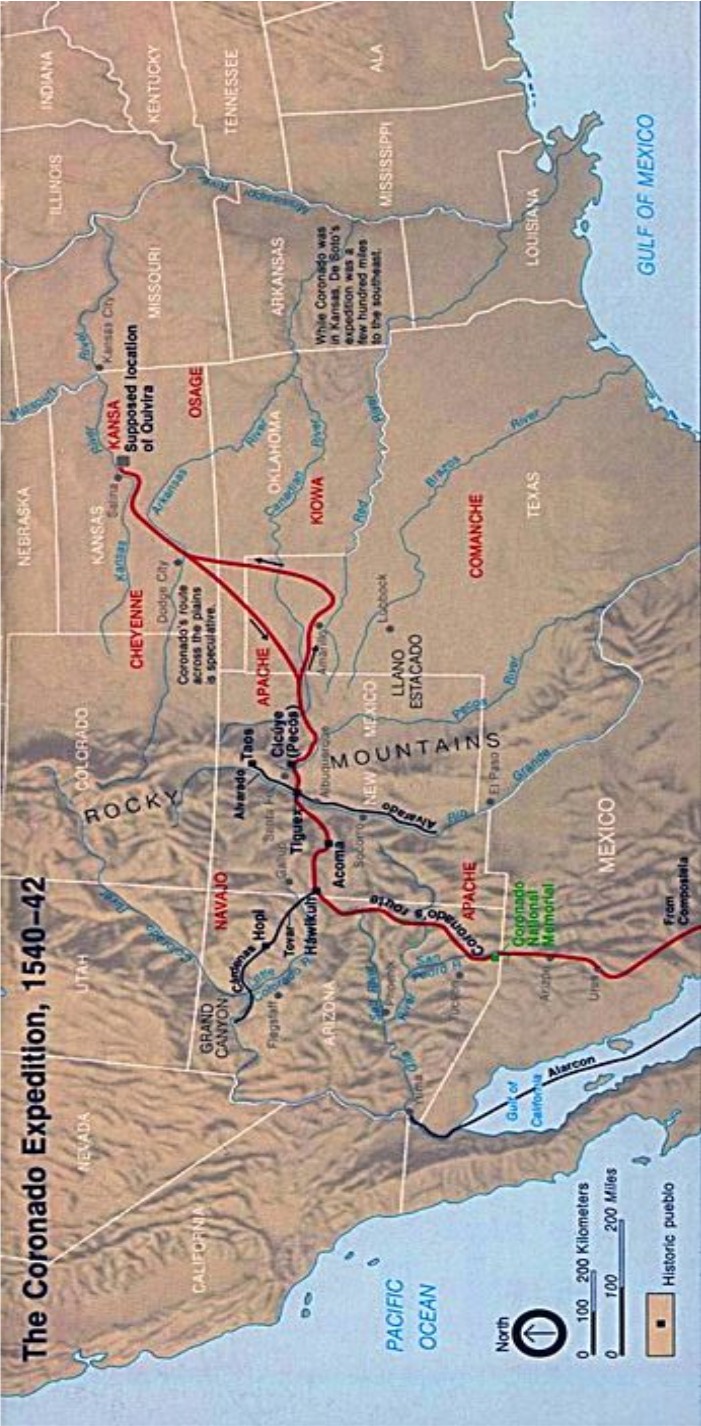
Veebruaris 1540 algas siis suur
ekspeditsioon , kus oli enam kui 230
ratsaväelast, 62 jalaväelast, mitu preestrit ja ligi 1000
indiaanlasest liitlase. Liiguti Compostela
piirkonnast siis
põhjapoole. Pärast pikka
retke läbi Põhja-
Mehhiko ja
Lõuna-
Arizona jõuti sama aasta juulis Zuni hõimule kuuluvasse
Hawikuhi külla (pueblo). Isa de Niza ütles, et see ongi see Cibola
piirkond, aga teistele ekspeditsiooni tegelastele oli see vaid väike
mudaonni küla.
Pettunud Coronado siis jagas ekspeditsiooni mitmeteks
väiksemateks
gruppideks . Üks liikus läände Colorado jõe poole,
teine jõudis hopide külla, kolmas läks loode suunas ja jõudis
Grand Kanjoni juurde, neljas grupp Hernando de Alvarado juhtimisel
uuris ülem Rio
Grandet . Talvel Coronado liigutas oma
armee Rio
Grande juurde ja vallutas tiguexi külad tänapäeva Albequerque
piirkonnas.
Nendes
tiguexi külades kuulsid hispaanlased rikkast maast põhjas, mille
nimi oli Quivira. Kevadel
1541 Coronado siis hakkas liikuma
põhjapoole, et seda legendaarset maad leida. Asuti siis liikuma
idapoole üle Pecose jõe, sealt keerati põhja poole Llando Estacado
poole
Texases . Kui ta aga Arkansase jõeäärsesse Quivirasse jõudis
avastas ta eest vaid ühe vaese
indiaani küla. Ülimalt pettunud oma
läbikukkumises ta jättis kolm misjonäri seda piirkonda
ristiusustama ja pöördus tagasi Tiguexi poole, kus ta kogus oma
järelejäänud väe ja siis hakkas kodupoole liikuma. Tagasi
Mehhikosse jõudis ta 1542 aastal. Järgmise kahe kümnendi jooksul
hispaanlased lasid
peast põhjapoolsete alade
vallutused ja
keskendusid oma enda Mehhiko arendamisele.
1544
aastal Coronado esitati talle süüdistused kohustuste
hooletus täitmises ja indiaanlaste vastases julmuses. Selle tulemusena ta
kaotas Nueva Galicia kubernäri koha. Ta naasis
Mexico Citysse kus ta
teenis linna nõukogu ametnikuna oma surmani.
Francisco
Vázquez de Coronado y Luján
(1510 – 22 September 1554)
Coronado
sündis Salamanca linnas Hispaanias jõuka kaupmehe perre. Ta oli oma
peres teine poeg ja seetõttu ei saanud temast perekonna vara
pärijat. Siis ta otsustas Uude Maailma õnne otsima minna ja jõudis
sinna 1535. aastal olles oma sõbra ja tõusva tähe, Mehhiko
asevalitseja Antonio de Mendoza kaaskonnas.
Mehhikos ta võttis
endale ka naise, Beateiz de Estrada. Neil oli ka viis last.
Coronado
oli ka Nuevo Galicia vallutaja ja
kuberner . Nuevo Galicia oli Uus
Hispaania
provintsis loode Mehhikos.
1539 aastal saatis ta
munk Marcos de Niza ja Narvaezi ekspeditsiooni ellujääja Estevanico
Compostela linnast ekspeditsioonile põhja, New Mexico poole. Kui
Marcos de Niza naases, siis ta rääkis tohutuid rikkusi täis
kuldsest Cibola linnast ja et Estevanico seal kohalike Cibola linnas
elavate zuni hõimu indiaanlaste poolt oli
tapetud . Kuigi de Niza ei
väitnud end linnas sees käinud olevat, rääkis ta, et linn oli
olnud kõrge künka otsas ja et see olevat olnud
kullast , ta rääkis
ka, et ta nägi Vaikset Ookeani sealt läänes.
Selle
jutu peale Coronado kogus endale kokku ekspeditsiooni, millel oli
kaks põhikomponenti. Esimene
kandis suuremat osa ekspeditsiooni
varudest ja liikus Hernando de Alarconi juhtimisel mööda
merd .
Teine osa sellest ekspeditsioonist liikus de Niza kirjeldatud teed
pidi mööda maad.
Coronado
ja Mehhiko asevalitseja Antonio de Mendoza olid selle ettevõtmise
alla
pannud väga suure hulga
isiklikku vara. Mendoza määras siis
Coronado ekspeditsiooni juhtima. Coronado ülesandeks oli siis leida
üles
Seitse Kuldset Linna ja nende
kuld ära röövida.
1539
aasta sügisel andis Mendoza käsu Melchor Diazile, Culiacani linna
komandörile, et too peaks de Niza väidetavaid
leide siis otsima ja
tõestama minema.
Diaz siis novembris asus teele. Chichilticalli
varemete juures pöördus Diaz siiski tagasi, sest ta polnud saanud
jätkata tänu tugevatele tuultele ja lumele. Seejärel Diaz kohtus
Coronadoga, kes polnud veel Culiacanist teele
asunud ning rääkis
talle, et de Niza väidete uurimised olid seni olnud viljatud ja
poldud leitud mingit külluslikku maad. Diazi
raport siis
kanti ette
Mendozale, 1540a. Teisejärgulised
kuulujutud Cibola olemasolust
vastavat tõele, aga
rikaste linnade olemasolu poldud tõestatud ja
Coronado soovitas, et ekspeditsioonil olevate meeste kõrvu see jutt
jõuda ei tohiks.
Coronado
asus siis Compostela linnast 1540a veebruaris teele, kaasas suur
ekspeditsioon kuhu kuulus üle tuhande inimese. Liikus ta mööda
Sinaloa rannikut põhja kuni jõudis Culiacani linna. Ta täheldas
ka, et teekonnal läbitud maa polnud võimeline ülal
pidama väga
suurt loomade ja sõdurite hulka. Selle peale siis Coronado jagas oma
ekspeditsiooni mitmeks väiksemaks grupiks ja ajastas nende
edaspidise liikumise nii, et karjatamise maa ja veekogud saaksid
taastuda . Mööda liikumisteed siis kindlate intervallidega lasi
Coronado püstitada
laagreid , et hoida varude toomise tee avatud. Kui
luureretked ja
planeerimine oli valmis, siis Coronado juhtimisel
hakkas esimene rühm sõdureid
ratsa ja jala kiirelt liikuma,
seejärel pidi ülejäänud osa ekspeditsioonist kindlate
intervallidega jupphaaval järgnema.
Coronado
lahkus Culiacani linnast 20
aprillil 1540 ja liikus mööda rannikut
Sinaloa poole. Maa mida mööda liiguti, oli karm. Siis jõuti
Sonora jõeni,
mindi üleselle ja liiguti mööda sellekülge peaaegu selle
lätteni. Siis liiguti mööda maaala mida nimetati Nexpa’ks
(tänapäeva
Santa Cruz või
Pedro ). Lõpuks jõuti de Niza
kirjeldatud Chichilticalli juurde, asub see Lõuna-Arizonas. Seal
kandis siis leiti tee kust saadi üle mägede mindud ja maa muutus
taas tasaseks.
Vahepeal mindi veel üle Väikse Colorado jõe ja
liiguti mööda Zuni jõge kuni jõuti Cibola piirkonda (tänapäeva
New Mexico). Seal siis sai ta suure pettumuse
osaliseks , Cibola
polnud midagi de Niza kirjeldatud küllusemaa sarnast. See oli olnud
hoopis mitmete zuni indiaanikülade
kompleks . Nüüd tahtsid sõdurid
de Nizat tema valejutu eest ära tappa, aga Coronado sekkus vahele ja
saatis de Niza häbis tagasi Mehhikosse.
Ühel
hetkel jõuti Hawikuhi külla (suurim zunide küla, did
you
know the Spaniards called this village
Granada ?),
kuhu siis nälgas ekspeditsioon sissepääsu nõudis,
indiaanlased aga keeldusid ning otsustati jõuga minna. Toimus ka lahing, kus
Coronado
haavata sai ning pidi zunide juurde paranema jääma.
Vahepeal saadi uut teavet ja saadeti välja mitmeid luureretki.
Üks
retk oli Pedro de Tovari juhtida, see läks
hopi külade poole,
uskudes et seal võib äkki olla see Cibola. Taas indiaanlased
keeldusid hispaanlasi edasi laskmast ja hispaanlased pidid taas jõudu
kasutama. Pärast seda
pidasid allesjäänud indiaani külad nõu
hispaanlaste vastu võidelda, aga otsustati seda siiski mitte teha.
Üldiselt oli hopide maa sama vaene kui zuni’de oma, aga sealt
saadi teada suure jõe (Colorado jõgi) kohta läänes.
Siis
moodustati sellest teine grupp, mis naases zuni maaladele ja rääkis
Coronadole oma teadasaamistest. Coronado siis moodustas uue retke
Garcia Lopez de Cardenase juhtimisel, et leida Colorado jõgi. See
ekspeditsioon läks hopide poole tagasi, et
kohtuda sinna jäänud
rühmaga ja lisavarusid endale teepeale kaasa võtta. Selle retkega
jõuti siis Colorado jõe ja Grand Kanjoni juurde (Esimesed
Eurooplased Grand Kanjonil).
Pärast
seda, kui ei suudetud Grand Kanjonist alla jõe äärde ronida,
teatati, et Colorado jõge ei saa laevadega kokkusaamiseks kasutada.
On arvatud, et
hopid meelega, olles vihased hispaanlaste peale,
juhtisid neid Grand Kanjoni poole, kust hispaanlased siis pikema
ringiga jõe äärde pääsemiseks liikuma pidid.
Seejärel
siis liikus suurem osa ekspeditsioonist edasi järgmiste suurte
külade poole, mis asusid Rio Grande ääres New Mexicos.
Ühte
külla, Tiguex’i (tänapäeva Albuquerque või Santa Fe juures),
pani siis Coronado ka talveks laagri püsti. Talvel tekkis
hispaanlastel vastuolusid kohalike hõimudega, mis kulmineerus
Tiguexi sõjaga 1540-1541. Selle sõja tulemusel hävitati palju
indiaani külasid.
Vahepeal
üks kohalik põlisameeriklane, keda Coronado „türklaseks“
kutsus, rääkis talle rikkast maast
loodes , Quivirast. Coronado siis
otsustas seda otsima minna ja võttis „türklase endale teejuhiks.
Liiguti siis Llano Estacados (Texases). Coronado aga hakkas ajapikku
türklase siiruses kahtlema ja lasi ta hukata. Järgnevad teejuhid
siis juhatasid teda edasi põhjapoole, kuni ta jõudis tänapäeva
Kansasesse.
Taaskord sai ta pettumuse osaliseks, leides eest
tavalised indiaani külad (
wichita hõim), kust kulda üldse ei
leitud. Coronado naases siis Tiguexi, kus suur osa ekspeditsioonist
oli jäetud. Seal ta saatis mööda veel ühe talve. Kansases
tänapäeva Dodge City’s lasi ta pidada ka Põhja-Ameerika
sisemaa esimese
missa (29 juuni 1541).
Järgmisel
aastal sai Coronado korralduse naasta Mehhikosse, et aidata maha
suruda Mixtóni ülestõusu (kohalike põlisameeriklaste ülestõus).
Mehhikosse läks ta sama teed pidi, kust oli tulnud. Kui ta aga
Kohale jõudis, oli mäss juba maha surutud. Vaid sadakond meest
jõudis koos temaga tagasi. Kogu tema suur ettevõtmine oli läbi
kukkunud, ja ta oli ka majanduslikult
pankrotis . Nueva Galicia
kubernerina oli ta ametis kuni 1544 aastani.
Exploration
of the Colorado River
Three
leaders affiliated with the Coronado Expedition were able to
reach the Colorado
River . The
first was Hernando
de Alarcón, then
Melchior Díaz and lastly Don Garcia Lopez de Cardenas. Alarcón's
fleet was tasked to carry supplies and to establish contact with the main
body of Coronado's expedition, but was unable to do so because of the
extreme distance to Cibola. He
traveled up the Colorado river
until the river entered the
lower half of the Grand Canyon. In this
exploration he hauled some supplies for Coronado, but eventually he
buried them with a
note in a bottle. Melchior Díaz was
sent down
from Cibola by Coronado take
charge of the
camp of Corazones and to
establish contact with the fleet. Soon after arriving at the camp he
set out from the
valley of Corazones in Sonora and traveled overland
in a
north /northwesterly direction until he
arrived at the
junction of the Colorado
River and
Gila River.
There the
local natives, probably the CocoMaricopa (see
Seymour 2007b),
told him that Alarcón's sailors had buried supplies
and
left a note in a bottle. The supplies were
retrieved and the note
stated that Alarcón's men had rowed up the river as far as they
could , searching in vain for the Coronado expedition. They had
given up and decided to
return to their departure point because
worms were
eating holes in their ships. Díaz
named the river the "
firebrand "
river because the natives used
fire brands to
keep their body warm in
the
winter . Díaz died on the trip
back to the camp in the valley of
the Corazones. Don Garcia Lopez de Cardenas saw the Colorado River
from the rim of the
South Rim of the Grand Canyon
while looking for a
route that would connect them with Alarcón's fleet.
The
Legend of the Seven CitiesThe
Legend of the Seven Cities of
Gold dates back to the eighth
century ,
when the
Moors of Africa conquered Spain for
Islam . The archbishop of
Porto in Portugual was believed to have set
sail with six
other bishops and a group of colonists and their cattle and supplies. The
Christians reached
land , so the story
goes , burned their ships so
that no one would be tempted to return to Spain, and each bishop
built a fabulously
rich city.
Spanish cartographers had traditionally
placed
these cities on an
island somewhere in the
Atlantic , but as
more and more islands were explored and no cities turned up, they
began to
position them at various places on the huge land mass
representing the New World—often in North America. There was also
an Aztec legend of Chicomoztoc, the Seven Caves, which seemed to give
substance to the Spanish hopes.
As
these
stories circulated as
part of the Spanish lore,
tales were
coming down from the north from Indians who
claimed to have
seen cities of buildings
four and
five stories high, decorated with
turquoises. When the four forlorn survivors of the
Florida expedition
of Narvaez arrived in Mexico in 1536, they reported tales of large
and
powerful villages, four and five stories high. Cabeza de Vaca,
one of these survivors, said that the lands he had actually seen were
"remote and malign, devoid of resources," but that the
Indians in the Sonora valley had told tales of a rich, faraway people
with
whom they traded.
Two
Franciscans, Fray
Juan de la Asuncion and Fray Pedro
Nadal , who
traveled north in 1538 on a missionary
journey , were also told of a
country where people wore
cotton clothes, had many turquoises and
knew of larger and wealthier villages
than their own.
The
first European to enter what is now Arizona was probably Fray Marcos
de Niza in 1539.* The viceroy, Antonio de Mendoza, had selected the
Franciscan to
lead a small
party north. Accompanying Fray Marcos was
a Negro who was one of the survivors in Cabeza de Vaca's party. This
Negro, now a
slave of Mendoza, was
still called Estevan de Dorantes,
after his
former master. The party also
included Fray Onorato and a
number of Piman Indians who had
come to Mexico with Cabeza de Vaca.
Traveling northward the friar sent Estevan ahead with instructions to
send back reports on what he
found . According to Marcos' report he
went up the Sonora river valley and, after traveling eighty miles
across Sonora, reached the San Pedro river. There he found the
Indians he called Pintados (because his Pima guides called them
Rsarsavina
meaning spotted.) As the friar continued for five days
down the San Pedro he passed small,
poor settlements where some of
the people claimed to have seen seven cities where the
houses were
eleven stories high and decorated with turquoises.
Did
you know another significant
exploration
took place in 1539? Spanish
explorer Hernando de
Soto became the first European to see the
Mississippi River.
Did
you know Alvarado and his men were
the first Europeans to see American
bison ? American bison are
sometimes called
buffalo .
Maize: A
kind of corn
grown by the Indians in the American Southwest. Its
kernels are
hard and many-colored. It
grows well in the hot, dry
climate of the American southwest. The Zuni Indians lived in the
American Southwest. They ground up the maize to make
flat cakes.
Did
you know the Spaniards called these
tortillas?
Francisco
Vázquez de Coronado y Luján
(1510 – 22 September 1554)
Allar
Pajumägi
AJ-21
Kasutatud
Kirjandus:
http://www.win.tue.nl/~engels/discovery/coronado.html http://en.wikipedia.org/wiki/Francisco_Vasquez_de_Coronado http://www.answers.com/topic/francisco-v-squez-de-coronado http://www.s9.com/Biography/Coronado-Francisco-Vasquez-De http://www.floridahistory.com/coronado.html
 Tasuta
Faili alla laadimine on tasuta
Tasuta
Faili alla laadimine on tasuta
 ~ 7 lehte
Lehekülgede arv dokumendis
~ 7 lehte
Lehekülgede arv dokumendis
 2018-04-19
Kuupäev, millal dokument üles laeti
2018-04-19
Kuupäev, millal dokument üles laeti
 3 laadimist
Kokku alla laetud
3 laadimist
Kokku alla laetud
 0 arvamust
Teiste kasutajate poolt lisatud kommentaarid
0 arvamust
Teiste kasutajate poolt lisatud kommentaarid
 despair1
Õppematerjali autor
despair1
Õppematerjali autor
 annaabi.ee









Kõik kommentaarid