Vajad kellegagi rääkida?
Küsi julgelt abi LasteAbi
Logi sisse

National Symbols of New Zealand (1)

1 Hindamata
Punktid

National Symbols of New Zealand
New Zealand flag
History
The idea of the flag of New Zealand was first introduced in 1830, because of trading troubles. At that time, a trading ship built inNZ, Sir George Murray was seized in Sydney by Customs officials for sailing without a flag or register . Australia , which was the most important trading partner for NZ had British navigation laws which ruled that every ship must carry an official certificate detailing construction, ownership and nationality of the ship. The problem was that during that period of time, NZ was not yet a colony ofGreat Britan , thats why the NZ-built ships could not sail under a British flag or register. Without a flag to represent the new nation , trading ships and their valuable cargoes would continue to be seized ( held by the Australian customs ( toll )
The Australians called for signing a legislation to remove any obstacles to New Zealand's increasing trade with the ports in Australia. While a temporary licence was granted in August 1831 allowing the Sir George Murray to return to Sydney for trading, the need for an official flag to mark New Zealand-built ships was clear .
Description
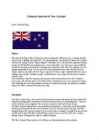
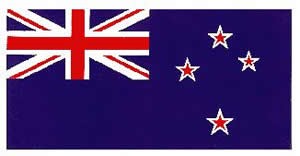
The New Zealand flag is the symbol of the realm government and people of New Zealand. Its royal blue background is reminiscent of the blue sea and clear sky surrounding NZ. The stars of the Southern Cross emphasise the country 's location in the South Pacific Ocean .
The New Zealand Flag features , on a royal blue background, a Union Jack in the first quarter and four five -pointed red stars of the Southern Cross on the other part of the flag. The New Zealand Flag is the national symbol of this country and accordingly it should be honoured and treated with respect . The New Zealand Flag may be flown on any day of the year , usually during normal working hours, and in a variety of places .
The New Zealand Flag should never be flown in a bad and unrespectful condition.
New Zealand's Coat of Arms
History of the New Zealand Coat of Arms
Until 1911, New Zealand used the same national coat of arms as the United Kingdom. When New Zealand became a Dominion in 1907, it was decided that a new Coat of Arms was required .
The competition was hold in 1908 and 75 designs sent their version . Three entries were sent to England for final judging. The winning entry was a design by James McDonald, a draughtsman in the Department of Tourist and Health Resorts.
Although the Royal Warrant of 1911 gave a description of the New Zealand Coat of Arms, by the mid 1940s it was found that there were at least 20 versions of the design in use. A committee was established to arrange for the redrawing and standardisation of the Arms, and a revised version received The Queen 's approval in 1956. This version is used until now.
Description of the New Zealand Coat of Arms
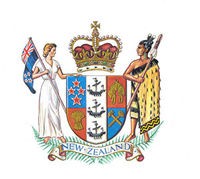
Four stars stand fot the representatives of the Southern Cross, then three ships symbolize the importance of New Zealand's sea trade; a fleece represent the farming industry. The wheat sheaf represents the agricultural industry, the crossed hammers represent the mining industry.
The supporters on either side of the shield consist of a Maori Chieftain holding a taiaha (a Maori war weapon ) and a European woman holding the New Zealand Ensign.
The crown symbolises the fact that Her Majesty is Queen of New Zealand under the New Zealand Royal Titles Act 1953.
Use of the Coat of Arms
The use of the New Zealand Coat of Arms is restricted to Government. It may not be used by private individuals or organisations.
Private persons and organisations may display the Arms as a decorative feature on particular national occasions, for example Royal Visits, and Jubilee celebrations provided the display is not a permanent feature. Use of the Arms may be permitted on permanent souvenirs of a particular event, for example a Royal Anniversary or Visit. Advice of permission to use the Arms in this manner is published in the New Zealand Gazette. Publishers of encyclopaedia, educational and heraldry books may be granted permission to reproduce the Arms in certain circumstances.
New Zealand's National Anthems
The words for "God Defend New Zealand" were written as a poem in the 1870s by Irish immigrant Thomas Bracken. A competition to compose music for the poem was held in 1876. The winner of the competition was John Joseph Woods of Lawrence, New Zealand who composed the melody in a single sitting the evening after finding out about the competition.
The song became increasingly popular during the 19th century and early 20th century, and in 1940 the New Zealand government bought the copyright and made it New Zealand's national hymn.While being used as New Zealand's national anthem at the British Empire Games from 1950 onward, it was first officially used at the Olympic Games in 1972. Following the performance at the Munich games, a campaign began to have the song adopted as the national anthem.
In 1976 a petition was presented to parliament asking for it to be made the national anthem, and, with the permission of Queen Elizabeth II, it became the country's second national anthem on November 21, 1977, on equal standing with God Save The Queen. Up until then God Save The Queen was New Zealand's national anthem.
Kiwi as a national bird
A kiwi a flightless bird, about 45 cm high an weighs about 3.3 kg. All kiwi species are endangered . The kiwi lays the largest egg in relation to its body size.
The Kiwi as a symbol first appeared in the late 19th century in New Zealand regimental badges. It was later featured in the badges of the South Canterbury Battalion in 1886 and the Hastings Rifle Volunteers in 1887. Soon after, kiwis appeared in many military badges.
During the First World War, the giant kiwi was carved on the chalk hill above Sling Camp in England. During the war, the name "Kiwi" for New Zealand soldiers came into general use.
The Kiwi bird has since become the well- known national symbol for New Zealand. All New Zealanders overseas (and at home) are still called "Kiwis". The Kiwi is still closely associated with the Armed Forces of NZ. The New Zealand dollar is often referred to as the "Kiwi", and the kiwi fruit is known as a "Kiwi" in some countries. Kiwis are prominent in the coat of arms, crests and badges of many New Zealand cities, clubs and organisations.
Used sources :
http://www.mch.govt.nz/emblems/index.html
http://en.wikipedia.org/wiki/Category:National_symbols_of_New_Zealand
http://www.chemistry.co.nz/kiwibird.ht m
http://www.chemistry.co.nz/new_zealand_national_anthem.ht m
http://flagspot.net/flags/nz.html
http://www.123independenceday.com/newzealand/national-flag.html
National Symbols of New Zealand #1 National Symbols of New Zealand #2 National Symbols of New Zealand #3 National Symbols of New Zealand #4
Punktid 50 punkti Autor soovib selle materjali allalaadimise eest saada 50 punkti.
Leheküljed ~ 4 lehte Lehekülgede arv dokumendis
Aeg2009-04-19 Kuupäev, millal dokument üles laeti
Allalaadimisi 8 laadimist Kokku alla laetud
Kommentaarid 1 arvamus Teiste kasutajate poolt lisatud kommentaarid
Autor synne Õppematerjali autor

Kasutatud allikad

Sarnased õppematerjalid

New Zealand - lühireferaat
3
docx

New Zealand - lühireferaat

New Zealand New Zealand is an island country. It is in the south-western Pacific Ocean comprising two main island, North- and the South Island with lots of smaller islands. New Zealand is notable for its geographic isolation. It's about 1,600 kilometers from Australia and its closest neighbours to the north are New Caledonia, Fiji and Tonga. New Zealand's total land area is 268,021 square kilometers. The country extends more than 1600 kilometers along its main,north - north-east axis and has about 15,000 kilometers of coastline. The South Island is the largest land mass of New Zealand and is divided along its

inglise teaduskeel
New-Zealand
12
docx

New-Zealand

Misso Keskkool New Zealand Precis Compiler: Maiki Joakit Instructor: Mailis Teppo Misso 2011 New Zealand is an island country in the south-western Pacific Ocean comprising two main landmasses (the North Island and the South Island), and numerous smaller islands, most notably Stewart Island/Rakiura and the Chatham Islands. The indigenous Mori language name for New Zealand is Aotearoa, commonly translated as land of the long white cloud. Population (1998): 3,801,000.New Zealand is notable for its geographic isolation; it is

Inglisekeelne geograafia
The Commonwealth of nations and the Brittish Empire
5
doc

The Commonwealth of nations and the Brittish Empire

This was a saying refering to the fact that Britian had colonies all around the world. 2. What is the Commonwealth? The Commonwealth is an association of sovereign nations that support each other and work together towards international goals. 3. When was it founded? 1931 4. Who were the founder members? Great Britain, the Irish Free State (now the Republic of Ireland), Canada, Newfoundland (since 1949 part of Canada), Australia, New Zealand, and South Africa. 5. Are they still members? Why? Irish Free State left in 1949 with the republic of ireland acts, Newfoundland (since 1949 part of Canada), 6. What was the difference between the British Empire and the British Commonwealth of Nations? the british Empire has a constitutional monarchy, all countries were a part of the british Empire and the queen was the head of all countries,

Inglisekeelne geograafia
New Zealand
2
doc

New Zealand

Geography New Zealand is an island country in the Southwest Pacific Ocean. It lies about 1600 kilometres southeast of Australia, its nearest continental neighbour. New Zealand belongs to Polynesia, a large island group. The country consists of two main islands ­ The North Island and the South Island ­ and several dozen much smaller islands. The population is 4.1 million. New Zealand is a beautiful country of snowcapped mountains, green lowlands, beaches and many lakes and waterfalls. No place is more than 130 kilometres from the coast. Lakes, rivers, and waterfalls are found throughout New Zealand. Most of the lakes lie in the volcanic plateu of the North Island and in glacial valleys near the Southern Alps of the South Isaland. On both islands the rivers rise in the mountains and flow down to the sea

Inglise keel
New Zealand
3
doc

New Zealand

state of Colorado. North Island is volcanically active with three active volcanoes. South Island has the high snow covered mountain peaks and glaciers of the Southern Alps, a range running almost 500Km along the Island. The longest river is the Waikato on North Island (425 Km), the largest inland stretch of water is Lake Taupo also on North Island (607 sq Km) and the highest point is Mount Cook on South Island (3754 m). Over 75% of New Zealand is above 200m. Land use is broken down to about: forested 30% - meadows and pastures 50% - agricultural and under permanent cultivation 15% . Sheep and cattle graze on the rich farmland around Hamilton and New Plymouth in North Island and around Dunedin and Invercargill on South Island. It lies just west of the International Date Line and is among the first into the new millennium. People : New Zealand has a population of around 3.65 million.

Inglise keel
Inglise keelt kõnelevate maade ühiskond ja kultuur
6
docx

Inglise keelt kõnelevate maade ühiskond ja kultuur

SOCIETY AND CULTURE OF ENGLISH-SPEAKING COUNTRIES Introduction 1. Nowadays, English is so widely spoken that it can hardly be considered "a one nation's" language. The main countries where English is spoken are: the U.K, the U.S, Canada, Australia, the Republic of Ireland, New Zealand, West Indies 2. There are approx. 300-400 million speakers of English in the world. English occupies the 3rd place by its number of speakers; it is right behind Mandarin and Spanish. 3. ESL (English as a Second Language) ­ used in your own country (e.g. India) EFL (English as a Foreign Language) ­ used in a foreign country ESP (English for Specific Purposes) ­ used in business, airlines, hotels etc. 4

Inglise keel
BRITISH NATIONAL SYMBOLS
72
doc

BRITISH NATIONAL SYMBOLS

BRITISH NATIONAL SYMBOLS Research work CONTENTS CONTENTS.....................................................................................................................................2 INTRODUCTION............................................................................................................................3 1. BRITISH NATIONAL SYMBOLS..............................................................................................5 1.1 Great Britain and British story................................................................................................5 1.2 National Symbols and Nation Building..................................................................................5 1.3 The Use of Flags throughout History.....................................................................................6 1

British culture (briti kultuur)
Austraalia referaat inglise keeles
11
doc

Austraalia referaat inglise keeles

speaking about the country you may call it by its official name: Commonwealth of Australia. Australia is the smallest continent, but one of the largest countries in the world. Its area is about 7,6 million sq kilometers. Its population is about 20,0 million and most of the people live in bigger cities: Sydney (4.2 million), Melbourne (3.7 million), Brisbane (2 million) and in Canberra, Which is also the capital of Australia. National language in Australia is english and the monetary unit is Australian dollar. Australia is divided into 6 states and 2 territories. Symbols Australia has a British Union flag. It is red, white and blue. Five small stars represent the constellation Southern cross. The big star represents country's states and territories. In 1901 the flag was chosen from about 30000 entries in a public contest. It was officially adopted as Australian flag in 1953.

Inglise keel


Meedia

Kommentaarid (1)

Sannuts121 profiilipilt
Sannuts121: norm
20:49 03-05-2009


Sellel veebilehel kasutatakse küpsiseid. Kasutamist jätkates nõustute küpsiste ja veebilehe üldtingimustega Nõustun