 50 punkti
Autor soovib selle materjali allalaadimise eest saada 50 punkti.
50 punkti
Autor soovib selle materjali allalaadimise eest saada 50 punkti.
 ~ 2 lehte
Lehekülgede arv dokumendis
~ 2 lehte
Lehekülgede arv dokumendis
 2012-10-23
Kuupäev, millal dokument üles laeti
2012-10-23
Kuupäev, millal dokument üles laeti
 3 laadimist
Kokku alla laetud
3 laadimist
Kokku alla laetud
 0 arvamust
Teiste kasutajate poolt lisatud kommentaarid
0 arvamust
Teiste kasutajate poolt lisatud kommentaarid
 Kiisukene8
Õppematerjali autor
Kiisukene8
Õppematerjali autor
Standing with arms folded is sometimes viewed as a sign of arrogance. Always cover the mouth when yawning! Finnish Behaviour Finns believe there is a proper way to act in any circumstance and always expect courteous behaviour. Talk in moderate tones and do not do anything to call attention to yourself. Serial conversation is the rule - i.e. listen to the speaker, wait for them to finish and then reply. Interrupting is rude. Finnish Meeting Etiquette Greetings are formal, with a firm handshake, direct eye contact, and a smile. It is common practice to repeat your first and surname while shaking hands. When greeting a married couple, the wife should be greeted first. Finnish Gift Giving Etiquette If you are invited to a Finn's home, bring flowers, good
1. TELEPHONE ETIQUETTE · When answering the phone at your desk say..."Hello, this is Mr. or Ms. Smith". Do not say phrases such as... "Smith here!" or simply "Hello". · Many people think it is rude when you use call waiting to talk to someone else in the middle of the conversation you are having with them. · When using a cell phone, try to find a quiet spot to answer a call. It is considered particularly rude to leave a cell phone turned on in public places like: classrooms, libraries, movie theaters, churches, etc. 2. CLOTHES AND DRESS · Also, pay attention to how much of your body you are exposing (have uncovered) and whether it is appropriate for the situation. (Ex. shorts, sandals, a very short or very tight skirt, or low cut or too tight shirt, are really not appropriate for meetings, interviews, etc.) Wearing this type of clothing can also communicate the same negative things. · Men: socks should match their
Men should initiate greetings with women and the younger person always greets the older person. When meeting someone make sure you are stood up, offer direct eye contact and give a nice firm handshake. The most common greeting is "tere" ("hello"). Titles are very important. "Härra" is for Mr, "Prova" is Mrs and "Preili" is Miss. All should be followed with the surname. Only use first names once you have been invited to do so. Gift Giving Etiquette Gifts are usually exchanged for birthdays and at Christmas. Gifts need not be expensive as it is more about the thought than monetary worth. If you are invited to an Estonian's house, a decent gift is a bring a box of chocolates or flowers. Flowers should be given in odd numbers. Gifts are usually opened when received. Dining Etiquette Arrive on time. Punctuality is expected. Call if running late. Check to see if shoes are being worn in the house.
up. Do not get into immigration and aboriginal issues no matter how curious you are. Also, comments on accents will not be welcome, as they often distinguish social classes. Business meetings and meals *Regarding dress code, men should wear a dark coloured, conservative business suit. *Similarly, women should wear a smart dress or a business suit. *Punctuality is important, it better to arrive a few minutes early. *Offering gifts is not part of Australian business etiquette, but it is acceptable to bring a small gift from your country. *Table manners are same as in Europe. *The person making the invitation generally pays the bill in restaurants. However, it is usual for friends to split the bill. *If you are invited out for a drink, don’t recall the subject of business unless your counterpart does so. *In a pub, each person is expected to pay for a round of drinks. Avoiding your turn to pay will only create a bad impression of you. Body language
address who share cooking facilities and share a living room, sitting room or dining area. A household can consist of a single family, more than one family or no families in the case of a group of unrelated people. In the UK there were 27.2 million households in 2017, an average household size of 2.4. Though many people’s idea of the family has changed dramatically, in 2017, just over half of the population (51.0%) in England were married, compared to 93 percent in 1950. Included are the couples who cohabit without getting married, calling each other partners, and who often make their relationship official after the birth of their first child. Couples who live together are sometimes called common-law partners. The family picture of England today reflects a change away from the married couple model that dominated for most of the 20th Century. London has the smallest proportion of married couples.
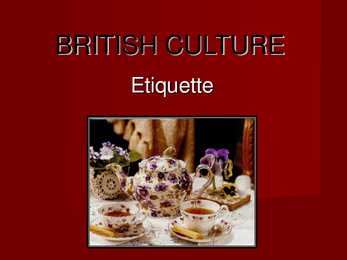
BRITISH CULTURE Etiquette Table of contents Everyday etiquette Time Eating etiquette English literature Sports Everyday Etiquette In general the British prefer to be introduced to strangers, if at all possible wait for a third party introduction when meeting someone new. Great Britain (especially England) is a non touching culture. When greeting someone a handshake accompanied by a "Pleased to meet you" is appropriate. When departing be sure to shake everyone's hand, a general group wave as is often done in the United States is not looked on favorably.
Intercultural communication What is business English? Loosely defined, BE refers to the Engl lg used in international trade or business. Loosely defined, BE refers to the Engl lg used in international trade or business. It is a specialized area of the Engl lg learning and teaching largely attributed to non-native English speakers Aim to enhance their chances of doing business with companies from English speaking countries. BE can refer to the study of business Engl voc used in the fields of trade, business, finance, or international relations. If the study focuses on techniques on business presentations, negotiations, correspondence, writing and other skills needed for business communications, then it can be classified as the study of Business English communication skills in the workplace. Both are important and used usually together. Culture. Barriers to Intercultural communication Synergy (from Greek for "working together") means that the combined effect is more than the effect o
1. How many public holidays or Red-Letter Days are there in Britain? Name them. 8 public holidays in Britain: two at Christmas, one for the New Year(which was only introduced in the late 1970s) two at Easter and three Bank Holidays. 2. What is the same and what is different about the way Christmas is celebrated in England and Estonia? In England, there's common to sing Carol's and for children, Christmas means pantomimes plays based on fairy tales which combine comedy, dance and song. A traditional Christmas dinner includes roast turkey with roast potatoes, a range of vegetables, cranberry sauce etc., followed by Christmas pudding and Christmas cake. The pulling of crackers(and the wearing of paper hats) before the meal is quite popular. Afterwards many watch the Queen's traditional Christmas address on TV at 3 pm
 annaabi.ee









Kõik kommentaarid