 100 punkti
Autor soovib selle materjali allalaadimise eest saada 100 punkti.
100 punkti
Autor soovib selle materjali allalaadimise eest saada 100 punkti.
 ~ 7 lehte
Lehekülgede arv dokumendis
~ 7 lehte
Lehekülgede arv dokumendis
 2010-03-21
Kuupäev, millal dokument üles laeti
2010-03-21
Kuupäev, millal dokument üles laeti
 15 laadimist
Kokku alla laetud
15 laadimist
Kokku alla laetud
 0 arvamust
Teiste kasutajate poolt lisatud kommentaarid
0 arvamust
Teiste kasutajate poolt lisatud kommentaarid
 roberta66
Õppematerjali autor
roberta66
Õppematerjali autor
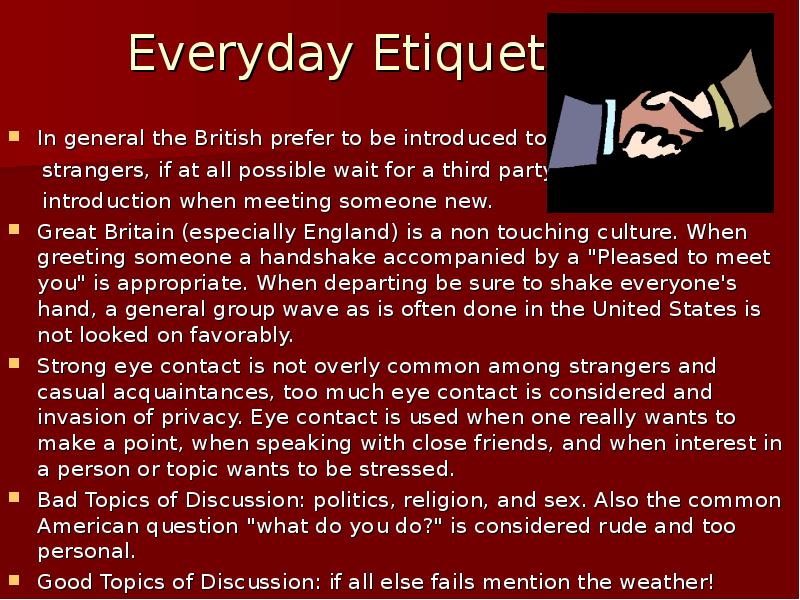
Etiquette in england *meeting and greeting · The British are reserved, which may cause them to appear cool and indifferent or overly formal. In fact, they are very friendly and helpful to foreigners. · Shake hands with everyone present men, women, and children at business and social meetings. Shake hands again when leaving. · Use last names and appropriate titles until specifically invited by your British hosts or colleagues to use their first names. *body language · The English tend to keep about an 23 feet between them while speaking. · Touching is usually kept to a minimum. · Family members are more relaxed and familiar with each other, so touching of the arms, elbows, or hands is acceptable. However in a business environment, touching is very minimal and personal space is respected much more than in a family setting.
Standing with arms folded is sometimes viewed as a sign of arrogance. Always cover the mouth when yawning! Finnish Behaviour Finns believe there is a proper way to act in any circumstance and always expect courteous behaviour. Talk in moderate tones and do not do anything to call attention to yourself. Serial conversation is the rule - i.e. listen to the speaker, wait for them to finish and then reply. Interrupting is rude. Finnish Meeting Etiquette Greetings are formal, with a firm handshake, direct eye contact, and a smile. It is common practice to repeat your first and surname while shaking hands. When greeting a married couple, the wife should be greeted first. Finnish Gift Giving Etiquette If you are invited to a Finn's home, bring flowers, good
Age, experience and position earn respect. Older people are generally viewed as wiser and as a result revered and honoured. Elders are introduced first and in general are treated much like royalty. Those in senior positions bear the responsibility to make decisions in the interest of the group. Due to seniority titles are very important when addressing people. It is expected that you will use a person's title and their surname until invited to use their first name. Cultural Traditions Estonian culture as an identity is very strong. Oral traditions especially have played a key role in preserving traditions, stories and customs during Soviet administration. Singing is a very Estonian activity and the Estonians are known to have sung their way to freedom during the "Singing Revolution" of 1989-91. Manners Estonians on the whole are quiet and reserved. They tend to speak softly and do not like to draw attention to themselves.
British Cuisine Some people criticize English food. They say it's unimaginable, boring, tasteless, it's chips with everything and totally overcooked vegetables. The basic ingredients, when fresh, are so full of flavour that British haven't had to invent sauces to disguise their natural taste. What can compare with fresh pees or new potatoes just boiled and served with butter? Why drown spring lamb in wine or cream and spices, when with just one or two herbs it is absolutely delicious? If you ask foreigners to name some typically English dishes, they will probably say "Fish and chips" then stop. It is disappointing, but true that, there is no tradition in England
rice. Apples, oranges, and pears have long been integral to the Irish diet, but are now joined by a wider variety of fruit that have become available since Ireland joined the European Union (EU). Smoked salmon is considered an Irish specialty, as are Irish stew and Irish lamb. Irish breads include soda bread and brack, a rich, dark loaf containing dried fruit and traditionally served at Halloween. Tea and coffee are popular drinks in the home, and Dublin is rapidly developing a café culture. Ireland is also the home of stout, a rich, black beer brewed by Guinness and Murphy's. The traditional cooked breakfast consists of any or all of the following: bacon, sausages, grilled or fried tomatoes, mushrooms, eggs, white and black pudding (a form of blood sausage) and toast or bread fried in fat or oil. Fewer people now eat such a morning meal, however, preferring a lighter breakfast. In recent years, the Irish, particularly those
1. TELEPHONE ETIQUETTE · When answering the phone at your desk say..."Hello, this is Mr. or Ms. Smith". Do not say phrases such as... "Smith here!" or simply "Hello". · Many people think it is rude when you use call waiting to talk to someone else in the middle of the conversation you are having with them. · When using a cell phone, try to find a quiet spot to answer a call. It is considered particularly rude to leave a cell phone turned on in public places like: classrooms, libraries, movie theaters, churches, etc. 2. CLOTHES AND DRESS · Also, pay attention to how much of your body you are exposing (have uncovered) and whether it is appropriate for the situation. (Ex. shorts, sandals, a very short or very tight skirt, or low cut or too tight shirt, are really not appropriate for meetings, interviews, etc.) Wearing this type of clothing can also communicate the same negative things. · Men: socks should match their
England Scotland • Capital is Edinburgh • Population about 5 million • Territory covers about 78 387 km2 Scotland Wales • Capital is Cardiff • Population 3 million • Territory covers 20 779 km2 Wales Northern Ireland • Capital is Belfast • Population 1,8 million • Territory covers 13 824 km2 Northern Ireland Culture • „Cultural superpower“ • Christian religious • Christmas and Easter are national public holidays • 95% of the British population speak English British etiquette and customs • The handshake is the common form of greeting • Avoid prolonged eye contact as it makes people feel uncomfortable • The British might seem a little stiff and formal at first • Introduce a younger person to an older person • Introduce a person of lower status to a person of higher status Gift giving • The British exchange gifts between family members and close friends for birthdays and Christmas
France business etiquette Keiu Peetsalu 2012 Main points France France economy France business etiquette Good to know Summary France France is the largest country in Western Europe and the third-largest in Europe France shares borders with six neighbours Capital : Paris Population; 65,350,000 Area; 674,843 km2 (41st) Economy France has the world's fifth largest economy by nominal figures Main export partners: Germany , Italy , Spain , Belgium, United Kingdom, United States , Netherlands
 annaabi.ee






Kõik kommentaarid