 50 punkti
Autor soovib selle materjali allalaadimise eest saada 50 punkti.
50 punkti
Autor soovib selle materjali allalaadimise eest saada 50 punkti.
 ~ 2 lehte
Lehekülgede arv dokumendis
~ 2 lehte
Lehekülgede arv dokumendis
 2014-04-27
Kuupäev, millal dokument üles laeti
2014-04-27
Kuupäev, millal dokument üles laeti
 2 laadimist
Kokku alla laetud
2 laadimist
Kokku alla laetud
 0 arvamust
Teiste kasutajate poolt lisatud kommentaarid
0 arvamust
Teiste kasutajate poolt lisatud kommentaarid
 hannaloora
Õppematerjali autor
hannaloora
Õppematerjali autor
honor him as a martyr. *St Andrew He is the patron saint of Scotland. He was a very humble man and to honour the Savior he had himself crucified on the X-shaped cross. It was not a regular cross, because he did not want to put himself on the same level than the Christ. The flag of Scotland feature St Andrew's X-shaped cross. The feast of Saint Andrew is held on November 30 in both the Eastern and Western churches, and is the national day of Scotland. *St David He is the patron saint of Wales. He was a model monk ad he established 12 monasteries in Wales. David contrasts with the other national patron saints of the British Isles, because he is a native of the country of which he is patron saint. He became known as a teacher and preacher, founding monastic settlements and churches. He rose to a bishopric, and and went on pilgrimages to Jerusalem and Rome. St David's Cathedral now stands on the site of the monastery he founded in the remote and inhospitable valley of 'Glyn Rhosyn' in
Most merchants were well educated, considered themselves equals of the esquires & gentlemen of the countryside. The lawyers were another class of city people. In London they were considered equal in importance to the big merchants & clots manufacturers. By the end of the Middle Ages the more successful of these lawyers, merchants, clots manufacturers, exporters, esquires, gentlemen and yeomen farmers were forming a class of people with interests in both ton & country. This was also true in Wales & Scotland. This class was literate. Created a new atmosphere. Questioned the way in which the Church & the state were organised, for both religious & practical reasons. Believed it was partly because it was not economically practical. They also questioned the value of the feudal system, because it didn't create wealth. The development of Parliament showed the beginnings of new relationship between the middle class & the king. Ed I had wanted his Parliament to provide him with money, but when
1940 King George VI inauguarated The George Cross- acts of grate heroism St Andrew Patron saint od Scotland as well as Creece russia Was one of the 12 apostles Travelled to Greece to preach christianity where he was crucified on an x-shaped cross- saltire, crux decusata St Andrews cross on Scotland flag Some remains in teh town St Andrews, a place of pilgrimage St david Patron saint of Wales Missioanry, ealry saint who travelled to Wales, sout-west England and Brittany Became archbischop of Wales He was preaching to crowd and the ground rise up. To a hill David founded monastery where St David stands today The Synod of Whitby 664 664 Oswy, king of Northumbria, called a meeting at Whitby- The Synod Of Whitby Which church practises should have precedence in his kingdom- celtic or roman? How to calculate day of easter?
1. Ancient Britain: the Celtic tribes. 2000 years ago there was an Iron Age Celtic culture throughout the Br Isles. It seems that the Celts, who had been arriving from Europe from the 8th cent BC onward, intermingled with the peoples who were already there. The Celts were extremely talented people, creative and artistic. More than 1 Celtic tribe invaded Br. The descendants of ancient Celts live in Wales, Scotland, Cornwall and Ireland. They lived in primitive society. Druids priests, more powerful than chiefs. Acted like prophets. 2. Stonehenge From prehistoric period. Was built on Salisbury plain between 2500 and 1500 bc. One of the most famous and mysterious archaeological sites in the world. One of the mysteries is how it was built at all with the technology of the time. Another is its purpose. It appears to function as a kind on
50 000 BC in a milder Ice Age period Britain became habitable again. People from that time were the ancestors of the modern British. 10 000 BC ige age ended and Britain became inhabited by small groups of hunters who probably followed herds of deer. 5000BC Britain became an island and deer died out. 3000BC the Neolithic people came (probably from Spanish peninsula or even North African coast). They may be the forefathers of the people from Cornwall and Wales. The building of Stonehenge started around that time. 2400BC the 'Beaker' people arrived in Britain. They had better metal working skills and they soon became the leaders of the British society. They started building individual graves. 1300BC the farming society became more important than the henge society. 55BC the Romans arrived. The Celts The Celts arrived from central Europe or further east around 700BC. They were tall and had fair or red hair and blue eyes
The United Kingdom The United Kingdom consists of England, Scotland, Wales and North Ireland and it is situated in the Atlantic Ocean near the mainland of Europe. The population of the UK is 58.6 million and area is 244,110 sq km. Britain has a temperate humid climate. Its characteristic features are mild winters, warm summer, no temperature extremes, abundant rain all year round and frequent changes of weather. The mild climate is partly due to the warm Gulf Stream and partly to the south westerly winds. Occasional winds from the east in winter may
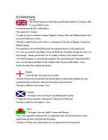
1) General facts The UK: * the United Kingdom of Great Britain and Northern Ireland was formed in 1801 * it covers 243,610 sq km * everybody from the UK is called British * the capital city is London * is made up of four constituent countries: England, Scotland, Wales and Northern Ireland which in turn are divided into counties * the flag is called the Union Jack which is a combination of the flags of England, Scotland and Northern Ireland * the population is about 60,000,000 people, the population density is 242 people/sq km * its coasts are washed by the Atlantic Ocean, the North Sea, the English Channel, the Celtic Sea, Saint George's Channel, and the Irish Sea. It is linked to France by the Channel Tunnel * the United Kingdom is a constitutional monarchy
Mercia, East Anglia, Northumbria). They were constant struggle against one another for predominance. From time to time some stronger state seized the land of the neighbouring kingdoms & made them pay tribute or even ruled directly. The number of kingdoms & their boundaries were always changing. The greatest & most important kingdoms were Kent, Northumbria, Mercia & Wessex. King Offa of Mercia claimed ,,Kingship of the English". His power his shown by the border barrier he built between Mercia & Wales Offa's Dyke. It probably took 5000 men to build it. It stretches for about 180 km, was 7 metres high, the ditch in front of it 2 metres deep. By the beginning of the 9th cent. Wessex had become the strongest. Wessex never again lost its supremacy. In 829 King Egbert was acknowledged by Kent, Mercia & Northumbria. This was the beginning of the united kingdom. King Egbert became 1st King of England. The clergy, royal warriors & officials supported the king's power
 annaabi.ee







Kõik kommentaarid