 5 punkti
Autor soovib selle materjali allalaadimise eest saada 5 punkti.
5 punkti
Autor soovib selle materjali allalaadimise eest saada 5 punkti.
 ~ 2 lehte
Lehekülgede arv dokumendis
~ 2 lehte
Lehekülgede arv dokumendis
 2009-04-01
Kuupäev, millal dokument üles laeti
2009-04-01
Kuupäev, millal dokument üles laeti
 3 laadimist
Kokku alla laetud
3 laadimist
Kokku alla laetud
 0 arvamust
Teiste kasutajate poolt lisatud kommentaarid
0 arvamust
Teiste kasutajate poolt lisatud kommentaarid
 mew
Õppematerjali autor
mew
Õppematerjali autor
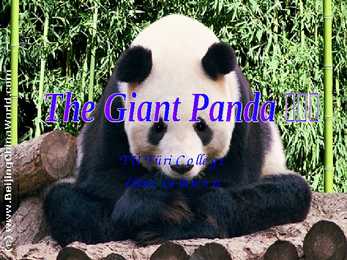
T Ü T üri C o lle g e Liina Le inm e ts Introduction · Panda (Ailuropoda melanoleuca) is a mammal classified in the bear family, native to centralwestern and southwestern China. It is easily recognized by its large, distinctive black patches around the eyes, over the ears, and across its round body. · The Giant Panda lives in a few mountain ranges in central China. · It once lived in lowland areas, but farming, forest clearing, and other development now restrict the Giant Panda to the mountains. In the wild · The Giant Panda is a · Pandas communicate terrestrial animal and through vocalization primarily spends its life and scent marking such roaming and feeding in as clawing trees or the bamboo forests. spraying urine
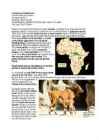
Tundra animals Reindeer Reindeer were first domesticated in Norway and northern Asia. When it was seen how valuable they were, they were brought to Alaska in 1887 and later to parts of Canada. These North American reindeer became known as caribou. Although they are called by different names, they are both considered to be a single species. Unlike deer, both the male and female have antlers. The antlers of the male are long, branched and massive, and they are a little flattened at the ends. The antlers of the female are much shorter, simpler and more slender and irregular. Their large, spreading hooves support the animal in snow in the winter and marshy tundra in the summer. Reindeer are also great swimmers and use their feet as paddles. They can also lower their metabolic rate and go into a semi-hibernation when conditions get very harsh. When it looks like there is nothing to eat on the winter tundra, reindeer will scrape the snow away wit
found on barren black lava flows Iguanas on the Galapagos are either land or marine iguanas. Both are about the same size, growing up to about 1.5m, have stocky heads, a ridge of spiny scales along the neck and backbones. Land iguanas are lighter in color, tan to dark brown, and have shorter scales on the backbone. Land iguanas are inland, lesser in number, and feed on cactus . There are 11 remaining races of the Galapagos Giant Tortoises. They eat grasse, cacti, and other vegetation. They can go for more than a year without drinking or eating. The most famous tortoise from Galapagos is the Lonesome George who was found in 1971 on the island of Pinta. He is the sole survivor of his race. There are four forms of sea turtles living in the Galapagos. Their front legs have modified into flippers for the water. They breathe air, but can stay submerged for a long time. Depending on
Tundra swans Tundra swans ● Whooper swan, Bewick´s swan and mute swan (laululuik, väikeluik, kühmnokk-luik) Whooper swan ● Large white swan (bigger than bewick) ● Lenght – 140 to 165 cm ● Deep honking call and powerfull fliers ● Require large areas to live in ● Adult birds – feathers entirely white, black feet, mostly black bill ● Pens (females) – slightly smaller than cobs (males) ● Immatures – white mixed with some dull grey feathering; bills – black, large dirty-pink patch ● In Estonia first nesting - 1979 Whooper swan Behaviour of whooper swan ● Pair for life, cygnets stay with them all the winter ● Breffered breeding habitat – wetlands ● Both build the nest ● Male will stand guard over the nest while female incubates ● 4 to 7 eggs Influence of whooper swan ● Much admired in Europe ● National bird of
The Mountain Lion cougar (Puma concolor), also puma, cougar, or panther, is a member of the Felidae family, native to the Americas. This large, solitary cat has the greatest range of any wild land mammal in the Western Hemisphere, extending from Yukon in Canada to the southern Andes of South America. An adaptable species, the cougar is found in every major North American habitat. The Mountain lions of Yellowstone region were significantly reduced by predator control measures during the early 1900s. It is reported that 121 lions were removed from the park between the years 1904 and 1925. Then, the remaining population was estimated to be 12 individuals. Mountain lions apparently existed at very low numbers between 1925 and 1940. They maintain a secretive profile in the Yellowstone region. Although the cougar population numbered in the hundreds during the early 1900s, controlled hunts between 1904 and 1925 decimated the population. Today, twenty to thirty-five mountain lions reportedly i
AMBER AND RUSSET - LATE COLOUR CHANGE GENES Copyright 2014, Sarah Hartwell The ancestors of the domestic cat were nondescript black/brown striped tabbies. Over the centuries, mutation produced a wide array of colours based on 2 different pigments. Eumelanin gives the blacks, browns and blues while phaeomelanin gives the reds, fawns and creams. A few other genes give further variations on those colours such silvers, colourpoints and solids/selfs. Mutations continue to occur and unexpected colours also turn up due to inbreeding where recessive genes, hidden for generations, start showing up. AMBER AND LIGHT AMBER During the 1990s, some purebred Norwegian Forest Cats in Sweden produced chocolate/lilac and cinnamon/fawn offspring. However, those colours are not found in the purebred Norwegian Forest Cat gene pool. Had the gene pool become polluted by someone, perhaps generations ago, breeding their Norwegian Forest Cat to another breed? Was it a spontaneous mutation? Crossing of those c
Topic Australia Tallinn English College 2006 Australia 1 . Introduction The name Australia is derived from the Latin Australis, meaning of the south. In land area, Australia is the sixth largest nation, its territory is 7,686,850 sq km and its population reaches today over 20,5 million people. It is the only nation to govern an entire continent and its outlying islands. Australia's capital is Canberra, the only city with its own territory. It was built in the early 1900s just to be the capital. The official language is English and the official name of Australia is the Commonwealth of Australia. Australia is located on the Southern Hemisphere (because of that Australia is also called "A land down under"). 2 . Geographical position Australia is an island continent and it is located between the Indian and South Pacifi
Cultivation and uses A sunflower farm near Mysore, India. Sunflower heads solds as snacks in China. Sunflowers are native(pärit) to the Americas. The earliest known examples of a fully domesticated sunflower were found at the Olmec site of San Andrés dating some time before 2500 B.C.[1] The Incas used the sunflower as an image of their sun god. Gold images of the flower, as well as seeds, were taken back to Europe early in the 16th century. The Giant sunflower (Hlianthus giganteus) is native to Connecticut. They can grow to be between 3 and 12 feet tall. Their flower heads can be between 2 to 3 inches wide. They are most commonly found in valleys with wet meadows or swamps. The Giant sunflower grows between July and October. To grow well, sunflowers need full sun. They grow best in fertile, moist, well-drained soil with a lot of mulch. In commercial planting, seeds are planted 45 cm (1.5') apart and 2.5 cm (1") deep.
 annaabi.ee







Kõik kommentaarid