 100 punkti
Autor soovib selle materjali allalaadimise eest saada 100 punkti.
100 punkti
Autor soovib selle materjali allalaadimise eest saada 100 punkti.
 ~ 16 lehte
Lehekülgede arv dokumendis
~ 16 lehte
Lehekülgede arv dokumendis
 2009-01-27
Kuupäev, millal dokument üles laeti
2009-01-27
Kuupäev, millal dokument üles laeti
 23 laadimist
Kokku alla laetud
23 laadimist
Kokku alla laetud
 0 arvamust
Teiste kasutajate poolt lisatud kommentaarid
0 arvamust
Teiste kasutajate poolt lisatud kommentaarid
 p2evakoer
Õppematerjali autor
p2evakoer
Õppematerjali autor
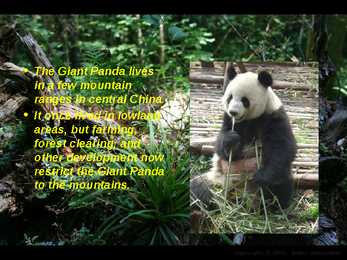
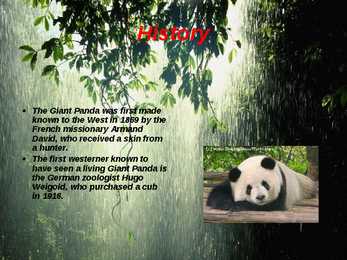
Wildlife under threat Giant panda The giant panda lives in a few mountain ranges in central China. As a result of farming, deforestation and other development, the panda has been driven out of the lowland areas where it once lived. The Chinese language has given the bear 20 different names, such as ,,large bear cat'' or ,,bamboo bear'. Unlike other bear species, pandas have round pupils. Pandas are known for their large black patches around their eyes, ears and across their round bodies. Male pandas can weigh up to 160 kg and females can weigh as little as 75 kg. The giant panda's thick, wooly coat keeps it warm in the cool forests. It has strong
time running out before the building work begins, extinction is imminent for a species that was only recently added to the UK's red list of endangered species. Can China's rare `bear' survive? Pandas are not a species at an `evolutionary dead end' as is sometimes claimed, according to new research that has been carried out by scientists at Cardiff University and in Sichuan in China. Previous findings have suggested that the serious decline in giant panda numbers in modern times is related to its unusual dietary requirements the species exists almost entirely on bamboo habitat isolation and relatively slow reproductive rate. But this new study, published in Molecular Biology and Evolution, has uncovered an important relationship between the species' decline and human activities. "It is clear that the species has suffered at the hands of human activities such as deforestation and poaching," said Professor Michael Bruford.
and black ears. o The muzzle area around the nose is also covered in white fur. Ha b i t a t o Red Pandas live in Nepal, Burma, southern China and surrounding areas. o They live in Himalaya forests and in mountains, bamboo forests and thickets. Live in trees. o Be h a v i o r Red pandas are fast climbers and will use their tails to balance o when running in trees. Red panda sleeps during the day. o When they wake up, then they clean their fur like cats. o Their enemy is snow leopard. o Red pandas use their sharp claws to defend themselves. o They can even stand up for ten seconds. o Ba b y r e d pa nd a s o They make dens and hiding places for the small panda cubs. Cubs are born in June or July. o Red pandas have one to four babies in a year. o For the first four months, cubs eat milk. o
1976 to 13 000 in 2013. 85 000 elephants were lost to poaching in Tanzania between 2009 and 2014. Even though zoos compared to reserves are really small, they are still important in preserving animal species. Also, some of the animals lose their natural habitat completely due to the natural disasters or something even worse like pollution caused by who?-human being. It is really hard to accept the fact that we are trying to protect something from ourselves. Giant panda in south central China does not have a "home" anymore. Chinese Wolong National Nature Reserve with the help of UNESCO World Heritage Site and Japanese zoos are helping to preserve panda bears. A 2006 New York Times article outlined the economics of keeping pandas, which costs five times more than that of the next most expensive animal, an elephant. American zoos generally pay the Chinese government $1 million a year in fees, as part of a typical ten- year contract.
Protecting endangered species will make a difference in humans' life In the nature of humankind it is natural to hunt animals. However, nowadays hunting endangered species will make humans be just killers, because it is not necessary to kill something just to have a trophy on the wall at home. People can be proud of what they have done, but decreasing the population of a species largely will cause the specific animal breed to go extinct faster than it would happen via natural causes. Therefore, humans should stop hunting endangered species to slow down their extinction, as these species offer balance in the wildlife, are used without purpose in medicine, and may even reduce poverty. Species on the brink of extinction affect us more than we realize. Sure, pandas are cute, and rhinos are fun to look at, but is there anything more to that? All animals and plants form a very important part of our ecosystem that also includes our lands and waters. Remove one part from the environment
Endangered species The Giant Panda lives in central-western and southwesterns China. Although the panda is a carnivore, he has a diet which is 99% bamboo. Like most subtropical mammals, but unlike most bears, the giant panda does not hibernate. The Giant Panda is endangered as there are only 2,000-3,000 of them living in the wild and about 270 living in captivity. They have become endangered due to the destruction of their habitat and the variety of bamboo that is decreasing. They are also illegally hunted for their fur. To protect them, there have been many special wildlife parks set up. Elephants live in Central Africa and are the largest land animals alive today. They eat grass, twigs and some fruit. In many
on its edge. The tail is long, and ends with a dark tuft of hair. Both sexes have tightly spiralled horns, which are relatively straight. In males the horns form a wide "V" and can grow to 120 cm (4 ft) in length, slightly longer than on females. Ontogeny and Reproduction Gestation Period: 9 months Young per Birth: 1 Weaning: After 6 months. Sexual Maturity: Females at 15-36 months, males at 4-5 years. Life span: Up to 25 years. Primarily nocturnal, Giant Elands are highly nomadic, with large home ranges and seasonal migration patterns. During the day, herds often rest in sheltered areas. A gregarious species, Giant Eland herds usually consist of twenty or more animals and do not disband during the wet season, suggesting that social rather than ecological factors are responsible for herding. There is no evidence of territoriality, and males rarely display aggression, even during the breeding season. Giant Eland are alert and wary,
Tiger Summary Lilli Lakkur Biology, course 1 Today tigers are facing extinction but there are also some National Parks where they are protected. There is a National Park in the heart of India where a female tiger is trying to raise a family. She has got three little cubs. They are only nine weeks old and need mother's milk and protection. She is a successful mother because she knows how to take care of her cubs. The male tiger doesn't help her to raise the cubs. Male tigers also don't like being followed and they fight for their territory in order to mate several females. In fact male tigers are a huge danger to young cubs and one of their main enemies. Females also fight for territory but they do it so as to have more food. Mother tiger can track her cubs by scent. She gives her offspring killing lessons in a form of games because playing is a crucial part of survival. Cubs also grow fast
 annaabi.ee









Kõik kommentaarid