Leidsid 33 sarnast õppematerjali, mis on seotud failiga "British Parliament". Need materjalid aitavad sul teemat sügavamalt mõista.
parliament, government, member, members, elect, bill, lords, bills, british, major, experience, vote, prime, leader, king, queen, known, year, function, sign, former, given, majority, houses, role, power, tradition, important, political, nation, party, accept, even, chamber, proposal, parties, session, official, motion, project, structure, above, monarchand practices. Anglican church(es) The Anglican Communion is an international association of independent churches consisting of the Church of England and national and regional Anglican churches in full communion with it. Full participation in the sacramental life of each church is available to all communicant Anglicans. The Kirk = the Church of Scotland is Presbyterian in its structure, governed by a system of local, regional and national 'courts' or councils. 'Presbyterian' government refers to the sharing of authority in the church by an equal number of 'elders' (elected from the membership of the church) and ministers. Evangelical = low church The Low Church movement can trace its roots back to the early 18th century but is primarily associated with the opposition to the Anglo-Catholic movement of the later 19th century. Low Church placed great emphasis on preaching, personal piety and the
THE U.K Different Parts The United Kingdom is a short way of saying the United Kingdom of Great Britain and Northern Ireland. The UK is the political name for those countries which share a parliament in London. All of them were at one time independent kingdoms with their own monarch. Now they are all part of the same kingdom and share the same monarch. The UK consists of Northern Ireland, Scotland, England and Wales. The peoples of these countries are British subjects; they hold British passports and therefore their nationality is British. The british Isles is the geographical name for all the islands off the west coast of Europe.
Describe the British Parliament Works in a large building called the Palace of Westminster aka The Houses of Parliament. There are offices, committee rooms, restaurants, bars, libraries and even some places of residence. Two large rooms: The House of Lords meet in one and the House of Commons in the other. The British Parliament is divided into two houses, but the House of Commons is obviously more important and only they are considered to be the MPs. In the House of Commons there are just two rows of benches facing each other. On the left sit the members of the governing party and on the right sit the opposition. The Speaker sits between them and controls the action. The arrangement of the benches encourages confrontation between the government and the opposition. There is no place for somebody
progressing to the last. 12.French influence on the English language English language originally sprang from the dialects of three Germanic tribes known by historians as the Angles, Saxons, and Jutes. These peoples settled in Britain around 450 AD. Their language became known as Anglo-Saxon. One of the most important influences ever to shape the English language arrived in 1066 AD-William the Conquerors invasion of the British Isles. The Norman Conquest and its Consequences On William the Conqueror's accession to the throne of England, several important changes took place. Firstly, the French dialect the Normans spoke (Anglo-Norman) became the official language of the court, administration, and perhaps just as importantly, the language of culture. At the same time, English was relegated the common people, and became the language of everyday use. This official
1. The Queen’s official title. Elizabeth the Second, by the Grace of God, of the United Kingdom of Great Britain and Northern Ireland and of Her other Realms and Territories Queen, Head of the Commonwealth, Defender of the Faith. 2. The Queen’s working day. Starts after breakfast. Reads the newspapers which are prepared by the Press Secretary, and a report on the previous day’s proceedings in the Parliament and the letters she receives. Also phone calls. Once a month she attends the Privy Council in order to give Royal Assent to various items of government legislation. Discusses domestic matters with the Master of the Household. Towards the end of the day, there is always another pile of official papers and reports waiting to be read or acted upon. The business on constitutional monarchy never ends. 3. Who is the present heir to the throne
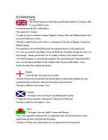
The Scottish flag has a white cross on a blue background. It is also on the Union Jack. Northern Ireland is the smallest part of the UK as it only covers about 5500 square kilometres. About half of the 1.7 million inhabitants live in or around Belfast, the capital, in the eastern coastal region. The centrepiece of Northern Ireland's geography is Lough Neagh, at 151 square miles (392 km²) the largest freshwater lake both on the island of Ireland and in the British Isles, and the third largest lake in Western Europe. A second extensive lake system is centred on Lower and Upper Lough Erne in Fermanagh. Northern Ireland don't have an official flag any more nor a coat of arms. Due to the division of the population along ethnic, religious and political lines, a wide variety of flags can be seen flying from lampposts and private houses across Northern Ireland. Government. The British Constitution is an unwritten constitution, not being
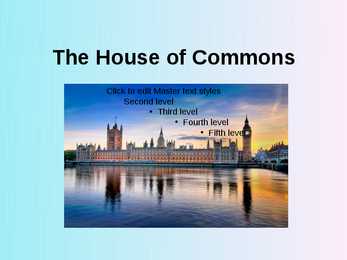
The House of Commons Click to edit Master text styles Second level Third level Fourth level Fifth level The House of Commons is the lower house of the Parliament of the United Kingdom, which also comprises the Sovereign and the House of Lords. It consists of 650 elected members called Members of Parliament. The House of Commons was originally far less powerful than the House of Lords, but today its legislative powers greatly exceed those of the Lords. The full, formal style and title of the House of Commons is The Honourable the Commons of the United Kingdom of Great Britain and Northern Ireland in Parliament assembled. Role The House of Commons main purpose is to make laws by passing Acts of Parliament, as well as to discuss current political issues
UK Parliament Parliament of the United Kingdom The Parliament of the United Kingdom is the highest legislative body in the United Kingdom and British overseas territories. It alone has parliamentary sovereignty over all other political bodies. At its head is the Queen Elizabeth II. The parliament has an upper house, the House of Lords, and a lower house, the House of Commons. The House of Lords plays an important role in checking and challenging the decisions and actions of the government through questions and debates. A House of Commons evolved at some point in England during the 14th century, becoming the House of Commons of Great Britain after the political union with Scotland in 1707. How laws are made Most new laws passed by Parliament result from proposals made by the government. Proposals aim to shape society or address particular problems. Normally, they are created over a period of time. History
1) General facts The UK: * the United Kingdom of Great Britain and Northern Ireland was formed in 1801 * it covers 243,610 sq km * everybody from the UK is called British * the capital city is London * is made up of four constituent countries: England, Scotland, Wales and Northern Ireland which in turn are divided into counties * the flag is called the Union Jack which is a combination of the flags of England, Scotland and Northern Ireland * the population is about 60,000,000 people, the population density is 242 people/sq km * its coasts are washed by the Atlantic Ocean, the North Sea, the English Channel, the Celtic Sea,
REVISION QUESTIONS 1. What do you know about Margaret Thatcher? Winston Churchill? Margaret Thatcher was the first female Prime Minister in Europe. She was a member of the conservative party. She died recently. Winston Churchill was the Prime Minister during WW II. He was excellent in making speeches, but he was a heavy drinker and also smoker. 2. What are the main countries of the UK and their capitals? There are 4: England with London as the capital; Wales with Cardiff as the capital; Scotland with Edinburgh as the capital; and Northern Ireland with Belfast as the capital. 3
It was not a regular cross, because he did not want to put himself on the same level than the Christ. The flag of Scotland feature St Andrew's X-shaped cross. The feast of Saint Andrew is held on November 30 in both the Eastern and Western churches, and is the national day of Scotland. *St David He is the patron saint of Wales. He was a model monk ad he established 12 monasteries in Wales. David contrasts with the other national patron saints of the British Isles, because he is a native of the country of which he is patron saint. He became known as a teacher and preacher, founding monastic settlements and churches. He rose to a bishopric, and and went on pilgrimages to Jerusalem and Rome. St David's Cathedral now stands on the site of the monastery he founded in the remote and inhospitable valley of 'Glyn Rhosyn' in Pembrokeshire. *The Synod of Whitby 664 The Roman monks who were sent to convert the "English" to
Alberta is rich in natural resources such as oil and natural gas. In Quebec and Ontario are many manufactories and industries. In the west there is maritime climate and so they fish and ship there. Toronto is the biggest city in Canada, with a population of 5,1 million people. It is followed by Montreal with 3,9, Vancouver, Ottawa (which is the capital of Canada) 800 000 and Quebec with 700 000. Government Canada is a federation of ten provinces (Alberta, British Columbia, Manitoba, New Brunswick, Newfoundland and Labrador, Nova Scotia, Ontario, Prince Edward Island, Quebec, and Saskatchewan) and three territories (Northwest Territories, Yukon, and Nunavut). Formally considered a constitutional monarchy, Canada is governed by its own House of Commons. While the governor-general is officially the representative of Queen Elizabeth II, in reality the governor-general acts only on the advice of the Canadian prime minister.
10 million square kilometres, but is one of the most sparsely populated, with only about 34 million inhabitants. The majority of them live within 300 kilometres of Canada's southern border. Much of the rest of Canada is uninhabited or thinly populated, because the country has a rugged terrain and severe climate. Canada extends across the continent of North America, from Newfoundland on the Atlantic coast to British Columbia on the Pacific coast and northward into the Arctic Ocean. Canada shares land borders with the United States to the south and north-west. Canada is a land of great variety. Towering mountains, crystal-clear lakes, and lush, green forests make Canada's far west a beautiful region. Farther inland, fields of wheat and other grains cover Canada's vast prairies. Thes fertile farmlands contrast vividly with the Arctic wastelands to the north
Highlands and Lowlands, and a large number of royal minorities. Modern history In 1603, James VI King of Scots inherited the throne of the Kingdom of England, and became King James I of England, and left Edinburgh for London. With the exception of a short period under the Protectorate, Scotland remained a separate state, but there was considerable conflict between the crown and the Covenanters over the form of church government. After the Glorious Revolution, the abolition of episcopacy and the overthrow of the Roman Catholic James VII by William and Mary, Scotland briefly threatened to select a different Protestant monarch from England. On 22 July 1706 the Treaty of Union was agreed between representatives of the Scots Parliament and the Parliament of England and the following year twin Acts of Union were passed by both parliaments to create the united Kingdom of Great Britain with effect from 1 May 1707.
· Her actual birthday is 21st April but it is a long-standing tradition to publicly celebrate her birthday on a summer day. · This tradition dates back to the early 18th century when the Colours of the battalion were carried past soldiers to reinforce the colours of their regiment so that they would recognise them in battle. · Ever since 1748 this ceremony has also marked the Sovereign's birthday. State Opening of Parliament · Dating back to Medieval London, this spectacular annual ceremony marking the beginning of the new parliamentary year takes places in October or November and features peers and bishops in traditional robes and a royal procession involving the State Coach . · The Yeomen of the Guard are responsible for searching the cellars of the Houses of parliament before the Queen arrives. · A duty undertaken ever since the infamous Gunpowder Plot of 1605 when Guy
ACCESS ASSESSMENT COVER SHEET Student Name: Alex Callaghan EC1305063 Course: Access to Humanities Tutor: John Gordon Assessment Title: Critically evaluate Locke's theory of limited government Number of Words 1616 NOTE: The ESSAY should be 1500 words in length. Student signature - Alex Callaghan Date - 24/04/2014 Critically evaluate Locke's theory of limited government The end of law is not to abolish or restrain, but to preserve and enlarge freedom. For in all the states of created beings, capable of laws, where there is no law there is no freedom. John Locke Although John Locke is not the progenitor of social contract theory and is not by any means the last philosopher to wrestle with this concept, his views on fiduciary power, majority consent and limited government have been instrumental in western
Conversion of Irish- 432-461 Patron saint of Ireland, originally pagan, slave He escaped, became a Christian priest and later bishop. Ireland was largely christian by 6th C Monasteries multiplied, monastic lines, provinces were ruled by abbots St Columba 6th, 7th C Irish sent missionaries to Gaul, Germany, Scotland and England St Columba went to Scotland, converted Picts, 563 founded a monastery of island Iona Credited with major role in converting Scotland to Christianity St Aidan Irish missionary, King Oswalds of Northumbria bishop Had qualities to convet Northumbria. After monastery of Lindisfarne 635 had built he set up a church in royal village He always travelled on foot, Several monasteries were founded St Augustine 597 Christ church influenced English society of kings, warriors ad farmers Pope Gregory the Great, sent the first mission
made Britain a Roman province. They stayed for three hundred years, and built villas, roads and towns. Many Roman remains can be visited in Britain today. The Romans finally abandoned Britain in AD 410 and a long period of invasion by Nordic peoples (from northern Germany and Scandinavia) started. The Angles, Saxons and Jutes began to settle from the sixth to the eighth centuries, and the Angles gave England its name. These invaders introduced a new culture to Britain, and even today British customs and habits are described as ´Anglo-Saxon`. Anglo-Saxon England was one of the most civilised countries in Europe, with organised systems of agriculture and trade. The Vikings came from Scandinavia in the tenth century; they settled in the north and made the town of York the capital of their kingdom. The last successful invasion of Britain was in 1066, when William the Conqueror defeated the English at the Battle of
HOUSES OF PARLIAMENT Houses of Parliament also known as the Palace of Westminster is one of the most attractive buildings in London. It stands on the site where Edward the Confessor had the original palace built in the first half of the eleventh century . In 1547 the royal residence was moved to Whitehall Palace, but the Lords continued to meet at Westminster, while the commons met in St. Stephen's Chapel. Ever since these early times, the Palace of Westminster has been home to the English Parliament. In 1834 there was a huge fire that destroyed much of the old palace. All that remained was the chapel crypt, The Jewel Tower and Westminster Hall. It was Lord Melbourne, the Prime Minister, who saved the great hall by arranging for the fire
world. The capital of Canada is Ottawa the name of whose comes from the old Algonquin language, with the original word meaning `to trade'. Due to the country's huge size and position, it is very diverse. It is bordered by the Pacific Ocean to the west, the Atlantic to the east, and the Arctic to the north. The landscapes differ greatly from rolling plains and mountains to the cold tundra in the northern part of the country. Geographically, the country's split into 5 major regions the Pacific, the Prairie Provinces, Central Canada, the Atlantic Provinces and the North. The Pacific Region is known for its mild coastal climate, its forests and its spectacular mountains. The three Prairie Provinces are known for their rolling plains and their extreme climate with long, cold winters and hot, dry summers. Part of the Rocky Mountains are in the there. A lot of the Prairie Provinces' area is covered with farms producing wheat and other grains
They also influenced the language (pound, butter, cheese, wine, candle). 9. Which areas of life is English used in? technology, science, politics, tourism, aviation 10. Which languages influenced the Old English (until the 10th century) most?Anglo-Saxon, Celtic(the Celts), Scandinavian languages (Norse and Danish), Latin (the Romans) 11. Where do British people live? British Isles 12. Describe Ireland.- N I is famous for the Giant's causeway. Anthem God save the queen, 13. What is the approximate population of the 4 constituent countries? 62 million. England- 51,4 million, Scotland- 5,1 , Wales 2,9 m , Northern Ireland 1,8 million. 14. How did the Anglo-Saxons influence Britain? Language, first settlers on British Isles 15. Name some countries where English is used as the first language
EU policies aim to ensure the free movement of people, goods, services, and capital, enact legislation in justice and home affairs, and maintain common policies on trade, agriculture, fisheries, and regional development. Within the Schengen Area, passport controls have been abolished.The monetary union was established in 1999 and came into full force in 2002. It is currently composed of 18 member states that use the euro as their legal tender. At the moment there are 28 member states in the EU. To become a member, a country must meet the Copenhagen criteria. These require a stable democracy that respects human rights and the rule of law; a functioning marketeconomy; and the acceptance of the obligations of membership, including EU law. No member state has ever left the Union. After 1952, there have been 7 enlargements: 1973, 1981, 1986, 1995, 2004 (including Estonia), 2007, 2013. Most important 5 treaties (lepingud) till today are Paris, Rome, Brussels, Maastrict and
The British Parliament The Parliament of the United Kingdom of Great Britain and Northern Ireland, commonly known as the British Parliament,Westminster Parliament or simply "Westminster". The British constitution has envolved over many centuries and unlike many other nations, the UK has no single constitutional documents. But Britain does, however, have certain important constitutional documents, including Magna Carta, Bill of Rights and Reform Act. It is formed partly by statue law, partly by common law and partly by conventions. Fundamental law doesn´t exist in the United Kingdom. There can be distinguish three separate organs: the legislature, the executive and the judiciary. Parliament, the law-making body, consists of three elements: the Monarchy, the House of Commons and the House of Lords. They meet together only on occasions of ceremonial significance, such as the state opening of Parliament.
Kingdom of Great Britain and Ireland Late history • After the defeat of France at the end of the Revolutionary and Napoleonic Wars (1792–1815), the UK emerged as the principal naval and imperial power of the 19th century • UK had the industrial monopoly World War I • The UK fought with France, Russia and (after 1917) the US, against Germany and its allies in World War I • The British Empire reached its greatest extent, covering a fifth of the world's land surface and a quarter of its population • However, the UK had suffered 2.5 million casualties and finished the war with a huge national debt World War II • The UK entered World War II by declaring war on Germany in 1939, after the Nazis had invaded Poland and Czechoslovakia • In 1940, Winston Churchill became prime minister and head of a coalition government
English Royal Navy was his creation. Elizabeth I reign is also called the Golden Age of England. On her reign tradeing improved and English fleet was one of the biggest in the world. At her time Spanish Armada was destroyed in 1588 . England had great naval commanders who discovered land for Britain. They were the first to reach northen coast of New World and also they developed in India. East-Indias tradeing company was made and it was very rich and powerful. Britain had a lot of land so British Empire was made. Stuart England Stuart period was between 1603-1714. First king was James I. He was not as powerful as Elizabeth and people didnt like him. Thats why Guy Fawkes and some more people planned the Gunpowder plot to kill the king. The plot failed and Guy Fawkes was hanged. James I raised taxes and he didnt cooperate with the Parliament, what led to civil war in 1641. English civil war was between the parliament and the king
☄ This led to The Civil War ☄ Victory for the parliamentary force ☄ The king (Charles I) was captured and became the first monarch in Europe to be executed after a formal trial for crimes against his people. 1649 Charles I is executed. For the first and only time, Britain briefly becomes a republic and is called the Common wealth. 1660 The monarchy and the Anglican religion are restored. ☾ The church was restored. However, the conflict between monarch and Parliament soon re-emerged ☾ Prince William and Mary became the king and the queen so this way it was established that a monarch could rule only with the support of Parliament. ☾ Bill of Rights, which limited some of the powers of the monarch 1666 The Great Fire of London destroys most of the city's old wooden buildings. It also destroys bubonic plague, which never reappears. Most of the city's finest churches,
The EU institutions Lecturer: Matti Kauppi Student: Viktoria Gratšjova Tallinn, 2014 The institutions of the European Union form a complex and unique polity and, in determining whether or not this structure and the law making powers granted to each respective institution are inherently undemocratic, it is vital to define what is meant by the term ‘democratic’. In his Gettysburg address Abraham Lincoln referred to a government which was ‘of the people, by the people, for the people’and it is by this criterion that democracy is often judged. These principles are reflected in having equal access to power and in being equal before the law. It must be considered not only whether law making powers are granted to elected persons, but also whether the balance of power between institutions within the European Union promotes the ideals of democracy.
Tallinn Järveotsa Gymnasium MARGARET THATCHER Maria Ignatenko Form 11.B Tallinn 2008 Margaret Thatcher (1925-...) General Data Margaret Hilda Thatcher was born on the 13th of October, 1925 in London. She is a British politician who served as Prime Minister of the United Kingdom and Leader of the Conservative Party. Margaret is the first woman who has ever held these posts. Childhood and Education Margaret Hilda Roberts was born on the 13th of October, 1925 in Grantham in Lincolnshire, England. Her parents were Alfred Roberts and Beatrice Stephenson Roberts. Thatcher spent her childhood in the town of Grantham in Lincolnshire. The Roberts family ran a grocery business,
Great Britain 2007 1. Introduction The official name of Great Britain is `the United Kingdom of Great Britain and Northern Ireland (or short United Kingdom)' The population is about 60.4 million. The capital is London. Other biggest cities include Birmingham, Bristol, Portsmouth, Glasgow and Swansea. English is the main language of Great Britain, but Welsh is officially recognized in Wales and Gaelic in Scotland. 2. Geographical position The British Isles is the geographical term for a group of about 5000 islands off the coast of mainland Europe. The largest island is Great Britain, which is also the largest island in Europe. It consists of England, Wales and Scotland. The next largest island is Ireland, which is made up of Northern Ireland and the Irish Republic. Britain and Northern Island together form the United Kingdom. When referring to Britain or Great Britain in everyday life, the names are used to mean the United Kingdom.
....................................................................18 2 Introduction The aim of this research is to get know more about the Netherlands history and its geographical facts. This report is describing one of most the most beautiful countries in the Europe - Netherlands. Netherlands is famous for its windmills and flowers. Netherlands is also known unofficially as Holland. Government is constitutional monarchy of north-western Europe. Netherlands is bordered on the north and west by the North Sea, on the east by Germany and on the south by Belgium. The European portion of the Netherlands has a total area of 41,528 sq km of which 33,939 sq km is land surface. Country's capital and largest city is Amsterdam. Population is about 16 million. 3 Chapter 1
материала, закрепление словаря и развитие навыков ведения беседы по тематике пособия. Пособие предназначено для студентов гуманитарных специальностей. Подготовлено на факультете лингвистики. The book contains an overview of the most important events in British history – from the first documented invasions of the island to the formation and fall of the British colonial empire. A series of exercises will help to remember the subject matter, practise the vocabulary and contribute to skills work. The book is intended for the Humanities students. Вавилов Н.А., 2008 3 4 Contents 5 ПРЕДИСЛОВИЕ
1) · Monarch: a ruler of a state, such as a king or queen, who has a right to rule by birth, and does not have to be elected. · Monarchy: the system by which a state is ruled by a king or queen. Also a state ruled by a king or queen. Monarchy is the oldest form of government in the United Kingdom. · There are many monarchy contries like Canada , denmark , norway, Sweden, United kingdom, Thailand, and so one 2) · The British monarchy is known as a constitutional monarchy. This means that, while The Sovereign is Head of State, the ability to make and pass legislation resides with an elected Parliament. · The monarch, at present Queen Elizabeth II, is the Head of State (the official ruler of the country). she has reigned since 6 February 1952. 3) · The British Sovereign can be seen as having two roles: Head of State, and 'Head of the Nation'.
Today Canada is the home of over a million Aboriginal people. They came to Canada about 25 000 years ago. First Europeans came to Canada about 1000 years ago. The first Europeans in Canada were the Vikings. The population of Canada is about 33 million. Canada has two official languages: English and French. About 65% of Canadians speak only English and about 20% of them speak only French. English and French have equal status in federal courts, Parliament, and in all federal institutions. The public has the right to receive federal government services in either English or French. About 77% of the Canadians live in cities or towns. Montreal and Toronto are the two largest cities in Canada. Toronto has more than 3 million people and is Canada's business centre. It's also famous for its skyscrapers. In general Toronto is the cleanest and safest city in Canada. The city is also well-known for its three famous universities. Montreal is a
 annaabi.ee