Vajad kellegagi rääkida?
Küsi julgelt abi LasteAbi
Logi sisse

Lecture1 Introduction to psychology (0)

1 Hindamata
Punktid

Marii Haak
2017
To start with…
• Two main concepts to understand
- Psychology
Psyche  
How do you define them? 
What is psychology?
• The  study  of the  soul  and mind (psyche  logos )
• Psychology is the  scientific  study of the  behavior  
of the individuals (what we do)  and their  mental  
processes  
(inner thoughts and  feelings )
•  Studies  human behavior, inner experiences and 
circumstances under they occur  
• Is psychology a study of differences   between  
people or  rather  a study of similarities? 
- General tendencies
Primary goal
• The primary goal of psychology is to improve the 
understanding  of behavior and cognition of our self and 
other people
Why do we do what we do?
Why do we think what we think?
Why do we  feel  what we feel?
• The aim is to…
•  Describe behavior – what is the nature of this behavior?
• Understand and  explain  behavior  - why does it occur?
•  Predict  behavior– can we  forecast when and under what 
circumstances it will occur?
•  Change behavior  how can we change behaviour
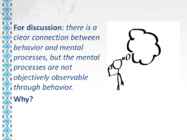
For discussion there is a 
clear connection between 
behavior and mental 
processes, but the mental 
processes are not 
objectively observable 
through  behavior.
Why?   
What is psyche?
• A soul or a spirit? 
• Psyche is a reflection of actuality in the 
mind, cognition of the environment and 
ourselves 
• Psyche as a form of interaction with oneself 
or an environment based on an individual  
experience 
More for discussion..
• What is the aim of psyche?
• Is it possible to change psyche? If yes, how?
• Is it possible that the same phenomenon is 
once psychical and  another  time not? 
• What is a mental  disorder
• Do we have free will, or are we driven by our 
environment, biology, and nonconscious 
influences ?

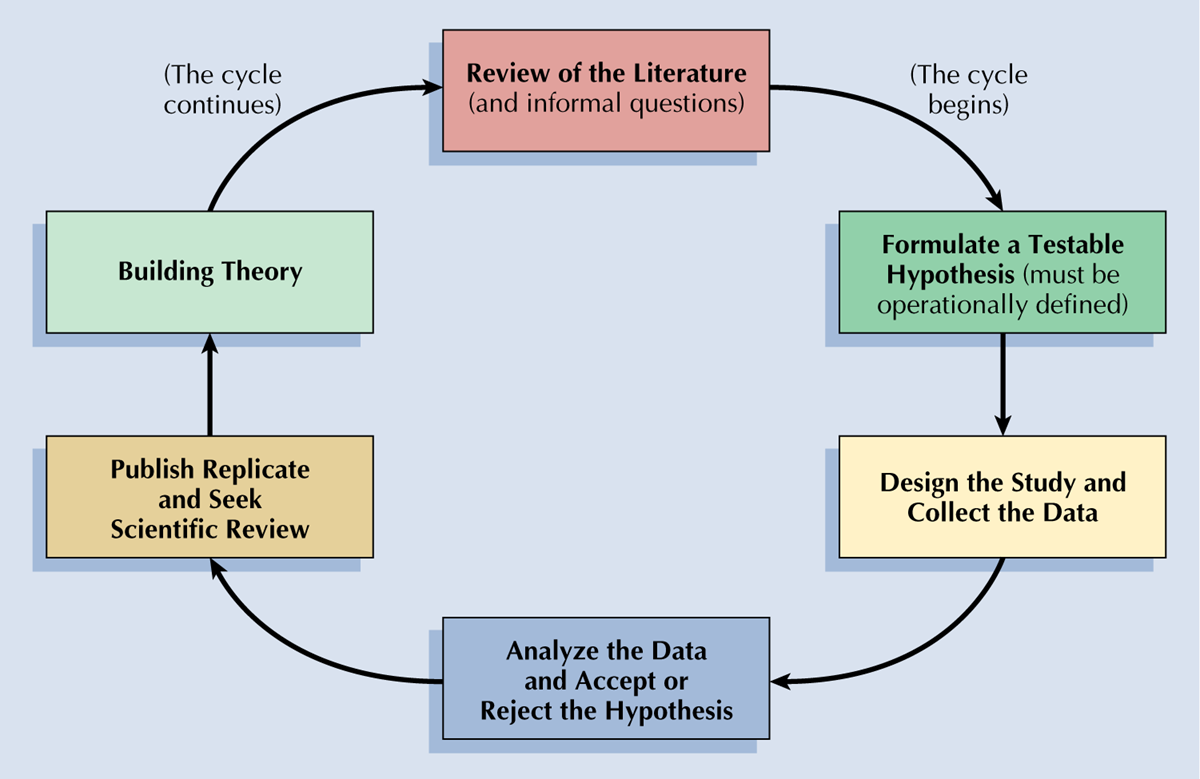
Psychology as a science  
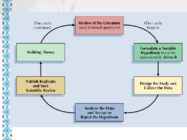
• Psychology is a science that gathers facts 
systematically, organizes them into general 
principles and formulates theories out of 
these  factual data
Is psychology rather a new or an old science? 
Scientific and pre-scientific psychology
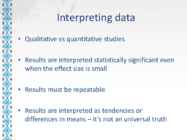
Interpreting data
•  Qualitative vs quantitative studies 
•  Results  are interpreted statistically significant even 
when the effect size is small 
• Results must be repeatable 
• Results are interpreted as tendencies or 
differences in means – it’s not an universal  truth 
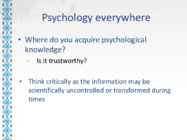
Psychology everywhere
• Where do you acquire psychological 
knowledge ?
- Is it trustworthy?
• Think critically as the information may be 
scientifically uncontrolled or transformed during 
times  
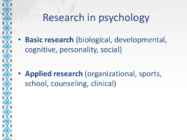
Research in psychology
• Basic research ( biological , developmental
cognitive , personality, social)
• Applied research ( organizational , sports, 
school, counseling,  clinical )
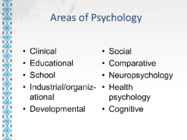
Areas of Psychology
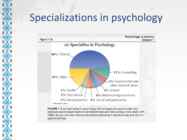
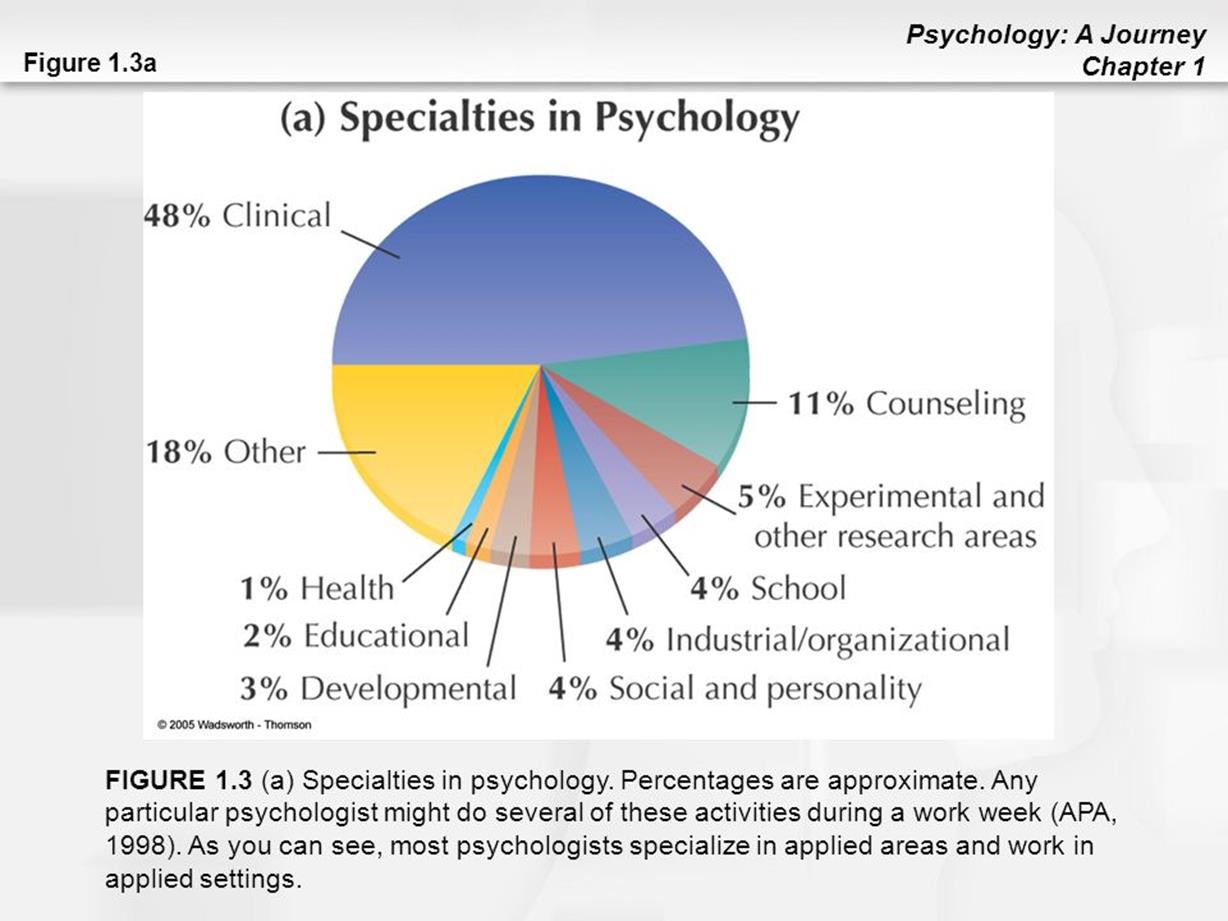
Specializations in psychology
• Most psychologists are involved in the areas  
of clinical and counseling psychology.
• The primary focus of clinical psychologists is 
the diagnosis and treatment of mental and 
behavioral disorders. 
What is a main  difference  between a 
psychologist and psychiatrist? 

Modern psychology
PSYCHOANALYSES (psychoanalytic perspective)
Sigmund Freud ( 1856  – 1939)
• Our behaviour comes from unconscious  drives  and 
problems arise from unsolved conflicts in the 
unconscious mind
•  Usually  stemming from our childhood
• Used  dream  analyses to explore unconscious mind
Behaviorist perspective
• Was  founded  by John B. Watson .
• Focuses on our observable behaviours 
(thoughts and  hidden  parts of the mind are 
not  relevant
that can be measured 
objectively
• Observes the  influence  of rewards and 
punishments
• Classical and  operant conditioning 
Humanistic perspective
• Focuses on self-  growth
• Attempt to seek  self-actualization by trying to 
achieve the maximum  potential of each individual
• Involves active  listening  and unconditional 
positive   approach
• Believes that positive  thinking  supports self-
development
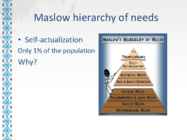
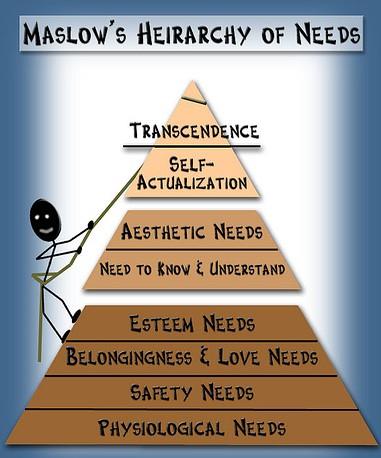
Maslow hierarchy of needs
• Self-actualization
Only 1% of the population
Why?
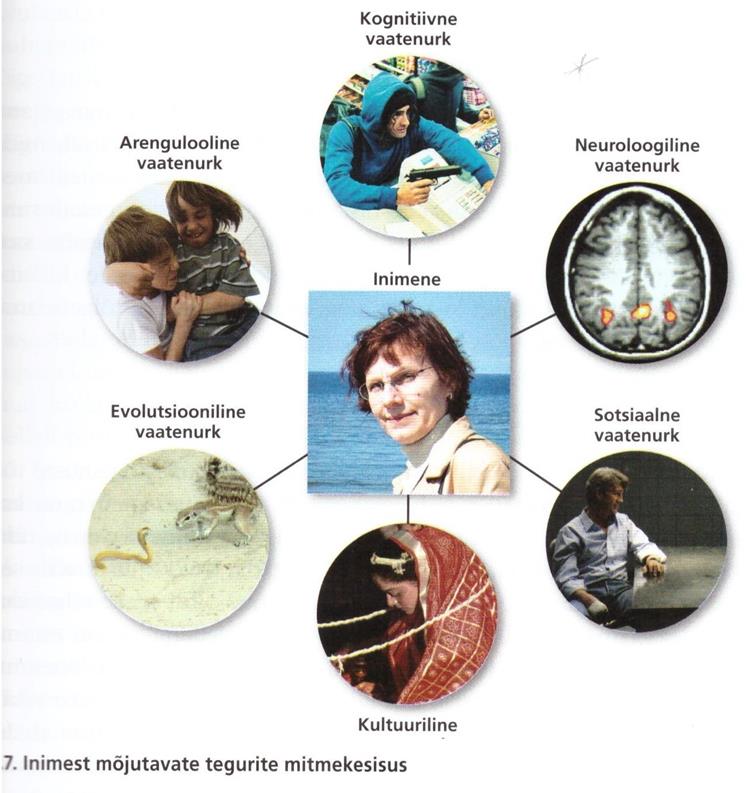
Cognitive perspective
• Focuses on how do we think or encode 
information and how do we see the world 
in general
• Human behavior cannot  be fully  understood  
without analyzing how people acquire , 
store and process information.
Biological perspective
Neuroscience  perspective
• How do our biological features influence 
our way of thinking and behaving?
• Focus on how the  physical   body  and  brain  
creates our emotions , memories and 
sensory experiences

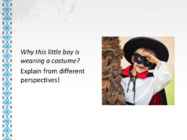
Why this little boy is 
wearing a costume?
Explain from  different  
perspectives!
What approach is the best ?
• Combination of approaches
• Some topics/issues have become dominated 
by a certain approach, so this will lead our 
thinking, but all should be in our 
consideration  
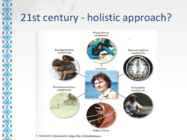
21st century  - holistic approach?
Current trends  in psychology
•  Fast development of applied research
• Positive psychology
Eastern philosophy influences (mindfulness)
• Neurosciences (understanding how the 
brain and body create thoughts, emotions, 
memories, etc.)
Vasakule Paremale
Lecture1 Introduction to psychology #1 Lecture1 Introduction to psychology #2 Lecture1 Introduction to psychology #3 Lecture1 Introduction to psychology #4 Lecture1 Introduction to psychology #5 Lecture1 Introduction to psychology #6 Lecture1 Introduction to psychology #7 Lecture1 Introduction to psychology #8 Lecture1 Introduction to psychology #9 Lecture1 Introduction to psychology #10 Lecture1 Introduction to psychology #11 Lecture1 Introduction to psychology #12 Lecture1 Introduction to psychology #13 Lecture1 Introduction to psychology #14 Lecture1 Introduction to psychology #15 Lecture1 Introduction to psychology #16 Lecture1 Introduction to psychology #17 Lecture1 Introduction to psychology #18 Lecture1 Introduction to psychology #19 Lecture1 Introduction to psychology #20 Lecture1 Introduction to psychology #21 Lecture1 Introduction to psychology #22 Lecture1 Introduction to psychology #23 Lecture1 Introduction to psychology #24 Lecture1 Introduction to psychology #25
Punktid 50 punkti Autor soovib selle materjali allalaadimise eest saada 50 punkti.
Leheküljed ~ 25 lehte Lehekülgede arv dokumendis
Aeg2018-03-21 Kuupäev, millal dokument üles laeti
Allalaadimisi 1 laadimist Kokku alla laetud
Kommentaarid 0 arvamust Teiste kasutajate poolt lisatud kommentaarid
Autor ricks6343 Õppematerjali autor

Sarnased õppematerjalid

Psühholoogia bioloogiline--kognitiivne- ja sotsiaalne vaade
26
doc

Psühholoogia bioloogiline-, kognitiivne- ja sotsiaalne vaade

some limitations like ethical concerns and no adequate control to establish the frequency of contact between the twins or the assumption that the twins raised together experienced the same environment. Examine one evolutionary explanation of behavior. The environment presents challenges to each individual and those who adapt best will have a greater chance of surviving and passing on their genes. This is the principle of Charles Darwin's theory of evolution. Evolutionary psychology is grounded on the principle that as genes mutate, those that are advantageous are passed down through natural selection. One example of evolutionary research is the study of emotions. Fessler has carried out research on disgust. He argues that the emotion of disgust allowed our ancestors to survive long enough to produce offspring, who in turn passed the same sensitivities to us. He investigated nausea experienced by women in their first trimester of pregnancy

Psühholoogia
Differential Psychology
21
pdf

Differential Psychology

Individual Differences (Differential Psychology) Psychology 1 It is generally assumed that: Differential Psychology · People vary on a range of psychological attributes Ian Deary · It is possible to measure and study these individual differences · Individual differences are useful for explaining and predicting

Inglise keel
Kvalitatiivne uurimustöö Emotsioonide regulatsioon ja stress
32
doc

Kvalitatiivne uurimustöö Emotsioonide regulatsioon ja stress

impact on the cortisol response. Emotion regulation in relation.. 3 Acknowledgements Firstly I would like to thank my supervisor xxx for his help and advice throughout this research and also xxx is gratefully acknowledged for his support and advice on blood markers of stress. Emotion regulation in relation.. 4 Table of Contents 1 Introduction 5 1.2 The effects of emotion regulation (ER) strategies in response to psychological stress 6 Figure 1. A process model of emotionregulation 8 Figure 2. Cybernetic 3-Dimentional Model on ER 10 1.3 Stress and physiological factors 11

Psühholoogia
Psychology-– Gleitman
3
docx

Psychology – Gleitman

Themes of bodily mutilation were common, ( woman killed her husband and then stuffed parts of his body into a camel's head) In contrast, normal's dreams were comparatively mild and ordinary. Result fits. Schizophrenics ofthe jump from one idea to another without maintaining firm line of thought. As a result their behavior often appears bizarre. It seems their extremely bizarre and morbid dreams are simply an exaggeration of a condition already present intheir waking life. Task of Psychology: What holds for dreams holds for most other psychological phenomena- they can all be viewed from several perspectives. Each perspective is valid but none is complete without the others, for psychology is a field of many faces and to see it fully, we must see them all. Wilhelm Wundt (Germany) and William James (USA)- founders. General Principles and Unique Individuals: Psychology's main purpose is not to describe the distinctive characteristics of a particular individual

Psühholoogia
Üld- ja sotsiaalpsühholoogia kordamisküsimused
9
docx

Üld- ja sotsiaalpsühholoogia kordamisküsimused

1. First social psychology experiment 1897 the first published social psychology experiment: ● by Norman Triplett ● Better results in cycling than when cycling alone Social facilitation effect: presence of others acts as a stimulation to the performer 2. Social identity theory; differences between personal, social and collective identities Stems from in-group/out-group categorization, tires to explain intergroup behaviour based on social identities. People are motivated to have a positive concept of selves. To increase self-

Üldpsühholoogia
Cialdini raamat
548
pdf

Cialdini raamat

Defense 221 Summary 225 Study Questions 226 CHAPTER 8 Instant Influence: Primitive Consent for an Automatic Age 227 Primitive Automaticity 228 Modern Automaticity 230 Shortcuts Shall Be Sacred 231 Summary 233 Study Questions 234 References 235 Index 254 Credits 260 About the Author Robert B. Cialdini is Regents' Professor of Psychology at Arizona State University, where he has also been named Graduate Distinguished Research Professor. He received undergraduate, graduate, and post- graduate training in psychology from the University of Wisconsin, the University of North Carolina, and Columbia University, respectively. He is past president of the Society of Personality and Social Psychology. He attributes his long-standing interest in the in-

Psühholoogia
Consumer behavior
4
docx

Consumer behavior

Defining consumer behavior Consumer behavior refers to the process of acquiring and organizing information in the direction of a purchase decision and of using and evaluating products and services (Moutinho, Ballantyne & Rate, 2011, p. 83) The nature of consumer behavior is focusing on when, why, how and where people do or do not buy products. It blends elements from psychology, sociology, social anthropology, and economics. It attempts to understand the buyer decision making process, both individually and in groups. It also tries to assess influences on the consumer from groups such as family, friends, reference groups and society in general (Sandhusen, 2000, p. 218, 219)

Inglise keel
Education
14
doc

Education

It helps the student have an insight in to the subject; 4. Library, computer facilities ( e-mail, Internet), literature in the bookstore are available for everyone. There is an easy access to any information. 5. Business education is on a very good level and embraces all spheres of knowledge: English ( Technical Writing: Letters, reports, presentations, resume, academic papers etc needed for real life), Speech communication (Interviews, presentations ), Psychology in Management, International issues, cultural awareness., foreign languages. In methodology -case study: theory and real life together. The students of Business College know what they want and how to achieve that, how to present themselves ( in their terms "to sell themselves"). Both content and appearance matter. But: The students are overloaded with information. Team work ( derived from eastern cultures) is being

Inglise keel


Meedia

Kommentaarid (0)

Kommentaarid sellele materjalile puuduvad. Ole esimene ja kommenteeri


Sellel veebilehel kasutatakse küpsiseid. Kasutamist jätkates nõustute küpsiste ja veebilehe üldtingimustega Nõustun