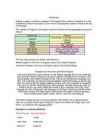
· (Traditional: the grammar-translation method/ classical method.) · Traditional: the direct method Youtube: http://www.youtube.com/watch?v=XiQvG-fvzLM Kids lesson (direct method) Language is primarily speech Reading skills are developed through practice with speaking Realia is used to convey the meaning Demonstration instead of translation or explanation Complete sentences instead of vocabulary lists The purpose of language learning is communication Pronunciation Self correction The goals of the teacher are communication, demonstration instead of translation (the teacher used pictures and pointed to yourself....), they studied complete sentences. It is a teacher-centred method. (T. was the leader, asked questions). The teacher and students were sociable and easy-going. Students´ presentations were approved for several times. When an error occurred the teacher encouraged students to correct it themselves. No native language was used.
change places 1) are made possible by preassembling and therefore 2) serve as evidence of preassembling. What causes slips of the tongue, includingmetathetical slips of the tongue, in the first place, and why some people are more prone to them than others is not yet clear: more needs to be known about how the brain works. However, for the present purposes this question is immaterial Why do metathetical forms oust old forms? ease of pronunciation (suhkrut-suhkurt) analogy-Nucular pro nuclear,Cf circular, muscular Proto-Indo-European *kailo-"whole, uninjured, of good omen" Proto-Germanic *hailaz 1. Old English hal HALE (sound in health, vigorous, robust (HALE AND HEARTY), WHOLE 2. Old English halsum WHOLESOME (e.g. WHOLESOME FOOD) 3. Old Norse heill (healthy) HAIL (as a greeting), TO HAIL (to greet, also: to hail a taxi, also fig. to praise highly, to acclaim, as in "critics hailed her new book"),
Phonetician John C. Wells defines Estuary English as "Standard English spoken with the accent of the southeast of England".[1] The name comes from the area around the Thames, particularly London, Kent, north Surrey and south Essex. The variety first came to public prominence in an article by DavidRosewarne in the Times Educational Supplement in October 1984. [2] Rosewarne argued that it may eventually replace RP (Received Pronunciation) in the south-east. Studies have indicated that Estuary English is not a single coherent form of English; rather, the reality behind the construct consists of some (but not all) phonetic features of working-class London speech spreading at various rates socially into middle-class speech and geographically into other accents of south-eastern England.[3][4] Rosewarne (1984) states that "the heartland of this variety lies by the banks of the Thames and its estuary"
Standard language a language variety used by a group of people in their public discourse has high social prestige promoted through the educational system Has legal status effectively used in public (court, legislature, schools) popularity and acceptance in the community Standard English (SE) variety of English that is acknowledged as the model for the speech and writing of educated speakers often associated with the Received Pronunciation (RP) accent in countries where English isn't a native language typically English English or North American English is considered "standard" for teaching purposes Differences between pidgins, creoles and standard language varieties Pidgins and creoles are a simplified version of already existing languages: Lexis drawn from the dominant language (reduplication) Pronunciation: fewer sounds (simplification, conflation)
SHORTENING AND LENGTHENING IN MIDDLE ENGLISH Late in Old English, vowels were lengthened before certain clusters: /nd/, /ld/, /rd/, /mb/, //. Later on, the vowels in many of these words were shortened again, giving the appearance that no lengthening happened; but evidence from the Ormulum indicates otherwise. vt. Middle-English period: lengthening and shortening of vowels faili GREAT VOWEL SHIFT The Great Vowel Shift was a major change in the pronunciation of the English language that took place in England between 1350 and 1600.[1][2] Through the Great Vowel Shift, all Middle English long vowels changed their pronunciation. English spelling was becoming standardized in the 15th and 16th centuries, and the Great Vowel Shift is responsible for many of the peculiarities of English spelling.[3] The main difference between the pronunciation of Middle English in the year 1400 and Modern English is in the value of the long vowels
computer. In my opinion are there more positive sides. I think that it would be more easier when you can study whatever time you want. When you are studying by computer then you abstain from conflicts with teacher. If you have your own computer then you can study at home and at the same time lie around, eat, listen to music, etc. I think that it would be cheaper and acceptable too. When you are studying english by computer then you don't have to think about your pronunciation. In my opinion is there only few bad sides. For example when you are studying at home then there's no discipline and you don't knuckle down. In my opinion is learning english by computer better way to improve your skills. I think that some day is learning english by computer usual way.
exist side by side in their country. It has two official languages, English and French. The Canadian population is made up mainly of British and French origins. However Canada is not like Britain, or France, or the USA. The way of life there is very varied. It has influenced by immigrants from all over the world. Canadians prefer British English spellings, such as theatre, centre, colour and harbour. Words for some objects can be different, example a sofa is a chesterfield. There are also pronunciation differences in the three Canadian regions. But as Canadians watch lots and lots of American TV, all varieties of Canadian English are beginning to sound more and more American.
explicitly; an indirect or passing reference. Simile - a figure of speech involving the comparison of one thing with another thing of a different kind, used to make a description more emphatic or vivid (e.g. as brave as a lion ). Metaphor - a figure of speech in which a word or phrase is applied to an object or action to which it is not literally applicable. Graphon - Intentional violation of the graphical shape of a word (or word combination) used to reflect its pronunciation point of view - the narrator's position in relation to a story being told. Narrator - a person who narrates something, especially a character who recounts the events of a novel or narrative poem. Mood - is a literary element that evokes certain feelings or vibes in readers through words and descriptions. Usually, mood is referred to as the atmosphere of a literary piece, as it creates an emotional situation that surrounds the readers.
Why do I need to speak English in the English class? I am going to write why I need to use English in English class. Using English in theEnglish class is important, because it is the best practise for English pronunciation and the more I use English the more I will command the language. I must express strong regret that I have not been using English in English classes very often and because of that I have many cacoepies and I am not very good at speaking English and that is why I should speak English during the English classes much more. Using English frequently gives me better understanding of the language, I will become more fluent in it and my general intelligence improves remarkably.
Old English was spoken until around 1100. Middle English (1100-1500) In 1066 William the Conqueror, the Duke of Normandy invaded England. The new conquerors brought with them a kind of French and there was a period where the lower classes spoke English and the upper classes spoke French. In the 14th century English became dominant in Britain again, but with many French words added. Modern English Early Modern English (1500-1800) Towards the end of Middle English the change in pronunciation started, with vowels being pronounced shorter and shorter. From the 16th century the British had contact with many peoples from around the world and many new words and phrases entered the language. In 1604 the first English dictionary was published. Late Modern English (1800-Present) The main difference between Early Modern English and Late Modern English is vocabulary. Late Modern English has many more words because the Industrial Revolution and technology created a need for new words;
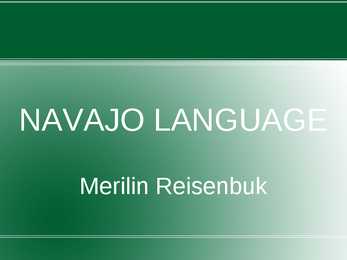
NAVAJO LANGUAGE Merilin Reisenbuk What is Navajo Language? Navajo is an Athabaskan (is a large group of indigenous peoples of North America) language spoken in the southwest United States by the Navajo people. It is geographically and linguistically one of the Southern Athabaskan languages. Orthography and pronunciation Consonants Vowels. Navajo has four basic vowel qualities: a, e, i and o. Each of these may occur either short or long. Tones. Navajo has two tones, low and high. - high, as in áá and éé - low, as in aa and ee Grammar The key element in Navajo is the verb. Every verb must have at least one prefix. Many concepts expressed using nouns in other languages appear as verbs in Navajo. There are two main types of nouns in Navajo:
protect protection arrange arrangement disappoint disappointment pronounce pronunciation happen happening bleed blood defend defence order order
He then went on to create Mr Bean. A walking disaster, Bean was purely physical comedy, the opposite of Edmund Blackadder's polished dialogue. This clumsy character was a huge success and became another national treasure. Atkinson's other characters rely more heavily on language. Atkinson often plays authority figures, especially priests or vicars, speaking absurd lines with a completely deadpan delivery. One of his better-known comic devices is over-articulation of the "B" sound, such as his pronunciation of "Bob" in the Blackadder II episode "Bells". Atkinson suffers from a stammer, and the over-articulation is a technique to overcome problematic consonants. Atkinson's often visually based style, which has been compared to Buster Keaton, sets him apart from most modern television and film comics, who rely heavily on dialogue, as well as stand-up comedy which is mostly based on monologues. Rowan made his big-screen debut in 1983's unofficial James Bond picture Never Say Never Again
medicine and philosophy. Nowadays 80 percent of the word-stock is foreign-born. So we can say that most world languages have contributed some words to English at some time, and the process is now being reversed. Purists of the languages are resisting the arrival of English in their vocabulary. The standard English oh today is known as BBC English. Few British people know much about grammar, since it is not usually taught in schools. Spelling and pronunciation seem to be the most difficult aspects of the English language for foreign students. English is very rich in synonyms. The huge vocabulary is due to the free admission of words from other languages and the easy creation of compounds and derivaties. English vocabulary numbers at least 750,000 words. Educated English speakers use approximately 5,000 words in speech and up to 10,000 in written communication. Shakespeare used a vocabulary of 33,000 words.
EDUCATION AND JOBS A5 MONOLOGUE Topic A5.2 Read the topic below and prepare to speak about it. Use the questions given to help to plan your monologue. Some people think that all school-children should wear school uniforms. Why do you think they say that? Do you agree? Give reasons. ---------------------------------------------------------------------------------------------------------------- You are expected to structure your monologue and present it speaking fluently with appropriate pronunciation and intonation and only natural pauses. You are expected to express yourself confidently, clearly and politely. Interact naturally with appropriate openings, fillers and amplifications. Be logical and clear, paraphrase successfully. Your vocabulary should be precise and appropriate, as well as the register. Use a VARIETY of simple and complex grammatical structures as appropriate. Your monologue can be structured as following: 1. Introduction: state the topic (the conviction held)
where basic language abilities such as reading or repeating are tested (Bernstein, 1999). This is another way of avoiding the high error rate in open-ended speech recognition for spontaneous speech. They showed correlations around 0.80 between their tests and other widely used language tests such as ETS's TOEFL (Bernstein, DeJong, Pisoni, & Townshend, 2000). Cucchiarini et al. (Cucchiarini, Strik, & Boves, 1997a, 1997b) developed a speech recognition based automatic pronunciation scoring system for Dutch by using features such as log likelihood Hidden Markov Model scores, various duration scores, and information on pauses, word stress, syllable structure, and intonation. They also found good agreement (correlations above 0.70) between machine scores and human ratings of pronunciation. Stanford Research Institute (SRI) International, similarly, has been developing an automatic pronunciation scoring system, EduSpeakTM, which measures phone accuracy,
John Denveriga laulu "Perhaps Love" http://www.youtube.com/watch?v=3YnfCH7LNcM * John Denver (Henry John Deutschendorf juunior 31.12. 1943 Roswell, New Mexico osariik 12. 10. 1997 Pacific Grove, California osariik) oli USA folk- ja kantrilaulja, laulukirjutaja, muusik ning helilooja. Tema tuntuim laul on "Take Me Home, Country Roads". José Carreras Josep Maria Carreras i Coll ( Catalan pronunciation: ; born 5 December 1946), better known as José Carreras ( Spanish pronunciation: ), is a particularly known for his performances in the of and . Born in , he made his debut on the opera stage at the age of 11 as Trujamán in 's and went on to a career that encompassed over 60 roles on the stages of the world's leading opera houses and in the recording studio.Josep Maria Carreras i Coll sündis 5. detsemberil 1946 Barcelonas, Kataloonia pealinnas. (Carreras "õige" eesnimi on Josep, katalaani versioon José.) Kolmest lapsest noorim, on ta
Pitmatic (Durham and Northumberland) Yorkshire (also known as Tyke) In the far north, local speech is noticeably Scots in nature. o East Midlands o West Midlands Black Country English Brummie (Birmingham) Potteries (north Staffordshire) o Southern Received Pronunciation Cockney (East London) East Anglian (Norfolk, Suffolk and North Essex) Estuary (Thames Estuary) Kentish (Kent) Multicultural London English (Inner London) Sussex o West Country · Scotland o Scottish English Highland Glaswegian Cromarty · Wales
Ibiza is an island in the Mediterranean Sea 79km off the coast of the city of Valencia in Iberian Peninsula Spain. It is the third largest of the Balearic Islands, an autonomous community of Spain. With Formentera, it is one of the two Pine Islands or Pityuses. Its largest cities are Ibiza Town (Catalan:Vila d'Eivissa or simply Vila), Santa Eulària des Riu and Sant Antoni de Portmany. Eivissa is the official Catalan name (Catalan pronunciation:, locally. The name in Spanish is Ibiza . In British English, the name is usually pronounced in an approximation of the Spanish while in American English the pronunciation is more anglicized The island is well-known for its summer club parties which attract large numbers of tourists, but the island and the Spanish Tourist Office have been working to shed the prevailing "sex-and-alcohol" image in order to promote more family-
QUESTIONS AND ROLE PLAY When you have completed your monologue, you will be asked 4-5 questions related to the topic of your monologue. This is nothing like asking and answering questions: try to behave as if in a real conversation. Respond naturally in 2-3 utterances but you are not expected to be lengthy at this stage. Speak fluently with appropriate pronunciation and intonation and only natural pauses. Express yourself confidently, clearly and politely. If you fail to understand the question, say `Pardon?' with the rising tone and the interviewer will interpret the question to make it clear for you. The following expressions of asking someone to repeat can also be useful: - Could you say that again, please? - Would you mind repeating that, please? - Could you repeat that, please? Once you have finished, you will be moved on to the next task
Eulària des Riu and Sant Antoni de Portmany . Eivissa is the official Catalan nam e (Catalan pronunciation: [ i is] , locally [ i vis ] ). The nam e Spanish in is Ibiza [i i a] . In British English, the nam e is usually pronoun c e d in an approxim ation of the
http://www.betelco.com/bd/bangla/bangla.html#alphabet Bengali (). Kasutatud 26.09.2017. https://www.omniglot.com/writing/bengali.htm Bengali. Kasutatud 22.09.2017 https://www.ethnologue.com/language/ben Bengali keel. (1985). Kasutatud 22.09.2017 http://entsyklopeedia.ee/artikkel/bengali_keel1 Bengali keel. (1968). Kasutatud 22.09.2017 http://entsyklopeedia.ee/artikkel/bengali_keel2 Devanaagari. (1968). Kasutatud 22.09.2017 http://entsyklopeedia.ee/artikkel/devanaagari1 Bengali alphabet, pronunciation and language. Kasutatud 22.09.2017 https://www.omniglot.com/writing/bengali.htm Chatterji, Suniti Kumar. 24.12.2009. Bengali phonetics. Kasutatud 26.09.2017. https://www.cambridge.org/core/journals/bulletin-of-the-school-of-oriental-and- african-studies/article/bengali- phonetics/D0EC5C797B69A94402EF3AFBE8DC8BDC Erelt, M., Erelt, T., Ross, K. Häälikud. Eesti keele käsiraamat. Kasutatud 26.09.2017 https://www.eki.ee/books/ekk09/index.php?p=2&p1=5 Syntax. Estonian grammar. Kasutatud 26.09
language. Although British English is considered to be more sophisticated and prestigious than American English, the latter is clearly more featured in television, music, video games and internet, naturally appealing more to English learners than British English. Also, in international communication American English is usually the preferred choice as it is acceptable and easily understandable in any context from Japan to Peru. While British English, especially the Received Pronunciation, is generally viewed as some kind of a “gold standard” in education and is usually focused on in textbooks and dictionaries, it should be remembered that American English has about 10 times more speakers than the RP and thus the significance of it in the today’s world should not be underestimated. 2) Submarine sandwich is ‘a large sandwich consisting of a long roll split lengthwise and filled with layers of meat, cheese, tomatoes, lettuce and condiments’ (www.ahdictionary.com)
Meaning restriction and extension. Specialization of meaning- means narrowing the meaning, extended - widened meanings. Generalization. Meaning degradation and elevation Pejoration (worsening of meaning) deterioration. Amelioration- improvement of meaning. Monosemy Word only has one meaning. Polysemy the meaning of the word depends on the sentence. The content- where the word is placed in the sentence. Homonyms words with the same spelling and pronunciation but a different meaning. Skate, mouth Homophones words that are pronounced the same. Rose, to-two-too Homographs words that are spelled the same. Lead, close, wind. Synonyms words that share the same denotative, different spelling and pronunciation but the same meaning. e.g. male masculine Opposites (antonyms) words with opposite meanings, e.g. long-short, dead-alive, buy- sell Hyponyms a word phrase or lexeme of narrower or more specific meaning that comes
Näiteks kui panna pildi otsingusse sõna ,,Baywatch" tulevad vasteks rannavalve pildid, aga kui panna ,,Baywatch +Hasselhoff", siis saad selle mehe pildid.[15] Lycos võimaldab otsingus kasutada ka erinevaid piirangudi. Neid on küll vähe võrreldes näiteks Google-ga. Lycos-es on võimalik piirata domeeniga, näiteks tripod.com või .gov. Seal saab valida maa või piirkonna ning saab ka valida kas otsingutulemustes on ainult täiskasvanutele mõeldud materjalid. Näiteks Otsing ,,received pronunciation"; domeeniks on seatud .gov.[14] Stopsõnadena kasutatakse: A, An, In, On, Are, Is, They. Tulemuste saamiseks panna jutumärkidesse nt. Dialects ,,in" Britain. Kui on teada täpne fraas, siis saab kasutada fraasiotsingut jutumärkidega. Lycos-el tõstutundlikkus puudub. Pole vahet, kas otsitav on kirjutatud suure või väikse algustähega. Lisateenussena saab kasutada Lycos top 50, Lycos weather ja Channel Lycos. Lycos top 50 lisateenusena võimaldab näha www.lycos
E.g. laaaaarge, ruuuuuuin. Hyphenation may split up a word into syllables or even letters, thus, emphesizing this very word. E.g. I des- pise him! Italics show that words are important in this very context or words are used in some special, ironic meaning. It is a tradition to italicize foreign words. Graphical stylistic devices Graphon is distorted spelling of a word. It renders phonetic peculiarities of pronunciation and occurs in prose only and not in authors´ narrative but dialogue. I suggest blurred, coherent or careless pronunciation caused by 5 6 temporary features (young age, ignorance of the discussed topic) or by permanent outs (social, territorial, educational)
petrol gasoline or gas saloon sedan silencer muffler spanner wrench ticking over idling windscreen windshield anti-clockwise counter-clockwise car valeting auto detailing In addition to vocabulary, British and American English differ in other ways. English speakers in America have a different accent; their spelling and pronunciation vary as well. For example, in American English any 'r' is usually pronounced. So words large, hear, hurt, and dinner would sound differently. In 1785 Noah Webster became famous by producing The American Spelling Book, which marked the real birth of American English. He was a graduate of Yale University who started his career as a teacher in a school. When teaching, reading and spelling, he lacked good materials. The only textbooks used
Move hands and arms Don't point at anyone Move around the room Don't rock backwards and forwards Move towards the audience Don't stand rooted to the spot Move your eyes around the audience Don't leave your hands by your sides Moving is normal Don't avoid eye contact Voice, intonation and pronunciation Stressing a point It is vital/essential/imperative that we ... We must ... Stretching vowels These figures are extreeeemely useful. We are waaaay ahead of the competition. Using adverbs extremely really entirely very completely quite totally Repeating words Communication is vital. Without communication, nothing is achieved. With little communication, little is achieved. Stressing auxiliaries
. example: However if you want to describe a particular instance of these you should use a/an. "I could hear the wind." / "There's a cold wind blowing." For example: "What are your plans for the future?" / "She has a promising future ahead of her." The is also used to say that a particular person or thing being mentioned is the best, most famous, etc. In this use, 'the' is usually given strong pronunciation: "Harry's Bar is the place to go." For example: "You don't mean you met the Tony Blair, do you?" !Note - The doesn't mean all:- "The books are expensive." = (Not all books are expensive, just the ones I'm talking about.) For example: "Books are expensive." = (All books are expensive.) No article We usually use no article to talk about things in general:-
In many languages, the citation form of a verb is the infinitive: French aller, German gehen, Spanish ir. In English it usually is the full infinitive (to go) although alphabetized without 'to' (go); the present tense is used for some defective verbs (shall, can, and must have only the one form). In Latin, Ancient Greek, and Modern Greek (which has no infinitive), however, the first person singular present tense is normally used, though occasionally the infinitive may also be seen. The pronunciation form in a dictionary will usually relate to the citation form of the word in question. This may differ in various respects from the forms to be expected in connected speech, sometimes referred to as phonotypical forms. Wells, J.C. 1999. Phonetic transcription and analysis. Available at https://www.phon.ucl.ac.uk/home/wells/transcription-ELL.pdf, accessed January 19, 2016. Lyons, John. 1981. Language and Linguistics
Ireland Ireland (Irish: Éire, Irish pronunciation:) is a country in north-western Europe. The modern sovereign state occupies about five-sixths of the island of Ireland, which was first partitioned on 3 May 1921. It is bordered by Northern Ireland--part of the United Kingdom--to the north, by the Atlantic Ocean to the west, the Irish Sea to the east and the Celtic Sea and St George's Channel to the South and South-East. The legal name of the state is simply "Ireland", but its legal description the Republic of Ireland is
People from different social classes eat different food at different times of day, they like to talk about different topics using different styles and accents of English, they enjoy different sports, they have different values about what things are most important in life and different ideas about the correct way to behave. 10. Standard English is used `naturally' in everyday speech by between 15% and 30% of the population in Britain. Received Pronunciation (RP) is used in everyday speech by only 3% to 12% of the population. So why is Standard English with an RP accent the usual model for people learning British English as a foreign language? What justification can you find for this practise? 11. Can you think of examples of British individualism? Love of the countryside is a good example of individualism and conservatism the countryside represents stability. Also British people are much more reserved than
Phonology- The subfield of linguistics that studies the structure and systematic patterning of sounds in human language. Allophone is a sound form of a phone. For example: An Estonian word palk has two possible pronunciation ways. L can be palatalised or not. Phoneme is a smallest unit in language which distinguishes meaning. With other phonemes it can form morphemes and words. For example: The difference
o De-, un-, mis-, re-, etc In english all prefixes are derivational, thus creating new lexemes instead of inflected forms of words. o Happy – unhappy, contaminate – decontaminate 19. Suffixes A suffix is an affix that follows its base. An element placed at the end of a word to form a derivative, such as –ation, -fy, -ing, frequently one that converts the stem into another part of speech. While the prefixes do not change anything in the pronunciation of shape of the base words, the suffixes have such an effect. They lead either to the deletion of material at the end of the base or to a different stress pattern Adjectival 7 o Relational - to relate the noun the adjective qualifies to the base word of the derived adjective Algebraic, colonial, theoretical
1) Standard and non-standard varieties of English Standard varieties of English are the varieties of the English language that are considered to be a norm and are spoken and written by the minority (educated people). This is the optimum for educational purposes. The standard varieties of English are: BrEng (British), EngEng (English), NAmEng (North-America), USEng (United States), CanEng (Canada), AusEng (Australia), NZEng (New Zealand). Standard English (British English) is the most widely accepted and understood among native speakers, learned by foreigners. It is used in broadcasting, TV, news etc. It doesn't concern pronounciation (accent), but grammar and vocabulary. It includes formal and informal styles. British Standard English grammar and vocabulary, together with the RP accent should be called English English. RP (Received Pronounciation) is an accent that originates from South-East of England. A social accent, associated o...
Interpretation of a verbal sign according to Roman Jakobson can happen in three ways: Intralingual-(within)- Eng-Eng/Fin-Fin/Est-Est Interlingual-(between)- Est-Eng/Rus-Ger Intersemiotic-(between)- Sound-Words/Words-Sound. F.e.-in movies *phone ringing* Problems: Dialects/Regional varieties- When translating: Mainstream Eng. vs Jamaican Eng., then you could translate MS Eng to MS Est, and Jamaican Eng into a language variety with a similar (social) role. Social class- RP-received pronunciation-(aka posh lang.) When translating: RP vs lower class Eng, then you could translate RP using complicated words, and lower class Eng, using limited vocabulary. • Hatim and Munday – what is translation according to these two men? Why is this not quite enough nowadays? 1.Process of transferring written text from SL to TL(done by a translator) 2.The written product of the process in No.1 3.Mental, social, linguistic etc phenomenon related to the written product in No.2
Almost every consonant has a hard or a soft counterpart, and the distinction is a prominent feature of the language. Another important aspect is the reduction of unstressed vowels. Stress, which is unpredictable, is not normally indicated orthographically. though an optional acute accent ( , znak udareniya) may be used to mark stress, such as to distinguish between homographic words, for example (zamók, meaning a lock) and (zámok, meaning a castle), or to indicate the proper pronunciation of uncommon words or names. The standard form of Russian is generally regarded as the modern Russian literary language ( ). It arose in the beginning of the 18th century with the modernization reforms of the Russian state under the rule of Peter the Great, and developed from the Moscow (Middle or Central Russian) dialect substratum under the influence of some of the previous century's Russian chancellery language.
Samas on sõimusõnadel oma Eestis ei ole sotsiaalseid murdeid väga tugevalt välja kujune- tähendus: need viitavad enamasti genitaalidele, tabuks peetava- nud, kuid näiteks Inglismaal on suur erinevus Londoni töölis tele seksuaalsetele tegevustele, väljaheidetele ja kehavedelikele klassi keelepruugi ehk kokni ja kõrgklassi keelepruugi ehk RP jne. Sõimusõnade emotsionaalne laeng tuleneb nendega tähis- (received pronunciation 'vastuvõetav hääldus') vahel. tatud asjade pidamisest räpaseks, kuid see pole muidugi ainus Siiski võib ka Eestis eristada mõningaid sotsiaalseid murdeid, põhjus. Kui meditsiinis tuleb rääkida samadest asjadest, siis sel üks ilmekamaid neist on vähese haridusega noorte ehk rullnok- puhul kasutatakse meditsiiniterminoloogiat, millel emotsio- kade keel
Francisco gives swimming all of his energy and time. Swimming = indirect object of the verb gives. When Francisco wore dive fins to class, everyone knew that he was devoted to swimming. Swimming = object of the preposition to. indefinite article In English, the two indefinite articles are a and an. Like other articles, indefinite articles are invariable. You use one or the other, depending on the first letter of the word following the article, for pronunciation reasons. Use a when the next word starts with a consonant, or before words starting in u and eu when they sound like you. Use an when the next word starts with a vowel (a,e,i,o,u) or with a mute h. The indefinite article is used to refer to something for the first time or to refer to a particular member of a group or class. movement verb position verb possessive determiner In English grammar, a possessive determiner is a type of function word used in front of a noun to
i: y: (pikad) u: (ülikõrge) (lühikesed) (poolkõrge) e: ø: o: (keskkõrge) (:) oe (keskmadal) a : (pikk, madal tagavokaal) Meil enim tuntud võõrkeeltest briti-inglise kirjakeele nn Received Pronunciation (RP) -süsteemis (BBC hääldus) on Jonesi järgi kokku 20 foneemi (O'Connoril 21) neist 12 monoftongi 4 kõrgusastmel (vt pikad ja lühikesed eri veergudes) ja 8 (või 9?) diftongi (parempoolne tulp): i: u: e : : ,
gave old English words entirely new meanings, such as lumber ( which in British English means approximately junk ) and corn ( which in British means any grain, especially wheat ). Some of the new terms were needed, because there were new and un-English things to talk about. Others can be explained only on the general theory that languages are always changing, and American English is no exception. Aside from the new vocabulary, differences in pronunciation, in grammatical construction, and especially in intonation developed. If the colonization had taken place a few centuries earlier, American might have become as different from English as French is from Italian. But the settlement occurred after the invention of printing, and continued through a period when the idea of educating everybody was making rapid progress. For a long time most of the books read in America came from England, and a surprising number of Americans read those
became more rapid, with 10,000 Anglo-Norman words entering English before the 15th century. Vocabulary Change Of the 10,000 French words adopted during the Norman occupation, three-quarters of these are still in use. Currently, French vocabulary is found in all areas-government, law, art, and literature. More than one third of English words today are derived, directly or indirectly, from French. This is so pronounced, that without prior study, English speakers already know 15,000 French words. Pronunciation Change Much of current English pronunciation can be traced to definite French influence. Old English had many unvoiced, fricative sounds, while French introduced voiced counterparts. English French f v s z th th sh g (as in mirage)
The flag has the „Union Jack“ in the top left-hand corner. The rest is dark blue background with white stars. These stars consist of the southern cross and a large seven-pointed white „federation star“ representing 6 states and the territories. 48. The Strine. Strine is a term coined in 1964 and subsequently used to describe a broad accent of Australian English. The term is derived from a shortened phonetic rendition of the pronunciation of the word "Australian" in an exaggerated Broad Australian accent, drawing upon the tendency of this accent to run words together in a form of liaison.
Special letters, such as those of the signal alphabet, Initialism> An abbreviation that consists of the first letter or letters of words in a phrase. Unlike acronyms, initialisms are not spoken as words; they are spoken letter by letter. Examples: Acronyms: typically the initial letters of several words, pronounced according to normal orthoepical principles: • aids ‘acquired immune deficiency syndrome’. Some forms mix the two kinds of pronunciation: Beeb from BBC, with clipping of the final C. 25. Clippings, fore clippings, back clippings, ambiclippings Clipping refers to the shortening of some word while the original meaning is retained. Clipping does not create lexemes with new meanings, but lexemes with a new stylistic value.”In morphology, a word formed by dropping one or more syllables from a polysyllabic word, such as cell from cellular phone. A clipped form generally has the same
classes spoke English and the upper classes spoke French. In the 14th century English became dominant in Britain again, but with many French words added. This language is called Middle English. It was the language of the great poet Chaucer (c1340-1400), but it would still be difficult for native English speakers to understand today. [5] 3) Early Modern English (1500-1800) Towards the end of Middle English, a sudden and distinct change in pronunciation (the Great Vowel Shift) started, with vowels being pronounced shorter and shorter. From the 16th century the British had contact with many peoples from around the world. This, and the Renaissance of Classical learning, meant that many new words and phrases entered the language. The invention of printing also meant that there was now a 5 common language in print
someone you just met, do not know well, or someone for whom you would like to show respect (a professor, for example.) Encantado, cansado, enfermo, and aburrido are the masculine forms of the words. If the words refer to a woman or are spoken by a woman, then the final o changes to a: encantada, cansada, enferma, and aburrida In Spain, as well as Argentina, Bolivia, Chile, Paraguay, Peru, Uruguay and Venezuela, the Spanish language is called castellano instead of español. 2. Pronunciation Spanish Letter English Sound a ah e ay i ee o oh u oo ll y b at beginning of word, real soft b between 2 v vowels ñ ny (as in canyon)
expressions used in English, and biographical listings. Some also contain geographical listings. Learner's dictionaries are highly recommended. This type of dictionary is written specifically for students of English as a foreign language. Definitions are written in clear, easy to understand English. These dictionaries often anticipate learners' questions with special explanatory sections. They also use a standard phonetic alphabet to indicate pronunciation of entries . Unabridged dictionaries are the most comprehensive, but are not practical for second language learners because of their size and detail. These dictionaries are often found in the reference sections of libraries on special tables to accommodate their size and weight. An unabridged dictionary is an excellent source for determining the historical development of words , examples of sentences that demonstrate proper usage , antonyms, and synonyms.
FGI 1081 Stilistika (Irina Ladusseva) Kab. 420 2 AP Ends with an exam; lasts only for 1 semester. At the exam you get 2 questions and an exercise (50 sentences: establish the device used, recognize it, and name it). Care about the pronunciation of the terms. Books: - I. Galperin "Stylistics" - I. Ladusseva "Rhythm and Text" - I. Ladusseva "Vocabulary and Style" - I. Ladusseva "Stylistic practice: Book I, Book II" - I. Ladusseva "A Guide to Punctuation" EXAMINATION TOPICS:
The Italics show that the words are important in the present context and should be pronounced accordingly. Graphon means distorting the spelling of the words. It is characteristics of prose only. It occurres in dialogue. It is used to suggest that the person is drunk, very young or ignorant of the discussed topic (temporary things) Permanent are educational and social factors. (Fella, helluva, don't cha, gimme etc.) Spelling in Graphon usually reproduces the correct pronunciation of the word. 11. Common literary and common colloquial vocabulary Neutral words are used in any style of language and are natural under any circumstances (man, walk, room, etc.) In contrast to neutral words, there are those that possess fixed stylistic colouring. Standing alone, they are felt as elements of style. (Homicide, murder; kid, child) Common literary words are loftier than their neutral or colloquial counterparts.
 annaabi.ee