Tugevate rühm (0)
Ibiza
Independed work
Enelin Paistu
LM08
Ibiza
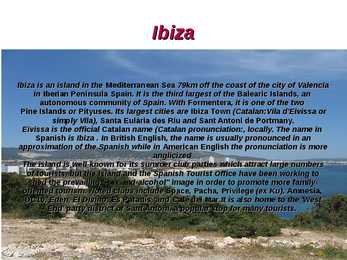
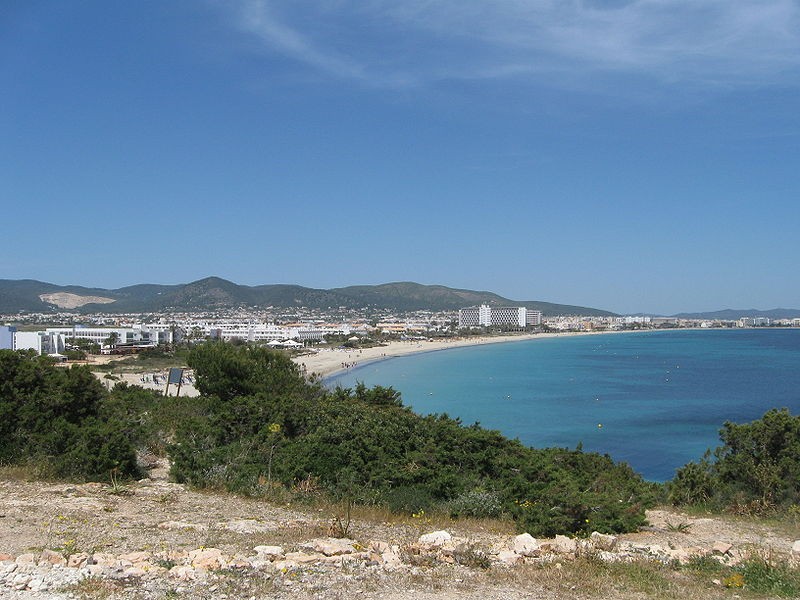
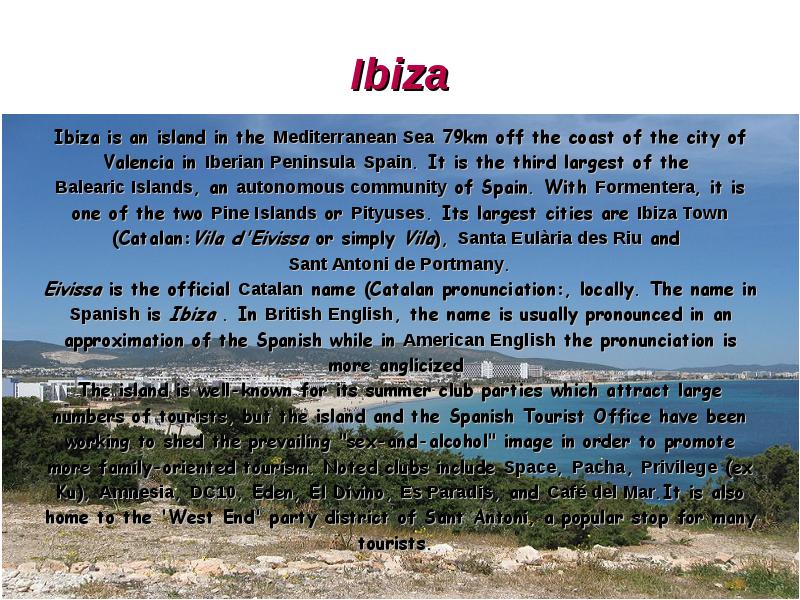
Ibiza is an island in the Mediterranean Sea 79km off the coast of the city of Valencia
in Iberian Peninsula Spain. It is the third largest of the Balearic Islands, an
autonomous community of Spain. With Formentera, it is one of the two
Pine Islands or Pityuses. Its largest cities are Ibiza Town (Catalan:Vila d'Eivissa or
simply Vila), Santa Eulària des Riu and Sant Antoni de Portmany.
Eivissa is the official Catalan name (Catalan pronunciation:, locally. The name in
Spanish is Ibiza . In British English, the name is usually pronounced in an
approximation of the Spanish while in American English the pronunciation is more
anglicized
The island is well-known for its summer club parties which attract large numbers
of tourists, but the island and the Spanish Tourist Office have been working to
shed the prevailing "sex-and-alcohol" image in order to promote more family-
oriented tourism. Noted clubs include Space, Pacha, Privilege (ex Ku), Amnesia,
DC10, Eden, El Divino, Es Paradis, and Café del Mar.It is also home to the 'West
End' party district of Sant Antoni, a popular stop for many tourists.
History
In 654 BC Phoenician settlers founded a port in the Balearic
Islands, as Ibossim (from the Phoenician iboshim dedicated to
the god of the music and dance Bes).It was later known to
Romans as "Ebusus". The Greeks, who came to Ibiza during
the time of the Phoenicians, were the first to call the two
islands of Ibiza and Formentera the Pityûssai (,
"pine-covered islands"; a translation of the Phoenician
name).With the decline of Phoenicia after the Assyrian
invasions, Ibiza came under the control of Carthage, also a
former Phoenician colony. The island produced dye, salt, fish
sauce (garum), and wool.
History
A shrinewith offerings to the goddess Tanit was established in the cave at
Es Culleram, and the rest of the Balearic Islands entered Eivissa's
commercial orbit after 400 BC. Ibiza was a major trading post along the
Mediterranean routes. Ibiza began establishing its own trading stations
along the nearby Balearic island of Majorca such as Na Guardis, from
which large quantities of renowned Balearic slingers were hired as
mercenaries who fought for Carthage.
The island was reclaimed for Christendom by Aragonese King
James I of Aragon in 1235. Since then, the island has had its own self-
government in several forms but in 1715 King Philip V of Spain abolished
the local government's autonomy. The arrival of democracy in the late
1970s led to the Statute of Autonomy of the Balearic Islands. Today the
island is part of the Balearic Autonomous Community, along with Majorca,
Minorca and Forment
History
During the Second Punic War, the island was assaulted by the two Scipio brothers in
209 BC but remained loyal to Carthage. With Carthaginian military luck running out on
the Iberian mainland, Ibiza was last used by the fleeing Carthaginian General Mago to
gather supplies and men before sailing to Minorca and then to Liguria. Ibiza negotiated
a favorable treaty with the Romans, which spared Ibiza from further destruction and
allowed it to continue its Carthaginian-Punic institutions well into the Empire days,
when it became an official Roman municipality. For this reason, Ibiza today offers
excellent examples of late Carthaginian-Punic civilization. During the Roman Empire,
the island became a quiet imperial outpost, removed from the important trading routes
of the time.
After the fall of the Roman empire and a brief period of first Vandal and then Byzantine
rule, the island was conquered by the Moors, as well as much of the Iberian peninsula.
Under Islamic rule, Ibiza came in close contact with the city of Dénia (the closest port in
the nearby Iberian peninsula, located in the Valencian Community) as the two areas
were administered jointly by the same taifa. Moreover, the tribes who lived in Ibiza and
Denia during the period 10601085 were Moorish tribes named Bno-Alaglab & Bano-
Mujahed.
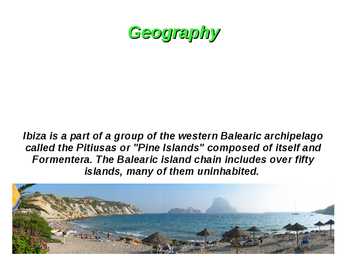
Geography
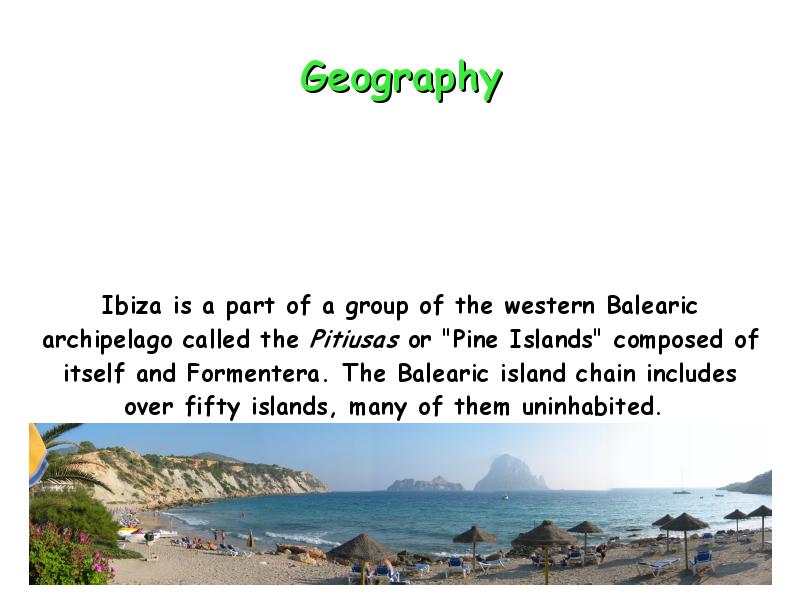
Ibiza is a part of a group of the western Balearic archipelago
called the Pitiusas or "Pine Islands" composed of itself and
Formentera. The Balearic island chain includes over fifty
islands, many of them uninhabited.
Climate
The climate of Ibiza is Mediterranean and has milder
winters but slightly cooler summers than Majorca. The
winters are generally mild with temperatures around 15°C
(60°F) during the day and 8°C (46°F) at night. The hottest
time of the year is July and August with temperatures
reaching 30°C (90 °F) most afternoons. The lowest
recorded temperature in Ibiza is -5°C (20°F), the highest
is 37 °C (100 °F).
People
Demographically, Ibiza display a very peculiar configuration, as census agencies
diverge on exact figures. According to the 2001 national census, Ibiza had 93,000
inhabitants (against 76,000 in 1991, 64,000 in 1981, 45,000 in 1971, and 38,000 in
1961). However, two years later, this figure jumped to 108,000 (Govern de les Illes
Balears - IBAE 2004). This discrepancy stems from the amnesty which
incorporated a number of unregistered foreign migrants. In terms of origin, about
55 per cent of island residents were born in Ibiza, 35 per cent are immigrants from
mainland Spain (mostly working-class families from Andalusia, and the remainder
from Catalonia, Valencia and Castilla), and the about remaining 10 to 15 per cent
are foreign, dual and multi-national citizens of the EU and abroad (Govern de les
Illes Balears - IBAE 1996). In decreasing order, foreigners are Germans, British,
Latin Americans, Moroccans, French, Italians, Dutch, in addition to a myriad of
other nationalities. This mosaic reflects the fluidity of foreigners living and moving
across the island, in ways that render impossible to exactly quantify the expatriate
population (Rozenberg 1990).
Language
While Catalan and Spanish are the official languages
of Ibiza, a "dialectal variation [of Catalan]...called
Eivissenc or Ibicenco is more readily spoken by both
the residents and those of Formentera. Additionally,
because of the influence of tourism (see below) and
expatriates living in or maintaining residences on the
island other, atypical languages, such as English,
German and Russian are also spoken. Polylinguality
is the norm, not the exception.
Tourism
Nightlife
Ibiza is considered a popular tourist destination, especially due to
its legendary and at times riotous nightlife centered around two
areas: Ibiza Town, the island's capital on the southern shore and
Sant Antoni to the West. Well-known nightclubs are Privilege (the
largest club in the world), Eden (the busiest nightclub in Sant
Antoni), Es Paradís (noted for its water parties), Amnesia (known for
foam parties), Space (an afterparty club), Pacha, and DC10.During
the summer, well-known DJs perform at the various clubs on weekly
schedules, in between touring to other international destinations.
Many of these DJs use Ibiza as an outlet for presenting new songs
within the house, trance and techno genres of electronic dance
music.
Tourism
The season traditionally begins at the start of June with Space and DC10's
opening parties and finishes on the first weekend of October with the
Closing Parties. A typical schedule for clubbers going to Ibiza includes
waking at noon, early evening naps, late night clubbing, and "disco
sunrises". Due to Ibiza's notable tolerance toward misbehavior from young
adult tourists, it has acquired the sobriquet "Gomorrah of the Med". Also
well-known is Café del Mar, a long-standing bar where many tourists
traditionally view the sunset made famous by José Padilla. That and other
bars close by have become an increasingly popular venue for club pre-
parties after sunset, hosting popular DJ performers.
The island's government is trying to encourage a more cultured and
quieter tourism scene, passing rules including the closing of all nightclubs
by 6 a.m. at the latest, and requiring all new hotels to be 5-star. However,
many clubs tend to stay open until 7 or 8 a.m. as 6 a.m. is viewed as an
unrealistic time for one to stop partying. The administration is wanting to
attract a more international mixture of tourists.
World Heritage Site
hough primarily known for its party scene, large portions of the
island are registered as U.N. World Heritage Sites, and thus
protected from the development and commercialization of the main
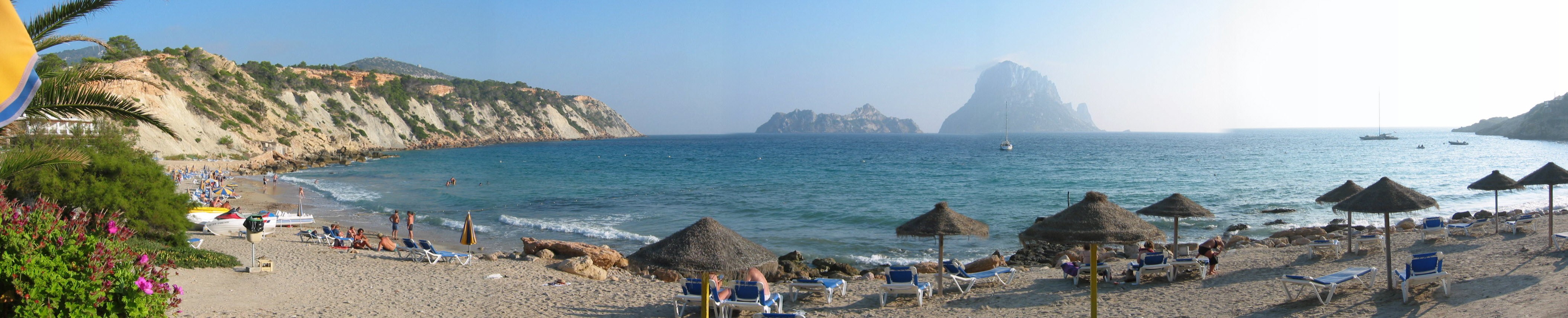
cities. A notable example includes "God's Finger" in the Benirràs Bay
as well as some of the more traditional Ibicenco cultural sites.
Because of its rustic beauty, companies and artists alike frequently
use the island for photographic and film shoots. A monument (
"The Egg") erected in honour of Christopher Columbus can be found
in Sant Antoni: Ibiza is one of several places purporting to be his
birthplace.
Religion
Here in Ibiza it's impossible to forget that we still live in a
devoutly religious, Catholic country. Visitors to the island at
Easter can get a taste of the faith and pageantry of the
Ibicencos in the religious processions which take place in the
towns and villages.
The main ones are in Santa Eulalia and Ibiza town and smaller
versions take place in Santa Gertrudis, San Miguel, San
Vicente and San Lorenzo. First timers are often shocked at the
outfits worn by the 'cofradias' or brotherhoods of penitents
whose pointed hats and flowing robes resemble those of the
Klansmen of the USA.
In Santa Eulalia the processions leave the church at 21.00 on
Thursday 9th April and 20.00 on Friday 10th and march
solemnly through the streets of the town carrying statues and
accompanied by brass bands. In Ibiza the procession leaves
the Cathedral on Friday 10th at 20.30 hours.
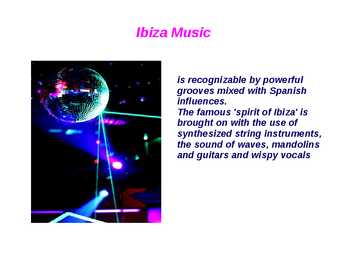
Ibiza Music
is recognizable by powerful
grooves mixed with Spanish
influences.
The famous 'spirit of Ibiza' is
brought on with the use of
synthesized string instruments,
the sound of waves, mandolins
and guitars and wispy vocals
Transport
Ibiza is served by Ibiza Airport
.
Iseseisev töö. slide show.
Research some land. Climate,history,people,geography,language(s).
Sarnased õppematerjalid
![Ibiza]()
4
doc
Ibiza
Ibiza is an island in theMediterran
e a n S
79 km
e a off the coa st of the
city of Valencia Iberian
in Peninsula Spain. It is the third large st of the
Baleari
![Kodutöö word variant 9 teema 19]()
18
docx
Kodutöö word variant 9 teema 19
� I. Portugal
ABOUT
Photo Location of Portugal (dark green)
Portugal (Portuguese: Portugal, IPA: [putua];
officially the Portuguese Republic, Portuguese:
República Portuguesa) is a country located in
Southwestern Europe, on the Iberian Peninsula. It is
the westernmost country of mainland Europe, and is
bordered by the Atlantic Ocean to the west and south
and by Spain to the north and east. The Atlantic
archipelagos of the Azores and Madeira are
Portuguese territory as well. The country is named
after its second largest city, Porto, whose Latin name was Portus Cale.
SETTLEMENT
The land within the bo
![The Road-Short Analysis and Summary]()
2
docx
The Road, Short Analysis and Summary
https://www.youtube.com/watch?v=q1_knonj0Lw
https://www.youtube.com/watch?v=9ow1UcJF6Ic
https://www.youtube.com/watch?v=_MIndsjt9Rg
https://www.youtube.com/watch?v=y3kpzuk1Y8I
Biography of Cormac McCarthy
Cormac McCarthy was born and raised in Rhode Island on July 20, 1933. He
was originally named Charles, but he decided to change his name to Cormac
after the Irish King. Cormac was raised Roman Catholic. He attended Catholic
High School in Knoxville, then went to the University of Tennessee in 1951-52.
His major was liberal arts. He also served the U.S. Air Force for four years.
After leaving the university twice, he headed to Chicago, where he worked,
apparently as an auto mechanic, while writing his first novel, The Orchard
Keeper. After travelling for quite a while, he settled on the island of Ibiza. Some
say that the island of Ibiza was an artist colony. There, McCarthy finished
revisions of Outer Dark, his second novel. After some years, he moved back to
the USA, into a barn, wh
![Jamaica]()
9
doc
Jamaica
Tartu Secondary School of business
JAMAICA
Form 10 A
� Tartu 2007
Introduction.................................................................................................................................3
Geography...................................................................................................................................3
History.........................................................................................................................................3
Economy..................................................................................................................................... 4
Econometrics...............................................................................................................................6
Climate................................................................................................
![Netherlands]()
18
doc
Netherlands
Tartu Kivilinna Grammar School
Netherlands
Report
Composer: Reino Urbanovits
Supervisors: Tiia Krass
Erika Hunt
� Tartu, 2003
Table of contents
Table of contents............................................................................................................................2
Introduction....................................................................................................................................3
Chapter 1........................................................................................................................................4
The Netherlands.............................................................................................................................4
Chapter 2......................................................
![Ireland report]()
3
doc
Ireland report
Ireland is the third largest island in Europe. It lies in between the Atlantic Ocean and the Irish Sea.
Politically it is divided into a sovereign state, the Republic of Ireland, that covers about five-sixths of the
island (south, east, west and north-west), and Northern Ireland, which is part of the United Kingdom,
covering the northeastern sixth of the island.[1] The name 'Ireland' derives from the name Ériu (in modern
Irish, Éire) with the addition of the Germanic word 'land'.
The population of the island is just under 6 million (2006); just over 4.2 million in the Republic of
Ireland[2] (1.6 million in Greater Dublin[3]) and just over 1.7 million in Northern Ireland[4] (0.6 million in
Greater Belfast[5])).
Politics
Politically, Ireland is divided into:
· The Republic of Ireland, with its capital Dublin.
· Northern Ireland, which is part of the United Kingdom,
Geography
A ring of coastal mountains surrounds low central plains. The highest peak is Carrauntuohill , which is
1,
![Traveling]()
20
ppt
Traveling
Traveling
�Description
Traveling is the movement of people or
objects (conveyances) between relatively
distant geographical locations.
Travel may occur by human-powered
transport such as walking or bycycling, or with
vehicles, such as public transport,
automobiles, trains and airplanes.
�Etymology
The term "travel" originates from the Old
French word travail. The term also covers
all the activites performed during a travel
(movement). A person who travels is
spelled "traveler" in the United states, and
"traveller" in the United Kingdom.
�Purpose and motivation
Reason for traveling include recreation, tourism or
vacationing, research travel for gathering
information, for holiday to visit people, volunteer
travel for charity, migration to begin life
somewhere else, religious pilgrimages and
mission trips, business travel, trade, commuting,
and other reason, such as to obtain health care or
fleeing war or for the enjoyment of traveling.
�Wo
![Topic - USA]()
11
doc
Topic - USA
Tallinn English College
Topic
The United States of
America
Tallinn
2007
�1. Introduction
The United States of America's territory is over 3.7 million square miles (over 9.6 million km²)
and population more than 300 million people. The capital city is Washington D.C. Although the
United States has no official language at the federal level, English is the de facto national
language. English is the most common language for daily interaction among both native and
non-native speakers. Spanish is the second language. The largest city is the New York City. The
Government is Federal constitutional republic and the president is George W. Bush.
2. Geographical position
The United States of America is located on the continent of North America. It has borders with
two countries Mexico and Canada. There are also the Atlantic Ocean, the Pacific Ocean and
the Gulf of Mexico surrounding the big country. There are 50 states in America.
Meedia
Kommentaarid (0)
 50 punkti
Autor soovib selle materjali allalaadimise eest saada 50 punkti.
50 punkti
Autor soovib selle materjali allalaadimise eest saada 50 punkti.
 ~ 17 lehte
Lehekülgede arv dokumendis
~ 17 lehte
Lehekülgede arv dokumendis
 2010-01-14
Kuupäev, millal dokument üles laeti
2010-01-14
Kuupäev, millal dokument üles laeti
 5 laadimist
Kokku alla laetud
5 laadimist
Kokku alla laetud
 0 arvamust
Teiste kasutajate poolt lisatud kommentaarid
0 arvamust
Teiste kasutajate poolt lisatud kommentaarid
 enelinp
Õppematerjali autor
enelinp
Õppematerjali autor
 annaabi.ee













Kõik kommentaarid