 50 punkti
Autor soovib selle materjali allalaadimise eest saada 50 punkti.
50 punkti
Autor soovib selle materjali allalaadimise eest saada 50 punkti.
 ~ 1 leht
Lehekülgede arv dokumendis
~ 1 leht
Lehekülgede arv dokumendis
 2011-04-25
Kuupäev, millal dokument üles laeti
2011-04-25
Kuupäev, millal dokument üles laeti
 19 laadimist
Kokku alla laetud
19 laadimist
Kokku alla laetud
 0 arvamust
Teiste kasutajate poolt lisatud kommentaarid
0 arvamust
Teiste kasutajate poolt lisatud kommentaarid
 inksul
Õppematerjali autor
inksul
Õppematerjali autor
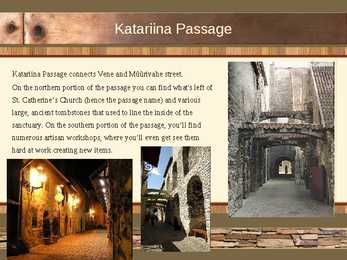
Katariina Passage Katariina Passage connects Vene and Müürivahe street. On the northern portion of the passage you can find what's left of St. Catherine's Church (hence the passage name) and various large, ancient tombstones that used to line the inside of the sanctuary. On the southern portion of the passage, you'll find numerous artisan workshops, where you'll even get see them hard at work creating new items. City wall Tallinn's medieval city wall is a sub-facility that was built to protect the lower Tallinn and upper Tallinn (Toompea). The building of the city wall began in 1310th years, and by improving over time it formed the city wall with defensive buildings (towers). It was finished by the end of the 1561. Then it was 2.35-kilometer-long circular wall, which had 27 wall gate, 8 tower gate and 21 other stone fortifications. Many parts of the town wall have survived until today Great Coast
Introduction Tallinn, the capital city of the Republic of Estonia and of the Harju county, is a town in North Estonia on the coast of the Gulf of Finland. It has nearly half a million inhabitants and covers an area of almost 160 sqkm. It is also an important economic and cultural centre and one of the main ports in the Baltic States. Tallinn is one of the oldest cities on the Baltic Sea. It is unique for its well-preserved architecture from the 13-15 centuries. In contrast to the ancient town-walls and towers, Tallinn of today offers modern hotels, restaurants, sport and cultural centres. Every five years national song and folk dance festivals take place in Tallinn. The yachting regatta of the 1980 Moscow Olympic Games was held at Pirita. History Tallinn means in English "Danish town". The place is believed to have been settled by Finno-Ugric people about 2500 BC. It was first marked on a map of the world by the Arab geographer al-Idrisi in 1154. The Estonians were the first to bui
2 Towns (Upper & Lower Town) Tallinn used to be divided into 2 parts - Upper Town where lived the aristocracy, gentry and the clergy; and Lower Town with traders, craftsmen and merchants. Legend says the Toompea Hill is actually the tumulus mound of the great Kalev. Linda carried rocks to his grave. It is a naturally- formed limestone hill. Lower Town was a merchantile centre, Tallinn also belonged to the Hansaetic League (1285). It is often referred to as the town of citizens. Any grown-up, married and economically independent person, born in a legal marriage between two free people and having lived in the town for at least 3 months, could apply to the Magistracy for citizenship. Serfs could escape from serdom after having successfully hidden in town for a year and a day. Two parts remained separated until the end of the 19th century. Four Names Lyndanise - mentioned by Henricus de Lettis in his Chronicle; derives from the name Linda - the wife of Kalev and mother of Kalevipoeg Kol
Kunda Ühisgümnaasium Tallin Old Town Report Student: Kristin Karu Teacher: Kristi Aron Kunda 2012 The Alexander Nevsky Cathedral The Alexander Nevsky Cathedral is an orthodox cathedral in the Tallinn Old Town,Estonia. It was built to a design by Mikhail Preobrazhensky in a typical Russian Revivalstyle between 1894 and 1900, during the period when the country was part of theRussian Empire. The Alexander Nevsky Cathedral is Tallinn's largest and grandest orthodox cupola cathedral. It is dedicated to Saint Alexander Nevsky who in 1242 won the Battle of the Ice on Lake Peipus, in the territorial waters of present-day Estonia. The late Russian patriarch, Alexis II, started his priestly ministry in the church. Interior of the Cathedral. The Alexander Nevsky Cathedral crowns the hill of Toompea where the Estonian folk hero Kalevipoeg is said to have been buried according to a lege
Tallinn English College English Sergo Vainumäe 9A TALLINN Report Supervisor: Inge Välja Tallinn 2006 Order of contents: 1.Introduction 2.Toompea 3.Lower Town 4.Kadriorg and Pirita 5.Museums 1. Introduction Tallinn, the capital of Estonia, lies on the Baltic Sea. It is on almost the same latitude east St. Petersburg in Russia, Stockholm in Sweden and Stavanger in Norway, and covers 158 sq km. Tallinn was first marked on a map of the world by the Arab geographer al-Idrisi in 1154, its name then being Kolyvan (probably derived from the name Kalev). In the 13th-century Chronicle of Henricus de Lettis the town was called Lyndanise. Later came Reval (presumably after the old county of Rävala), the name used by the Germans who ruled the country for seven centuries. Russians then modified Reval to Revel. For Estonians, the town came to be c
Tallinna Mustamäe College The Most Important Buildings in Lai Street in Tallinn Report Supervisor: Ingrid Teigar Tallinn 2014 Table of Contents Introduction.............................................................................. 3 Lai Street in general.................................................................. 4 The origin of the name "Lai"...................................................... 4 1 Lai Street / 4 Nunne Street...................................................... 5 17 Lai Street............................................................................. 6 23 Lai Street............................................................................. 6 27 Lai Street............................................................................. 8 29 Lai Street............................................................................. 8 30 Lai Street............................
Old Market square (Vanaturg) is the former market square in Tallinn old town. Five streets meet here: Vene, Viru, Suur Karja and Kuninga streets, and Vana Turu Kael sidestreet. The market location perfectly suited for trade: five trade routes started there. The square is connected to Town Hall Square by a short sidestreet. Town Hall Square Was used as marketing place, for festivities as well as for executions. In summer it is filled with outdoors cafes In winter it becames a magical christmas market The L-shaped sigh There has been a town hall in Tallinn since at least 1322. Town Hall Built in 13th century The management of the city worked in the Town Hall until the year 1970 The only gothic town hall on Northern Europe Weathervane Old Thomas The height of the towe is 64 metres Town Hall pharmacy Is one of the oldest working pharmacies in Europe and the oldest company in Tallinn Was first
Kunda Gymnasium Rait Türkel Old Tallinn Report Instructor:Teacher Kristi Aron Kunda 2012 Introduction Like most cities with an eight-hundred-year-old past, Tallinn is a patchwork of historic areas. The city's pride and joy is without a doubt its Medieval Old Town, but equally enchanting is the Kadriorg district, a throwback to the time when Estonia was ruled by the Russian Tsars. Tallinn is the capital and largest city of Estonia. It occupies an area of 159.2 km2 with a population of 416,470. It is situated on the northern coast of the country, on the shore of the Gulf of Finland, 80 km south of Helsinki, east of Stockholm and west of Saint Petersburg. Tallinn's Old Town is in the list of UNESCO World Heritage Sites. It is ranked as a global city and has been listed among the top 10 digital cities in the world.The city was a European Capital of Culture for 2011, along with urku, Finland.Tallinn is the oldest capital inNorthern Europe. T
 annaabi.ee






Kõik kommentaarid