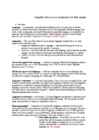
1. Faithful and false friends a. How do you understand literal translation (based on this short text)? Literal translation is translating directly from source language into target language b. Which types of words are more/less literal? More literal: objects and movements Less literal: qualities and ways of moving c. What are the two views of translation that the author brings out? Explain. 1) A process of explanation, interpretation, reformulating ideas and words. 2) Impossible due to other definitions 2. Expressive function a. Name the three expressive text types. - Serious imaginative literature; Authoritative statements; Autobiographies, essays, personal correspondence. b. Why is it difficult to translate an expressive text? - Because of the used dialect may get lost in the translation. c. What constitutes the personal component in an expressive text? - original metaphors, unusual collocations d. What is a...
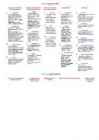
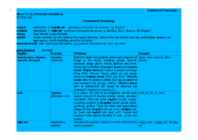
LEXICAL STYLISTIC DEVICES Based on: interaction of lexical and interaction of denotational interaction of primary circumlocution other cases contextual meaning and emotional meaning and secondary meaning 1. EPITHET 1. METAPHOR indicates individual 1. ZEUGMA 1. PERIPHRASIS 1. BATHOS based on similarity of 2 evaluation of sth. Logical "to join" w-d is use of longer spoiling the lofty effect. Function notions, hidden comparison at...
Phonology. Mid-term 2. Syllable - is a phonological unit consisting of one or more phonemes. In phonetics a syllable is a unit which consists of a centre, that has little or no obstruction to airflow; it is comparatively louder than other sounds. In phonology syllables are the possible combinations of phonemes. The syllable consists of - onset, nucleus, coda. (every syllable has a nucleus: vowel, syllabic l, or m, n). Rhyme/rime nucleus + coda; the nucleus and the coda constitute a sub-syllabic unit rhyme. Words rhyme, when their nucleus and coda are identical. (E.g 'cr-o-wn', 'd-o-wn'). The hierarchical structure of the syllable: Onset the beginning of the syllable Nucleus/peak the open part of a syllable, generally a vowel. Coda a consonant sound which ends the syllable. Open syllable - has no coda Closed syllable - has a coda! Texts: [t-e-k-s-t-s]- (Consonant, Vowel, Consonant, Consonant, Consonant, Consonant). Stron...
1 SYNTACTIC STYLISTIC DEVICES SYNTACTIC STYLISTIC DEVICES are based on a peculiar place of the word or phrase in the utterance (text, sentence, etc).This special place creates emphasis irrespective of the lexical meaning of the words used. Categories: syntactic stylistic devises based on: SDD: based on ABSENCE OF LOGICALLY REQUIRED ELEMENTS OF SPEECH ELLIPSIS ELLIPSIS or ELLIPTICAL SENTENCES means leaving out one or both principle members of the sentence that is the subject or predicate. NT: Where is the man I'm going to marry? - Out in the garden. (no subject) What is he doing out there? - Annoying father. Here, in the dialogue, ellipsis creates the colloquial tone of the utterance. It also renders realistically the way the characters speak. The elliptical sentences convoy/render carelessness, familiarity, harshness. It...
adjective + preposition omadussõna + eessõna proud of, good at, married to adverb particle Some verbs are followed by adverb particles. Examples are: put on, take off, give away, bring up, call in. Sometimes the particle is detached from the verb and put after the object. •He took his boots off. •They called the doctor in. apposition a grammatical construction in which two usually adjacent nouns having the same referent stand in the same syntactical relation to the rest of a sentence (as the poet and Burns in “a biography of the poet Burns”) back-reference In grammatical analysis, the term reference is often used to state a relationship of identity which exists between grammatical units, e.g. a pronoun 'refers' to a noun or noun phrase. When the reference is to an earlier part of the discourse, it may be called a 'back-reference' (or anaphora); collective noun Collective noun is the name we give to a group of nouns...
1. STYLE The term "style" is polysemantic (has many meanings): a Latin word "stilus" originally meant a writing instrument used by ancient people. Already in classical Latin the meaning was extended to denote the manner of expressing one's ideas in written or oral form. Jonathan Swift defined style as "proper words in proper places". In present day English the word "style" is used in about a dozen of principle meanings: 1. the characteristic manner in which a writer expresses his/her ideas (e.g. style of Byron) 2. the manner of expressing ideas, characteristic of a literary movement or period 3. the use of language typical of a literary genre (e.g. the style of a comedy, drama, novel). 4. the selective use of language that depends on spheres / areas of human activity (e.g. style of fiction, scientific prose, newspapers, business correspondence, etc.). STYLISTICS Stylistics is the study of s...
STYLISTICS 1. Style, stylistics, a survey of stylistic studies The term ,,style" is polysemantic. Latin ,,stilus"--a writing instrument used by the ancients for writing on waxed tablets. Soon, the meaning was extended to denote the manner of expressing one's ideas in written or oral form. Jonathan Swift said: ,, Style is proper words in proper places" Present day--half a dozen meanings: · the characteristic manner in which a writer expresses his ideas (Style of Byron) · the manner of expressing ideas characteristic of a literary movement or period (symbolism, romanticism) · the use of lg. typical of a literary genre (comedy, drama, novel) · the selective use of lg that depends on spheres of human activity. These are called functional styles or registers (fiction, newspaper) Stylist...
FGI 1081 Stilistika (Irina Ladusseva) Kab. 420 2 AP Ends with an exam; lasts only for 1 semester. At the exam you get 2 questions and an exercise (50 sentences: establish the device used, recognize it, and name it). Care about the pronunciation of the terms. Books: - I. Galperin "Stylistics" - I. Ladusseva "Rhythm and Text" - I. Ladusseva "Vocabulary and Style" - I. Ladusseva "Stylistic practice: Book I, Book II" - I. Ladusseva "A Guide to Punctuation" EXAMINATION TOPICS: 1. Style, stylistics, a survey of stylistic studies ...
Pronouns By: Anneli Võikar Pronouns are small words that take the place of a noun. We can use a pronoun instead of a noun. Pronouns are words like: he, you, ours, themselves, some, each... If we didn't have pronouns, we would have to repeat a lot of nouns. Types of pronouns Personal pronouns Reflexive pronouns Demonstrative pronouns Interrogative pronouns Indefinite pronouns Relative pronouns Possesive pronouns Reciprocal pronouns Pronoun case Personal pronouns Personal pronouns represent specific people or things. We use them depending on: number person gender Case Singular: subject- I, you, he, she, it ; object-me, you, him, her, it. Plural: subject-we, you, they ; object-us, you, them. Examples: 1) Do you like coffee? (subject) 2) John loves you. (object) Reflexive pronouns We use a reflexive pronoun when we want to refer back to the subject of the sentence or clause. Reflexive pronouns end in "-self" (sin...
1 Grammatical Terminology PRACTICAL ENGLISH GRAMMAR FLGR.01.042 Grammatical Terminology analytic analüütiline (= uninflected - grammar is focused in the sentence , e.g. English) synthetic sünteetiline (= inflected - grammar is focused in the word, e.g. Estonian, Latin, Russian, Old English) ending lõpp (käände- ja pöördelõpud) marker tunnus (mitmuse, oleviku, lihtmineviku, tingiva kõneviisi, käskiva kõneviisi, kaudse kõneviisi, umbisikulise tegumoe, ma- tegevusnime, oleviku kesksõna, mineviku kesksõna) derivational affix liide, tuletusliide, tuletusafiks (e.g. postwar, anti-American, wiser, greenish) parts of speech sõnaliigid English Estonian ...
Tallinn University of Technology Department of Electrical Drives and Power Electronics Report on Exercises 2 Diodes Student ******* Code ****96 Group AAVB41 Tallinn 2012 2.1. Diode rectifier VD f = 9 kHz U=6V U = 19.7 V R = 96 k Figure 1. Circuit diagram Figure 2. Timing diagram VD + R = 96 k...
English structure revision for the exam 1. Terms Language → A systematic, conventional (tavakohane) use of sounds, signs or written symbols in a human society for communication and self-expression. Human language at all levels is rule- or principle- governed (valitsema) meaning that language corresponds to the grammar. Natural language is usually spoken, while language can also be encoded into symbols (such as letters, morse etc) For example: Estonian, English. Linguistics → The scientific study of human natural language. Broadly, there are three aspects to the study which are Pragmatics (studies the use of language → interested in the gap between the sentence’s meaning and the speaker’s meaning). Semantics (concerned with the meaning of the language aspects and the way they change, also how objects and language and thinking and language are related). ...
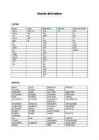
Words derivation LÕPUD: Noun Verb Adjective Adverb Prefix & Sufix -ation -ise/-ize -ing -ly dis- -ence -en -ive ir- -ion en- -able im- -ance -ate -y -il -age -fy -ed in- -er -ical un- -ing -ant over- -ness -ent out- -ity -en under- -ition -ous -ment -ful -hood -ible -ship -less -ist ...
Tim Chiu April 4th , 2009 Topics y Lao Zi The Person y Tao Te Ching The Book and the Name y Ch. 1 & 14 Describing the indescribable Tao y Ch. 2 & 11 On duality and Formlessness y Ch. 8 & 78 The Virtues of Water Lao Zi The Person y Real name was Lee Er, who was a highly regarded philosopher of his time y Keen observer of the virtues of Nature and the relationship between man and his environment y Realized the existence of a formless and indescribable origin: Tao y Can not thoroughly analyzed by our thoughts and logic y Its existence gave rise to everything and pervades all that we know y The manifestation of Tao in humans is called our True Nature y Purity and innocence of a child y Spring and Autumn, Warring States Era of the Chou dynasty (~500BC), during a time of turmoil and spiritual disintegration ...
1. What is a plant? Plant is a living organism. It is made up of different parts, each of whitch has specialized function. 2. Name the parts of a shoot system. The shoot system above the ground consists of the stem, the leaves, flowers and fruit. 3. What are the main functions of a shoot system? Main functions of a shoot system are: * Stem- to support the plant, to transport water, minerals and sugar * Leaves- to make food by photosynthesis, to absorb water from air * Flower- to contain reproductive organs, the reproductive function *Fruit- to enclode the seeds, to protect seeds 4. What are the main functions of a root system? Main functions of a root system are to take in, absorb water and minerals, to hold the plant firmly in the soil. 5. What happens in the process of photosynthesis? For the process of the photosynthesis is sunlight necessary. Water from the soil and carbon dioxide from the ...
Kairis Baumann K14KÕ U1 PRESS RELEASE We are pleased to announce the new dates for the iPhone 6 and iPhone 6 plus to launch. Sorry for keeping waiting due to technical problems in Software development. The waiting is over. The magic date is 27 October, 2014that the phones are available for purchase in all Apple stores. So forget your old mobile phone and prepare yourself for the biggest advancements that your new iPhone has to offer. The iPhone 6 and iPhone 6 plus comes with new innovative technologies: such as ultrafast wireless, longer battery life you have ever had, advanced cameras with 8MP, bigger screen and plenty of more. The benefiits of the iPhone 5 and iPhone 5 s include a simpl...
1. Be ready to explain the terms (lecture 1): language, linguistics, synchronic approach to language, diachronic approach to language, linguistic competence, linguistic performance, what is grammar?, prescriptive grammar vs. descriptive grammar; phonology, phonetics, phone, allophone, phoneme; morphology, morphemes (types of morphemes), morphs, allomorphs, types of affixes, derivational affixes, inflectional affixes; open vs closed class words; syntax. Language: a systematic, conventional use of sounds, signs or written symbols in a human society for communication and self-expression. - human language at all levels is rule- or principle-governed. Linguistics: the scientific study of human natural language Synchronic approach to language: Diachronic approach to language: Linguistic competence: Linguistic performance: What is grammar?: "The sounds and sound patterns, the basic units of meaning, such as words, and the rules to combine them...
CHARACTERISTIC FEATURES OF OLD ENGLISH - 15 monophtongs, (7 long, 7 short, 1 central), 4 diphtongs, 17 consonants. Free variaton of R, and it was pronounced everywhere. Very much Germanic in character. Quite some special consonants that no longer exist. About morphology: synthetic with numerous aglutinating tendencies. System of tenses Germanic, but with a reduction of tenses. Paradigmatic leveling; Stress shift; Word order; Loan words (Old Norse, Old French). Dual pronouns. Determiners - no separate definite article. Strong and weak verbs. Word order relatively free with tendencies towards SVO. SVO, SOV, VSO most common. Adposition and podposition were both possible (eesliide ja tagaliide). About syntax: clauses were joined much simpler than nowadays, using and, then etc. Because of case syncretion the word order in a sentence became much more important to be able to tell the difference between words. FIRST CONSONANT SHIFT (GRIMM'S L...
English lexicology 1. Size of English vocabulary Vocabulary is a sum total of words used in a language by speakers or for dictionary-making. Active and passive vocabulary. The Old English vocabulary was homogenous. There were about 50 000 – 60 000 words, 1/3 of which have survived. o About 450 loans from Latin o About 2000 from the Viking invasions. The Middle-English vocabulary became a heterogeneous hybrid of Germanic and Romanic languages. 100 000 to 125 000 words. o About 10 000 loans from Norman French, 75% are still in use o Continuing Latin influence Early Modern English. 200 000 – 250 000 words o English becomes a pluricentric language. o Polyglot. Cosmopolitan language Modern English. 500 000 words o At present at least 1 billion lexical units 2....
Technical translation Technical translation Forms a part of specialised translation The other part is comprised by institutional translation (politics, commerce, finance, government, etc.) Can be considered somewhat culture-free (not really true?) Universal: not confines to one speech community Characteristic features: Terminology (5-10%), only that much, but it makes the text hard to translate Format: technical report, but also instructions, manuals, notices, publicity Grammatical features in English: passives, third persons, empty verbs, present tenses. Technical Style Free from emotive language, connotations, sound-effects, original metaphor Part of technical translator’s job often is to rephrase poorly written language and convert metaphor to sense. Varieties of Technical Style Academic or scientific styl...
2018 Boolean Functions and their Cryptographic Criteria * Univeristy of Tartu, Estonia Lomonosov Moscow State University, Russia Contents 1. Introduction ..................................................................................................................................... 3 2. Boolean functions and their representations ................................................................................. 4 2.1 Truth table ............................................................................................................................... 4 2.1.1 Disjunctive normal form .................................................................................................. 4 2.1.2 Conjunctive normal form ......................................................................................
Style The term style is a polysemantic one. The latin word ,,stilus" meant a writing instrument used by the ancients for writing on waxed tablets. Already, in classical latin the meaning of style was extended to denote the manner of expressing one's ideas in written or oral form. One of the abts/the best was given by Jonathan Swift: ,,Proper words in proper places." In present- day english, the world style is used in about half a dozen basic meanings. 1. the characteristic manner in which a writer expresses his ideas. Some speak about the style of Hemingway, Dickens etc. 2. the manner of expressing ideas, characteristic of a literary movement or period. Style of symbolism, romanticism 3. the use of language to pick a literary genre-comedy, novel, drama, O.D (poetic form) etc. 4. the selective use of language that depends on spheres of human activity fiction, scientific prose, newspape...
The Article Table of Contents General Rules....................................................................... 2 The Definite Article ............................................................... 5 Names that take the Definite Article...................................... 6 No article.............................................................................. 7 Countable and uncountable nouns ....................................... 9 General Rules There are two articles in the English language – the Indefinite Article and the Definite Article. The Indefinite Article has two forms – a and an (a precedes words beginning with a consonant sound and an precedes words beginning with a vowel sound). It comes from the Old English word ãn, which meant one. The Definite Article is the. It comes from the Old English word ţis, which meant this. Thus, in most general term...
1.Lexicology as a science L. studies the voc of lg as a system. Word-learning, lexis-logos. The task of L is to establish the general features of modern Engl voc. Theoretical L. gives a complete picture of voc. Practical value lies in using and appretiating the lg more conciously. There is diachronic (historical) L that studies origin and development; syncronic studies voc at a given historical period. There are general L (studies words disregarding particular features of any particular lg); special L (studies specific features of a separate lg, there is Engl that bases on general L); contrastive (compares vocabularys in different languages). 2. Connection of L with other linguistic disciplines a) the word performes a certain grammatical function (nt, he always misses the class, how many misses are there; the girl powders her nose, soliders face powder)In speech words are combined according to grammatical rules. The plural of nouns m...
My analysis of the article " Why Ebola is so dangerous" I chose this article because this theme is very current in our society, and many people are dying due to the disease called Ebola. The theme is very intriguing and I hope it interests people, because it definitely interests me. I think that this article makes people more aware of the disease and hopefully helps to put a stop to Ebola. Ebola virus disease, or simply Ebola, is a disease of humans and other primates caused by ebolaviruses. Signs and symptoms typically start between two days and three weeks after contracting the virus, as a fever, sore throat, muscle pain and headaches. Then, vomiting, diarrhea and rash usually follow, along with decreased function of the liver and kidneys. At this time, generally, some people begin to bleed both internally and externally. Death, if it occurs, follows typically six to sixteen days after symptoms appear and is often due to low blood ...
Cat. No. W317-E1-11 SYSMAC CPM1A Programmable Controllers OPERATION MANUAL CPM1A Programmable Controllers Operation Manual Revised October 2007 iv Notice: OMRON products are manufactured for use according to proper procedures by a qualified operator and only for the purposes described in this manual. The following conventions are used to indicate and classify precautions in this manual. Always heed the information provided with them. Failure to heed precautions can result in injury to people or dam- age to property. ! DANGER Indicates an imminently hazardous situation which, if not avoided, will result in death or serious injury. Additionally, there may be severe property damage. ! WARNING Indicates a potentially hazardous situation which, if not avoided, could re...
CHAPTER 1 GETTING TO KNOW THE TOEFL WHAT IS THE TOEFL? The TOEFL is a comprehensive English language examination required by more than 3,000 colleges and universities in the United States, Canada, and other parts of the world. In addition, foreign born professionals frequently need a TOEFL score for certification to practice their profession in the United States or Canada. The TOEFL is a timed test that consists of the three sections listed here. THE TOEFL Section 1 Listening Comprehension 50 questions 35 minutes Part A Statements 20 questions Part B Short Dialogs 15 questions ...
TEKST 2. Durbin, Paul T. (1984). A Guide to The Culture of Science, Technology, 3. Broad Synthetic vs. Narrow Analytic. Third, one may approach science and Medicine. The Free Press. pp. 217-222. (Katkendid) from a narrow analytic or a broad synthetic point of view. That is, one could see one's task as primarily dissecting various features of science to see how they look or work, or C. Frameworks for Philosophy of Science as primarily locating science within a broader framework of human activities and artifacts. Questions about, for example, the form and function of scientific explanations In this section our aim is to examine alternative approaches to t...
LEXICOLOGY 1. Size of English vocabulary 1) Old English – 50,000 to 60,000 words Vocabulary of Shakespeare OE – homogeneous; 1/3 of the vocabulary has survived • 884,647 words of running text About 450 Latin loans (Amosova) • 29,000 different words (incl. work, working, Viking invasions added 2,000 worked, which are counted here as separate 2) Middle English – 100,000 – 125,000 words) English becomes heterogeneous (Norman French, • 21,000 words English, Latin), hybrid of Germanic and Romance languages Norman French influence – about 10,000 words, 75 % are still in use (Baugh) Latin influence continues 3) Early Modern English – 200,000 – 250,000 English becomes a polycentric language; polyglot, cosmopolitan lang...
Short and long term effects of alcohol Good morning. My name is NIMI. I'm going to talk about short and long term effects of alcohol consumption. Firstly I'll tell you about short term effects and then move on to long term effects. My presentation will take about 5 minutes. If you have any questions, you are welcome to ask them afterwards. Firstly I would focus on the short term effects of alcohol consumption. The amount and circumstances of alcohol consumption play a large part in determining the extent of intoxication; for instance, consuming alcohol after a heavy meal causes alcohol to absorb more slowly. Hydration also plays a role as for determining the extent of hangovers. Initially, alcohol produces feelings of relaxation and cheerfulness, but as a result of further consumption blurred vision and coordination problems generally occure. As far as cell membranes are concerned they are highly permeable to alcohol, once alcohol is ...
Analysis of Major Characters Frederic Henry - In the sections of the novel in which he describes his experience in the war, Henry portrays himself as a man of duty. He attaches to this understanding of himself no sense of honor, nor does he expect any praise for his service. Even after he has been severely wounded, he discourages Rinaldi from pursuing medals of distinction for him. Time and again, through conversations with men like the priest, Ettore Moretti, and Gino, Henry distances himself from such abstract notions as faith, honor, and patriotism. Concepts such as these mean nothing to him beside such concrete facts of war as the names of the cities in which he has fought and the numbers of decimated streets. Against this bleak backdrop, Henry's reaction to Catherine Barkley is rather astonishing. The reader understands why Henry responds to the game that Catherine proposes--why he pledges his love to a woman he barely kn...
Stonehenge Stonehenge is a prehistoric monument located in the English county of Wiltshire, about 3.2 kilometres (2.0 mi) west of Amesbury and 13 kilometres (8.1 mi) north of Salisbury. One of the most famous prehistoric sites in the world, Stonehenge is composed of earthworks surrounding a circular setting of large standing stones. Archaeologists had believed that the iconic stone monument was erected around 2500 BC, as described in the chronology below. However one recent theory has suggested that the first stones were not erected until 2400-2200 BC,[1] whilst another suggests that bluestones may have been erected at the site as early as 3000 BC (see phase 1 below). The surrounding circular earth bank and ditch, which constitute the earliest phase of the monument, have been dated to about 3100 BC. The site and its surroundings were added to the UNESCO's list of World Heritage Sites in 1986 in a co-lis...
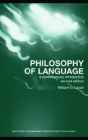
Philosophy of Language Philosophy of Language: a Contemporary Introduction introduces the student to the main issues and theories in twentieth and twenty-first-century phi- losophy of language, focusing specifically on linguistic phenomena. Topics are structured in four parts in the book. Part I, Reference and Referring, includes topics such as Russell's Theory of Descriptions, Donnellan's distinction, problems of anaphora, the description theory of proper names, Searle's cluster theory, and the causalhistorical theory. Part II, Theories of Meaning, surveys the competing theories of linguistic mean- ing and compares their various advantages and liabilities. Part III, Pragmatics and Speech Acts, introduces the basic concepts of linguistic pragmatics, includes a detailed discussion of the problem of indirect force and surveys approaches to metaphor. Part IV, new to this edition, examines the four theories of metaphor. Features...
UNIT 1 Writing in the Business World Writing gives structure and form to our ideas. In the business world this is done for a purpose: to persuade, recommend, offer advice, give an order, etc. The business text must therefore be easily and quickly read and its message must be understood exactly as intended. If you learn to recognize and avoid the more common errors of information control, grammar and style, you will achieve this aim. You will write more confidently and more correctly if you check everything you write. Pay particular attention to the following: · Appropriate Subject Heading Take care to prepare your reader by introducing the subject appropriately in your subject heading. · Carefully Organized Information If a reader needs to be persuaded or convinced, your information will need careful planning and organizing. · Correct Grammar and Sp...
The Death of the Author The Death of the Author - Roland Barthes Source: UbuWeb | UbuWeb Papers 1 The Death of the Author In his story Sarrasine, Balzac, speaking of a castrato disguised as a woman, writes this sentence: “It was Woman, with her sudden fears, her irrational whims, her instinctive fears, her unprovoked bravado, her daring and her delicious delicacy of feeling” Who is speaking in this way? Is it the story’s hero, concerned to ignore the castrato con- cealed beneath the woman? Is it the man Balzac, endowed by his personal experience with a philosophy of Woman? Is it the author Balzac, professing certain “literary” ideas of femininity? Is it universal wisdom? or romantic psychology? It will always be impossible to know, for the good reason that all writing is itself this special voice, consisting of several indiscernible voices, and t...
Inglise keele KT 27.02.13 PLACE Vocabulary: 1. shorthand- kiirkiri 2. outlet- müügiturg, kaubandusettevõte, firmakauplus 3. assumption- endastmõistetavaks pidamine, eeldus 4. on the assumption- eeldusel, et.. 5. in stock- laos, tagavaraks 6. brand- tootemark 7. to sort smth.out- välja sorteerima, välja selgitama 8. retailer- jaemüüja, jaemüügiettevõte 9. a sale was lost- müüki ei toimu, müügi kadu 10. to settle- otsustama 11. the consumer settled for a competitior's brand- tarbija otsustab konkurendi kaubamärgi kasuks 12. miscalculation- valearvestus, väärarvestus 13. to take into account- arvesse võtma, arvestama 14. to take into strategic account- strateegilise konto arvesse võtmine 15. channel of distribution= distribution channel- jaotuskanal, turustuskanal 16. sequence- jada, sari 17. negotiation- läbirääkimiste pidami...
In his book, All Marketers are Liars, Seth Godin contends that consumers prefer fantasy to the truth, and that consequently marketers should "live the lie, fully and completely." Stopping short of endorsing marketing methods which might kill people, Godin says that marketers should "give people what they want." The book is telling a story about why marketers must forsake any attempt to communicate nothing but the facts, and must focus on what people believe and then work to tell them stories that add their worldview. HIGHLIGHTS Before marketing, before shopping carts and long before informercials, people started telling themselves stories. Stories make it easier to understand the world. Stories are the only way to spread an idea. Marketers didn´t invent storytelling. They just perfected it. We tell ourselves stories, because we´re superstitious. Stories are shortcuts we use because we ´re too overwhelmed by data to discover ...
Edith D. de Leeuw, Joop J. Hox, Don A. Dillman INTERNATIONAL HANDBOOK OF SURVEY METHODOLOGY ÜLESANNE Õppeaines: SISSEJUHATUS ERIALASSE Tehnoloogia ja ringmajanduse instituut Õpperühm: Juhendaja: Tallinn 2021 TABLE OF CONTENTS 2 1 THE CORNERSTONES OF SURVEY RESEARCH 1.1 Introduction The idea of conducting a survey is deceptively simple. It involves identifying a specific group or category of people and collecting information from some of them in order to gain insight into what the entire group does or thinks; however, undertaking a survey inevitably raises questions that may be difficult to answer. How many people need to be surveyed in order to be able to describe fairly accurately the entire group? How should the people be selected? What questions should be asked and how should they be posed to...
A B S T R A C T W e l c o m e t o t h e n e w e r a o f b i g d a t a . P ii s Big a v data a l in t C o clou o l d I T opportu I 0 Academic essay (ITI0103) 2019 spring Introduction “Data is Everything and Everyone is Data. “[1] The ability to collect, organize, structure and analyse data on a large scale is probably the most significant trait that sets us, humans, apart from our primate friends. [1] To comprehend the op...
Tallinna Mustamäe Humanitargümnaasium Valeria Jefremenkova ENGLISH AS A GLOBAL LANGUAGE INGLISE KEEL KUI ÜLEMAAILMNE KEEL Research work Supervisor: Jevgenija Kozlova Tallinn 2016 1 Table of Contents СONTENT…………………………………………………………………………………...2 INTRODUCTION…………………………………………………………………………...3 CHAPTER I……………………………………………………………………………….....5 1.1. A Brief History of the English Language…………………………………………...…..5 1.2. Origins of English as the Global Language……………………………………..……....6 1.3. Necessity of a Global Language...……………………………………………………....8 1.4. Criticism of a Global Language………………………………………………………....9 1.5. The Role of English Today……………………………………………………………..10 1.6. English Speaking Countries…………………………………………………………….11 1.7. Perspectives of English………………………………………………………………....13 CHAPTER I...
PSYCHOLOGY PART 1: CORE Biological level of analysis Outline principles that define the biological level of analysis. 1) Behavior can be innate, because it is genetically based. Evolution may play a key role in behavior. 2) Animals may be studied as a means of understanding human behavior. 3) There are biological correlates of behavior. Cognitions, emotions and behaviors are products of the anatomy and physiology of our nervous and endocrine system. Explain how principles of the biological level of analysis may be demonstrated in research. 1) Correlational studies: Study by Buss, who hypothesized that across cultures, men will prefer to marry younger women because of greater reproductive capacity and women will place greater value on a potential mate's earning potential to provide survival advantages. This evolutionary hypothesis was tested in 37 cultures by sending out questione...
ECKHART TOLLE A NEW EARTH Awakening to Your Life's Purpose CONTENTS Chapter One The Flowering of Human Consciousness – 6 Evocation..................................................................................................6 The Purpose of This Book........................................................................8 Our Inherited Dysfunction........................................................................10 The Arising New consciousness..............................................................12 Spirituality and Religion..........................................................................14 The Urgency of Transformation...............................................................16 A New Heaven and a new Earth...............................................................18 ...
2 Photographic camera & photography (SEBA) Photographic camera is an equipment used for taking photographs (usually consisting of a lightproof box with a lens at one end and light-sensitive film at the other) Photography is The art or practice of taking and processing photographs. 3 Context of the creation of the camera (CARLA) The camera has been used since before Christ. The impact in society the emergence of the camera was important and shocking because it helped us capture important moments in time that can no longer be repeated and helped a lot in the field of communication. The first models of cameras were used in the years before Christ where they were used to see closely objects. After its emergence was marked a before and after in history because thanks to this artefact can capture exact moments in which a event happened. Advancing in history have improved the types of ca...
What is the real meaning of life? Why prefer one thing to another? Can we trust observation? It’s raining outside - how do you know it is? I can see it’s raining. How to convince yourself its raining? A good reason to doubt - 49 other peaople have the same opinion. Falsifiable → possible; not falsified World disappeared in 2012 and got recreated 3 secs later → unfalsifiable - cannot prove it’s true/wrong, cannot provide any tests to prove it. Or - one or another but not both → exclusive - one or another (both) → inclusive (Invited those who are managers or specialists - both) Arguments valid or not - logic is a science where to decide it Different arguments lead to different methods. 1 - Recognizing arguments What is an argument? An argument is a group of statements, so that one or more of them (called the premises) is said to provide support for one of the others (called the conclusion). When the course sta...
Emotion regulation in relation.. 1 Emotion regulation in relation to physiological stress response. University Name Research Project Module Code: xx 2007-2008 Supervised by xxx Word count: 7261 Emotion regulation in relation.. 2 Abstract The aim of this study was to investigate the association between psychological and the biological stress response. It is known that humans, interacting with each other or their environment, have emotional reactions that are individually regulated. These emotional responses are linked to changes in autonomic and neuroendocrine systems, which are essen...
1 Kliendipoolse JavaScript'i lühikonspekt Sissejuhatus JavaScript'i ................................................................................................1 1. JavaScript'i olemus ................................................................................................1 2. JavaScript'i versioonid ...........................................................................................3 Tuum-JavaScript ...........................................................................................................3 1. Leksikaalne ehitus .................................................................................................3 2. Andmetüübid .........................................................................................................4 3. Muutujad .....................................................
INTRODUCTION OF SUPPLY CHAIN MANAGEMENT (SCM) A supply chain is a network of facilities and distribution options that performs the functions of procurement of materials, transformation of these materials into intermediate and finished products, and the distribution of these finished products to customers. Supply chains exist in both service and manufacturing organizations, although the complexity of the chain may vary greatly from industry to industry and firm to firm. Supply chain management is typically viewed to lie between fully vertically integrated firms, where the entire material flow is owned by a single firm and those where each channel member operates independently. Therefore coordination between the various players in the chain is key in its effective management. Cooper and Ellram [1993] compare supply chain management to a well-balanced and well-practiced relay team. Such a team...
Drugs are chemicals that change the way a person's body works. You've probably heard that drugs are bad for you, but what does that mean and why are they bad? Medicines Are Legal Drugs If you've ever been sick and had to take medicine, you already know about one kind of drugs. Medicines are legal drugs, meaning doctors are allowed to prescribe them for patients, stores can sell them, and people are allowed to buy them. But it's not legal, or safe, for people to use these medicines any way they want. Cigarettes and Alcohol Cigarettes and alcohol are two other kinds of legal drugs. (In Estonia, adults 18 can buy cigarettes and alcohol.) But smoking and excessive drinking are not healthy for adults and off limits for kids. Nicotine is the drug in tobacco leaves. Whether someone smokes, chews, or sniffs tobacco, he or she is delivering nicotine to the brain. Each cigarette contains about 10 milligrams of nicotine. Nicotine is what keeps peo...
Letters Letters FORMAL, INFORMAL, TRANSACTIONAL TASK 1 Read the extracts and answer the questions. · Where are the extracts from? · What is the purpose of each letter? · How do they differ? · Which extracts are examples of formal letters? · How is the reader addressed in a formal letter? · What are the closing remarks for formal letters? · What is the salutation in a friendly letter? · How would you end extracts 1,2,3 ? · How would you begin the extracts 4 and 5? 1. Dear Mr Miller, I received your kind invitation to the reception. Unfortunately, owing to other commitments. I will be unable to attend ... 2. Dear Ralph, l just got your invitation to the company's event. l `m afraid I can't make it because I've a/ready made plans which l can "t change ... 3. Dear Sirs, I am writing to complain about the poor quality of ...
1. Ancient Britain: the Celtic tribes. 2000 years ago there was an Iron Age Celtic culture throughout the Br Isles. It seems that the Celts, who had been arriving from Europe from the 8th cent BC onward, intermingled with the peoples who were already there. The Celts were extremely talented people, creative and artistic. More than 1 Celtic tribe invaded Br. The descendants of ancient Celts live in Wales, Scotland, Cornwall and Ireland. They lived in primitive society. Druids priests, more powerful than chiefs. Acted like prophets. 2. Stonehenge From prehistoric period. Was built on Salisbury plain between 2500 and 1500 bc. One of the most famous and mysterious archaeological sites in the world. One of the mysteries is how it was built at all with the technology of the time. Another is its purpose. It appears to function as a kind on astronomical clock and we know it was used by the Druids for ceremonies marking the passing ...
 annaabi.ee