Some Love Poems and English Phrases!!! 1. A kiss is just a kiss until you find the one you love. A hug is just a hug until you find the one you're thinking of. A dream is just a dream until it comes true. Love was just a word until the day I saw you. 2. You are my sun, my moon you're my words, my tune. My earth, my sky, my sea you're everything to me! You're my light in the darkness you're my peace and happiness. You're ma hope and you put my above you are my forever love. 3. Love is an energy, love is a mystery love is meant to be true. Love is a part of me, love is the harmony love is going to be me and you. Love is patient, love is kind. It always protects, always trusts, always hopes. That what you are (name)...My love! 4. There's only 1 thing 2 do 3 words 4 you. I LOVE YOU! 5. I wrote you're name in t...
Prepositions (at, on, from, in) and phrases (offer a service, hold hands, give orders, carry a flag, become official, compare with sth, have a sauna, climb a tower, gain popularity, treat with respect, exchange goods, move westward, share basic views, live on fish, smell juniper's and wool's aroma, watch the people go by, raise sheep). 1. Prepositions: of course there are no all expressions what you can use in that document, only some of them but I hope I'll help somebody for sharing that document :). 2. Phrases: some phrases are in English (+ Estonian translation, of course), some in Estonian (+ English translation).
English structure revision for the exam 1. Terms Language → A systematic, conventional (tavakohane) use of sounds, signs or written symbols in a human society for communication and self-expression. Human language at all levels is rule- or principle- governed (valitsema) meaning that language corresponds to the grammar. Natural language is usually spoken, while language can also be encoded into symbols (such as letters, morse etc) For example: Estonian, English. Linguistics → The scientific study of human natural language. Broadly, there are three aspects to the study which are Pragmatics (studies the use of language → interested in the gap between the sentence’s meaning and the speaker’s meaning). Semantics (concerned with the meaning of the language aspects and the way they change, also how objects and language and thinking and language are related). ...
ENGLISH IDIOMS Nõmmik Vilian Apprentice 10 "A" class Ahtme Gymnasium Kohtla-Järve Relevance of the topic Ø The English language becomes the means of international communication, the language of trade, education, politics, and economics. People have to communicate with each other. It is very important for them to understand foreigners and be understood by them. Goal of my research work Ø Goal of my research work is to prove that idioms in the English language are integral part of it, which make our speech more colorful and authentically native. Tasks I like to achieve the following tasks: 1. To classify idioms; 2. To study the problem of the translation of idioms; 3. To understand the aim of the modern usage of idioms; 4. To distinguish different kinds of idioms; 5. To...
Old English ( 450-1100 AD) The invading Germanic tribes spoke similar languages, which in Britain developed into what we now call Old English. Old English did not sound or look like English today. Native English speakers now would have great difficulty understanding Old English. Old English was spoken until around 1100. Middle English (1100-1500) In 1066 William the Conqueror, the Duke of Normandy invaded England. The new conquerors brought with them a kind of French and there was a period where the lower classes spoke English and the upper classes spoke French. In the 14th century English became dominant in Britain again, but with many French words added. Modern English Early Modern English (1500-1800) Towards the end of Middle English the change in pronunciation started, with vowels being pronounced shorter and shorter. From the 16th century the British had contact with many peoples from around the world and many new words and phras...
My mother tongue in 21th century Thousands of Years ago Estonian did not exist. Even nowadays not very many people speak Estonian, nearly 1,5 Million. Compared to English speakers, it's nothing. The Estonian language has changed very much as the years have gone by. The expressions that were used years ago are replaced with English phrases, which are especially popular among young people. That's because almost all films, song lyrics and popular TV shows are in English. They also use slang too much. It's quite possible, that soon the Estonian language dies out and replaces with English. The second reason, why Estonian is in big danger, is because the little importance of the language. Almost everyone can speak at least one foreign language and nowadays the travelling possibilities are also very good. So if the Estonian language has no importance, it's possible, that if several nations will mix and there will be no...
The history of the English Language Kristin Klaus, 10a Short history · Started with the arrival of three Germanic tribes who invaded Britain during the 5th century AD · The tribes: the Angles, the Saxons, the Jutes · At that time the inhabitants spoke a Celtic language · The invadors pushed them west and north Germanic invaders entered Britain on the east and south coasts in the 5th century. Old English · 450-1100 AD · The Germanic tribes spoke similar languages which developed into Old English · Did not sound or look like English today · About half of the most commonly used English words have Old English roots · Be, strong, water Part of Beowulf, a poem written in Old English. Middle English · 1100-1500 · In 1066 William the Conqueror, the Duke of Normandy (part of modern France), invaded and conquered England · The new conquerors (called the Normans) brought with them a kind of French, which became the la...
1. Be ready to explain the terms (lecture 1): language, linguistics, synchronic approach to language, diachronic approach to language, linguistic competence, linguistic performance, what is grammar?, prescriptive grammar vs. descriptive grammar; phonology, phonetics, phone, allophone, phoneme; morphology, morphemes (types of morphemes), morphs, allomorphs, types of affixes, derivational affixes, inflectional affixes; open vs closed class words; syntax. Language: a systematic, conventional use of sounds, signs or written symbols in a human society for communication and self-expression. - human language at all levels is rule- or principle-governed. Linguistics: the scientific study of human natural language Synchronic approach to language: Diachronic approach to language: Linguistic competence: Linguistic performance: What is grammar?: "The sounds and sound patterns, the basic units of meaning, such as words, and the rules to combine them...
I Love English 5 Unit 8 Test Answers 1. Translate The phrases 1) This is Kevin. Could I speak to Tina, 5) Surf the internet please! 6) Enjoy visiting chat rooms 2) Switch off the mobile phone 7) Send an email to a friend 3) Be on the phone 8) Write in capital letters 4) Call back later 2. Write a / an or the were necessary 1) We travelled to Tallinn by – bus. 2) Tony is the tallest boy in our class. 3) We went to see a film yesterday. The film was called The Lord of the Rings 4) My father is a police officer and mother is a doctor. 5) I could play the piano when i was 6 years old. 6) Please don’t be late for – dinner 7) I’d like an apple please 8) My father liked to play – football when he was a student. 3. Write the correcto word ...
1 Grammatical Terminology PRACTICAL ENGLISH GRAMMAR FLGR.01.042 Grammatical Terminology analytic analüütiline (= uninflected - grammar is focused in the sentence , e.g. English) synthetic sünteetiline (= inflected - grammar is focused in the word, e.g. Estonian, Latin, Russian, Old English) ending lõpp (käände- ja pöördelõpud) marker tunnus (mitmuse, oleviku, lihtmineviku, tingiva kõneviisi, käskiva kõneviisi, kaudse kõneviisi, umbisikulise tegumoe, ma- tegevusnime, oleviku kesksõna, mineviku kesksõna) derivational affix liide, tuletusliide, tuletusafiks (e.g. postwar, anti-American, wiser, greenish) parts of speech sõnaliigid English Estonian ...
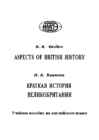
N. A. Vavilov ASPECTS OF BRITISH HISTORY Н. А. Вавилов КРАТКАЯ ИСТОРИЯ ВЕЛИКОБРИТАНИИ Учебное пособие на английском языке Москва Институт международного права и экономики имени А. С. Грибоедова 2008 2 УТВЕРЖДЕНО кафедрой лингвистики и переводоведения Вавилов Н.А. Краткая история Великобритании: Учебное пособие на английском языке. – 2-е изд., пересмотр. и испр. – М.: ИМПЭ им. А.С. Грибоедова, 2008. – 88 с. Пособие содержит краткий очерк важнейших событий в истории Великобритании – от первых документально засвидетельствованных вторжений на остров (кельтов, римлян и англосаксов) до создания и распада Британск...
American English Take-home exam 1) Discuss the significance of American English in the English-speaking world. English is one the most widely used languages in the world and globally acknowledged as the lingua franca. It is also the dominant business language. For these facts already, English has a great importance in the today’s world. As the United States of America is one of the leading countries of the world, American English has a certain authority as well. It is now an inescapable fact that America, through its worldwide influence and massive entertainment industry is the mighty power-house that drives the English language. Although British English is considered to be more sophisticated and prestigious than American English, the latter is clearly more featured in television, music, video games and internet, naturally appealing more to English learners than Brit...
I LOVE ENGLISH 6 8.klass Unit 1 test 1. Translate. 1 Mida on sul ja su sõbral ühist? What do you and your friend have a common? 2 Ma mõistan su vaatenurka. I can understand your point of view. 3 Mida sa selle all mõtled? What do you mean by this? 4 Missugune vapustavalt ilus pruutkleit! What a gorgeous bridal / wedding dress! 5 Kas sa oled kunagi pulmas käinud? Have you ever attended a wedding? 6 Jane rebis kutse kostüümipeole tükkideks. Jane tore the invitation to the fancy dress party into pieces. 7 Pinge Alice`i ja tema armukadeda poisssõbra vahel kasvas. The tension was building up between Alice and her jealous boyfriend. 8 Mis lahti? Su silmad on pisaraid täis. What`s up? Your eyes are filled with tears. 2. Write the verbs in the suitable tense. 1 have booked `ll be / booked was...
Phonology. Mid-term 2. Syllable - is a phonological unit consisting of one or more phonemes. In phonetics a syllable is a unit which consists of a centre, that has little or no obstruction to airflow; it is comparatively louder than other sounds. In phonology syllables are the possible combinations of phonemes. The syllable consists of - onset, nucleus, coda. (every syllable has a nucleus: vowel, syllabic l, or m, n). Rhyme/rime nucleus + coda; the nucleus and the coda constitute a sub-syllabic unit rhyme. Words rhyme, when their nucleus and coda are identical. (E.g 'cr-o-wn', 'd-o-wn'). The hierarchical structure of the syllable: Onset the beginning of the syllable Nucleus/peak the open part of a syllable, generally a vowel. Coda a consonant sound which ends the syllable. Open syllable - has no coda Closed syllable - has a coda! Texts: [t-e-k-s-t-s]- (Consonant, Vowel, Consonant, Consonant, Consonant, Consonant). Stron...
William Shakespeare (1564-1616) playwright, actor, poet 37 plays, over 400 screen adaptions Lord Chamberlain's Men, King's Men, The Globe Early life: John Shakespeare, Mary Arden, 2 sis', 3 bros; married Anne Hathaway 3 children Life in London: 1599 built Globe, 1623 first compilation Forms: classical & history plays, comedies+tragedies, poetry Style: metaphors, rhetorical phrases, free flow of words, unrhymed iambic pentameter; deviations Renaissance (end of 14th century) Italy, reaches rest of Europe Elizabethan era (16th II h - 17th I h) Theatre: combined medieval theatre, morality plays & Roman drama to create Elizabethan tragedy Poetry: Italian influences, sonnet (English: cddc ee) Rulers of England: Henry VII (brings prosperity, repairs economic situation; made alliances); Henry VIII (beginning of English reformation; killed "traitors"; 6 marriages); Mary I (Catholic); Elizabeth I (The Virgin Queen restores order; Religiou...
ELT Methodology (FLGR.01.041) 27.12.2012 Home Assignments. I Youtube clips: · A vision of K-12 students I personally think that Estonian learners are also digital learners. They spend more time at the computers or laptops or iPads etc. than read books or move outside. And another thing is that teachers are less capable in using technological appliances. But the latter mentioned fact is an advantage for us teachers as well. It gives us an opportunity to provide our students to experience success. They can help and assist us if we need some technological help. Another thing is that in schools, in classes generally students are not allowed to use their appliances, so it means they have to communicate verbally as well. I think that teachers ...
adjective + preposition omadussõna + eessõna proud of, good at, married to adverb particle Some verbs are followed by adverb particles. Examples are: put on, take off, give away, bring up, call in. Sometimes the particle is detached from the verb and put after the object. •He took his boots off. •They called the doctor in. apposition a grammatical construction in which two usually adjacent nouns having the same referent stand in the same syntactical relation to the rest of a sentence (as the poet and Burns in “a biography of the poet Burns”) back-reference In grammatical analysis, the term reference is often used to state a relationship of identity which exists between grammatical units, e.g. a pronoun 'refers' to a noun or noun phrase. When the reference is to an earlier part of the discourse, it may be called a 'back-reference' (or anaphora); collective noun Collective noun is the name we give to a group of nouns...
Oskar Lutsu Palamuse Gümnaasium Johanna-Marleen Veski 11. klass INGLISKEELSETE SÕNADE JA VÄLJENDITE KASUTAMINE EESTI KEELES Uurimistöö Juhendaja: Margit Menson Palamuse 2017 Sisukord Sisukord.............................................................................................................. 2 SISSEJUHATUS.................................................................................................... 3 KOKKUVÕTE................................................................................................... 16 SUMMARY...................................................................................................... 17 KASUTATUD KIRJANDUS................................................................................. 18 LISAD.........................................................................
Suppletion Present in languages of different families. Present in Old, Middle and Modern English, though the general tendency is towards more regularity/iconicity so the number of suppletive forms has decreased.In the text: goon to go wenden - to turn Gan was suppletive in Old English, past form: eode.Eode was supplanted by went (past form of wenden) at the end of the Middle English period.To wend has survived in Modern English in phrases such as to wend one's way, we wended homewards (ironic usage). Thus: suppletivity- suppletion different parts of one and the same paradigm come from what were originally different paradigms (different words with close meanings or words in different but close dialects).Suppletion embraces verbs, adjectives, nouns. Be was/were been (Old English beon/wesan) (am, art, is, are); in Old English some suppletive forms were used parallel to one another) Good better best Bad worse worst Much more...
EPIC ,,A long narrative poem on a great and serious subject, related in an elevated style, and centered on a heroic or quasi-divine figure on whose actions depends the fate of a tribe, a nation, or the human race. The traditional epics were shaped by a literary artist from historical and legendary materials which had developed in the oral traditions of his nation during a period of expansion and warfare" An epic is a lengthy narrative poem, ordinarily concerning a serious subject containing details of heroic deeds and events significant to a culture or nation. Nonetheless, epics have been written down at least since the works of Virgil, Dante Alighieri, and John Milton. Many probably would not have survived if not written down. The first epics are known as primary, or original, epics. One such epic is the Old English story Beowulf. Epic Conventions, or characteristics common to both type...
road signs All speed limit signs in the Republic changed to the metric system in 2005. Some direction signs still show distance in miles so tourists often mix them up. There are usually about 10 signs or more on one post , and its really hard to see them when driving, so tourists disturb traffic quite often when slowing down to read the signs All the signs are multilingual ,due to high percentage of English speakers Forests Ireland has only about 8 % of his whole land covered with forests. Centuries ago people cut the forests and didn't think about the future so nowadays there is mostly peat ( turvas) which Ireland uses to produce energy. Economy Ireland had a big economic boom in the late 20'th century, but now the Republic of Ireland is ranked the second wealthiest per capita country in the European Union. Education in Ireland is free at all levels, including college. The construction sector, which is inherently cyclical in nature, ...
Grammar point Made by Nikolai Hodosevich Conditional mood The conditional mood is the form of the verb used in conditional sentences to refer to a hypothetical state of affairs. Conditional verb forms can also have temporal uses, often for expressing "future in the past" tense. Condition sentences are often entered with conjunction IF Real events Structure: Additional clause Present Indefinite Main clause Future Indefinite If I have a lot of money, I will buy a car , Almost unreal events *In additional and main clauses usually use Subjunctive I and II *When you translate into Russian these sentences, you should use conjunction * This type of unreal conditional sentence use, when speaker wants to underline small probability of condition realization Almost unreal events Structure: Additional claus...
English lexicology 1. Size of English vocabulary Vocabulary is a sum total of words used in a language by speakers or for dictionary-making. Active and passive vocabulary. The Old English vocabulary was homogenous. There were about 50 000 – 60 000 words, 1/3 of which have survived. o About 450 loans from Latin o About 2000 from the Viking invasions. The Middle-English vocabulary became a heterogeneous hybrid of Germanic and Romanic languages. 100 000 to 125 000 words. o About 10 000 loans from Norman French, 75% are still in use o Continuing Latin influence Early Modern English. 200 000 – 250 000 words o English becomes a pluricentric language. o Polyglot. Cosmopolitan language Modern English. 500 000 words o At present at least 1 billion lexical units 2....
The Article Table of Contents General Rules....................................................................... 2 The Definite Article ............................................................... 5 Names that take the Definite Article...................................... 6 No article.............................................................................. 7 Countable and uncountable nouns ....................................... 9 General Rules There are two articles in the English language – the Indefinite Article and the Definite Article. The Indefinite Article has two forms – a and an (a precedes words beginning with a consonant sound and an precedes words beginning with a vowel sound). It comes from the Old English word ãn, which meant one. The Definite Article is the. It comes from the Old English word ţis, which meant this. Thus, in most general term...
ACTIVE TENSES Active form You use an active verb when you want to say that the subject of a sentence does something. · [Thing doing action] + [verb] + · +[thing receiving action] · Examples The professor (subject doing action) teaches (verb) · the students (object receiving action). · Mary (subject doing action) · washes (verb) · the dishes ( object receiving action). The tenses of the verb 1.Present (olevik) 2.Past (minevik) 3.Future (tulevik) 4.Future in the past (kaudne tulevik) Iga aeg võib esineda neljas eri rühmas 1.IndefiniteTenses (üldajad) 2.Continious Tenses (kestvad ajad) 3.Perfect Tenses (perfekti ajad) 4.Perfect Continious Tenses (perfekti kestvad ajad) Indefinite Tenses (üldajad) used to describe actions but do not state whether the action is completed or on- going märgivad tegevuse sooritamise fakti Peter visits us every day. Peter visited ...
Mare Jõul Ülle Kurm I Love English 6 Workbook Studium Units 1-4 e-formaat Toimetatud Tartu Emajõe Koolis Toimetaja I. Tars Tartus, 2016 Elektroonilisse vormingusse kohandatud õpikus kasutatud märgised, mis aitavad otsingukäsu kasutamisel navigeerida * Tavakirjas leheküljenumbri ees on kolm järjestikust sidekriipsu, tühik ja vastava lehekülje number, näiteks, --- 5; * peatüki ette on kirjutatud kolm x-i, tühik ja vastava peatüki number, näiteks xxx 5; * visuaalne info on pandud kahekordsete ümarsulgude vahele. I Love English 6 töövihik sobib inglise keele õpetamiseks 8. klassis Töövihik vastab riiklikule õppekavale Retsenseerinud Piret Kärtner, Viive Latt, Ingrit Tera Toimetanud Viiu Menning, Nicola Fyfe, Tiina Helekivi Kujundanud ja küljendanud Eve Kurm Tehniliselt toimetanud Andero Kurm Illustreerinud Ülle Meister Esikaas: Boswell and Dr. Johnson (foto Scanpix). Vaata Unit 20. Autoriõigus: Mare Jõul, Ülle Kurm, ...
UNIT 1 Writing in the Business World Writing gives structure and form to our ideas. In the business world this is done for a purpose: to persuade, recommend, offer advice, give an order, etc. The business text must therefore be easily and quickly read and its message must be understood exactly as intended. If you learn to recognize and avoid the more common errors of information control, grammar and style, you will achieve this aim. You will write more confidently and more correctly if you check everything you write. Pay particular attention to the following: · Appropriate Subject Heading Take care to prepare your reader by introducing the subject appropriately in your subject heading. · Carefully Organized Information If a reader needs to be persuaded or convinced, your information will need careful planning and organizing. · Correct Grammar and Sp...
Estonian dialects Kui k'äzi k'äüles? Kuiss käbäre käivä? Kuidas käsi käib? Traditionally, the Estonian dialects are categorized to three as follows: 1) Northestonian dialects : Insular, Western, Central and Eastern dialect 2) Southern Estonian dialect Group : Mulgi, Tartu and Võru dialect 3) Northeastern coastal dialect S-Saartemurre/insular dialect L-Läänemurre/western dialect K-Keskmurre/central dialect M-Mulgimurre/Mulgi dialect T-Tartumurre/Tartu dialect V-Võrumurre/Võru dialect I-Idamurre/eastern dialect R-(Kirde)rannikumurre/ northeastern coastal dialect Dialect Speakers % 1. Northen Estonian dialect 26 986 3,0 · Eastern dialect 1 270 0,1 · Central dialect 210 0,0 · Western dialect 777 0,1 · insular dialect 24 520 2,8 2. Southern Estonian dialect 101 851 11,5 Group · Mulgi dialec...
Philip Larkin’s Poetry: Themes, Form, Style, Imagery and Symbolism Author: Sandra Olivares González Tutor: Jesús Marín Calvarro Degree in English Studies, English Department, Faculty of Philosophy and Letters, University of Extremadura Cáceres, 29th January 2016 Philip Larkin’s Poetry: Themes, Form, Style, Imagery and Symbolism The aim of this work is to obtain some characteristics of the poetry of Philip Larkin, such us the origin of his themes, the way in which he writes his poems and the symbolism he uses (which is a very controversial topic because some assume that he does use it, while some others say that he uses it in an ironic way). In this work we tried to make a revision on the vision of Larkin through the studies that had been made on him, and on the basis of it we can say, that the voice of ...
All the world's a puzzle All the world's a stage, And all the men and women merely players; They have their exits and their entrances, And one man in his time plays many parts, His acts being seven ages. At first, the infant, Mewling and puking in the nurse's arms. Then the whining schoolboy, with his satchel And shining morning face, creeping like snail Unwillingly to school. And then the lover, Sighing like furnace, with a woeful ballad Made to his mistress' eyebrow. Then a soldier, Full of strange oaths and bearded like the pard, Jealous in honor, sudden and quick in quarrel, Seeking the bubble reputation Even in the cannon's mouth. And then the justice, In fair round belly with good capon lined, With eyes severe and beard of formal cut, Full of wise saws and modern instances; And so he plays his part. The sixth age shifts Into the lean and slippered pantaloon, With spectacles on nose and pouch on...
Leixcology revision questions 1) Composition of english vocabulary Vobabulary is the sum of a total of words used in a language by speekers or used in a dictionary. English vocabulary cosists of six units: Simple words- fall Complex words- prefall Phrasal word- face up to Compound word- face lift Multiword expression- face the music Shortened forms- prefab (prefabely?) 2) Core and pherifery English has been heavily influenced by other languages. 31.8 % comes from old english, 45% comes from french, 16,7% comes from latin, 4,2% other germanic languages and 2,3 other languages. The very core is mono-syllabic (93 of the first 100 words nad the other seven are two-syllabic). The core vocabulary is predominantly germanic. 3) Native and foreign elements Native vocabulary: INDO-EUROPEAN- mother, foot, heart, father, sea, night etc GERMANIC- friend, bidge, ship, life, heaven OLD-ENGLISH- bad, bird, woman, lady and gospel LATIN- ch...
1. STYLE The term "style" is polysemantic (has many meanings): a Latin word "stilus" originally meant a writing instrument used by ancient people. Already in classical Latin the meaning was extended to denote the manner of expressing one's ideas in written or oral form. Jonathan Swift defined style as "proper words in proper places". In present day English the word "style" is used in about a dozen of principle meanings: 1. the characteristic manner in which a writer expresses his/her ideas (e.g. style of Byron) 2. the manner of expressing ideas, characteristic of a literary movement or period 3. the use of language typical of a literary genre (e.g. the style of a comedy, drama, novel). 4. the selective use of language that depends on spheres / areas of human activity (e.g. style of fiction, scientific prose, newspapers, business correspondence, etc.). STYLISTICS Stylistics is the study of s...
1 SYNTACTIC STYLISTIC DEVICES SYNTACTIC STYLISTIC DEVICES are based on a peculiar place of the word or phrase in the utterance (text, sentence, etc).This special place creates emphasis irrespective of the lexical meaning of the words used. Categories: syntactic stylistic devises based on: SDD: based on ABSENCE OF LOGICALLY REQUIRED ELEMENTS OF SPEECH ELLIPSIS ELLIPSIS or ELLIPTICAL SENTENCES means leaving out one or both principle members of the sentence that is the subject or predicate. NT: Where is the man I'm going to marry? - Out in the garden. (no subject) What is he doing out there? - Annoying father. Here, in the dialogue, ellipsis creates the colloquial tone of the utterance. It also renders realistically the way the characters speak. The elliptical sentences convoy/render carelessness, familiarity, harshness. It...
Review questions English lexicology Size of English vocabulary. Average speaker 45,000-60,000 words, a total of about 200,000. Core and periphery. English has been heavily influenced by other languages. 31.8 % comes from Old English, 45% comes from French, 16,7% comes from Latin, 4,2% other germanic languages and 2,3 other languages. The very core is mono-syllabic (93 of the first 100 words and the other seven are two-syllabic). The core vocabulary is predominantly germanic. Native and foreign element. Native words belong to very important semantic group (modal verbs-shall, will, can, may; pronouns- I, you, he, my, his; preps- in, out, under; numerals and conjunctions::but, till, as. Native words are head, arms, back; mother, brother, son, wife; snow, rain, wind, sun; cat, sheep, cow; old, young, cold, hot, dark; do, make, go, come, see. Many native words have developed many meanings (nt, hand, man, head). Most native words have become ...
1 Ryker Huffman Spanish 432.001 4-15-2013 La Celestina Ejercicio de Traducción Esta cita es en el auto uno, cuando Celestina y Sempronio hablan en privado. Calisto y Pármeno se acercan, de la habitación, y empiezan a escuchar la conversación. Celestina puede oír que se están acercando e instruye Sempronio "escucha y déjame hablar lo que a ti y a mí me conviene." Después de escuchar a algunos de la conversación diseñada por Celestina y Sempronio, Calisto y Pármeno salen y Celestina y Sempronio continúan de hablar en privado. Entonces, Celestina explica a Sempronio que Calisto está "enfermo del amor." Eligio este pasaje porque explica la punta de vista de la Celestina sobre el "amor impervio." En la cita ella explica de dónde viene el amor y qué podemos hacer. Finch, 2003 Has de ...
1) Standard and non-standard varieties of English Standard varieties of English are the varieties of the English language that are considered to be a norm and are spoken and written by the minority (educated people). This is the optimum for educational purposes. The standard varieties of English are: BrEng (British), EngEng (English), NAmEng (North-America), USEng (United States), CanEng (Canada), AusEng (Australia), NZEng (New Zealand). Standard English (British English) is the most widely accepted and understood among native speakers, learned by foreigners. It is used in broadcasting, TV, news etc. It doesn't concern pronounciation (accent), but grammar and vocabulary. It includes formal and informal styles. British Standard English grammar and vocabulary, together with the RP accent should be called English English. RP (Received Pronounciation) is an accent that originates from South-East of England. A social accent, associated o...
Prepositions Table of Contents Prepositions of Time – in, on & at ....................................................................... 2 Prepositions of Time – for & since ....................................................................... 3 Prepositions of Time – for & during ..................................................................... 3 Prepositions of Time – during & while ................................................................. 4 Prepositions of Time – by & by the time .............................................................. 4 Prepositions of Time – until & from ... till / to ... ................................................. 4 Prepositions of Time - ago................................................................................... 5 Prepositions of Place – in ..........................................
Summary • Early history of translation studies – Cicero and St. Jerome (what did they do/how/why are they relevant to translation studies?) St. Jerome – Greek scholar, did some translation work. Lived during the 4th century. Jerome is best known as the translator of the Bible into Latin. A previous version (now called the Old Latin) existed, but Jerome's version far surpassed it in scholarship and in literary quality. Jerome was well versed in classical Latin (as well as Greek and Hebrew), but deliberately translated the Bible into the style of Latin that was actually spoken and written by the majority of persons in his own time. This kind of Latin is known as Vulgate Latin (meaning the Latin of the common people), and accordingly Jerome's translation is called the Vulgate. Cicero – Lived during the 1st century BC. Roman politician, philosopher & translator. Theory ‘‘word-for-word’’ & ‘‘sense-for-sen...
FGI 1081 Stilistika (Irina Ladusseva) Kab. 420 2 AP Ends with an exam; lasts only for 1 semester. At the exam you get 2 questions and an exercise (50 sentences: establish the device used, recognize it, and name it). Care about the pronunciation of the terms. Books: - I. Galperin "Stylistics" - I. Ladusseva "Rhythm and Text" - I. Ladusseva "Vocabulary and Style" - I. Ladusseva "Stylistic practice: Book I, Book II" - I. Ladusseva "A Guide to Punctuation" EXAMINATION TOPICS: 1. Style, stylistics, a survey of stylistic studies ...
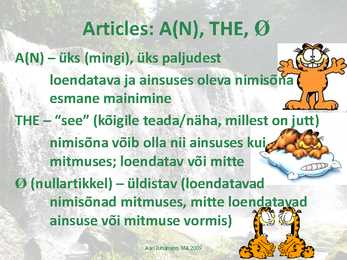
Articles: A(N), THE, Ø A(N) üks (mingi), üks paljudest loendatava ja ainsuses oleva nimisõna esmane mainimine THE "see" (kõigile teada/näha, millest on jutt) nimisõna võib olla nii ainsuses kui mitmuses; loendatav või mitte Ø (nullartikkel) üldistav (loendatavad nimisõnad mitmuses, mitte loendatavad ainsuse või mitmuse vormis) Aari Juhanson, MA 2009 A(N) Loendatavate, ainsuses olevate ja esmakordselt mainitavate nimisõnade/omadus- ja nimisõnade ees · Uus info: A (young) man in a streetcar smiled at me. · Ametid: She always wanted to be a dancer. · Kindlad väljendid: a couple of; be in a hurry; etc Aari Juhanson, MA 2009 A(N) set phrases They left a couple of days ago and all of a sudden I realized that it had been a long time since they last called. We usually have a good time together a...
STYLISTICS 1. Style, stylistics, a survey of stylistic studies The term ,,style" is polysemantic. Latin ,,stilus"--a writing instrument used by the ancients for writing on waxed tablets. Soon, the meaning was extended to denote the manner of expressing one's ideas in written or oral form. Jonathan Swift said: ,, Style is proper words in proper places" Present day--half a dozen meanings: · the characteristic manner in which a writer expresses his ideas (Style of Byron) · the manner of expressing ideas characteristic of a literary movement or period (symbolism, romanticism) · the use of lg. typical of a literary genre (comedy, drama, novel) · the selective use of lg that depends on spheres of human activity. These are called functional styles or registers (fiction, newspaper) Stylist...
Tallinna Mustamäe Humanitargümnaasium Valeria Jefremenkova ENGLISH AS A GLOBAL LANGUAGE INGLISE KEEL KUI ÜLEMAAILMNE KEEL Research work Supervisor: Jevgenija Kozlova Tallinn 2016 1 Table of Contents СONTENT…………………………………………………………………………………...2 INTRODUCTION…………………………………………………………………………...3 CHAPTER I……………………………………………………………………………….....5 1.1. A Brief History of the English Language…………………………………………...…..5 1.2. Origins of English as the Global Language……………………………………..……....6 1.3. Necessity of a Global Language...……………………………………………………....8 1.4. Criticism of a Global Language………………………………………………………....9 1.5. The Role of English Today……………………………………………………………..10 1.6. English Speaking Countries…………………………………………………………….11 1.7. Perspectives of English………………………………………………………………....13 CHAPTER I...
Viljandi County Gymnasium Prepositions Name Form 11b Supervisor: Name Viljandi 2009 Viljandi County Gymnasium 1. Prepositions of place The ball is in the box The ball is on the box. The ball is under the box. Jane's house Bill's house John's house John's house is next to Jane's Jane's house is between Bill's Bill's house is next to Jane's house. and John's houses. house. The man stood The climbers The man stood The enemies stood The gardners next to the gopher stood on top of between the two opposite each stood behind the ...
1 Ryker Huffman Spanish 432.001 29-4-2013 Proyecto Final: Transducción Entre Idiomas Pasaje seleccionado Celestina: Has de saber, Pármeno, que Calisto anda `de amor quejoso. Y no lo juzgues por eso por flaco, que el amor impervio todas las cosas vence. Y sabe, si no sabes, que dos conclusiones son verdaderas. La primera, que es forzoso el hombre amar a la mujer y la mujer al hombre. La segunda, que el que verdaderamente ama es necesario que `se turbe con la dulzura del soberano deleite, que por el Hacedor de las cosas fue puesto, porque el linaje de los hombres `se perpetuase, sin lo cual perescería. Y no sólo en `la humana especie; mas en los pesces, en las bestias, en las aves, en las reptilias; y en `lo vegetativo algunas plantas han este respecto, si ...
Discuss the representation of the generation of fathers in Turgenev's novel "Fathers and Sons" Turgenev always had two tasks before him to depict the body and pressure of time, and to depict the rapidly changing face of cultured Russian society (Freeborn 1960:48). Kluchevsky (1993:40) defined one case of the generation gap in the beginning of the XIX century as "merry cosmopolitan sentimentality of the fathers now transformed in a patriotic grief of their children. The Fathers were Russians, who passionately wanted to become French; the sons were raised as French and passionately wanted to become Russians. Fathers and Sons situates this generational conflict within family relations. In this essay, the ways how Turgenev represents the generation of Fathers in Fathers and Sons is discussed. Fathers and Sons is set in between Russia's defeat in the Crimean War and the Emancipation of the Serfs a socially challenging area. Mid-19 th c...
Letters Letters FORMAL, INFORMAL, TRANSACTIONAL TASK 1 Read the extracts and answer the questions. · Where are the extracts from? · What is the purpose of each letter? · How do they differ? · Which extracts are examples of formal letters? · How is the reader addressed in a formal letter? · What are the closing remarks for formal letters? · What is the salutation in a friendly letter? · How would you end extracts 1,2,3 ? · How would you begin the extracts 4 and 5? 1. Dear Mr Miller, I received your kind invitation to the reception. Unfortunately, owing to other commitments. I will be unable to attend ... 2. Dear Ralph, l just got your invitation to the company's event. l `m afraid I can't make it because I've a/ready made plans which l can "t change ... 3. Dear Sirs, I am writing to complain about the poor quality of ...
Tallinna Polütehnikum Automation Author: TomTom2 Group :AA-09 Instructor: Marina Zotikova Tallinn 2010 Contents Introduction......................................................................................................................3-4 Person Knowledge Technologies supports......................................................................4-6 Online Essay Evaluation Service.....................................................................................6-7 WordNet lexical database................................................................................................7-8 Practice Online (TPO)................................................................................................
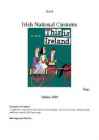
Kool Irish National Customs Nimi Tallinn 2009 Customs of Ireland i would like to talk about their families their holidays. the irish are a very cultural people and they're proud of all they've got. Marriage and Family People usually marry in their early to mid-20s. Most weddings are performed in a church, but a minority are also performed in a registry office. After marriage, many people in rural areas stay close to their family's home and visit frequently. Many couples, particularly in the cities, live together before or instead of marriage. Typically, the bonds between siblings in an Irish family are especially strong. In rural areas, extended families often live near one another, and family members who have moved to Dublin or overseas in search o...
1. Ancient Britain: the Celtic tribes. 2000 years ago there was an Iron Age Celtic culture throughout the Br Isles. It seems that the Celts, who had been arriving from Europe from the 8th cent BC onward, intermingled with the peoples who were already there. The Celts were extremely talented people, creative and artistic. More than 1 Celtic tribe invaded Br. The descendants of ancient Celts live in Wales, Scotland, Cornwall and Ireland. They lived in primitive society. Druids priests, more powerful than chiefs. Acted like prophets. 2. Stonehenge From prehistoric period. Was built on Salisbury plain between 2500 and 1500 bc. One of the most famous and mysterious archaeological sites in the world. One of the mysteries is how it was built at all with the technology of the time. Another is its purpose. It appears to function as a kind on astronomical clock and we know it was used by the Druids for ceremonies marking the passing ...
The use of satire in Swift's A Modest Proposal According to Oxford Advanced Learner's Dictionary satire is a way of criticizing a person, an idea or an institution in which you use humor to show their faults or weaknesses; a piece of writing in that uses that type of criticism: political/social satire (1180). Jonathan Swift, one of the ambiguous and interesting figure of the Anglo-Irish Literary Tradition, the greatest pamphleteers, and a master of satire, denotes that 'Satire is a sort of glass wherein beholders do generally discover everybody's face but their own; which is the chief reason for that kind reception it meets with in the world, and that so very few are offended with it' (Swift). The current essay attempts to analyze the use of satire in Jonathan Swift's most discussed pamphlet A Modest Proposal and the purposes of using this specific genre. The pamphlet reveals a vast number of social and reli...
 annaabi.ee