 50 punkti
Autor soovib selle materjali allalaadimise eest saada 50 punkti.
50 punkti
Autor soovib selle materjali allalaadimise eest saada 50 punkti.
 ~ 3 lehte
Lehekülgede arv dokumendis
~ 3 lehte
Lehekülgede arv dokumendis
 2012-12-19
Kuupäev, millal dokument üles laeti
2012-12-19
Kuupäev, millal dokument üles laeti
 20 laadimist
Kokku alla laetud
20 laadimist
Kokku alla laetud
 0 arvamust
Teiste kasutajate poolt lisatud kommentaarid
0 arvamust
Teiste kasutajate poolt lisatud kommentaarid
 californiancocoa
Õppematerjali autor
californiancocoa
Õppematerjali autor
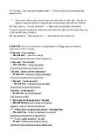
We can report people's words by using direct speech or direct speech reported speech. speech `I'm tired!', Helen said. Helen said (that) she was tired. The main verb of the sentence is usually past ( Tom said that... / I told her that...) and the rest of the sentence is usually past too. Sequence of tenses if the verb in the main sentence is in the past tense the other verbs are usually in one of the past tense too. Present Simple Past Simple I'm a teacher. He said (that) he was a teacher
Reported speech is often also called indirect speech. When we use reported speech, we are usually talking about the past (because obviously the person who spoke originally spoke in the past). The verbs therefore usually have to be in the past too. For example: "I'm going to the cinema". He said he was going to the cinema. Basic tense chart The tenses generally move backwards in this way (the tense on the left changes to the tense on the right): present simple past simple I'm a teacher
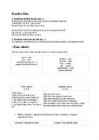
are -- were do/does --- did want/like/know/go etc --- have/has had wanted/liked/knew/went etc will --- would can --- could wanted/liked --- had wanted/had liked Direct speech Reported speech Jo says: Jo said: ,,I like tennis." (that) she liked tennis. ,,John is going to learn it too." (that) John was going to learn it too. ,,Mary has given up her hobby too." (that) Mary had given up her hobby too. ,,I can´t play tennis on Monday"
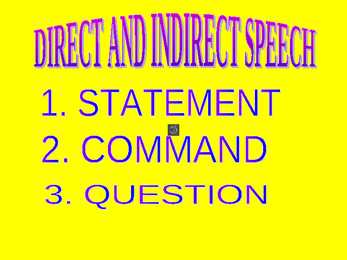
· THIS · THAT · THESE · THOSE CHANGES OF TENSES · DIRECT · INDIRECT · SIMPLE PRESENT · SIMPLE PAST · SIMPLE PAST · PAST PERFECT · PRESENT PERFECT · PAST PERFECT · PRESENT · PAST CONTINUOUS CONTINUOUS · PAST PERFECT · PRESENT PERFECT CONT. CONT. · SIMPLE FUTURE · PAST FUTURE 1. STATEMENT HE SAID HE SAID TO ME THAT REPORTED WORDS HE TOLD ME STATEMENT EXAMPLE · DIRECT · INDIRECT · They said to me: "we are going · They said to me that to visit Borobudur tomorrow." they were going to visit Borobudur the following day. · Jeffry said: "I didn't go to school today. · Jeffry said that he
want/like/know/go etc have/has had wanted/liked/knew/went etc will would can could wanted/liked had wanted/had liked Direct speech Reported speech Jo says: Jo said: ,,I like tennis." (that) she liked tennis. ,,John is going to learn it too." (that) John was going to learn it too. ,,Mary has given up her hobby too." (that) Mary had given up her hobby too. ,,I can´t play tennis on Monday" (that) she couldn´t play tennis on Monday.
Eessõnad 7 Kesksõnad 8 Prefiksid ehk eesliited 8 Sufiksid ehk järelliited 9 Artikkel the pärisnimedega 10 Artikkel the geograafiliste nimedega 10 Artikkel a, an 10 Muu 11 Otsekõne Direct speech 11 Kaudkõne Reported speech 11 Kaudküsimused Reported questions 12 Passiiv Passive voice 12 Loendatavad nimisõnad Countable nouns 12 Loendamatud nimisõnad Uncountable nouns. 13 Mitmuse moodustamine 13 Siduvad asesõnad 14 Omastav kääne 14 Käskiv kõneviis 15
............................................................................................ 9 Artikkel the pärisnimedega...........................................................................................10 Artikkel the geograafiliste nimedega............................................................................10 Artikkel a, an.................................................................................................................10 Otsekõne Direct speech..............................................................................................11 Kaudkõne Reported speech........................................................................................11 Kaudküsimused Reported questions..........................................................................12 Passiiv Passive voice .................................................................................................12
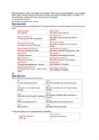
Could you swim when you were six? 3) be able to am/are/is, et rääkida oleviku võimalusest She is able to play violin. 4) will be able kasutame, et rääkida tuleviku võimalusest I'll be able to win all the races. 5) was/were able kasutame, et öelda midagi, mida keegi käskis ühel juhusel We was able to tell the police UNIT 6 6.2 Reported speech and reporting verbs 6.2b Kaunde kõne Direct speech Reported speech 1. present simple/continuos Past simple/continous She said, "I'm leaving on Monday" She said she was leaving on Monday. 2. past simple/continuous Past perfect simple/continous "He moved here five years ago", you said. You said he had moved here five years before. 3
 annaabi.ee








Kõik kommentaarid