Vajad kellegagi rääkida?
Küsi julgelt abi LasteAbi
Logi sisse

Direct and indirect speech revs (0)

1 Hindamata
Punktid


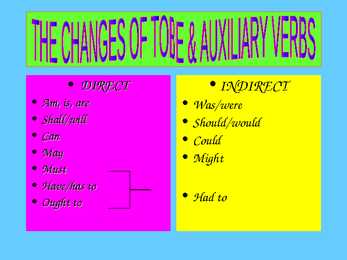
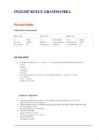
•  DIRECT
•  INDIRECT  
• Am, is, are
• Was/were
• Shal /wil
• Should/would
• Can
•  Could
• May
• Might
• Must
• Have/has to
• Ought to
• Had to
 
 
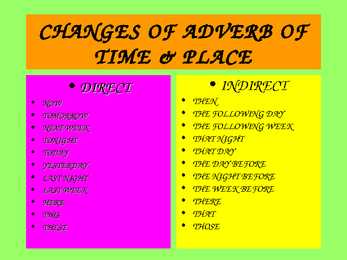
CHANGES  OF ADVERB OF 
TIME & PLACE
• DIRECT
• INDIRECT 
• NOW
• THEN
•  TOMORROW
• THE  FOLLOWING  DAY
• NEXT WEEK
• THE FOLLOWING WEEK
•  TONIGHT
• THAT  NIGHT
•  TODAY
• THAT DAY
•  YESTERDAY
• THE DAY  BEFORE
• LAST NIGHT
• THE NIGHT BEFORE
• LAST WEEK
• THE WEEK BEFORE
•  HERE
•  THERE
• THIS
• THAT
•  THESE
• THOSE
 
 
CHANGES OF  TENSES
• DIRECT
• INDIRECT 
•  SIMPLE   PRESENT
• SIMPLE PAST
• SIMPLE PAST
• PAST  PERFECT
• PRESENT PERFECT
• PAST PERFECT
• PRESENT  

CONTINUOUS
PAST CONTINUOUS
• PRESENT PERFECT  • PAST PERFECT 
CONT .
CONT.
• SIMPLE FUTURE
• PAST FUTURE
 
 
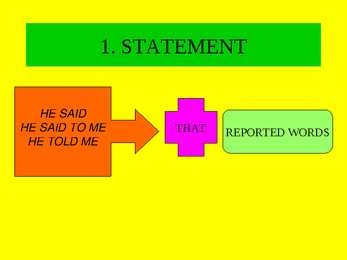
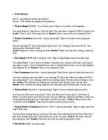
1.  STATEMENT
HE SAID
HE SAID TO ME
THAT
REPORTED  WORDS
HE  TOLD  ME
 
 
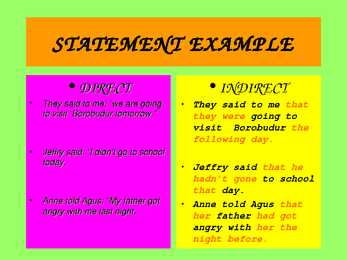
STATEMENT EXAMPLE
• DIRECT
• INDIRECT 
• They said to me: “we are  going  
• They said to me that 
to  visit   Borobudur tomorrow.” 
they were  going  to 
visit  Borobudur the 
following day. 

• Jeffry said: “I didn’t go to school 
today. 
• Jeffry said that he 
hadn’t gone to school 
that day.

• Anne told Agus: “My  father  got 
• Anne told Agus that 
angry with me last night.
her father had got 
angry with her the 
night before.


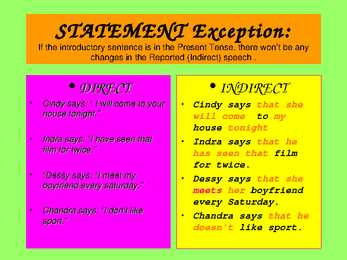
STATEMENT Exception:
If the introductory sentence is in the Present  Tense , there won’t be any 
changes in the Reported (Indirect)  speech  .
• DIRECT
• INDIRECT 
•  Cindy   says : “ I will  come  to your 
• Cindy says that she 
house tonight.”
will come  to my 
house tonight 

•  Indra  says: “I have  seen  that 
• Indra says that he 
film  for twice.” 
has seen that film 
for twice.

• Dessy  says: “I meet my 
• Dessy says that she 
boyfriend every saturday.”
meets her boyfriend 
every Saturday.

• Chandra says: “I don’t like 
• Chandra says that he 
sport .”
doesn’t like sport.
 
 
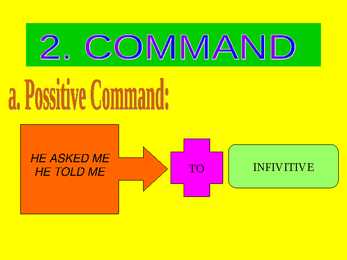
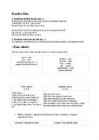
HE  ASKED  ME
HE TOLD ME
TO
INFIVITIVE
 
 
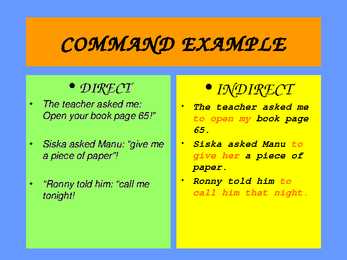
COMMAND EXAMPLE
• DIRECT
• INDIRECT 
• The  teacher  asked me: 
• The teacher asked me 
Open  your book page 65!” 
to open my book page 
65. 

• Siska asked Manu: “give me 
• Siska asked Manu to 
piece  of  paper ”! 
give her a piece of 
paper.

• “Ronny told him: “cal  me 
• Ronny told him to 
tonight!
call  him that night.
 
 
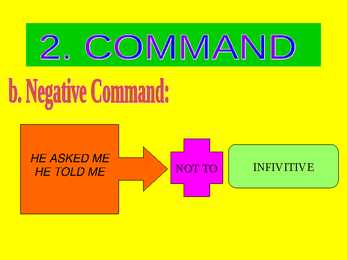
HE ASKED ME
HE TOLD ME
NOT TO
INFIVITIVE
 
 
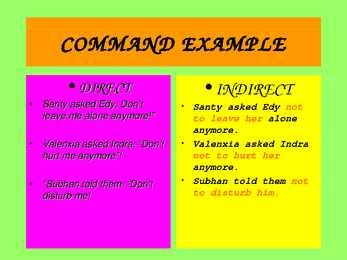
COMMAND EXAMPLE
• DIRECT
• INDIRECT 
• Santy asked Edy: Don’t 
• Santy asked Edy not 
leave me  alone   anymore !” 
to leave her alone 
anymore. 

• Valenxia asked Indra: “Don’t 
• Valenxia asked Indra 
hurt  me anymore”! 
not to hurt her 
anymore.

• “Subhan told  them : “Don’t 
• Subhan told them not 
disturb me!
to disturb him.
 
 
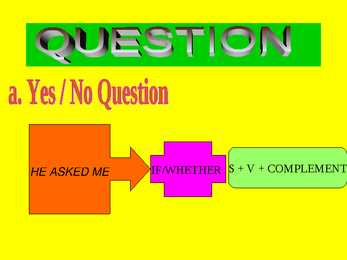
HE ASKED ME
IF/WHETHER  S + V + COMPLEMENT
 
 
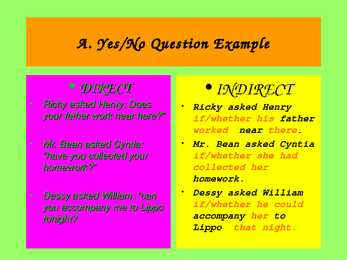
A. Yes/No Question Example
• DIRECT
• INDIRECT 
• Ricky asked  Henry : Does 
• Ricky asked Henry 
your father work  near  here?” 
if/whether his father 
worked  near there. 

• Mr.  Bean  asked Cyntia: 
• Mr. Bean asked Cyntia 
“have you col ected your 
if/whether she had 
homework ?”
collected her 
homework.

• Dessy asked Wil iam: “can 
• Dessy asked William 
you  accompany  me to Lippo 
if/whether he could 
tonight?
accompany her to 
Lippo  that night.


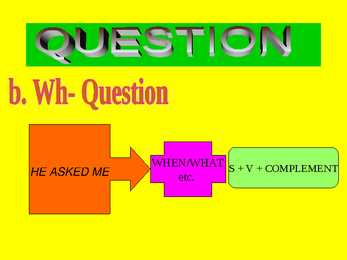
WHEN/WHAT
HE ASKED ME
S + V + COMPLEMENT
etc. 
 
 
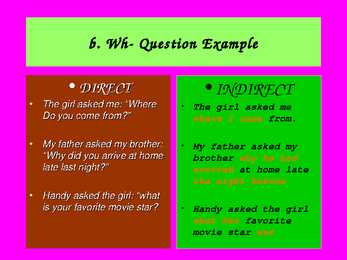
b. Wh­ Question Example
• DIRECT
• INDIRECT 
• The girl asked me: “Where 
• The girl asked me 
Do you come from?” 
where I came from. 
• My father asked my  brother
• My father asked my 
“Why did you  arrive  at home 
brother why he had 
late  last night?”
arrived at home late 
the night before

•  Handy  asked the girl: “what 
is your favorite movie  star ?
• Handy asked the girl 
what her favorite 
movie star was


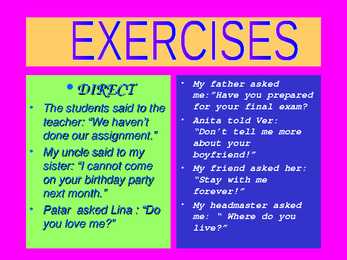
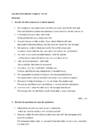
• DIRECT
• My father asked 
me:”Have you prepared 
• The  students  said to the 
for your final  exam ?
teacher: “We  haven ’t 
• Anita told Ver: 
done  our assignment.” 
“Don’t  tell  me more 
about your 

• My  uncle  said to my 
boyfriend!”
sister: “I  cannot  come 
• My  friend  asked her: 
on your birthday  party  
“Stay with me 
next  month .”
forever!”
• Patar  asked Lina : “Do 
• My headmaster asked 
me: “ Where do you 
you love me?”
live?” 


Document Outline

  • Slide 1
  • Slide 2
  • CHANGES OF ADVERB OF TIME & PLACE
  • CHANGES OF TENSES
  • 1. STATEMENT
  • STATEMENT EXAMPLE
  • STATEMENT Exception: If the introductory sentence is in the Present Tense, there won’t be any changes in the Reported (Indirect) speech .
  • Slide 8
  • COMMAND EXAMPLE
  • Slide 10
  • Slide 11
  • Slide 12
  • A. Yes/No Question Example
  • Slide 14
  • b. Wh- Question Example
  • Slide 16
Vasakule Paremale
Direct and indirect speech revs #1 Direct and indirect speech revs #2 Direct and indirect speech revs #3 Direct and indirect speech revs #4 Direct and indirect speech revs #5 Direct and indirect speech revs #6 Direct and indirect speech revs #7 Direct and indirect speech revs #8 Direct and indirect speech revs #9 Direct and indirect speech revs #10 Direct and indirect speech revs #11 Direct and indirect speech revs #12 Direct and indirect speech revs #13 Direct and indirect speech revs #14 Direct and indirect speech revs #15 Direct and indirect speech revs #16
Punktid 5 punkti Autor soovib selle materjali allalaadimise eest saada 5 punkti.
Leheküljed ~ 16 lehte Lehekülgede arv dokumendis
Aeg2014-01-12 Kuupäev, millal dokument üles laeti
Allalaadimisi 4 laadimist Kokku alla laetud
Kommentaarid 0 arvamust Teiste kasutajate poolt lisatud kommentaarid
Autor elena23 Õppematerjali autor

Sarnased õppematerjalid

Reported speech presentation
20
ppt

Reported speech presentation

We can report people's words by using direct speech or direct speech reported speech. speech `I'm tired!', Helen said. Helen said (that) she was tired. The main verb of the sentence is usually past ( Tom said that... / I told her that...) and the rest of the sentence is usually past too. Sequence of tenses ­ if the verb in the main sentence is in the past tense the other verbs are usually in one of the past tense too. Present Simple Past Simple I'm a teacher. He said (that) he was a teacher

Inglise keel
Reported speech kokkuvõte ja harjutused
3
odt

Reported speech kokkuvõte ja harjutused

Reported Speech (in other words Indirect Speech) If we report what another person has said, we usually do not use the speaker's exact words (direct speech), but reported (indirect) speech. Therefore, you need to learn how to transform direct speech into reported speech. We use reported speech when we are saying what other people say, think or believe. - Example: If this verb is in the present tense (says), it's easy. We just put 'she says' and then the sentence. When we are reporting things in the present, future or present perfect we don't change the tense. : direct speech: "I like ice cream" reported speech: She says she likes ice cream - But, if the reporting verb is in the past tense (said), then usually we change the tenses in the reported speech:

Inglise keel
Reported speech reeglid
4
docx

Reported speech reeglid

Reported speech is often also called indirect speech. When we use reported speech, we are usually talking about the past (because obviously the person who spoke originally spoke in the past). The verbs therefore usually have to be in the past too. For example: "I'm going to the cinema". He said he was going to the cinema. Basic tense chart The tenses generally move backwards in this way (the tense on the left changes to the tense on the right): present simple past simple I'm a teacher

Inglise keel
Kaudne kõne
12
pptx

Kaudne kõne

kaudselt.Otsene kõne kordab kõneleja sõnu täpselt Näiteks: She says, ,,I am a student ." Kaudne kõne annab kõneleja sõnu edasi ümberjutustatult. Näiteks: She says that she is a student. Otsene kõne Otsene kõne antakse kaudses kõned edasi sihitislausega, kusjuures toimuvad mõningad muudatused , näiteks muutuvad vastavalt lause mõttele asesõnad ja mõnel juhul ka verbi pöördevormid. Saatelause Otsene kõne Reporting clause Direct speech He says, ,,I like your car." Kaudne Kõne Indirect speech Pealause Sidesõna Sihitislause Main clause Linking word Object clause He says that he likes my car Väitlaused kaudses kõnes Statements in indirect speech Tom says to me he likes my car Joe is saying that Mary is leaving next week

Inglise keel
Grammatika inglise keel
30
doc

Grammatika inglise keel

want/like/know/go etc have/has ­ had wanted/liked/knew/went etc will would can could wanted/liked had wanted/had liked Direct speech Reported speech Jo says: Jo said: ,,I like tennis." (that) she liked tennis. ,,John is going to learn it too." (that) John was going to learn it too. ,,Mary has given up her hobby too." (that) Mary had given up her hobby too. ,,I can´t play tennis on Monday" (that) she couldn´t play tennis on Monday.

Inglise keel
Inglise keele grammatika reeglid
4
docx

Inglise keele grammatika reeglid

1. Active/Passive Active - the professor teaches the students. Passive - The students are taught by the professor 2. Present Simple [VERB] + s/es in third person. Tegevus on korduv või tavapärane. You speak English. I play tennis. Cats like milk. The train leaves tonight at 6 PM. I am here now. Active= Once a week, Tom cleans the car. Passive= Once a week, the car is cleaned by Tom. 3. Present Continuous [am/is/are + present participle]. Tegevus toimub/ei toimu praegusel hetkel. You are watching TV. You are learning English now. I am studying to become a doctor. I am meeting some friends after work. Active= Right now, Tom is writing the letter. Passive= Right now, the letter is being written by Tom. 4. Past Simple [VERB+ed] or irregular verbs. Tegevus algas/lõppes minevikus täpsel ajal. . You called Debbie. I saw a movie yesterday. I finished work, walked to the beach, and found a nice place to swim. I lived in Brazil for two years. I studied French when I was a child. Active

Inglise keel
Kaudne kõne
3
doc

Kaudne kõne

are -- were do/does --- did want/like/know/go etc --- have/has ­ had wanted/liked/knew/went etc will --- would can --- could wanted/liked --- had wanted/had liked Direct speech Reported speech Jo says: Jo said: ,,I like tennis." (that) she liked tennis. ,,John is going to learn it too." (that) John was going to learn it too. ,,Mary has given up her hobby too." (that) Mary had given up her hobby too. ,,I can´t play tennis on Monday"

Inglise keel
Sol Inter Progress Test 6A Grammar
2
docx

Sol Inter Progress Test 6A Grammar

Solutions Intermediate Progress Test 6A Grammar 1 Rewrite the direct speech as reported speech. 1 ‘Our company is planning to move out of the city centre next month,’ they said. They said that their company was planning to move out of the city the next month. 2 ‘I will always love you, Fred,’ said Sheila. Sheila said that she would always love him. 3 ‘You can’t borrow my bike tonight,’ Steve said to Olivia last Monday. Steva said to Olivia last Monday that she could not borrow his bike that night.

Inglise keel - 9.klass


Meedia

Kommentaarid (0)

Kommentaarid sellele materjalile puuduvad. Ole esimene ja kommenteeri


Sellel veebilehel kasutatakse küpsiseid. Kasutamist jätkates nõustute küpsiste ja veebilehe üldtingimustega Nõustun